



Walk
Behind the Scenes of Liberty
Boston, Estados Unidos
Walk
Behind the Scenes of Liberty
Boston, Estados Unidos
Distance
4.4 kmDurée
1h50Audios
27Parcours
Loop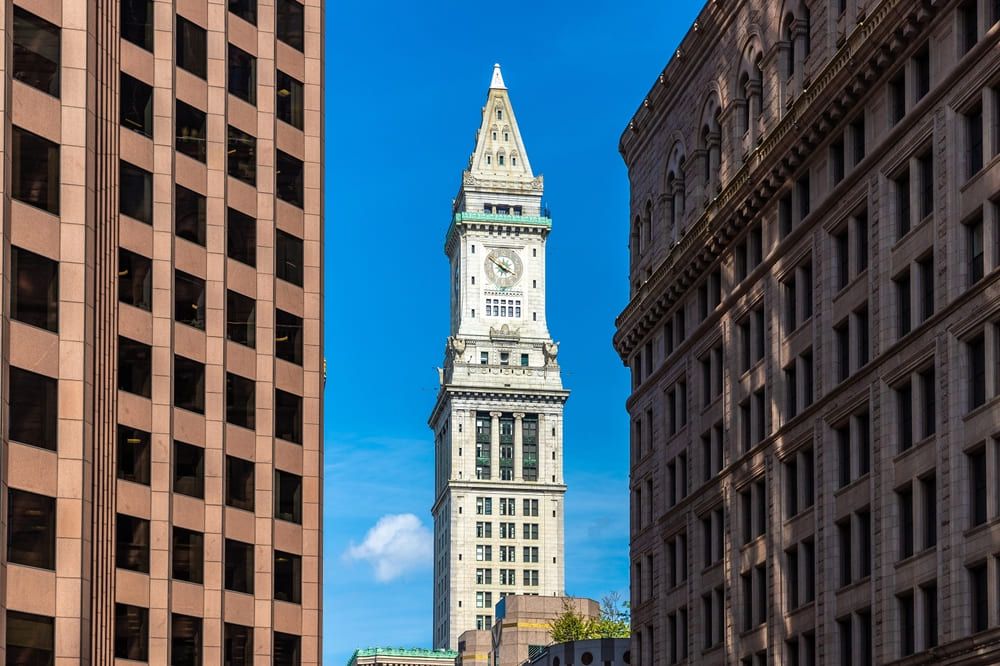
Shutterstock
You may want your sunglasses for this one—look all the way up to the top of the majestic Custom House Tower. The original Custom House, completed in 1847 in the Greek Revival style, was built to house the Federal Customs Service. It was later crowned with an enormous tower soaring 496 feet (or 151 metres) above the city, making it the tallest building in Boston for decades. You can still visit the observation deck on the 26th floor, where you’ll be rewarded with a spectacular three hundred and sixty degree view across the city. Access, however, is rather exclusive: there's just one tour each day, places are strictly limited, and reservations can only be made by phone. If you're lucky enough to make the climb, turn your gaze southward toward the waters of Boston Harbor. And if you're not visiting the tower today, don't worry—the harbor itself is well worth the short detour, because this is where the first revolutionaries of the future United States made history. At the entrance to Fort Point Channel, on 16 December 1773, one of the greatest acts of civil disobedience in history unfolded: the Boston Tea Party. Earlier that day, around 5,000 colonists (nearly a third of Boston's population) had gathered at the Old South Meeting House to protest the tea tax imposed by Britain without their consent, giving rise to their famous rallying cry: "No taxation without representation." When it became clear that the Royal Governor would not allow the merchant ships to leave without unloading the tea and collecting the tax, words gave way to action. A signal was given, and about 150 men broke away from the crowd and headed for the ships moored at Griffin's Wharf. To disguise themselves, they blackened their faces with soot and wore clothing inspired by Native American dress. While the costumes helped conceal their identities and reduce the risk of hanging, they also made the protest unforgettable. The operation was carried out with remarkable discipline. Nothing else was stolen or damaged. In less than three hours, the men broke open the holds, hauled 342 chests of tea onto the decks and dumped every one of them into the harbor. The financial loss was enormous—the destroyed cargo would be worth well over 1.5 million dollars today. But the protest didn't end there. Anger spread throughout the region, and in Lexington, residents even burned their own private tea supplies in the town square. London's response was swift and severe. Viewing the Tea Party as an act of high treason, the Crown ordered the complete closure of Boston Harbor until every penny of the tea had been repaid, while also sending troops back into the city. In trying to crush and isolate rebellious Boston through harsh punishment, the King made a political miscalculation that would prove enormously costly. Instead of ending the unrest, his actions united the Thirteen Colonies in an unprecedented display of solidarity, setting them on the irreversible path toward the American Revolutionary War of 1775 to 1783.
Aucun avis pour le moment
