





Walk
From Pioneers to Casinos: The Story of Downtown
Las Vegas, United States
Walk
From Pioneers to Casinos: The Story of Downtown
Las Vegas, United States
2.2 km
Distance
1h00
Durée
14
Audios
Loop
Parcours
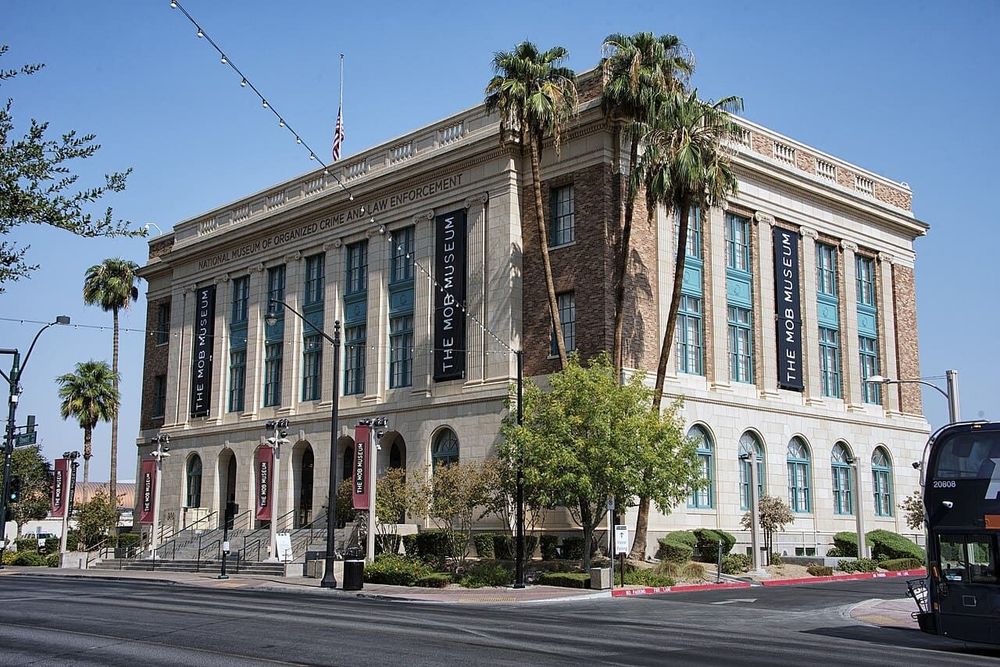
©Gillfoto, CC BY-SA 4.0 <https://creativecommons.org/licenses/by-sa/4.0/deed.fr>via Wikipedia Commons
The Mob Museum, officially the National Museum of Organized Crime and Law Enforcement, is dedicated to the history of organised crime in the United States and the struggle of the authorities against the mafia. The Las Vegas audio-guided tour stops here to evoke this museum of Downtown, opened in 2012 in the former federal courthouse of 1933, theatre of the famous anti-mafia hearings of the Kefauver committee.
The Mob Museum, officially called National Museum of Organized Crime and Law Enforcement, is a museum dedicated to the history of organised crime in the United States and the struggle of the authorities against the mafia. It opened in 2012 in the former federal courthouse of 1933, a historic building carefully restored, where the famous anti-mafia hearings of the Kefauver committee were held in the 1950s. It was a series of senatorial investigations carried out across the whole country to expose publicly the scale of organised crime, broadcast on television and followed by millions of Americans, that revealed in broad daylight the power of the underworld. The choice of this place, charged with history, is therefore no accident. Spread over three storeys, the museum offers an immersive and fascinating route through interactive exhibitions, photographs, authentic objects, weapons, documents and reconstitutions. You discover there the great figures of the American mafia, the gang wars, the prohibition, the murky links between organised crime and the beginnings of Las Vegas, but also the work of the forces of order, the FBI and the agents who fought these networks. The tone, at once documentary and spectacular, mingles fascination and critical distance. The museum also presents a real Saint Valentine's wall, vestige of a famous massacre of gangsters. A place of memory and pedagogy, it sheds light on a dark but founding page of the town. A museum of organised crime and justice, the Mob Museum is a fine stop of the discovery of Las Vegas.
Here you discover the museum dedicated to organised crime and the struggle against the mafia, opened in 2012 in the former federal courthouse of 1933 where the anti-mafia hearings of the Kefauver committee were held; on three storeys, interactive exhibitions, objects, weapons and reconstitutions tell the great figures of the underworld, the prohibition and the links with the beginnings of Las Vegas, alongside the work of the forces of order. The Mob Museum is a major museum of Downtown. It is a fine stop, indoors.
The Mob Museum lies in the former federal courthouse, in Downtown Las Vegas, a few minutes' walk from Fremont Street, reachable on foot. It follows its own days and opening hours, variable, and entry is subject to a fee. It is best to enquire before coming.
Because it opened in 2012 in the former federal courthouse of 1933, where in the 1950s the famous anti-mafia hearings of the Kefauver committee were held, that exposed publicly the scale of organised crime; this museum dedicated to the mafia and to the struggle of the authorities presents, on three storeys, interactive exhibitions, objects, weapons and reconstitutions.
In the former federal courthouse, in Downtown Las Vegas, near Fremont Street, in the United States.
Aucun avis pour le moment
