



Walk
From Pacific Royalty to the Aloha Spirit
Honolulu, United States
Walk
From Pacific Royalty to the Aloha Spirit
Honolulu, United States
Distance
4.8 kmDurée
2h00Audios
25Parcours
Loop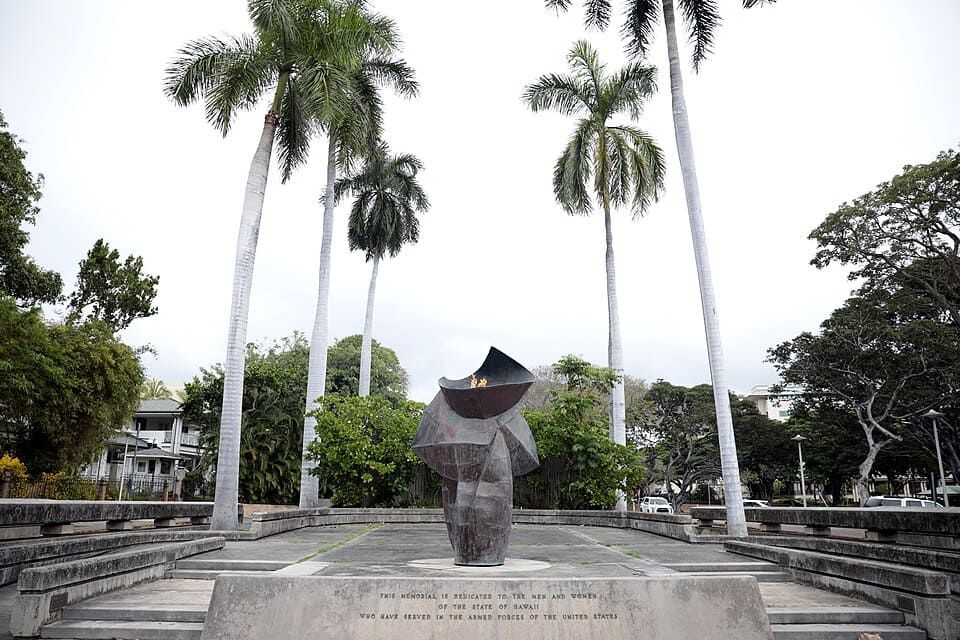
©Gage Skidmore from Surprise, AZ, United States of America, CC BY-SA 2.0 <https://creativecommons.org/licenses/by-sa/2.0/deed.fr>via Wikipedia Commons
You've just passed the statue of a man who never held political power in Hawaii, yet became one of its most respected figures. With his broad missionary hat and distinctive, almost block-like features, this is Father Damien. Originally from Belgium, he was a priest who volunteered in the 19th century to live among people suffering from leprosy on the neighboring island of Molokaʻi. At the time, those affected by the disease were completely shunned by society. Father Damien chose to live alongside them, spending 16 years caring for the sick, building facilities, and working to restore dignity to both the living and the dead. Eventually, he contracted the disease himself and died at the age of 49. The artist behind the statue, Marisol Escobar, chose a strikingly raw, geometric style, portraying Father Damien with features visibly marked by illness. And standing here, so close to the seat of government, his presence raises an interesting question. Could this statue be a reminder to those in power that a society should be judged above all by how it treats the people it leaves behind? Now, look just to the left of the statue. You might be surprised to find a familiar symbol of American independence right here in the middle of the Pacific: an exact replica of the Liberty Bell from Philadelphia. The U.S. Treasury presented it to Hawaii as the islands were preparing to become the 50th American state. Of course, the bell has no connection to traditional Hawaiian culture. Its purpose was to symbolize Hawaii's entry into American democracy and the ideals of freedom associated with it. And there's one more monument nearby that brings us to another important chapter of American history. Turn around and look across the street. You'll see an abstract bronze-and-copper sculpture with a flame rising from its center. This is the Eternal Flame, Hawaii's war memorial, created in 1974 by local artist Bumpei Akaji, who was himself a veteran of World War II. The flame burns continuously in remembrance of the attack on Pearl Harbor on December 7, 1941, just across the bay. But it also honors all those from Hawaii who lost their lives while serving in the U.S. military. So within just a few steps, you've encountered three very different monuments, each telling its own story about Hawaii's past and the people and events that have shaped it.
Aucun avis pour le moment
