





Walk
A town built on legends
Cody, United States
Walk
A town built on legends
Cody, United States
3.2 km
Distance
1h20
Durée
16
Audios
Loop
Parcours
Shutterstock
Here, you can take a moment to enjoy a great viewpoint over the town and its surroundings. Head to your left and walk up a few steps to reach the orientation table. From there, look out toward the horizon, and you’ll see Cody set within a wide, dramatic landscape that’s very typical of the Rocky Mountains.
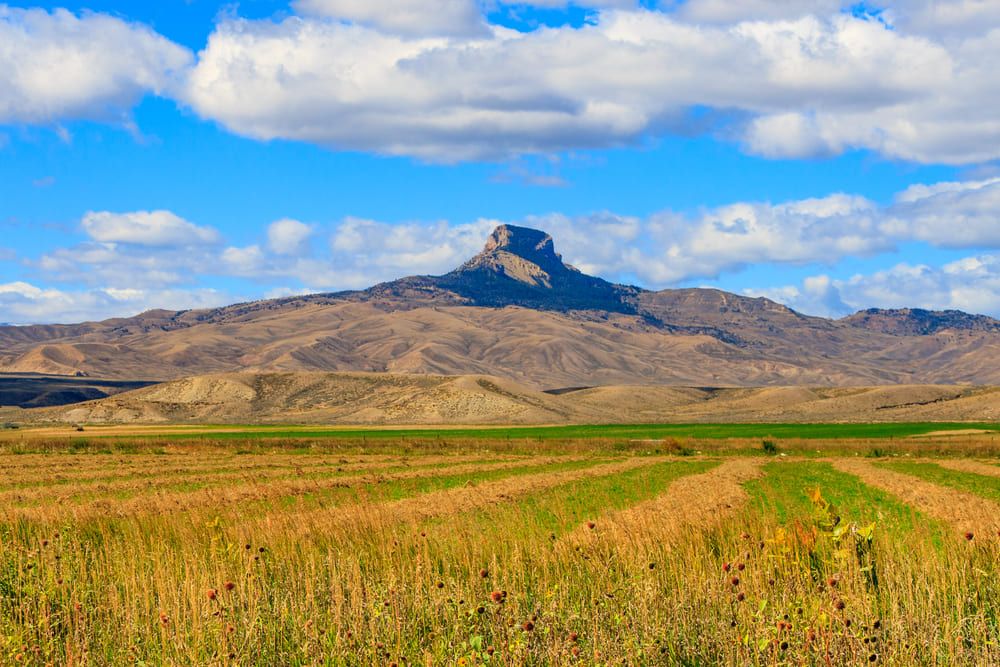
To the northwest, the most recognizable peak is Heart Mountain, whose distinctive shape stands out across the region. It’s well known for its unusual geology, formed when a massive block of very ancient rock slid over younger layers during a huge landslide millions of years ago. For the Crow people, it was also a sacred place, where spiritual leaders would come to seek visions.
But it also carries a more recent and difficult history. During World War II, a large internment camp for Japanese Americans was built at its base, where more than ten thousand people were held between 1942 and 1945, without trial and without any proven disloyalty. Looking west, you’ll see the entrance to Shoshone Canyon, framed by Cedar Mountain and Rattlesnake Mountain.
This canyon marks the route toward the East Entrance of Yellowstone National Park. Just a few kilometers from here stands Buffalo Bill Dam, inaugurated in 1910. At nearly one hundred meters high, it was the tallest dam in the world at the time, and its construction was a major technical challenge, carried out by teams of immigrant workers in sometimes very harsh conditions.
In the early 19th century, one of the first explorers to pass through this valley was the trapper John Colter. He described boiling springs, fumaroles, and strange landscapes so unusual that many people thought he was exaggerating or even losing his mind, and the area was nicknamed “Colter’s Hell.” Today, we know those geothermal features were real, located near the Shoshone River, just a few kilometers from here. Finally, if you look to the east, the landscape shifts completely.
The mountains give way to the dry, rugged hills of the McCullough Peaks, a badlands area with gray-blue tones and one of the few places in Wyoming where herds of wild mustangs still roam. This single viewpoint gives you a sense of the region’s diversity, from sacred mountains and deep canyons to traces of early exploration and wide-open wild landscapes that already hint at Yellowstone just beyond.
Aucun avis pour le moment
