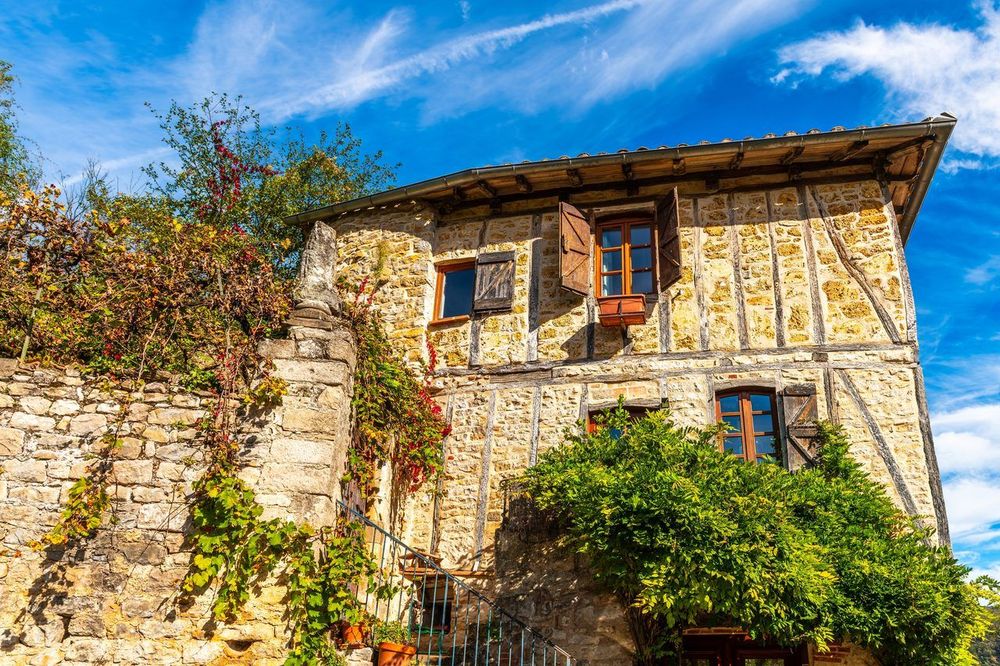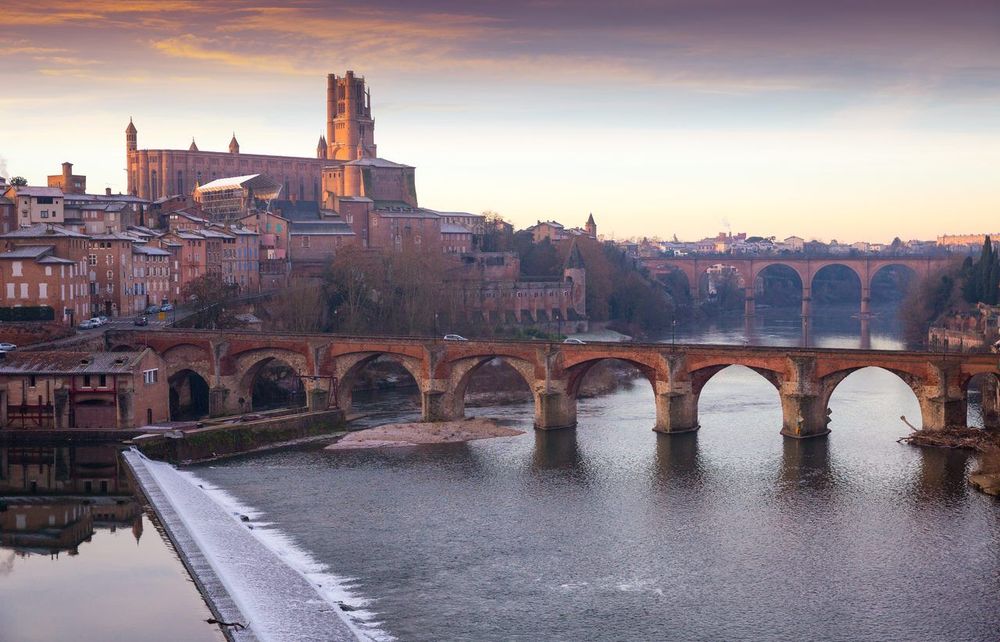
© Shutterstock
 Votre guide Ryo
Weekend in Albi in 2026: Episcopal City, Best Addresses, and Escapes in the Tarn
Albi doesn't wait for spring to blush. Year-round, its bricks bake in the sun and give the city that distinctive hue that earned it the nickname "Red City," visible from the very first crossing of the Pont Vieux. A weekend in Albi is more than enough to understand why UNESCO listed its episcopal city in 2010, between a fortified cathedral that dominates the entire Tarn valley and a museum dedicated to the most scandalous local son in modern painting. The Ryo audio-guided tour of the city allows you to connect these two monuments in under two hours, without missing the details that make all the difference.
The rest of the itinerary is made up of more discreet surprises. A pastry chef who hides "mystery pastries" beneath his counter, a roastery that has been torrefying its coffee for decades on Place du Vigan, a hilltop village that seems to levitate above the clouds on certain autumn mornings less than thirty minutes away by road. Add a vineyard among the oldest in France, a handful of bridges that tell eight centuries of river history, and you have a packed weekend that never feels exhausting. Here is how to organise it, neighbourhood by neighbourhood, address by address.
The Episcopal City of Albi, a Must-See UNESCO World Heritage Site
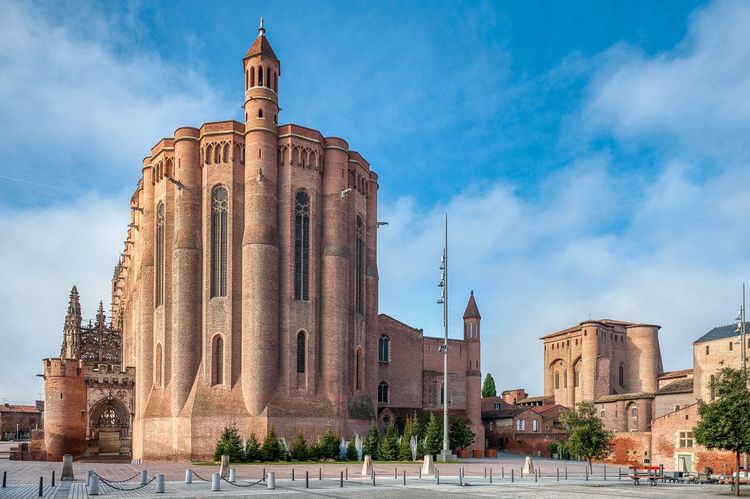
It is impossible to miss Sainte-Cécile Cathedral (Place Sainte-Cécile, 81000 Albi, rated 4.8/5 on Google based on 15,528 reviews) when arriving in Albi. Seen from the square, it looks more like a fortress than a place of worship: smooth brick walls over 40 metres high, massive buttresses, and a bell tower rising to 78 metres. Construction began in 1282, in the wake of the crusade against the Cathars, and stretched over nearly two centuries. The result is now considered the largest brick building in the world, which is no trivial detail when you consider that fired brick was historically the material of modest builders, not cathedrals.
The interior is a complete change of register. Beyond the Flamboyant Gothic porch, the entire vault is painted — a 16th-century Italian decoration covering more than 1,800 m² and one of the largest painted ensembles of the Renaissance in Europe. On the west wall, the Last Judgement lost part of its surface when a chapel was added in the 17th century, but what remains is enough to appreciate the ambition of the original project. Allow 30 to 45 minutes for the nave, a little more if you climb to the choir, for which entry is paid (a few euros, tickets on site).
Nearby, the Palais de la Berbie houses the Toulouse-Lautrec Museum. The former episcopal fortress, also built in red brick, holds the largest public collection in the world dedicated to the artist, who was born in Albi in 1864. Moulin Rouge posters, charcoal portraits, early canvases rarely shown elsewhere: the tour traces the painter's entire career without ever becoming as exhaustive as it is indigestible. A combined cathedral-and-museum ticket is available and quickly worth the price if you are only spending one day on site.
Behind the palace, the gardens of the Palais de la Berbie offer the best view over the Tarn and the Pont Vieux. The formal French garden, laid out on successive terraces, invites you to pause for a moment before heading back down to the river. In the late afternoon, the raking light on the brick is reason enough to make the detour, and it is also one of the convenient starting points for Ryo's audio-guided tour of Albi if you prefer to follow a thread rather than improvise your route.
For the episcopal city as a whole, allow a good half-day if you want to take in the cathedral, the museum, and the gardens without rushing. Access to the cathedral and gardens remains free; only the museum and the climb to the choir are paid, which gives you genuine flexibility depending on your budget.
Old Albi and the Banks of the Tarn, the Other Face of the City
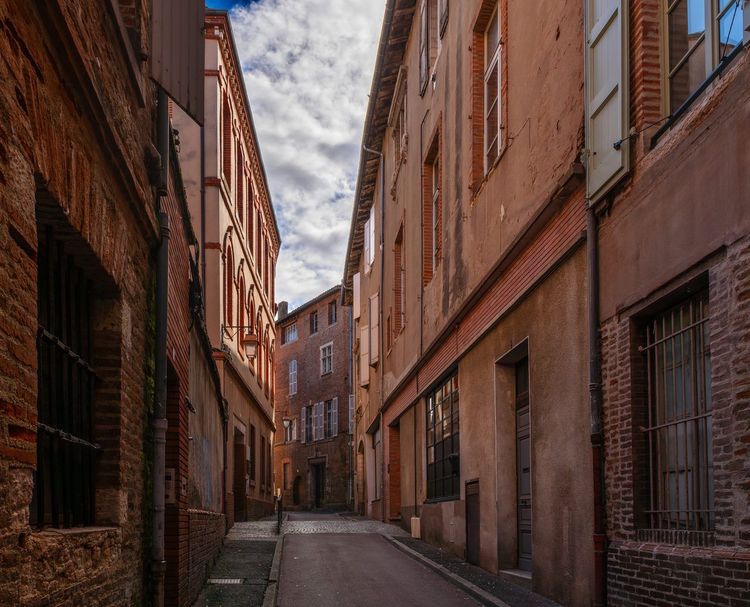
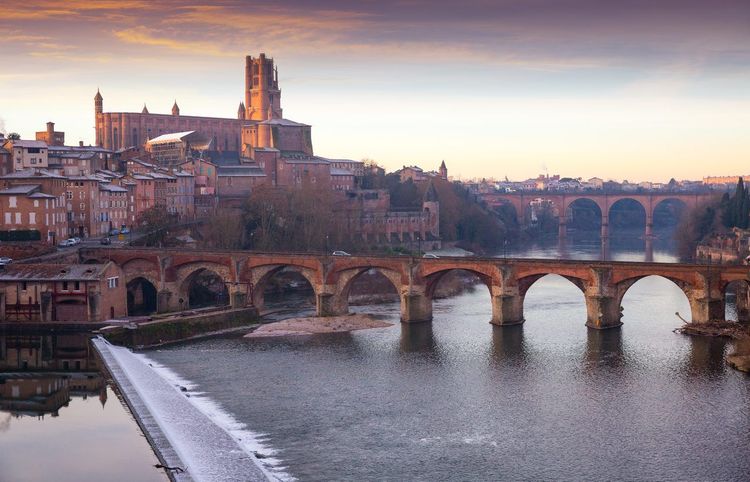
Leaving the gardens of the Palais de la Berbie, the pedestrian footbridge over the Tarn connects the two banks and offers a different angle on the episcopal city — the one most Sunday photographers prefer. It is also the best vantage point to take in, in a single glance, the mass of the cathedral, the palace ramparts, and the rooftops of old Albi stepping down to the water.
Walking along the bank upstream, you come across the trio that sums up the city's river history. The Pont Vieux, built around 1035, is among the oldest bridges in France still open to traffic. Right next to it, the moulins albigeois, former flour mills that have been converted, now house a cultural venue and serve as a reminder that the Tarn long drove the local economy before becoming a mere postcard backdrop. A little further on, the Pont Neuf, more recent as it was built in the 19th century, completes the trio and still carries a significant share of today's traffic.
Heading back up towards the historic centre, the cloister of the Collégiale Saint-Salvi deserves a detour that many hurried visitors skip. This Romanesque cloister, attached to the church of Saint-Salvi, offers a moment of complete calm barely a hundred metres from the tourist bustle around the cathedral. Few benches, little noise, just stone columns and an inner garden: it is the kind of place where you slow down without having planned to.
The historic core lends itself well to aimless wandering. Place Savène, tiny and cobbled, clusters several photogenic half-timbered houses. In the surrounding streets, the brick mansions tell the story of wealth drawn from the pastel trade — the blue dye that made Albi's fortune before the arrival of indigo. You can spot these façades without a guide: simply look up as you walk.
This whole network of lanes naturally opens onto Place du Vigan, the true central square of Albi, lined with terraces and shops. This is where the city breathes most freely, particularly in the late afternoon when locals settle in after work. To extend the discovery beyond this half-day, Ryo's audio-guided tour of Albi offers a route that logically connects both riverbanks without unnecessary detours.
The Best Food and Drink Addresses Not to Miss
A weekend in Albi is also judged by what ends up on your plate or in your cup. Five addresses come up consistently in local recommendations, each for a very specific reason.
Start with a coffee at Café Suau, brûlerie du marché, a roastery that has been toasting its beans on site for decades. You can smell the roaster before you even step inside, and the coffee that comes out bears no resemblance to anything from a chain.
For something sweet, two establishments vie for the top spot. At Cédric Millet, the so-called "mystery pastries" conceal a surprise texture or fruit beneath a flawless shell — a signature that has the whole city talking. A little further on, Michel Belin (16 Rue de l'Hôtel de Ville, 81000 Albi, rated 4.4/5 on Google based on 405 reviews) carries on a more classic chocolate and pastry tradition, ideal for an unfussy afternoon snack between two visits.
If coffee is not your thing, MoMaTcha, l'artisan du thé, offers a selection of teas and matchas prepared to order — a pleasant option for a lighter mid-morning or mid-afternoon break.
Finally, for a souvenir that is not edible, Albi pottery shops sell colourful pieces, often inspired by the brick and ochre tones of the city, produced in small runs.
On the local specialities front, it is hard to leave without trying the fouace albigeoise, a soft traditional brioche traditionally flavoured with orange blossom water, sold at most bakeries in the centre. Between these five addresses and a few impromptu stops, you already have enough to punctuate your breaks across two full days.
Cordes-sur-Ciel and the Gaillac Vineyard, Two Escapes Less than an Hour Away
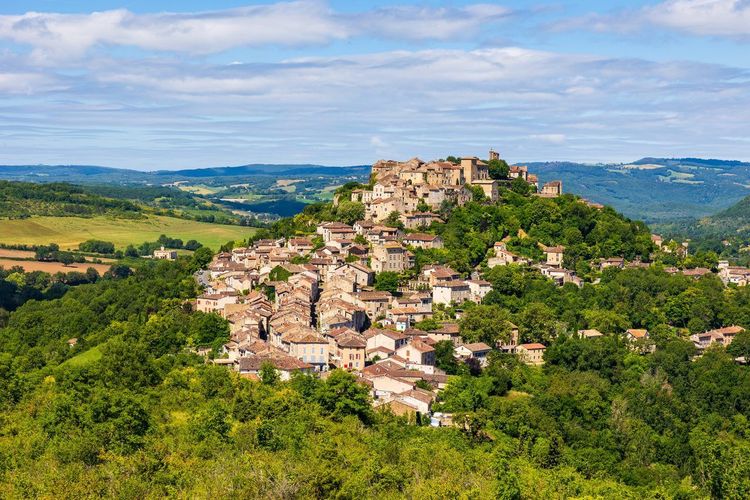
If your weekend stretches a little, two day trips are well worth the detour and can easily be combined with a free morning or afternoon.
Cordes-sur-Ciel, about 25 kilometres and a thirty-minute drive from Albi, owes its name to the morning mists that, on certain autumn or spring days, isolate the medieval bastide at the top of its rocky outcrop. Founded in the 13th century, the village long lived off the leather and textile trade before becoming a hub for craft artists. Allow a half-day to climb up to the ramparts, stroll along the steep lanes, and take in the panorama over the Tarn countryside — particularly spectacular in late morning when the mist clears.
In the other direction, heading towards Gaillac, about twenty minutes from Albi, the vineyard takes centre stage. The Gaillac appellation is among the oldest in France, with traces of viticulture dating back to Roman times. Several estates open their doors for tastings without compulsory booking, offering both full-bodied reds and lighter perlé wines typical of the region. An afternoon is enough to visit two or three estates and head home with a few bottles.
Between the two options, everything depends on your pace: Cordes-sur-Ciel for walking and heritage, Gaillac for tasting and a more relaxed rhythm. To plan either excursion in more detail, two Ryo blog articles dedicated to what to see around Albi and the city's surroundings lay out the possible itineraries. Back in Albi itself, Ryo's audio-guided tour, retracing the history of the Red City, covers the historic center at your own pace whenever you're ready to swap countryside for cobblestones.
Going Out in Albi for an Evening or a Sunday
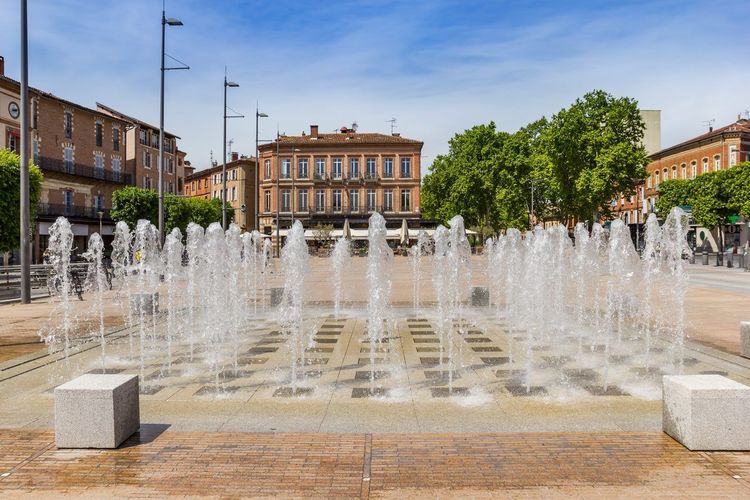
Albi is not a party capital, but it is not deserted in the evenings either. Place du Vigan remains the natural meeting point: its terraces stay lively until late on summer evenings, and several bars offer occasional live programming that is better checked at the last minute rather than planned weeks in advance.
On the cultural side, the city maintains a regular programme of concerts, cinema screenings, and temporary exhibitions, driven in part by the venue installed in the converted moulins albigeois. Rather than relying on a list of events that quickly goes out of date, the most reliable approach is to check the local cultural calendar once you arrive, which will give you an accurate picture of what is on the evening you are there.
On Sundays, when most shops pull down their shutters, the episcopal city keeps running: the cathedral, the gardens of the Palais de la Berbie, and the main squares remain accessible all day, and many families take advantage of this as one of the quieter time slots. Children are not forgotten either: occasional activities at the tourist office, heritage workshops, or simple walks along the Tarn can easily fill a Sunday afternoon without needing to book anything in advance.
Where to Stay, How to Get There, and Practical Info for a Weekend in Albi
For a two- to three-day stay, it is best to lodge in the historic centre or its immediate surroundings, within walking distance of the episcopal city. This is the most practical choice if you plan to get around on foot between the monuments and the food and drink addresses mentioned above. More out-of-the-way accommodation, often cheaper, means taking the car for every journey.
Albi is easy to reach from Toulouse, about one hour by road or 50 minutes by direct train, making it a very accessible weekend getaway for people living in the Toulouse area. From Paris, allow just over 5 hours by train with a connection, or around 1h20 by plane to Toulouse followed by the overland leg. Albi-Ville station is about a fifteen-minute walk from the centre — an entirely manageable distance on foot with light luggage.
How many days to plan? Two full days are enough to cover the episcopal city, old Albi, and a day trip to Cordes-sur-Ciel or Gaillac. Three days allow you to do both excursions without rushing and to add an evening in town. For a rough budget, allow between 150 and 250 euros per person for a two-day weekend including accommodation, meals, and a wine tasting, excluding long-distance transport.
Season-wise, spring and early autumn remain the most comfortable periods: soft light on the brick, pleasant temperatures for walking, and more manageable crowds than in the height of summer. To plan your visit in detail, two detailed guides exist depending on the length of stay — one for visiting Albi in 2 days and another for visiting Albi in 3 days — and Ryo's audio-guided tour of Albi remains the simplest option for not missing anything on the first day without having to put together your own itinerary.
FAQ
How many days should I plan for a weekend in Albi?
Two full days are enough to cover the episcopal city, old Albi, and a day trip. Add a third day if you want to combine Cordes-sur-Ciel and the Gaillac vineyard without rushing.
What is there to do in Albi and the surrounding area over a weekend?
Sainte-Cécile Cathedral, the Toulouse-Lautrec Museum, the gardens of the Palais de la Berbie, and old Albi fill the first day. The second lends itself to a trip to Cordes-sur-Ciel or the Gaillac vineyard, both less than 30 minutes away by road.
What can you do in Albi on Sunday when the shops are closed?
The episcopal city remains open every day: the cathedral, gardens, and main squares can be visited normally on Sundays. It is often the least crowded time to enjoy the monuments in peace and quiet.
Where can you go out in Albi in the evening?
Place du Vigan is the main hub for lively terraces and bars in the evening. For concerts and temporary exhibitions, it is better to check the local cultural calendar on arrival rather than relying on a fixed list prepared in advance.
What budget should I plan for a weekend in Albi?
Between 150 and 250 euros per person for two days, including accommodation, meals, and a wine tasting, excluding transport to the city.
How do I get to Albi from Toulouse or Paris?
From Toulouse, allow around one hour by car or 50 minutes by direct train. From Paris, allow around 5 hours by train with a connection, or a flight to Toulouse followed by the overland journey.
What is the best time to visit Albi?
Spring and early autumn offer the best conditions: pleasant light on the brick, moderate temperatures, and more reasonable crowds than in the height of summer.
A weekend in Albi more than lives up to expectations as long as you are open to combining listed monuments with more discreet addresses. The episcopal city impresses with its scale and history, but it is often the details — a silent cloister, a mystery pastry, a mist that isolates a hilltop village — that linger in the memory once you are back home. Whether you follow Ryo's audio-guided tour of Albi step by step or prefer to put together your own itinerary from this guide, the city reveals itself without ever giving the impression that you have seen everything in a single visit.
À lire également