© Shutterstock
 Votre guide Ryo
Activities in Carcassonne and Surroundings: The Complete 2026 Guide
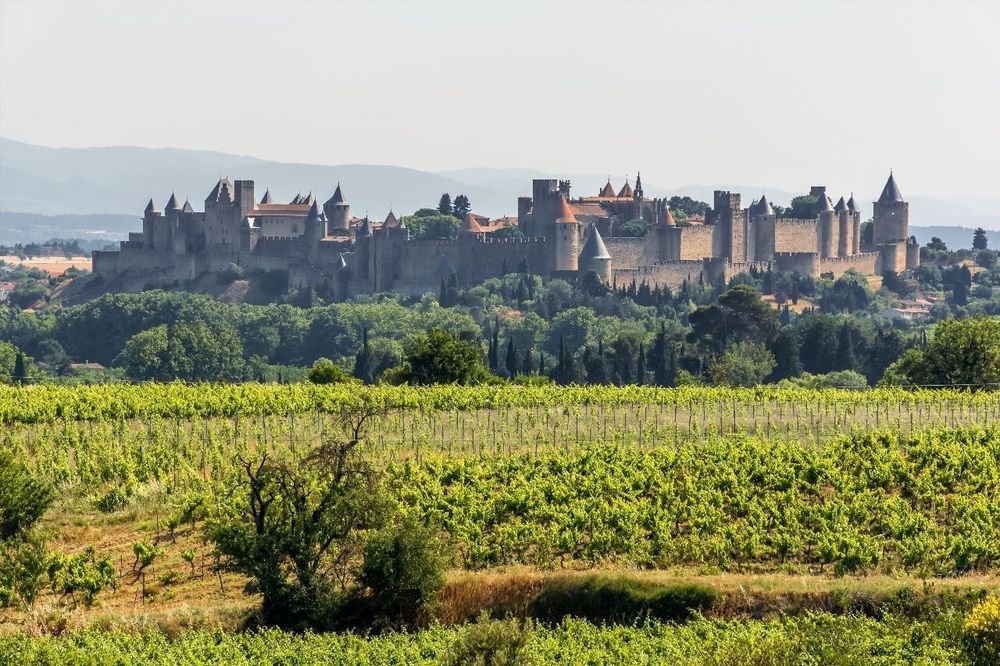
Few French cities provoke that first suspended glance from the highway: a medieval fortress perched on a hill, intact, with its 52 towers crenellated against the Languedoc sky. But activities in Carcassonne and its surroundings go far beyond its ramparts: the city more than earns its UNESCO World Heritage listing, and limiting yourself to the Cité alone would mean missing the essentials. Within a fifty-kilometre radius, you will find one of the largest underground cavities in Europe, Cathar castles perched on rocky outcrops, an entire village devoted to antiquarian books and vineyards producing some of the finest wines of the Languedoc.
This guide brings together all the activities in Carcassonne and its surroundings worth the journey in 2026: the must-sees of the medieval Cité, excursions to the Gouffre Géant de Cabrespine or the Châteaux de Lastours, family leisure activities, lesser-known gems such as Minerve or the abbaye de Lagrasse. To explore the Cité at your own pace with 27 geo-located audio commentaries, the Ryo audio-guided tour of Carcassonne covers 5.7 km in 2h30 and frees you from any group or human guide.
The Medieval Cité: Essential Highlights
The Cité de Carcassonne is the largest medieval fortress in Europe still standing. Built across two millennia of history — Gallo-Romans, Visigoths, Saracens, kings of France — it features 52 towers, a double ring of ramparts and an inner castle whose visit alone can occupy half a day. Listed as a UNESCO World Heritage Site since 1997, it attracts nearly two million visitors a year, making it the most visited site in Occitania and one of the most frequented monuments in France.
Entry into the Cité through the Porte Narbonnaise or the Porte d'Aude is entirely free; you can stroll at will through the lices — the space between the two enclosures — without paying a penny. The inner streets, with their artisan shops and restaurants, are accessible throughout the day. What is paid is entry to the Château Comtal and access to the inner ramparts, which allow you to climb the towers and view the fortification from the wall-walks.
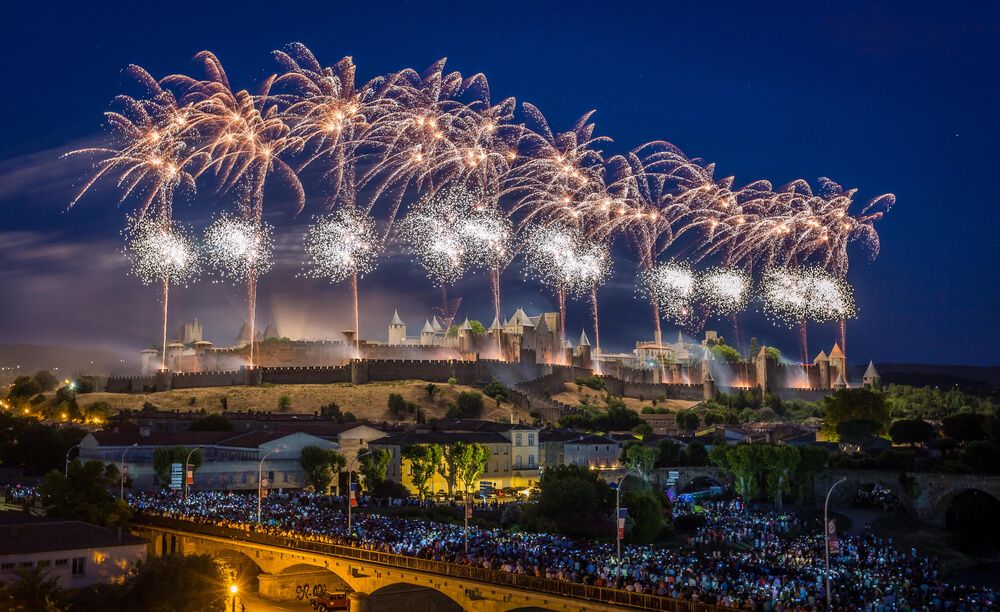
A tip few visitors know: come early in the morning, before 9:30 a.m., or late in the afternoon after 5 p.m. The raking evening light gilds the stones a warm ochre, and tourist density drops spectacularly at these hours. In July, the Festival de la Cité's performances transform the ramparts into a giant stage for concerts and sound-and-light shows with a truly singular atmosphere.
The Château Comtal and the Ramparts Tour
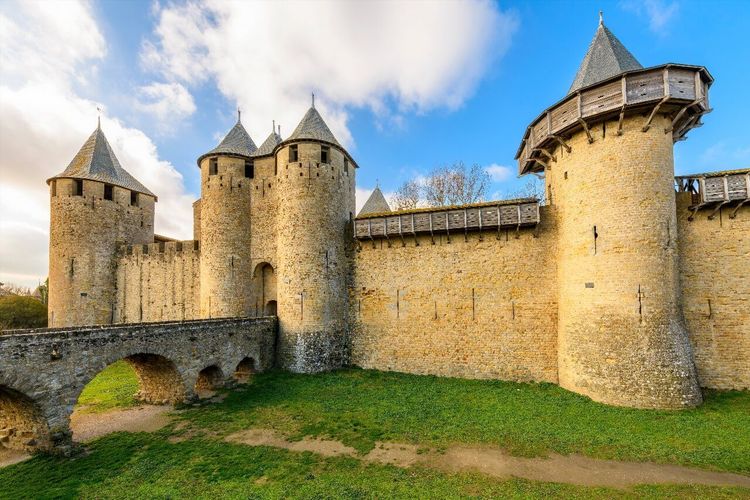
The Château Comtal (1 Rue Viollet-le-Duc, 11000 Carcassonne, rated 4.7/5 on Google across 13,913 reviews) is the military heart of the Cité. Built in the 12th century by the Trencavel Viscounts, this castle within a castle served successively as a residential palace, a fallback fortress and, after the Albigensian Crusade, as a royal prison for captured heretics. The guided or self-guided visit lasts approximately 1h30 and includes full access to the inner ramparts.
What you will see: the lapidary museum with its original medieval sculptures, the reserves of dressed stone restored by Eugène Viollet-le-Duc in the 19th century — the architect who "recreated" the Cité as we know it today, in a style sometimes contested by historians — and above all the view from the towers over the Bastide Saint-Louis and the plain of the Aude. Adult admission: from €13 in low season to €19 in high season; free for under-18s and EU citizens under 26.
The ramparts route is physically demanding: narrow staircases, low passages, uneven ground. Children generally love the "real castle" feel with its arrow slits and loopholes. The Ryo audio guide for the outer enclosure complements this paid visit very well by adding historical context to the sections you explore freely.
The Basilique Saint-Nazaire
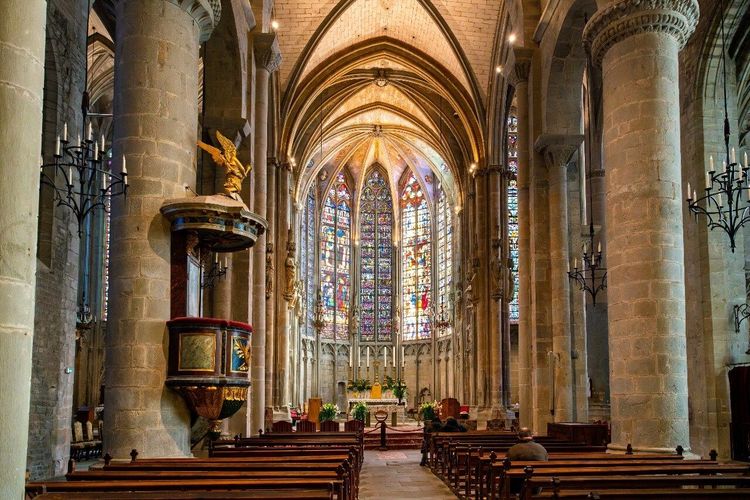
Nestled inside the Cité, the Basilique Saint-Nazaire is often rushed through in ten minutes by hurried visitors — wrongly so. Its Gothic stained-glass windows from the 13th and 14th centuries rank among the finest in the south of France, with deep blue and blood-red hues that filter the light in a striking way depending on the hour. The 11th-century Romanesque nave contrasts with the Gothic choir, creating an architectural hybridisation rare for the region. Entry is free. Allow 30 to 45 minutes to explore it in peace, preferably in the morning when the light streams through the east-facing windows.
The Bastide Saint-Louis and Its Market
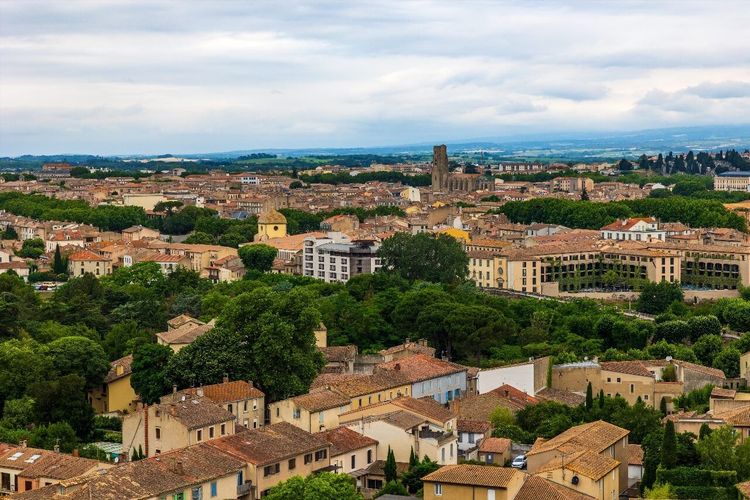
At the foot of the hill, the Bastide Saint-Louis, also known as the Ville Basse, is the Carcassonne of the locals. Founded in the 13th century by Saint Louis as a merchants' town, it has retained a perfect grid layout and a lively Place Carnot where the people of Carcassonne have gathered for centuries. The Tuesday and Thursday morning market is one of the most colourful in the Languedoc: marinated olives, sheep's cheeses, local charcuterie, Minervois wines and seasonal flowers.
Don't miss the Cathédrale Saint-Michel (Place Saint-Michel, 11000 Carcassonne, rated 4.4/5 on Google across 1,610 reviews), whose bell tower marks the centre of the Bastide, nor the arcades of Rue Georges Clemenceau. It is here, rather than in the Cité crowded with tourist shops, that the restaurants frequented by locals are found: the best cassoulet addresses are almost all on the Bastide side. The neo-Gothic fountain on Place Carnot, with its water-spouting tritons, dates from 1770 and remains the central landmark of the lower town.
The Canal du Midi and the Banks of the Aude
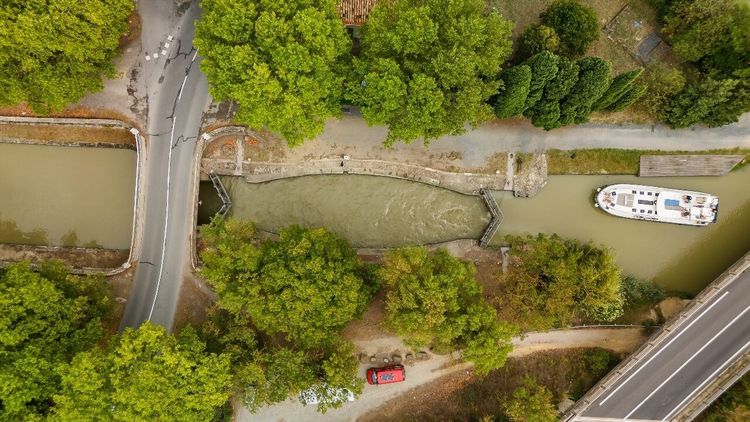
Also listed as a UNESCO World Heritage Site, the Canal du Midi runs through Carcassonne alongside the train station and the marina. It is a perfect setting for a cycling trip under century-old plane trees, or for a boat ride on an electric-powered vessel — silent and emission-free — ideal for soaking up the Languedoc landscape at the slow pace of the water.
Several hire companies offer live-aboard barges or day boats from the marina. The return cruise to the Écluse de l'Aiguille, 4 km away, surrounded by reed beds and willows, is a fine way to decompress after the tourist density of the Cité. On the Aude side, the developed riverbanks offer cycle paths linking the Cité from the station in about 3 km of riverside pedalling.
Lac de la Cavayère: Swimming and Watersports
Just 4 km from the town centre, Lac de la Cavayère (Route de la Cavayère, 11000 Carcassonne, rated 4.5/5 on Google across 2,800 reviews) is Carcassonne's urban beach. This 28-hectare artificial lake is supervised in summer and features a sandy beach, picnic tables, a marked swimming area and lawns shaded by stone pines.
The leisure base offers pedal boats, kayaks and paddleboards for hire. A shaded path circles the lake in about 45 minutes. Beach access is free; only the water activities are charged. In high season, arrive before 10 a.m. to find a shaded spot: the site becomes very busy on July–August weekends, especially when the thermometer exceeds 35 °C, which is common in the summer Languedoc.
Sports Activities and Leisure in Carcassonne
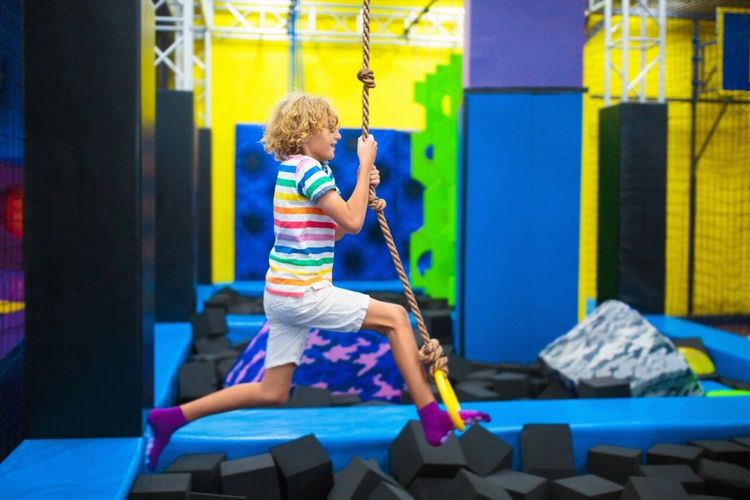
Carcassonne has no shortage of options for burning off energy between cultural visits. Jump-R Parc (indoor trampoline park) is the safe bet for families with children aged 5 to 15: free-jump zones, foam pit areas, spaces dedicated to younger children. In case of rain or heat wave, it is the ideal alternative to the Cité.
Planète Bowling and Win Kart (indoor karting) are other staples of the leisure offering. Those seeking an immersive experience will head to Odyssey Adventure Escape Game or the Maison Hantée, two venues that operate in the evenings and appeal equally to groups of friends and families with teenagers.
For something unusual and very local, the Miellerie des Clauses, Le Théâtre aux Abeilles offers guided tours of an educational apiary with a tasting of Languedoc honeys. A calm, surprising activity, perfect after the frenzy of the ramparts. And for the very young, the Petit Train de la Cité de Carcassonne (Place du Château, 11000 Carcassonne, rated 3.7/5 on Google across 207 reviews) makes a commented circuit of the outer enclosure in twenty minutes — a good introduction before entering on foot.
The Châteaux de Lastours: Four Cathar Fortresses on the Edge of the Abyss
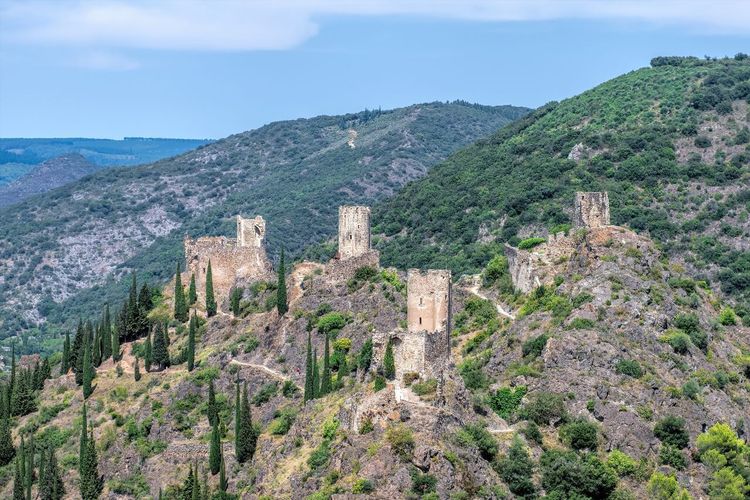
15 km north of Carcassonne, the Châteaux de Lastours (Chemin des Châteaux, 11600 Lastours, rated 4.7/5 on Google across 2,802 reviews) form one of the most impressive fortified ensembles in the Pays Cathare. Cabaret, Surdespine, Quertinheux and La Tour Régine: four castles perched on a rocky promontory that rises from the gorges of the Orbiel like a raised fist towards the sky. Built between the 10th and 13th centuries, they withstood the Albigensian Crusade before being partially dismantled by royal decree.
The visit is on foot, along a marked path that climbs in about half an hour to the Château de Cabaret, the best preserved of the four. Allow 1h30 to 2h to cover the whole site. The Belvédère des Quatre Châteaux, accessible by car from Lastours, offers a bird's-eye view of all four towers simultaneously, particularly striking in the late afternoon when the raking light catches the golden stones.
Adult admission: approximately €8 to €9; reduced rate for children. The site is open from spring to autumn (generally April to November), closed in winter. The village of Lastours, below, is worth a short stop: a few artisan workshops, a restaurant with a terrace overlooking the gorges, and the relative coolness of a deep valley floor that is most welcome on hot days. This excursion combines naturally with the Gouffre Géant de Cabrespine, a few kilometres away.
The Gouffre Géant de Cabrespine
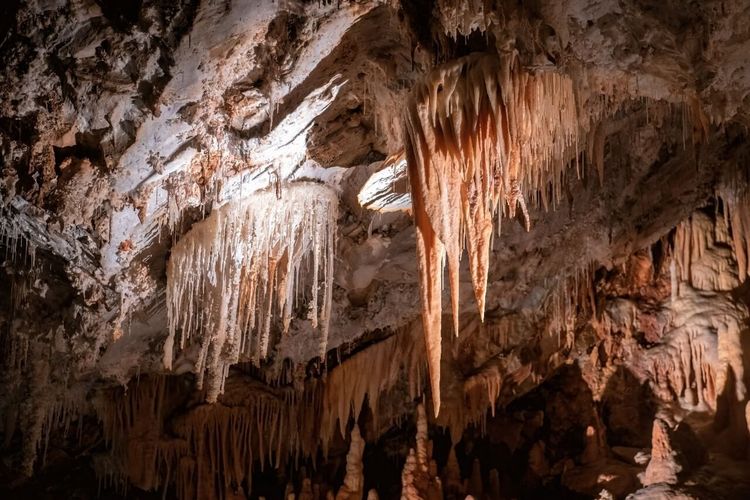
25 km from Carcassonne, the Gouffre Géant de Cabrespine (D112, 11160 Cabrespine, rated 4.6/5 on Google across 6,411 reviews) is one of the largest caverns open to the public in Europe. With 250 metres of depth and a main gallery 80 metres high, it is an underground cathedral: pink calcite stalagmites, translucent draperies, red silica crystallisations that appear hand-crafted. The largest column measures over ten metres.
The guided visit lasts 45 minutes to 1 hour and covers the main galleries. The interior temperature stays around 11 °C year-round; bring an extra layer even in the middle of August. Adult admission: approximately €15; child (5–12 years): approximately €9. The site is generally closed on Mondays outside July–August. For the more adventurous, speleological circuits in full equipment allow exploration of less accessible galleries; advance booking is advisable in high season.
Montolieu, the Book Village
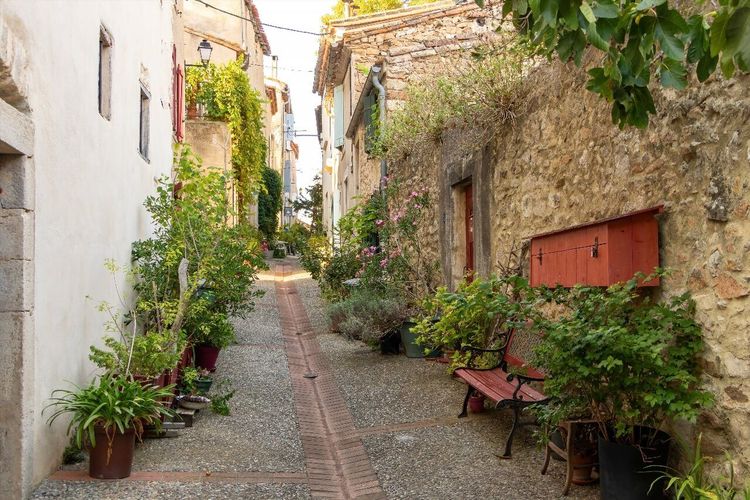
20 km east of Carcassonne, Montolieu has reinvented itself as a book village since the 1990s. Around fifteen antiquarian booksellers occupy former weavers' shops, offering old books, rare editions, prints and engravings. It is the southern counterpart of Hay-on-Wye in England or Redu in Belgium.
The village is also pleasant for its setting on a limestone plateau overlooking the Dure valley, with panoramas stretching as far as the Montagne Noire. The Musée des Arts et Métiers du Livre, a printing museum with working machines, fascinates curious visitors of all ages. Allow half a day including a stroll through the village and lunch at the local cheese shop. Most bookshops are closed on Mondays. Back in Carcassonne, our audio-guided tour of the medieval city fills the other half just as easily.
Minerve: A Village Suspended Above Its Gorges
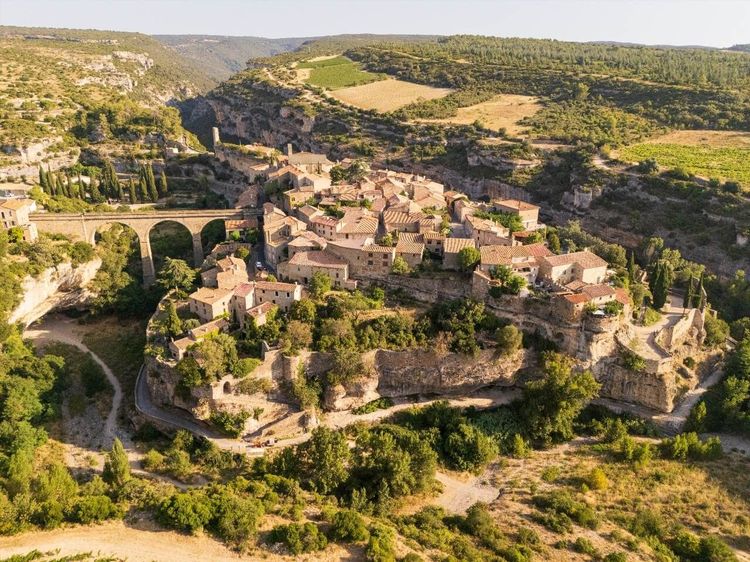
Listed among the Plus Beaux Villages de France, Minerve perches on a limestone spur between the gorges of the Brian and the Cesse, 45 km from Carcassonne. It can only be reached on foot from a car park below, via a path that follows the gorges and passes beneath natural bridges carved by the river through the limestone over millennia.
This village of fewer than a hundred permanent inhabitants carries a tragic history: it was here in 1210, during the Crusade against the Albigensians, that 140 Cathars were burned alive rather than renounce their faith. The Occitan cross and the ruins of the comtal castle are reminders of that past. The musée de Minerve displays prehistoric remains and elements of Cathar life, including a replica of the siege engine that besieged the village.
The gorges below can be walked in about 1h30, with the possibility of spotting the natural bridges of the Cesse — two limestone arches carved by the river, which almost entirely disappear beneath the pebbles in summer. In the late afternoon, the small café terrace at the edge of the precipice is one of the finest viewpoints in the Languedoc for watching the light change over the gorges.
The Abbaye de Lagrasse: A Thousand Years of Monastic History
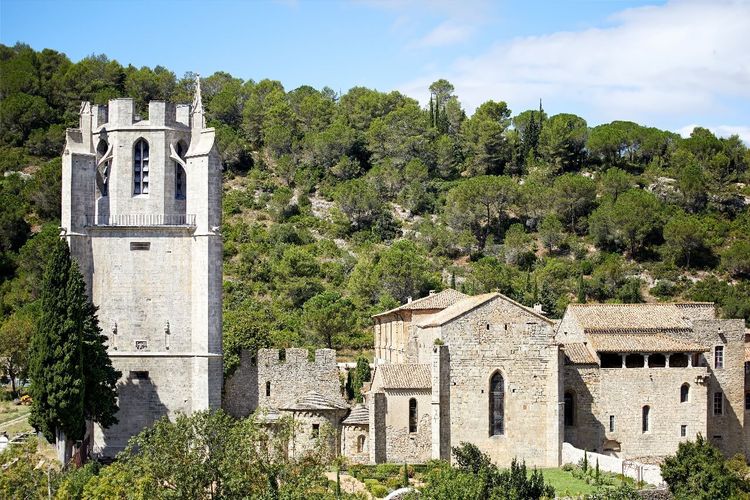
The Abbaye de Lagrasse (Rue de la Promenade, 11220 Lagrasse, rated 4.5/5 on Google across 2,418 reviews), whose foundation is traditionally attributed to Charlemagne in the 8th century, is one of the oldest monasteries in France still in activity. It stands on the banks of the Orbieu, 50 km from Carcassonne, amid a landscape of garrigue and Corbières vineyards.
The community of Canons Regular of Prémontré has occupied the medieval section since 2004 and oversees its progressive restoration. Guided visits, lasting about one hour, include the monks' dormitory, the 14th-century cloister and the chapter house. The "old abbey" section, managed by the local authority, hosts temporary contemporary art exhibitions in summer.
The village of Lagrasse itself, with its cobbled medieval lanes and its old Roman bridge over the Orbieu, ranks among the most beautiful villages in the Languedoc. The whole makes a half-day well worth the trip from Carcassonne, especially if you pair it with a stop at the surrounding Corbières vineyards.
The Pays Cathare: Fortresses on the Ridgelines
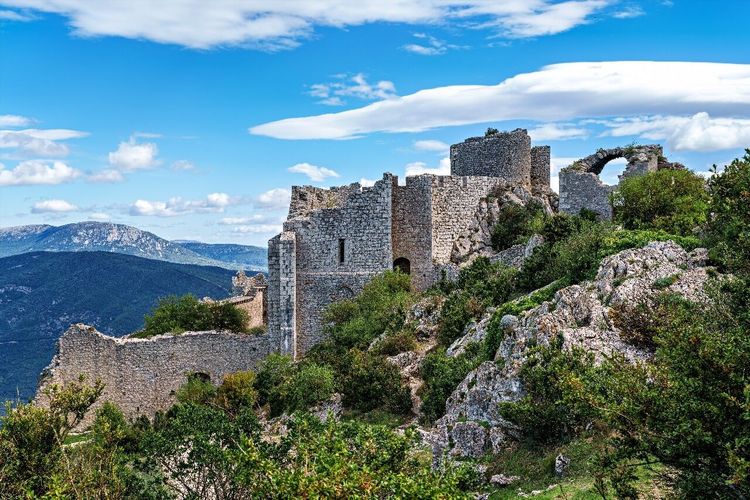
The Pays Cathare stretches across the entire Pyrenean foothills south of Carcassonne. Its vertiginous castles — Peyrepertuse, Quéribus, Puilaurens, Aguilar — are scattered between 50 and 80 km from Carcassonne, on limestone ridges swept by powerful winds. It is difficult to visit more than one or two in the same day without setting off very early.
Peyrepertuse is often described as the "Carcassonne of the sky": at 800 metres altitude, its ruins stretch 300 metres along the sierra ridge. The ascent from the car park takes 30 minutes along a stony path; sturdy shoes and water are essential. The view over the Corbières and, on a clear day, the snow-capped Pyrenees fully justifies the effort.
Quéribus, 15 km from Peyrepertuse, was the last Cathar castle to resist the royal army of France (1255). Smaller, but even more spectacular in its position atop a solitary peak, it offers a 360° view over the Corbières. Both castles can be visited in the same day from Carcassonne provided you leave before 9 a.m.; allow about 7 hours for the return journey and both visits.
Hiking and Nature in the Montagne Noire
The Montagne Noire, north of Carcassonne, is the natural massif closest to the residents of the plain. Its beech and oak forests, its reservoir lakes and its hilltop villages offer a complete contrast with the dry garrigue of the Pays Cathare. The trails are well marked and suited to all levels, from the beginner hiker to the seasoned walker.
The Pic de Nore (1,211 m), the highest point of the Montagne Noire, can be reached by car in 45 minutes from Carcassonne, then on foot in 1h30 from the pass. Panoramic views over the Narbonnaise plain and, on a clear day, as far as the Mediterranean. The Arboretum de Ramondens and the Prise d'Aliès, the 17th-century hydraulic works that feed the Canal du Midi from the Montagne Noire, are two curiosities for enthusiasts of the history of engineering.
For detailed itineraries with distances and elevation profiles, our Ryo guide to hiking in the Montagne Noire lists the best routes around Carcassonne.
Gastronomy and Wines of the Languedoc
It is impossible to pass through Carcassonne without trying cassoulet, this dish of lingot beans slow-cooked with Toulouse sausages and pork rind, simmered for hours. Several restaurants in the Cité and in the Bastide Saint-Louis serve it year-round, but winter is when the recipe is at its most generous. Purists will note that Castelnaudary, 30 km to the west, claims parenthood of the dish and offers even more specialist addresses.
The wines of the Minervois and the Corbières (two recognised AOPs) pair naturally with this terroir. Local cooperative cellars, particularly around Laure-Minervois and Capendu, offer tastings directly on the estate, often free of charge. Our Ryo article on the culinary specialities of Carcassonne lists the best food addresses in the region.
Practical Information
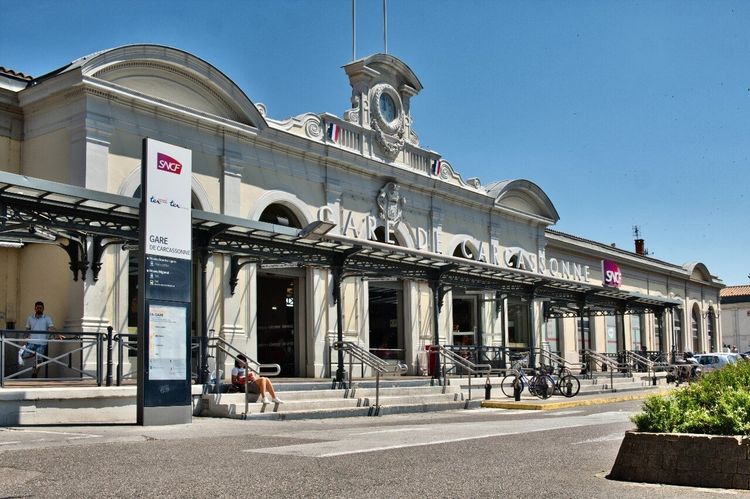
Getting there: Carcassonne has an international airport served by low-cost airlines from Paris, London and several European cities. By train, Carcassonne station is on the Bordeaux–Sète line, approximately 45 minutes from Toulouse. By car, the city lies on the A61 motorway (the Autoroute des Deux-Mers), 90 km from Toulouse and 80 km from Montpellier.
Accommodation: hotels inside the Cité itself are rare and expensive; the Bastide Saint-Louis offers much better value for money. In summer, book at least 2 to 3 months in advance.
Best time to visit: May–June and September–October for a compromise between pleasant weather and manageable crowds. The Cité is particularly striking in winter under the morning mist, with accommodation prices sometimes halved off-season.
FAQ
What activities are free in Carcassonne?
Strolling through the streets of the medieval Cité is entirely free; only entry to the Château Comtal is paid (from €13 to €19 depending on the season). The Basilique Saint-Nazaire can be admired at no cost. The Bastide Saint-Louis, the Place Carnot market, the banks of the Canal du Midi and the walk around Lac de la Cavayère are also freely accessible. The spectacle of the illuminated ramparts in the evening from the Pont Vieux, on the Aude side, is one of the most beautiful sights in the south of France — and it costs nothing.
What can you do in Carcassonne with children?
Children love the Cité, which looks like a life-size fairy-tale castle; just be sure to avoid the hottest hours in summer. To complement the cultural visit, Jump-R Parc (trampolines), Lac de la Cavayère (supervised swimming and pedal boats), the Gouffre Géant de Cabrespine (spectacular from age 5–6) and the Petit Train de la Cité (a twenty-minute commented circuit around the ramparts) are the best family options. The Châteaux de Lastours are also very popular with children curious about medieval history.
How do you visit the medieval Cité of Carcassonne?
Two complementary approaches: roam freely through the lanes and the outer ramparts (free, at your own pace), or purchase a ticket to the Château Comtal to access the inner walls and towers (from €13 to €19 depending on the season). The Ryo audio guide for Carcassonne covers 27 points of interest over 5.7 km in 2h30, works offline and frees you from any organised group. The best option is to combine both: the Ryo audio-guided route for the outer enclosure, then the paid visit to the Château Comtal for the interior.
What is there to see around Carcassonne in one day?
Several day trips are worth the journey. To the north: the Châteaux de Lastours combined with the Gouffre Géant de Cabrespine (6 to 7 hours in total). To the south-east: Peyrepertuse and Quéribus in the Corbières (a full day). To the east: Minerve and its gorges, combined with a stop in the Montagne Noire. To the west: Castelnaudary for cassoulet and a cruise on the Canal du Midi. All these excursions require a car, as public transport poorly serves sites outside the urban area.
What is the best time to visit Carcassonne?
May–June and September–October offer the best balance: temperatures of 20 to 27 °C, moderate crowds, available accommodation. The Cité is stunning in winter under the morning mist, and prices drop significantly off-season. In July, the Festival de la Cité — rock concerts, classical music and street performances within the ramparts — is an additional reason to make the trip, but the town is packed. The Bastille Day fireworks on 14 July, launched from the ramparts, are traditionally among the most beautiful in France.
Conclusion
Carcassonne and its surroundings form a territory of striking contrasts: the largest medieval fortress in Europe sits alongside giant underground caves and a wine-growing countryside among the most seductive in the Languedoc. Whether you are seeking an in-depth cultural immersion, nature excursions into the Corbières or family sporting activities, the region more than fills four to five days.
To begin your exploration of the Cité with the most thoroughly documented historical context, the Ryo audio guide for Carcassonne — 27 geo-located audio tracks, 5.7 km of route, available offline on the Ryo app — is the most independent way to get to know the Cité at your own pace.
À lire également