© Shutterstock
 Votre guide Ryo
18 Activities to Do in Collioure and Its Surroundings in 2026
What to do in Collioure with a weekend, a day, or just an afternoon? This small town of 3,000 people, nestled between the Pyrenees and the Côte Vermeille, resembles no other village on the Mediterranean coast and literally changed the history of modern painting: Matisse and Derain invented Fauvism here during the summer of 1905, overwhelmed by the singular light that makes its ochre and pink houses vibrate. Discover this exceptional heritage with the Ryo audio-guided tour La cité des peintres, 21 stops, 1h30 of walking, 3 km on foot.
What to do in Collioure beyond the postcards? A royal castle whose rooms tell eight centuries of domination, coves accessible by swimming from the port, terraced vineyards clinging to the mountainside five minutes from the beach, and anchovies recognized with a Protected Geographical Indication (PGI) since 2004. This guide brings together the 18 best experiences in Collioure and within a 30-kilometer radius, including monuments, hikes, neighboring villages, and great restaurants.
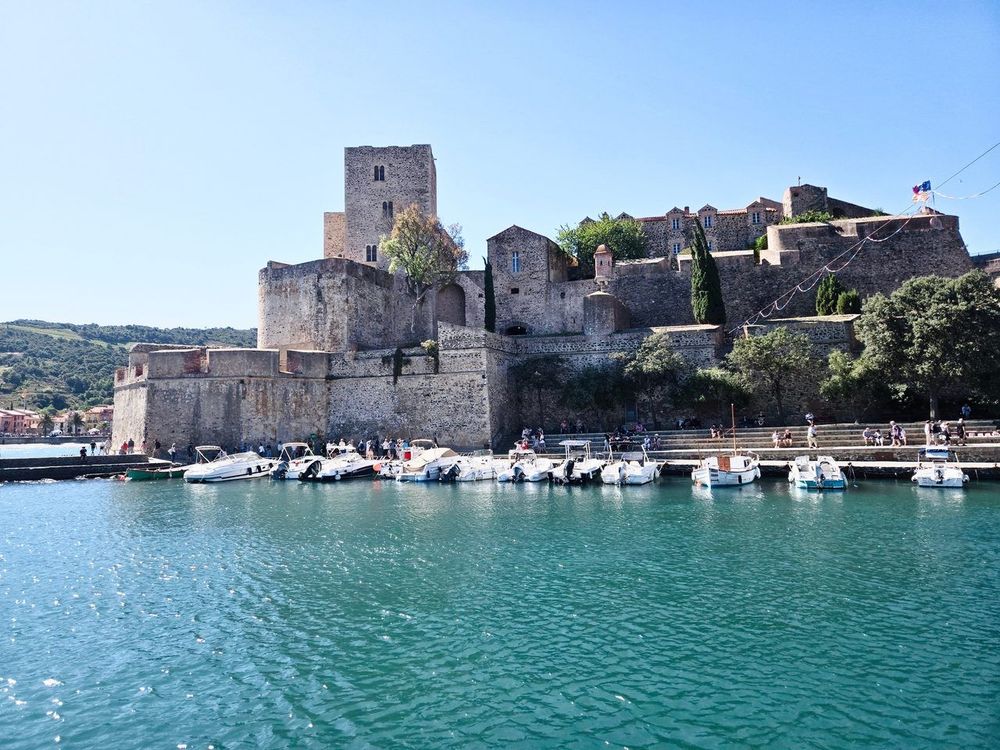
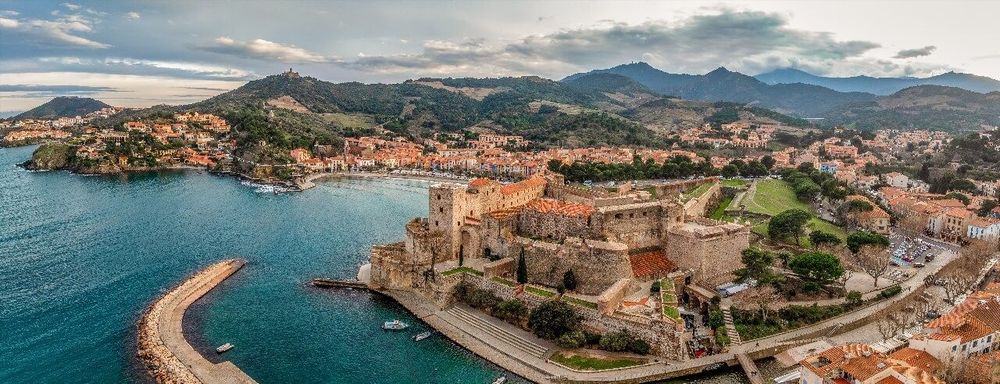
1. The Royal Castle of Collioure
The royal castle (Place du 8 mai 1945, 66190 Collioure, rated 4.6/5 on Google based on 8,131 reviews) is the founding monument of Collioure. Its origins date back to the 7th century, but it was under the kings of Majorca, then under the Aragonese sovereigns, and finally under Louis XIV that the fortress took on its current form — a composite building that visually reflects each era that occupied it.
The entrance gives access to three inner courtyards connected by steep stone staircases. The first courtyard dates from the Visigothic era, the second from the 13th-century Aragonese expansions, and the third from the Vauban construction project commissioned by Louis XIV in 1679. This project led to the demolition of the town's old bell tower, replaced by the round tower visible from the sea, and to the relocation of the parish church to its current waterfront location.
The visit lasts between one and two hours depending on your pace. The rooms house permanent collections on the history of the town, the geopolitics of the Eastern Pyrenees, and Vauban's fortification techniques. From the battlements, the panorama simultaneously takes in the Boramar beach, the marina, and the ridges of the Albères. Allow at least 1h30 to avoid rushing through the three courtyards. In summer, crowds peak between 11 am and 2 pm; arrive at opening time at 9 am.
Admission is charged: approximately €7 for adults, reduced rate at €5. The castle is closed on Tuesdays outside the summer season. A guided tour app is available at the ticket office, but Ryo's audio-guided tour "La cité des peintres" passes in front of the outer ramparts and provides the most comprehensive historical context.
2. The Notre-Dame-des-Anges Church
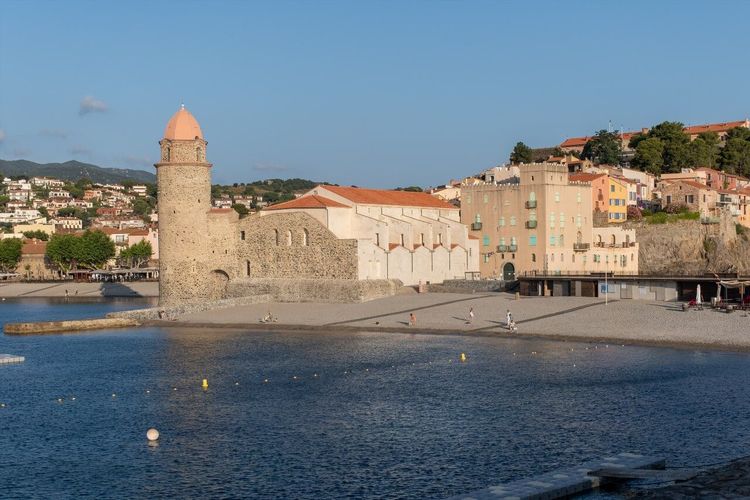
The Notre-Dame-des-Anges church is probably the most reproduced postcard image of the Côte Vermeille. Its cylindrical lighthouse-bell tower, painted in pink and ochre, stands directly on the port jetty — an extremely rare architectural configuration in France, a direct consequence of the forced relocation of the building during Vauban's 17th-century works.
The interior is absolutely worth a stop. The nave houses twenty-two gilded wooden altarpieces, among the finest examples of Catalan Baroque preserved in the Eastern Pyrenees. The organ dates from 1694 and still works during summer concerts. The light inside is exceptional — orange in the morning, golden in the afternoon — which explains why Matisse regularly returned to paint the doorway.
Entry is free. Sunday morning masses offer the chance to hear the organ in its liturgical context. Allow twenty to thirty minutes for a relaxed visit.
3. The Saint-Vincent Chapel and the Jetty
Just at the entrance to the port, a narrow strip of land juts out into the sea: this is the islet on which the Saint-Vincent chapel stands, a small 17th-century building surrounded by a sea cemetery. The jetty connecting the islet to the mainland is one of the most pleasant walks in Collioure — sea breeze, views over both sides of the bay, and a few anglers perched on the rocks.
The chapel itself is closed for most of the year but opens during the Saint-Vincent festival in January. What is most captivating here is the natural staging: the white chapel set against a backdrop of blue sea, framed by the silhouettes of traditional Catalan boats. Early in the morning, before the first groups arrive, the spot offers an atmosphere of absolute calm.
4. The Port of Collioure
The fishing and pleasure port of Collioure remains one of the few active ports on the Côte Vermeille where traditional Catalan boats, known as "llaguts", are still used for anchovy fishing. The fish auction is no longer public, but early in the morning fishermen unload their catch on the quay facing the castle.
Restaurant terraces line the north quay and all offer house-marinated anchovies. Strolling along the quays in the evening, when the castle lights reflect in the calm waters of the port, is free and worth any admission ticket.
5. The Beaches and Coves of Collioure
Collioure has several beaches, each with its own character. Boramar Beach (Plage du Boramar, 66190 Collioure, rated 4.6/5 on Google based on 2,105 reviews), the most well-known, stretches in front of the Notre-Dame-des-Anges church — fine sand, shallow water, perfect for families. Désirade Beach nestles beneath the castle ramparts: smaller, more shaded during midday, it attracts regulars looking to avoid the summer crowds.
But it is the coves located outside the town center that are truly worth the detour. Several small rocky inlets are accessible on foot from the D914 toward Port-Vendres: the Ouille cove (accessed via a five-minute path from the road) and the Bernards cove offer crystal-clear waters ideal for snorkeling, with rocky seabeds inhabited by white seabream and moray eels.
If you are looking for a more organized beach day, the Ouille beach has a fins and mask rental station. The water reaches 22°C in July–August and stays above 18°C through October. Avoid July and August weekends when parking becomes a nightmare; opt for the shuttle from the Palmiers car park, two kilometers from the center.
6. Fort Saint-Elme
Perched at 152 meters above sea level on the Albères ridge, Fort Saint-Elme overlooks the entire bay of Collioure and can be seen from the sea as far as Banyuls. Built in the 16th century by Charles V to protect the maritime approaches, this star-shaped fort is one of the best-preserved examples of Renaissance military architecture in France.
The walk up from the center of Collioure takes approximately 40 minutes along a marked trail, with a positive elevation gain of 130 meters. The view from the bastions more than rewards the effort: Collioure below, the terraced vineyards of the Albères, and the sea stretching to the Balearic Islands on a clear day. The fort opens for visits in summer, with exhibitions on the history of the fortifications along the Catalan-Spanish border. Before you go, download the Ryo audio guide of La cité des peintres; the tour includes a panoramic stop with a view of the fort.
If you drive up, a car park is available 200 meters from the fort. In summer, open Tuesday to Sunday from 10 am to 6 pm.
7. The Windmill of Collioure
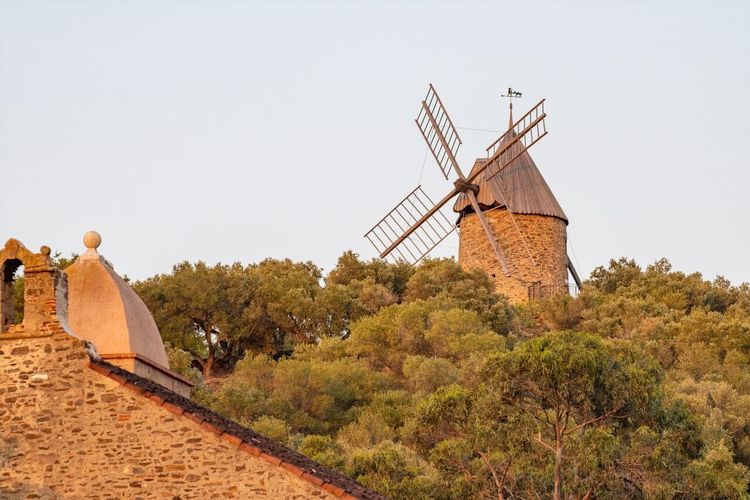
Located on the road to Fort Saint-Elme, the Collioure windmill is the last remaining mill among the twelve that once operated on the heights of the town. Built in the 17th century, it was used to grind the grain grown on the Albères terraces.
Now restored, it occasionally hosts exhibitions by local artists during the summer season. Access from the road is free, and a few minutes are enough to photograph it and enjoy the natural viewpoint that opens onto the Gulf of Lion.
8. In the Footsteps of the Fauvist Painters
In 1905, Henri Matisse and André Derain came to Collioure for the summer. What they painted there — canvases of explosive, non-naturalistic colors, built on the sole logic of emotion — caused a scandal at the Salon d'Automne in Paris and gave birth to the Fauvist movement. Collioure thus became the birthplace of Fauvism.
The town has given tangible form to this legacy with the Fauvist Trail, an open-air route that reproduces the paintings by Matisse and Derain directly at the spots where they were created. Twenty large-format reproductions are placed along the quays, the alleyways, and the heights — you can compare the canvas with the real landscape, and see what the painters transformed, exaggerated, or simplified.
The Collioure Museum of Modern Art holds works from after the Fauvist period, by painters who continued to come to Collioure throughout the 20th century, drawn by the same light. Admission costs €5. The museum is closed on Tuesdays outside the season.
To delve deeper into this story, Ryo's audio-guided tour "La cité des peintres de Collioure" recounts in 22 audio stops how Matisse experienced that summer of 1905 and how every corner of the town inspired his works. Content as well documented as the museum booklet, accessible on foot and without any queuing.
9. A Kayak or Boat Trip
The bay of Collioure can be discovered differently from the water. Several operators based on Désirade Beach offer sea kayak rentals by the hour or half-day. The classic route follows the castle ramparts, rounds Cap Douret, and reaches a cove accessible only by sea.
Motorboat or sailing boat trips allow you to reach the marine reserves between Collioure and Banyuls, where underwater visibility sometimes exceeds 15 meters. Expect to pay €25 to €35 for two hours of self-guided kayak rental, and €60 to €90 for a guided group outing. Booking is recommended in July–August.
10. The Wine Cellars and Vineyards of Roussillon
The terraced vineyards surrounding Collioure produce two of the most distinctive appellation d'origine contrôlée wines in the Languedoc-Roussillon: Collioure AOC (red, white, and rosé wines) and Banyuls AOC (natural sweet wines, often compared to Port). The vines grow on decomposed schist at over 400 meters of altitude, on slopes so steep that all viticultural operations are done by hand.
Several cellars offer free or low-cost tastings. La cave de l'Abbé Rous (56 avenue Charles-de-Gaulle, 66650 Banyuls-sur-Mer, rated 4.1/5 on Google based on 13 reviews) in Banyuls (7 km away), Domaine de la Rectorie in Collioure, and Domaine Madeloc are among the highest-rated by enthusiasts. Autumn is the ideal time: the grape harvest takes place in September–October, and some cellars welcome visitors during the picking season.
11. Banyuls-sur-Mer and the Marine Reserve
Just 7 kilometers to the south of Collioure via the D914, Banyuls-sur-Mer is an unmissable stop. This seaside resort, quieter than its neighbor, has a unique asset: the Cerbère-Banyuls marine reserve (Plage des Elmes, 66650 Banyuls-sur-Mer, rated 4.7/5 on Google based on 1,065 reviews), established in 1974 as the first marine reserve in France.
The reserve covers 650 hectares of seabed between 0 and 60 meters deep. The area open to the public (the "awareness zone") can be explored by snorkeling from Elmes Beach. Posidonia seagrass, grouper, amberjack, and rays are visible without diving equipment on calm days. An FFESSM-certified dive center offers beginner scuba diving lessons with guided boat trips. The Banyuls biological station, affiliated with Pierre-et-Marie-Curie University, offers visits to its aquarium open to the public for €5. If you are planning a day in Banyuls, also check the Ryo audio-guided tour of La cité des peintres to prepare your visit to Collioure right after.
12. Port-Vendres, the Fishing Port
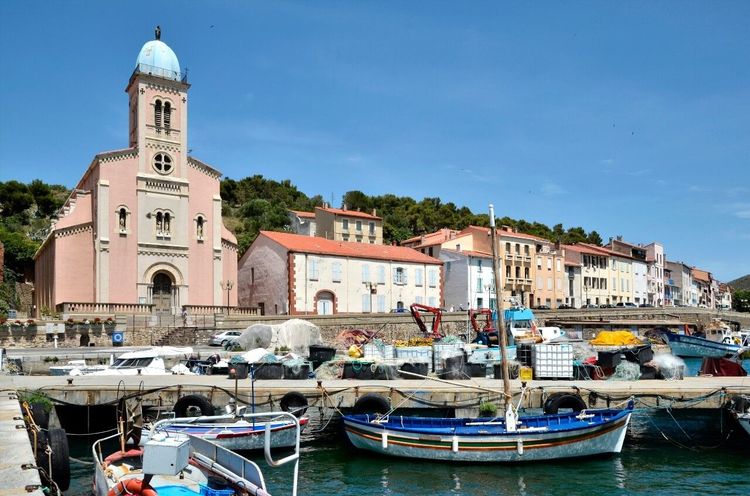
Just 5 kilometers to the north of Collioure, Port-Vendres is the only true professional fishing port on the Côte Vermeille. The fish auction, open to visitors in the morning, is one of the last auctions on the Mediterranean where you can watch the live sale of fish landed the previous night.
The village lacks the pictorial charm of Collioure, but its port restaurants — chez Baillaury and la Table du Pêcheur — serve the freshest seafood on the coast at more affordable prices than in Collioure. A combined visit — Port-Vendres in the morning, Collioure in the afternoon — is doable without a car thanks to the summer coastal shuttle.
13. Hiking the Coastal Path
The Côte Vermeille Coastal Path connects Argelès-sur-Mer to Cerbère over 37 kilometers of asphalt-free coastal trail. The most spectacular section stretches between Collioure and Banyuls: 12 kilometers with a cumulative elevation gain of around 700 meters, alternating cliff passages, descents to isolated coves, and crossings through terraced vineyards.
The full Collioure–Banyuls hike takes 4 to 5 hours depending on your pace. The starting point is Désirade Beach, at the southern end of the port. Bring at least two liters of water in summer — there are no water points or shops on the trail between the two villages. Light hiking shoes are essential, as the path includes several rocky sections.
For those who prefer a half-day, the Collioure – Cap Douret – Paulilles cove section (round trip, 2h30, 6 km) is the most accessible. The Paulilles cove, a former dynamite factory converted into a protected natural site, is worth the trip on its own: a large pebble beach, translucent waters, and a free dynamite museum open in summer.
14. Argelès-sur-Mer and Its Beaches
Just 10 kilometers to the north of Collioure by road or by bicycle (continuous cycle path), Argelès-sur-Mer offers the largest beaches in the region: 7 kilometers of fine sand between the Argelès village and the Racou dune belt.
The atmosphere is radically different from Collioure — more family-oriented, more lively, with campsites and holiday residences. The village of Argelès (distinct from the resort) is worth a visit for its Romanesque church and medieval alleyways. The two towns are connected in summer by a bus shuttle every 30 minutes.
15. Local Specialties: Anchovies, Banyuls Wine, and Cheese
Collioure and its surroundings produce three gastronomic specialties of a quality that far exceeds their national fame.
The Collioure anchovies have held a Protected Geographical Indication (PGI) since 2004 — the only designation of this type awarded to a fish in France. This European recognition rewards a salting craft attested since the Middle Ages. The fish, engraulis encrasicolus caught in the Gulf of Lion between March and July, are salted, matured for eight to ten months in wooden barrels, then hand-filleted and packed in olive oil. Salaison Desclaux (open since 1870) and Salaison Roque (1 Rue de la République, 66190 Collioure, rated 4.7/5 on Google based on 2,291 reviews) (the most renowned) both organize workshop visits during the season.
Banyuls wine is a naturally sweet wine produced by mutage — grape spirit is added during fermentation to stop the process and preserve the grape's natural sugars. The result is an amber or garnet-red wine, between 16 and 18 degrees, which pairs as well with dark chocolate as with anchovies. The "Rimage" vintages (bottle-aged) are the most sought-after by connoisseurs.
The region's cheeses, in particular Fenouillèdes ewe's milk cheese and Albères goat's cheese, complete a remarkably coherent local cheese board. Most weekly markets (Collioure on Wednesdays and Saturdays, Argelès on Wednesdays) offer all three product families directly from the producers.
16. The Saint-Vincent Festival
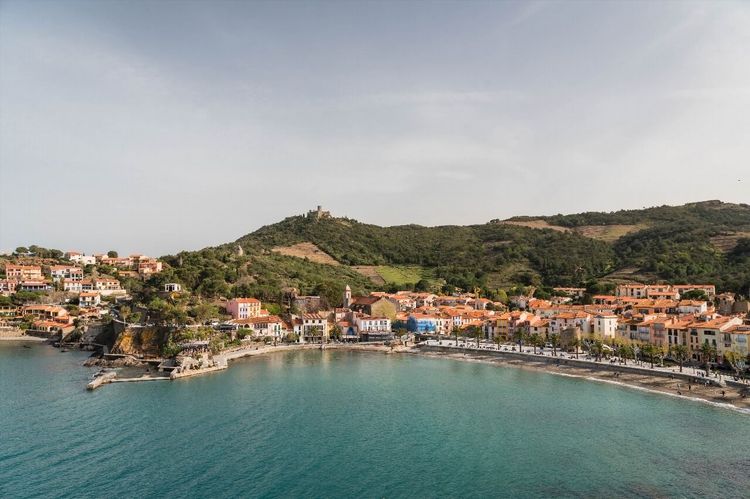
Every 22nd of January, Collioure celebrates its patron saint with a maritime procession unique in the region. The traditional Catalan boats are brought out of winter storage, decorated with palm fronds and flowers, and blessed during a ceremony at the entrance to the port.
This is one of the rare opportunities to see Collioure out of season, in its role as a fishing village. The festivities continue into the evening with a dinner held by the fishermen's brotherhood. If you are in the area in January, this event is well worth the trip.
17. The Elne Cathedral and Its Cloister
Located 20 kilometers to the north of Collioure, Elne is one of the oldest towns in Catalonia — older than Barcelona according to historians. Its Romanesque cathedral of Saints Eulalia and Julia, begun in the 11th century, houses the best-preserved cloister in Roussillon: four galleries sculpted between the 12th and 14th centuries, with capitals depicting biblical scenes and floral motifs of remarkable finesse.
Entry to the cloister costs €6. The cathedral itself is free to enter. The visit takes approximately one hour. From the terraces of the upper town, the panorama over the Roussillon plain — from the Pyrenean range to the sea — is one of the most sweeping in the region.
18. The Medieval Village of Castelnou
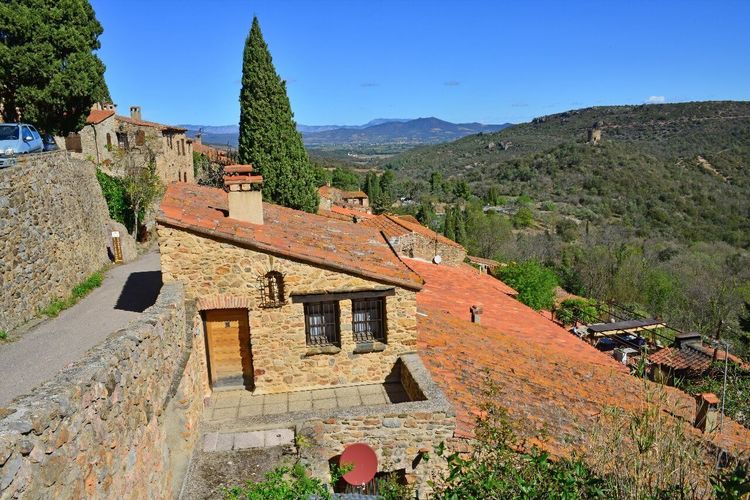
Listed among the Most Beautiful Villages of France, Castelnou nestles 30 kilometers from Collioure in the first foothills of the Pyrenees. This 10th-century fortified village has kept its ramparts, square tower, and cobbled alleyways intact — a rarity in the region.
The castle of Castelnou, privately owned, can be visited in summer for €6. The village is home to around twenty craftspeople and art galleries set up in the old medieval houses. On the way back, make a detour via the Marcevol abbey or the Têt gorges at Vinça — the region hides this kind of landscape around every bend in the road. To fully explore Collioure before or after this excursion, the Ryo audio-guided tour La cité des peintres offers a complete audio introduction to the town in 1h30.

FAQ
How long does it take to visit Collioure?
A full day is enough to see the main landmarks: the royal castle, the Notre-Dame-des-Anges church, the Saint-Vincent chapel, the port, and the Fauvist trail. A weekend allows you to add a hike along the Coastal Path and a visit to Banyuls-sur-Mer. If you want to enjoy the beaches and explore the nearby villages — Port-Vendres, Elne, Castelnou — allow at least three days.
What to Do in Collioure in the Evening?
Collioure comes alive in the evening around the port quays. Restaurants serve on their terraces until 11 pm in summer. Free concerts are organized on the Place du 8-Mai in July and August. The castle is lit up after dark, offering a night panorama from the Saint-Vincent jetty. In high season, several bars on the Rue de la République offer live music until midnight.
What to Do in Collioure When It Rains?
Rainy days are rare on the Côte Vermeille, but they do happen. The Collioure Museum of Modern Art offers an hour of sheltered visiting. The Roque salting house organizes workshop tours regardless of the weather. 20 km away, the cloister of Elne is fully covered. In Perpignan (25 km), the Palace of the Kings of Majorca and the Hyacinthe-Rigaud Museum can easily fill an afternoon.
What to Do in Collioure with Children?
The Boramar and Désirade beaches are suitable for young children, with calm and shallow waters. The visit to the royal castle keeps children engaged thanks to the armory rooms and battlements. The aquarium at the Banyuls biological station is ideal for children aged 5–12. Sea kayaking on the bay is suitable from age 7–8 with an accompanying adult.
What Are the Most Beautiful Villages around Collioure?
Castelnou (listed among the Most Beautiful Villages of France, 30 km), Elne (a Roman town with a medieval cloister, 20 km), and Céret (capital of Cubism, 30 km inland) are the three must-do excursions from Collioure. Within 15 km, Port-Vendres and Banyuls-sur-Mer are each worth a half-day.
What Is the Best Time to Visit Collioure?
May–June and September–October offer the best balance: pleasant temperatures (20–25°C), the sea still fresh but swimmable from June, and limited crowds. July and August are the hottest months (30°C on average) and the most crowded, with difficult parking and fully booked restaurants. Winter is mild (12–15°C in January) and lets you discover the town as the locals experience it — the quiet months when the Saint-Vincent Chapel and the Museum of Modern Art can be reached at your own pace on our audio walking tour.
Conclusion
Collioure packs centuries of military history, a pictorial revolution that changed 20th-century art, and a coastline of rare natural beauty into less than 3 square kilometers. Whether you come for a day or a week, the town almost always exceeds expectations — as long as you venture beyond the port quays and head up toward the fortifications, the vineyards, and the hidden coves.
To make the most of the town's history, open our Ryo app and follow the Ryo audio-guided tour La cité des peintres: 21 audio stops, 1h30 of walking, the best way to understand why Matisse said of Collioure that it was "the only place in the world where light does not need to be invented".