© Shutterstock
 Votre guide Ryo
Visit Collioure in 1 Day: Complete Itinerary 2026
At 8:30 a.m., the pink bell tower of Notre-Dame-des-Anges still casts a long shadow over the harbor water, and the first fishermen are bringing their boats back while the terraces have not yet opened. Visiting Collioure in one day fits within this narrow window between the calm of the morning and the afternoon crowds, provided you follow a route that avoids unnecessary back-and-forth through the Catalan alleyways. This small port in the Pyrénées-Orientales, which drove Matisse and Derain wild with color in 1905, can be covered in a single day if you know where to set foot first, and the Ryo audio-guided tour of Collioure helps you keep track of the historical thread as you walk.
In twelve hours on the ground, you can climb the ramparts of a 13th-century royal castle, swim beneath the windows where Matisse painted his fauves, taste an anchovy salted by six generations, and hike up to Fort Saint-Elme before sunset. This guide details a visiting order designed for a one-way trip from Perpignan or Argelès, with the timings that really matter: the covered market, low tide on Boramar beach, and the moment when the light strikes the bell tower just as it did in the days of the fauves.
Morning: Waking Up Opposite the Château Royal
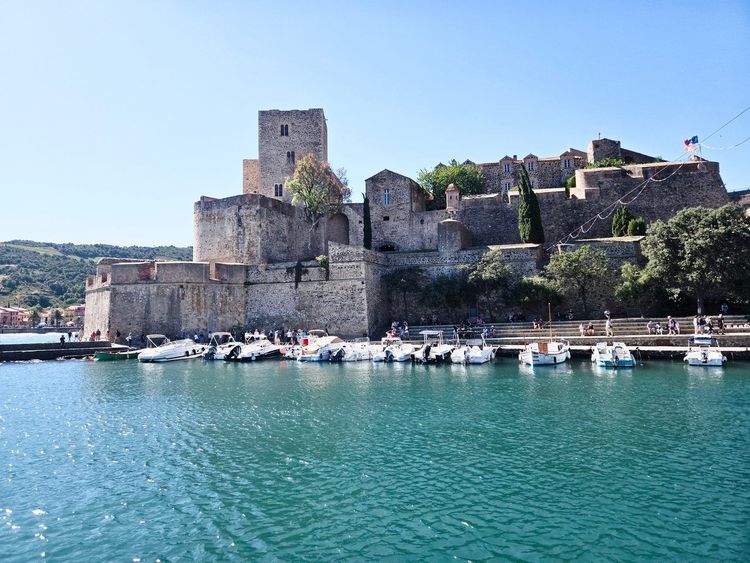
Arrive in Collioure before 9 a.m. if possible: it is the only time of day when the Quai de l'Amirauté still belongs to the locals. The tourist buses have not unloaded their first groups, the street artists have not set up their easels, and you can photograph the pink bell tower without a single head in the frame. Parking is the first logistical hurdle of the day: the three central car parks (Douy de la Maisonneuve, Amirauté, Faubourg) fill up by 10 a.m. in July–August, whereas a spot almost always opens up before 9 a.m.
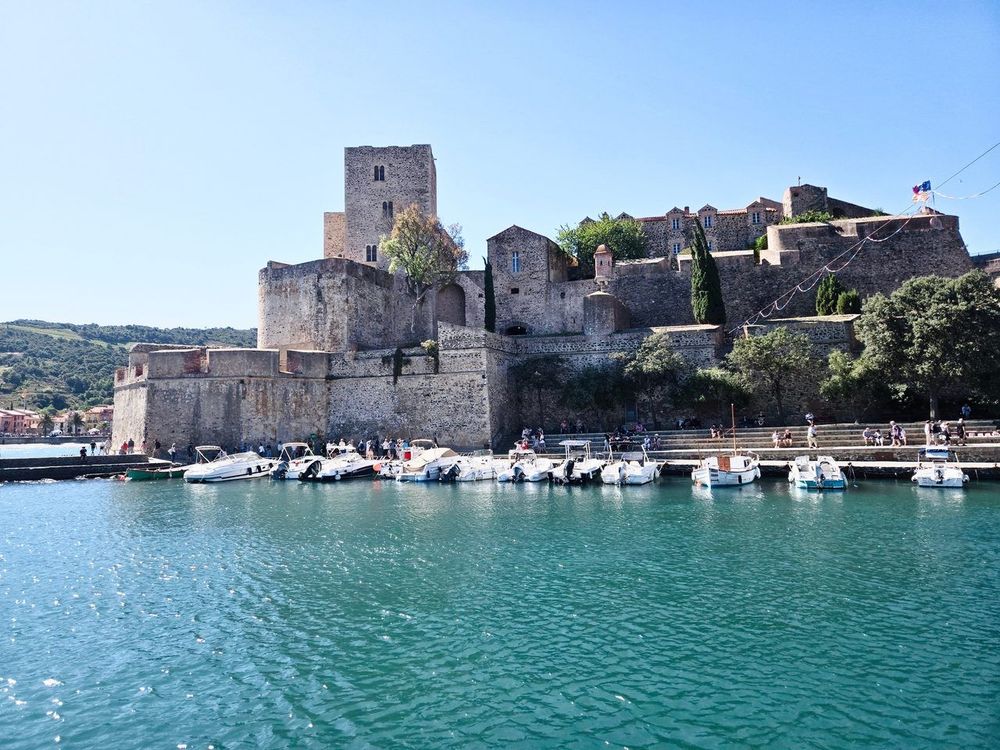
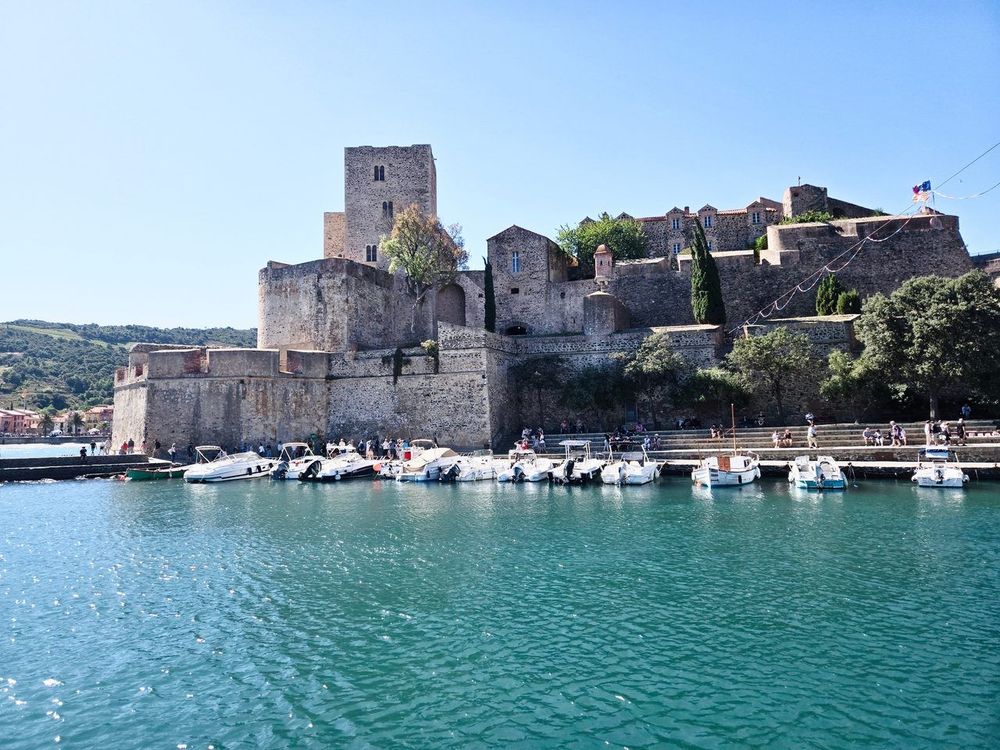
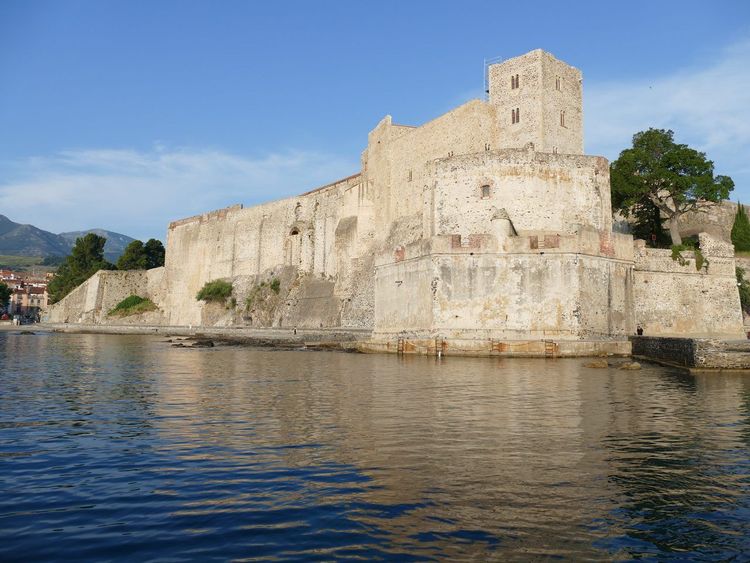
The Château Royal de Collioure (Quai de l'Amirauté, 66190 Collioure, rated 4.6/5 on Google with 8,188 reviews) opens its doors from 9:30 a.m. in high season. Built from the 13th century by the kings of Majorca and later fortified by Vauban in the 17th century to lock down the Catalan border, it sits on the headland separating the fishing harbor from Boramar beach. A self-guided visit takes about 45 minutes: the main courtyard, the guardroom, the rampart walk with views over the Catalan rooftops, and a descent to the terraced gardens. Entry costs €7, free for under-18s.
From the rampart walk, the view already takes in the day's main highlights: the church bell tower below, the Catalan boats moored along the quay, and in the distance the silhouette of Fort Saint-Elme on its headland. It's a good moment to get your bearings before heading back down into the maze of alleyways. Vauban remodeled the existing fortifications without razing them, which explains the visible mix of medieval stonework and later bastions designed to withstand artillery rather than assault ladders.
One piece of advice that changes the whole day: don't visit the castle last. Many visitors save it for the afternoon and end up queuing in 30-degree heat alongside cruise-ship groups disembarked at Port-Vendres. In the morning, the wait rarely exceeds five minutes, and the stone is still cool underfoot from the night before.
On the way out, the Place du 8 Mai marks the boundary between the castle quarter and old Collioure. The cafés are only just starting to put out their tables; this is the spot for a strong coffee before tackling the most packed part of the day.
Old Collioure and Its Catalan Alleyways
The historic heart of Collioure amounts to a tight triangle between the castle, the church, and the Fauvism hill, but every alleyway is worth lingering in. Rue Vauban, cobbled and lined with ochre and pink facades, keeps its typically Catalan blue shutters; Rue Mailly climbs toward artists' studios open to the public, where some local painters carry on the Fauvist tradition without ever reaching the prices of their illustrious predecessors.
The Mouré quarter (literally the 'snout' in Catalan) forms the peninsula separating the two main beaches. It is home to the oldest fishermen's houses, recognizable by their narrow facades turned toward the sea to withstand the Tramontane wind. Many have been bought up by artists since the 1900s, without the quarter losing its village character.
To understand how this maze was built up over the centuries, the Collioure audio-guided tour offers a route linking these alleyways to their history of fortifications and fishing, with audio commentary to listen to directly in front of each facade rather than in a paper guidebook you quickly close.
The covered market, open every morning except Monday out of season, occupies a 19th-century market hall right in the center. You'll find local anchovies, dried fruits, Catalan fabrics, and in season, figs and apricots from the Roussillon. It's a good place to pick up a light picnic before continuing to the church.
The shop windows are worth a look even without any intention of buying. Several galleries show paintings inspired by original Fauvism, and two or three Catalan ceramic workshops perpetuate solar motifs inherited from the 19th century. Rue de la Tour, which runs behind the church, concentrates most of the independent shops; avoid the main commercial street at peak hours (12 p.m.–2 p.m.), when it turns into a cruise-ship corridor that's difficult to navigate with a pushchair.
The French-Catalan bilingualism is immediately obvious from the first street signs: Collioure belongs to historic Catalonia, attached to the Crown of Aragon until the Treaty of the Pyrenees in 1659. This dual identity explains the architecture of the houses, turned inward around cool courtyards, and the festivals that still punctuate the summer, notably Sant Vicens at the end of August with its processions of illuminated boats on the harbor.
A few practical landmarks to avoid getting lost: the town can be covered entirely on foot in under 20 minutes from one end to the other, but not all the alleyways are signposted. Keep the pink bell tower in your sightline — it serves as a reference point from almost every angle in the historic center — and take time to look up: the facades of the Mouré quarter hide painted sundials and old ironwork that most hurried visitors never notice.
Notre-Dame-des-Anges and Its Iconic Bell Tower
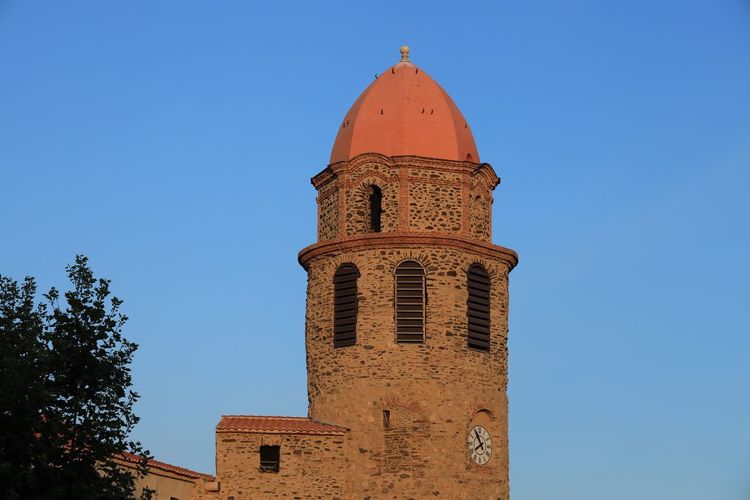
Leaving the old quarter, the Notre-Dame-des-Anges church appears at the end of the quay, its feet almost in the water. Built in the 17th century after the previous building was destroyed during a Spanish siege, it inherited its bell tower from a medieval lighthouse, converted into a tower-belfry with its characteristic pink dome. It is Collioure's most photographed image, reproduced on every postcard for a century.
The interior is worth five minutes, even for those with no particular religious sensibility: nine gilded Baroque altarpieces, including the high altar signed by Joseph Sunyer, a 17th-century Catalan sculptor. The coolness of the building contrasts with the heat of the quay in summer, making it a welcome mid-morning pause.
For the best photo, the ideal angle is from the adjacent Boramar beach, with the bell tower in the foreground and the Catalan boats lined up in front. Local photographers recommend the late afternoon, when the raking light pinks the stone even further. The Catalan name of the building, Nostra Senyora dels Àngels, is a reminder that Mass is still sometimes celebrated in Catalan during major festivals.
Lunch: Where to Eat in Collioure
Midday comes quickly when the morning is packed, and Collioure is full of addresses driven by the day's catch rather than tourist marketing. On the Quai de l'Amirauté, the terraces offer the view but often charge tourist prices; to eat better and more cheaply, simply head two streets back toward the interior, around Rue Rière or Place du 8 Mai.
Collioure anchovies, salted using an artisanal method passed down since the 17th century, appear on almost every menu: as tapenade, in oil, or simply on a slice of grilled bread with a drizzle of olive oil. Many restaurants also offer the famous 'anchoïade', a sauce made from pounded anchovies served with raw vegetables and sometimes hard-boiled eggs.
Budget €15 to €20 for a full set menu away from the seafront, and up to €35 for a table with a direct view of the castle. Reservations are not necessary outside July–August, except for terrace tables on weekends.
For a quicker lunch, the Cave Coopérative L'Étoile sells Catalan charcuterie boards and glasses of Côtes du Roussillon wine to enjoy on the premises, between tastings. It's a pleasant alternative for those who want to keep time for the beach in the afternoon rather than lingering at the table.
Afternoon: Beaches and a Swim
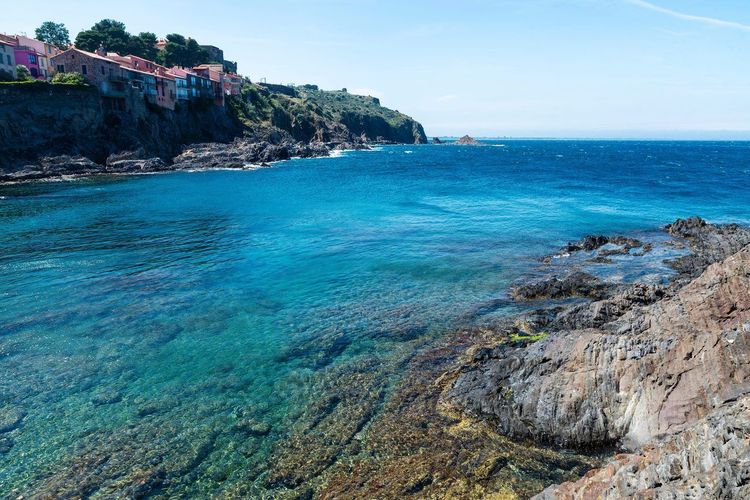
Collioure has two main beaches, separated by the castle peninsula, and your choice depends mostly on what time you arrive. Boramar beach (Boulevard du Boramar, 66190 Collioure, rated 4.7/5 on Google with 2,136 reviews), right in the center, fills up from 1 p.m. in summer; it is also the most photogenic, with the bell tower as a backdrop and surprisingly clear water for an urban beach.
On the other side of the castle, Saint-Vincent beach (sometimes called Plage de la Balette on the south side) offers more space and finer sand, at the cost of an extra ten-minute walk from the center. Families find it slightly quieter, especially in the late afternoon when the light begins to fade.
A swimsuit isn't essential to enjoy the site: many visitors simply dip their feet in the rocks lining the coastal path toward Port-Vendres, with coves reachable on foot in fifteen minutes. The water is cooler there but far less crowded than the two central beaches.
One detail that matters in peak season: pebbles replace sand on a good stretch of Boramar, so bring water shoes if you have sensitive soles. Public showers and toilets are located near the Amirauté car park, open from June to September.
In the Footsteps of the Fauvist Painters
In 1905, Henri Matisse and André Derain spent the summer in Collioure and painted around a hundred canvases in just a few months, unknowingly laying the foundations of Fauvism. The light of the Roussillon, considered too violent by the Parisian academic establishment of the time, became a method here: pure colors juxtaposed without gradation, blue or violet shadows, a sky that can appear green in a Derain canvas.
The Fauvism Trail, a free open-air route, places twenty large-format reproductions at the exact locations where the original paintings were made. Allow 45 minutes for the full trail, which crosses the harbor, the Mouré quarter, and climbs toward the hermitage hill. Each panel indicates the title of the work, the year, and the museum that holds it today — often the Centre Pompidou or the MoMA in New York.
To go deeper without being limited to the panels, the Collioure audio walking tour dedicated to the city of painters offers a 22-track Ryo audio-guided tour of approximately 1h30, which recontextualizes each stop with excerpts from Matisse's correspondence and anecdotes about village life in 1905. It's the most in-depth complement for those who genuinely want to understand why this light fascinated the Fauves more than Provence or Brittany.
The Musée d'Art Moderne de Collioure (Route de Port-Vendres, 66190 Collioure, rated 4/5 on Google with 359 reviews), housed in the Villa Pams on the road to Port-Vendres, holds works by Matisse and Derain, as well as Dufy and Charles Camoin, who would follow the movement in subsequent years. The visit takes around 40 minutes and costs €5; it usefully complements the Fauvism Trail for those who want to see originals rather than reproductions.
Some panels on the trail are more photogenic than others for recreating the original framing yourself: the one placed in front of the bell tower, reproducing Derain's painting Le Clocher de Collioure, attracts most comparative photography enthusiasts. Plan to visit it in the late morning, when the light is closest to that painted in 1905.
Several contemporary artists' studios still line this same circuit, particularly around Rue Arago, where painters established since the 1980s continue to work with local color without necessarily claiming the Fauvist legacy. Some open their doors in the afternoon, with no reservation required. A little-known anecdote: Matisse initially disliked Collioure, finding it too out of the way, before changing his mind within a few weeks under the influence of the September light. He would return every summer until 1914.
Fort Saint-Elme
Perched on the headland between Collioure and Port-Vendres, Fort Saint-Elme has dominated the bay since 1552, built in a six-pointed star shape on the orders of Charles V to monitor the border with Spain. Important note that changes the visit: privately owned, the fort has been closed to interior visits since 2023 for major renovation works, with no reopening date announced as of today. Don't plan on going inside, but keep it as a destination for a walk.
Access is via a narrow road or a hiking path of about 25 minutes from the center, with a steep climb but no technical difficulty. Even with the doors closed, the ascent is justified for the view: from the fort's surroundings, the panorama over the Gulf of Lion, Collioure, and Port-Vendres remains one of the finest on the Côte Vermeille, especially in the late afternoon when the raking light catches the terraced vineyards. Check with the tourist office before heading up, as the construction schedule changes from one season to the next. Ryo's audio-guided tour of Collioure is worth pairing with the climb, for the stories behind the ramparts you'll see from up here.
Anchovies and Vineyards: Local Specialties
Collioure belongs to two wine appellations that share the town's name: the AOC Collioure for dry wines (red, white, rosé) and the AOC Banyuls for naturally sweet wines, produced on the same terraced hillsides that tumble down to the sea. These vines, shaped by hand for centuries on slopes impossible to mechanize, yield some of the lowest outputs in France, which partly explains their prices.
The Cave Coopérative L'Étoile (Avenue Aristide Maillol, 66190 Collioure, rated 4.7/5 on Google with 12 reviews), right in the town center, offers tastings without a reservation most afternoons, with bottles of Collioure and Banyuls priced between €8 and €25. It's the simplest option for those who don't have time to leave town to visit a domaine, although independent winemakers established on the heights of Banyuls-sur-Mer offer more comprehensive visits for those with half a day to dedicate to wine.
On the anchovy side, the Roque establishment, in business since 1870, perpetuates artisanal wood-barrel salting using a method virtually unchanged across six generations. The workshop-shop can be visited free of charge and lets you watch the workers sort and fillet the fish by hand — a know-how that is increasingly rare on the Catalan coast.
For a meaningful souvenir to bring home, a tin of salt- or oil-packed anchovies (around €6 to €12) travels far more easily in a suitcase than a bottle of wine, and tells the story of the village to those who stayed behind just as well.
End of Day: Sunset and Aperitif
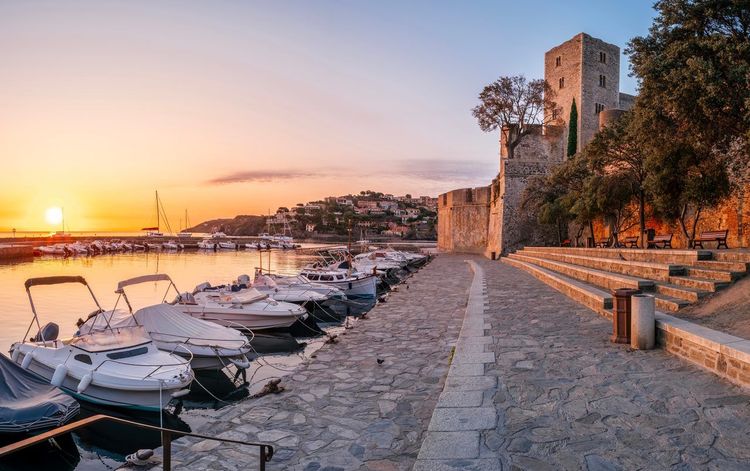
Around 7 p.m., the light shifts register and Collioure deserves one last slowing of the pace. The best viewpoint for sunset is on the harbor jetty, facing west, with the castle and bell tower silhouetted against a sky that often turns orange and then violet.
The Îlot Saint-Vincent, connected to the harbor by a pedestrian jetty, shelters a 17th-century chapel and offers a different angle on the town, almost from out at sea. It's a quieter spot than the seafront, favored by locals for a post-dinner stroll.
For the aperitif, the quayside bars almost all offer a chilled Banyuls wine as a Catalan-style kir, with olives or an anchovy board on the side. The most sought-after tables — those with a direct view of the bell tower — rarely free up before 8:30 p.m. in peak season, which leaves time to finish the walk to the end of the jetty while waiting for a spot to open up.
Getting There and Parking in Collioure
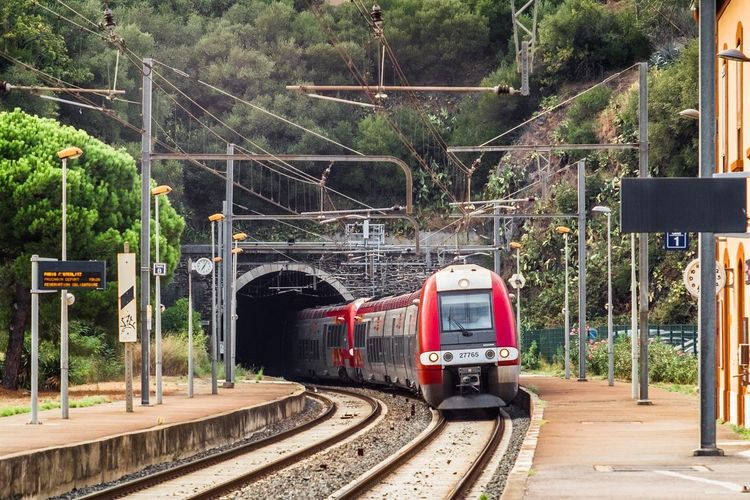
Collioure is 25 minutes from Perpignan and about 20 minutes from Argelès-sur-Mer, connected by the coastal road D914 or by train (TER Perpignan–Cerbère line, stop Collioure-Port-Vendres). For a stress-free day visit, the train is often the simplest option in summer, with the station a ten-minute walk from the center.
By car, three main car parks serve the town center: Amirauté, Douy de la Maisonneuve, and Faubourg, all paid from June to September (around €2 per hour). They frequently fill up after 10 a.m. in high season; arriving before 9 a.m. or using a park-and-ride on the outskirts with a free shuttle remains the most reliable solution in July–August.
If You Have More Time: the Surroundings
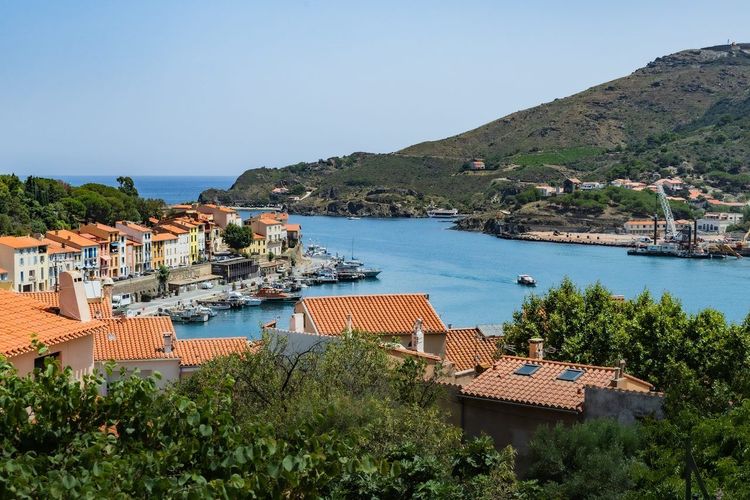
For those with an extra half-day, Port-Vendres (10 minutes by car) offers a more authentic, less touristy fishing harbor, with its fish halls open from early morning. Banyuls-sur-Mer, a little further on, adds its own wine estates and a marine reserve accessible by snorkeling from the beach.
Our Ryo article on the best things to do in and around Collioure covers more options for extending the stay over several days, including hikes toward the Tours de Madeloc or the wild coves between Collioure and Cerbère, far less frequented than the central beaches in the height of summer.
Budget and Tips for a Day in Collioure
A full day in Collioure, including the castle, museum, lunch, and a tasting, averages between €40 and €60 per person excluding transport, parking included. The beaches, the Fauvism Trail, and the church are all free, which significantly reduces the bill for families.
To cut costs further, visiting in the low season (May–June or September) avoids summer parking charges and lets you enjoy the same sites without the July–August queues. The morning covered market remains, whatever the season, the cheapest way to sample local gastronomy without sitting down at a restaurant.
FAQ
How long does it take to visit Collioure?
A full day is enough to see the essentials: the castle, the old quarter, the church, a beach, and the Fauvism Trail. To add the vineyards and nearby towns like Port-Vendres or Banyuls, it's better to plan two days on-site.
Where can you park in Collioure without the hassle?
The Amirauté car park is the most central, but it fills up after 10 a.m. in summer. Arriving before 9 a.m. or using a park-and-ride with a free shuttle is the most reliable option in high season, especially on weekends.
What is the best time of year to visit Collioure?
May–June and September offer light comparable to summer with smaller crowds and still-pleasant swimming temperatures. July–August remains very busy, particularly around the castle and the two central beaches.
Is Collioure suitable for children on a day trip?
Yes: the Boramar and Saint-Vincent beaches are safe, the castle is easy to visit as a family, and the open-air Fauvism Trail generally appeals to children thanks to its large-format reproductions.
Do you need to book a restaurant in Collioure in summer?
It's not essential on weekdays, but terrace tables with views of the castle or the bell tower fill up quickly on weekends. Booking late morning for the same evening is usually sufficient to secure a table.
Can you visit Collioure without a car?
Yes, the Collioure-Port-Vendres TER train station is a ten-minute walk from the centre, on the Perpignan–Cerbère line. It's actually the most practical option in summer, given the regular saturation of downtown car parks.
Collioure reveals itself as quickly as it closes back up: twelve hours are enough to understand why Matisse left part of his painting here and why the Catalans of Roussillon continue to make it a place apart on this coast. The secret lies less in the list of places to see than in the order in which you string them together, starting with the castle while the quay is still empty and ending on the jetty facing the sunset.
For those who want to extend the experience beyond a single day, or simply listen to the village's story while walking rather than reading a guidebook, the Ryo audio-guided tour of Collioure and its dedicated edition on the city of painters remain the most natural complement to this itinerary — enough to turn twelve hours of sightseeing into a true lesson in Catalan history, one brushstroke at a time.