© Shutterstock
 Votre guide Ryo
10 Villages to Discover around Colmar in 2026
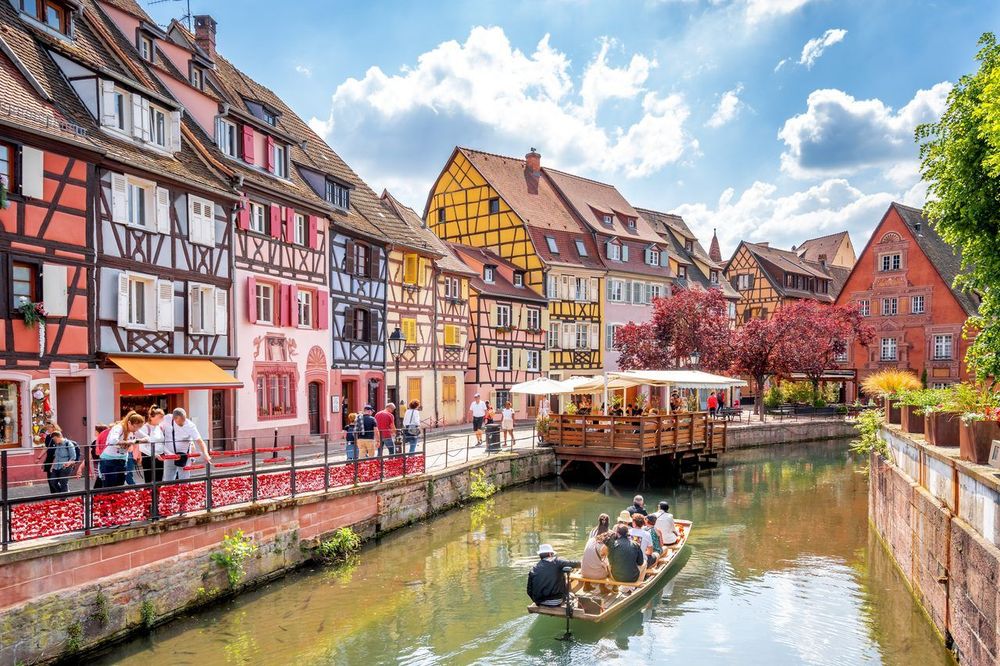
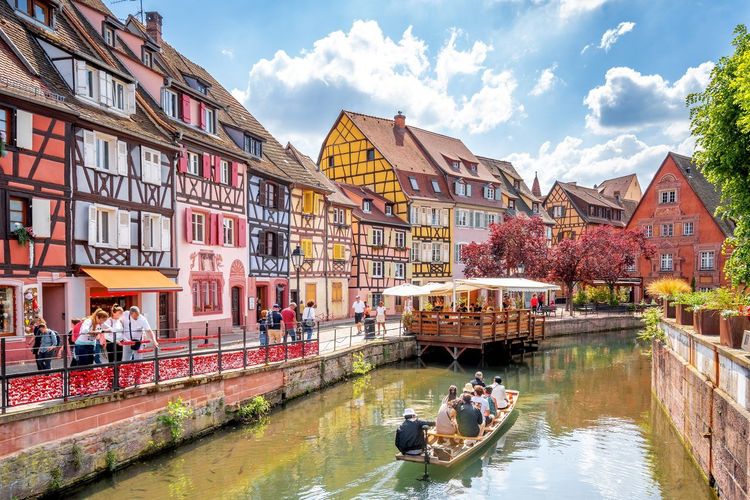
Alsace is one of the rare regions where the word "village" takes on an almost unreal dimension. Each village around Colmar lines up, within a radius of 30 kilometers, a concentration of medieval towns unmatched in France: half-timbered houses painted in vivid colors, cobbled streets winding through the vineyards, Renaissance fountains, and 13th-century ramparts nearly intact. Before setting off to explore these towns, the city itself deserves a stop — the Ryo audio-guided tour of Colmar takes you on a 2h10 journey through the Petite Venise, the tanners' quarter and the alleyways of the Old Town in complete independence.
Ten villages dot this itinerary, each with its own reasons to visit: a village elected favorite of the French whose lanes spiral around a count's castle, a wine town where a night watchman in medieval costume still makes his rounds at 10 p.m., a humanist library inscribed on UNESCO's World Memory register, 14th-century ramparts forgotten by tourists, and a 900-hectare vineyard surrounding a village almost unchanged since the 17th century. That is what awaits you in the surroundings of Colmar, often less than twenty minutes' drive away.
Eguisheim, the Favorite Village of the French
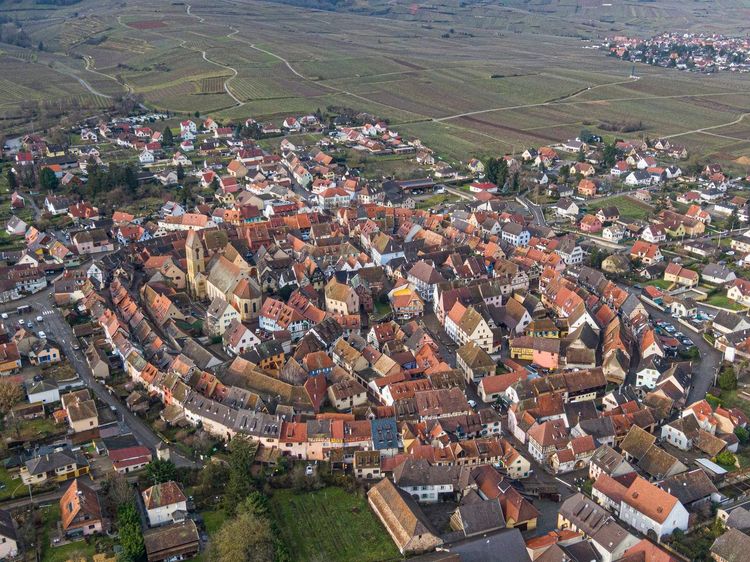
Eguisheim (Place du Château Saint-Léon, 68420 Eguisheim, rated 4.7/5 on Google with 8.2K reviews), located 7 km south of Colmar, is the logical starting point for any circuit in the surrounding area. The village was designated "favorite village of the French" in 2013 by the France 2 television program, a title that propelled its fame well beyond regional borders. Yet the surprise remains intact with every visit: the concentric lanes winding around the castle of the counts of Eguisheim create a medieval layout unique in France, a kind of cobbled snail that you walk in a spiral from the outer ramparts to the inner courtyard of the castle.
The village has around 1,700 inhabitants within a surprisingly small area, making it an ideal place for a two-hour walking visit. The Grand-Rue and its parallel streets concentrate half-timbered facades from the 15th and 16th centuries, some of which overflow with red geraniums from May to October. In front of the Saint-Léon fountain, at the center of the village, a discreet plaque marks the exact spot where Pope Leo IX was born in 1002 — a fact often overlooked by visitors in a hurry. The Chapelle Saint-Léon IX (12th century), adjoining the count's castle, deserves a stop for its interior medieval frescoes, among the best preserved in the Haut-Rhin.
The castle of the counts of Eguisheim dates back to the 10th century. Closed to visitors, its octagonal keep is nonetheless visible from almost every lane, having structured the village's interior landscape for over a millennium. Looking up toward the ridges, you can make out the ruins of Hohlandsbourg (13th century), reachable on foot in 1h30 from the village via a waymarked path through the vineyards.
Eguisheim is surrounded by two grand crus: Eichberg and Pfersigberg, both classified as Alsace AOC grand crus. If you visit between September and mid-October, you will witness the harvest in the plots that begin just behind the last houses. The Eguisheim cooperative cellar, founded in 1902, offers tastings year-round and is an excellent introduction to Alsatian grape varieties: gewurztraminer, riesling, muscat, pinot gris. Private cellars are numerous and often accessible without an appointment outside peak season.
Kaysersberg, the Birthplace of Albert Schweitzer
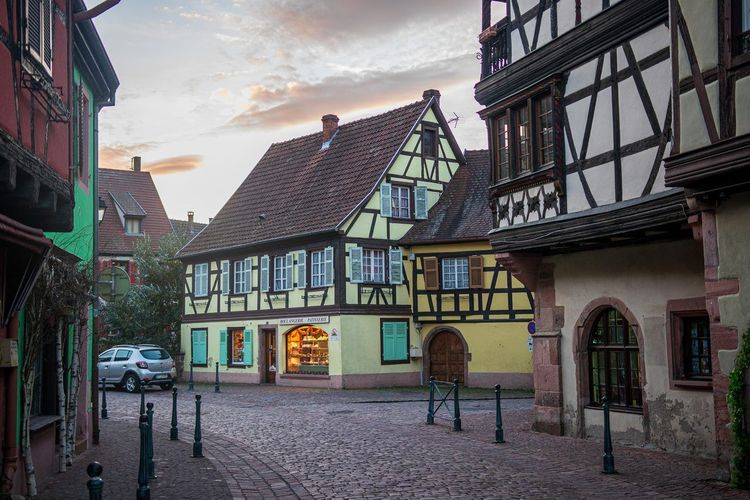
Kaysersberg (13 km northwest of Colmar) is one of the most complete villages in the region. Its name literally means "Emperor's mountain" — the imperial fortress that dominates the village from a rocky promontory once controlled the passage to the Col de Bonhomme, a strategic route between Alsace and Lorraine.
The castle of Kaysersberg (13th century) can be explored freely and at no cost. The climb takes about fifteen minutes from the town center and rewards you with a view over the vineyards, the glazed-tile rooftops and the Vosges massif in the background. Below, the Grand-Rue concentrates the village's most photographed facades: half-timbered houses from the 15th and 16th centuries, hand-forged signs, Renaissance fountains with sculpted figures. The Chapelle du Pont (14th century), with its carved wooden Renaissance balcony overlooking the Weiss, is often reproduced on the region's postcards.
Albert Schweitzer was born in Kaysersberg in 1875. His birthplace, now a museum, traces the life of this theologian, musicologist and physician who was awarded the Nobel Peace Prize in 1952. Admission is free and takes around 45 minutes. It is one of the few village museums in France entirely dedicated to a Nobel Prize laureate.
The Collégiale Sainte-Croix (12th–16th century) deserves a serious stop: its sculpted Romanesque porch, its Passion altarpiece (1518) attributed to Jean Bongartz and its Renaissance baptismal font with polychrome figures are among the jewels of Alsatian sacred art. The interior is freely accessible. Allow time for one of the village's wine cellars to taste the rieslings of the Weiss valley, renowned for their minerality and aging potential.
Riquewihr, the Pearl of the Wine Route
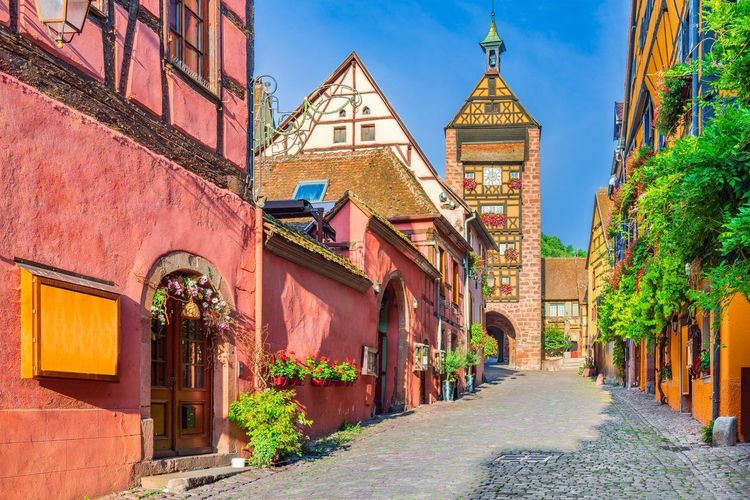
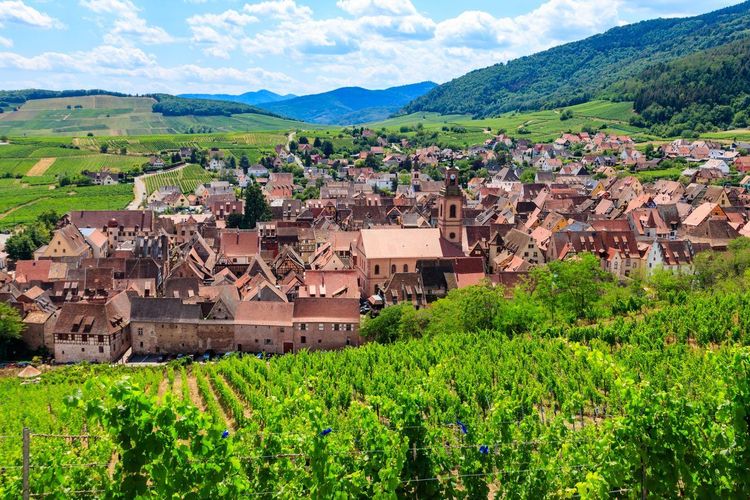
Riquewihr (Rue du Général de Gaulle, 68340 Riquewihr, rated 4.6/5 on Google with 9.8K reviews) (12 km north of Colmar) is often presented as the best-preserved village in Alsace. No modern building is visible from the main street — the town escaped the destruction of 1944 thanks to its voluntary surrender, earning it the long-standing nickname of "pearl of the Wine Route."
The Rue du Général de Gaulle, which runs through the village from north to south, is lined with 16th-century houses, some of the best-documented in Alsace. The Maison Liebrich (1535), the Maison Preiss-Zimmer (1686), the Tour des Voleurs (14th century) with its torture chamber converted into a museum… every building bears a date carved into the wood or stone. The Tour Dolder (13th century), at the village's northern entrance, houses a small historical museum tracing the history of Riquewihr under the counts of Württemberg.
Riquewihr is the home of Hugel & Fils, one of Alsace's most prestigious négociant houses, founded in 1639. Their vaulted cellars can be visited by appointment. The village is surrounded by the grand crus Schoenenbourg and Sporen, whose age-worthy rieslings rank among the finest bottles in the region.
Be warned: Riquewihr receives between 800,000 and 1 million visitors per year. To enjoy it without the crowds, arrive before 9 a.m. or after 5 p.m. in peak season (July–August), or visit on a weekday from April to June. The paid tickets for the two towers (Dolder + Tour des Voleurs) give access to elevated views over the village for a few euros.
Ribeauvillé, between Medieval Towers and Great Vineyards
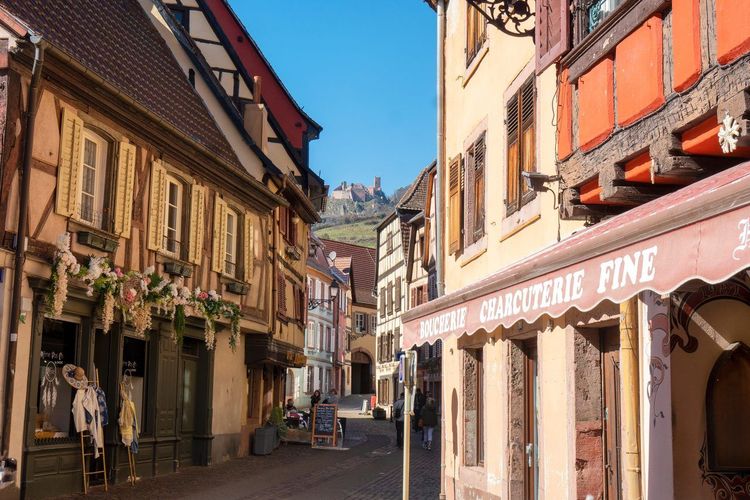
Ribeauvillé (Grande Rue, 68150 Ribeauvillé, rated 4.5/5 on Google with 6.4K reviews) (15 km north of Colmar) is recognizable by its unique profile: three ruined castles dominate the Vosges ridgeline behind the village — Saint-Ulrich (11th century), Girsberg (12th century) and Haut-Ribeaupierre (13th century). Their silhouette makes for a striking backdrop from the Grande Rue, especially at golden hour in the evening.
The Grande Rue of Ribeauvillé is organized into three distinct historic districts: Ober-Stadt (upper town), Mittel-Stadt (middle town) and Under-Stadt (lower town), each with its 17th-century fountains, half-timbered inns and wine cellars. The Pfifferhüs (minstrels' house, 15th century) is a reminder that Ribeauvillé was once the seat of the Alsatian minstrels' guild, itinerant musicians whose annual gathering still takes place every first Sunday in September under the name of "Pfifferdaj."
Wine lovers will recognize Ribeauvillé as an essential address: the house of Trimbach, founded in 1626, produces here some of the most internationally acclaimed Alsatian rieslings. The walk up to Château Saint-Ulrich (1 hour one way from the center) is accessible to any hiker and offers a 360° view over the Alsatian plain in fine weather.
Turckheim and Its Night Watchman
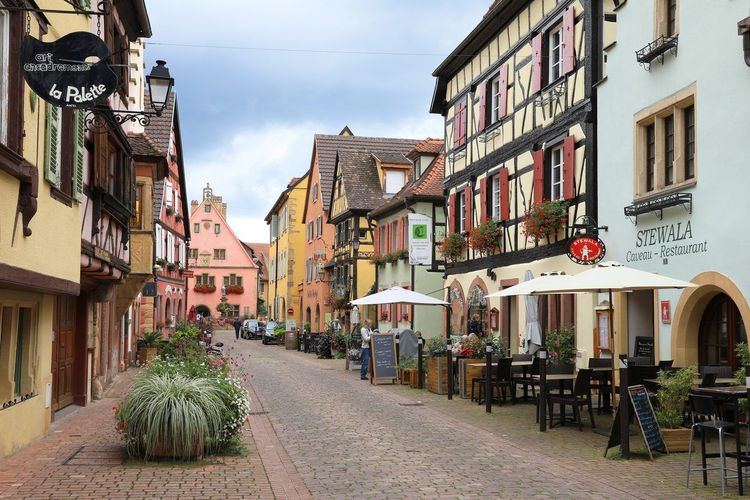
Turckheim (Place Turenne, 68230 Turckheim, rated 4.5/5 on Google with 3.7K reviews) (4 km west of Colmar) is the closest village to the city among those presented here. Its medieval architecture displays a remarkable coherence: the three fortified gates — Porte de France, Porte du Brand and Porte de Munster — are still standing and frame a town center almost unchanged since the 15th century.
Turckheim's great distinctive feature is its night watchman, a tradition maintained since the Middle Ages. From May to October, every evening at exactly 10 p.m., a watchman in medieval costume walks through the village's lanes by lantern light and sings out the hours. The gathering takes place at Place Turenne; access is entirely free, and the scene is genuinely captivating, especially for children.
Turckheim is also a gateway to the Fecht valley and its cycling paths. A greenway links Colmar to the Vosges along the river, making it possible to reach Munster by bike in under an hour from Turckheim. The village is surrounded by the grand cru Brand, one of the most renowned Alsatian grand crus for riesling and gewurztraminer.
Hunawihr, between Storks and Classified Vineyards
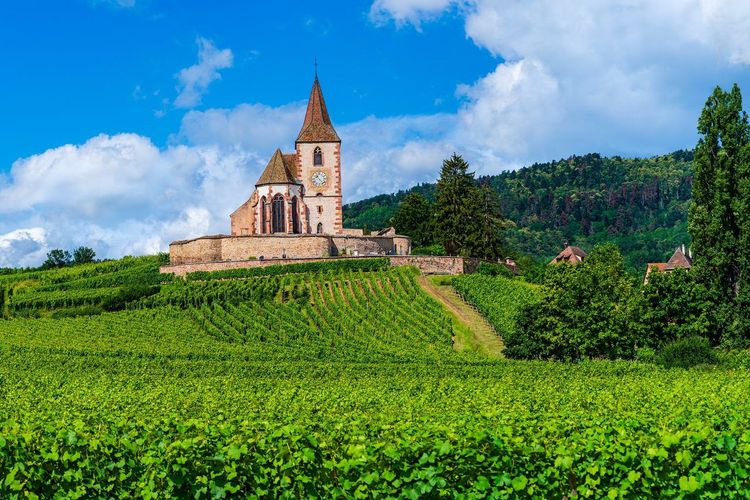
Hunawihr (Centre de réintroduction des cigognes, 68150 Hunawihr, rated 4.5/5 on Google with 5,582 reviews) (16 km north of Colmar) is listed among the "Most Beautiful Villages in France." With around 550 inhabitants, it is one of the smallest villages in this selection, and often the most peaceful to walk through.
Its emblematic monument is the fortified church of Saint-Jacques-le-Majeur (15th century), perched on a mound amid the vineyards. The building has been simultaneously Catholic and Protestant since the Reformation, a rare arrangement known as "simultaneum" that persisted into the 20th century. The hexagonal ramparts encircling the church are perfectly preserved and offer an unobstructed view over the surrounding grand crus.
Hunawihr also houses the Stork Reintroduction Centre, founded in 1976, which played a decisive role in the return of the white stork to Alsace. The region had only 9 nesting pairs in 1972; today there are more than 400 in Alsace. The centre also houses otters and fish from Alsatian rivers, making it a visit appreciated by families with children.
Bergheim, the Medieval Town Forgotten by Tourists
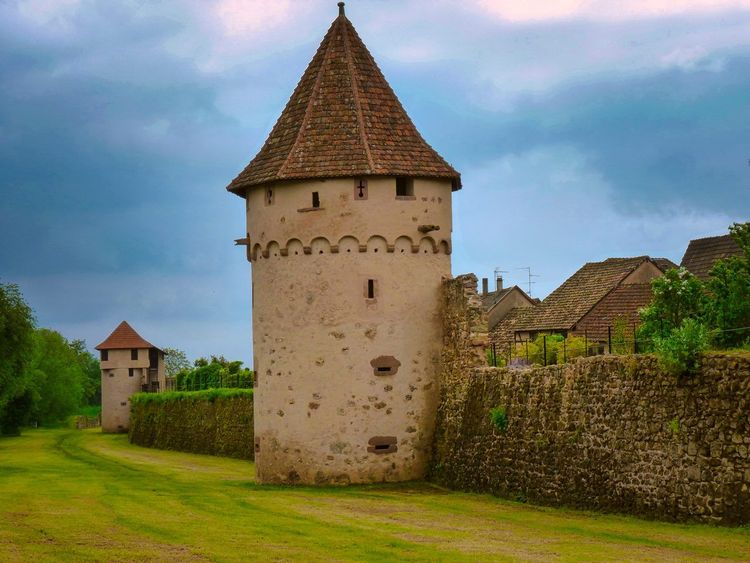
Bergheim (Rue du Général de Gaulle, 68750 Bergheim, rated 4.5/5 on Google with 28 reviews) (19 km north of Colmar) rarely appears on shortlists of Alsatian villages, which is precisely what makes it one of the most authentic to visit in the area. Its 14th-century ramparts are among the best preserved in Alsace, with the upper gate still standing and several round towers integrated into the medieval built fabric.
The village center revolves around its market square (Marktplatz), shaded by a linden tree planted in 1799. The adjacent streets reveal half-timbered houses from the 15th to the 17th centuries that are lightly restored, lending them a character that more touristy villages sometimes lack. The central fountain and a few inns complete the picture of an Alsatian village seen from within.
Bergheim is also known for a dark chapter in its history: between 1582 and 1683, 38 women were tried and executed for witchcraft here, one of the highest figures in Alsace. A permanent exhibition in the village recounts these trials in their historical context. For a lighter atmosphere, Colmar and its 23-stop audio walking loop are only a short drive away.
Katzenthal, the Discreet Village of Granite Grand Crus
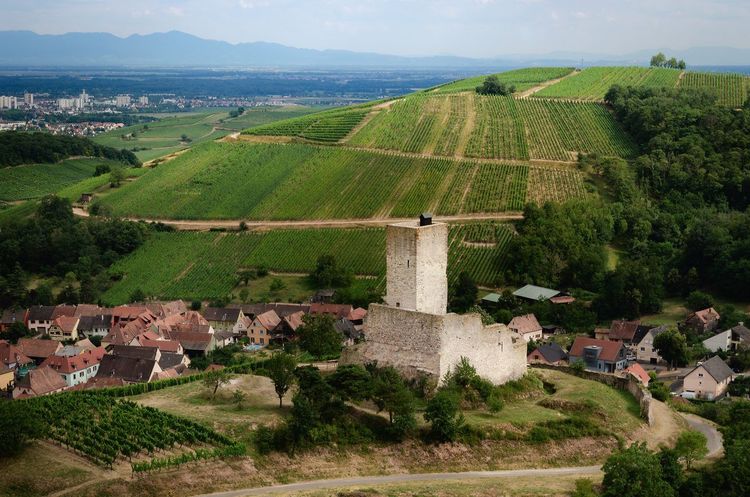
Katzenthal (68230 Katzenthal, rated 4.4/5 on Google with 980 reviews) (8 km west of Colmar, in the Fecht valley) is probably the least well-known of the ten villages presented here. It is also one of the most interesting for serious wine lovers: the village is surrounded by the grand cru Wineck-Schlossberg, a south-facing granite terroir at 300–400 meters altitude that produces rieslings of remarkable minerality and longevity.
The castle of Wineck (12th century), in ruins on the wooded hill overlooking the village, can be reached on foot in 20 minutes from the center. The view from the ruins extends over the Alsatian plain and the Vosges. The village has barely 600 inhabitants and a handful of producers whose wines are found at specialist wine merchants in France and abroad. Its tranquility is a sharp contrast to the bustle of Riquewihr or Eguisheim in high season.
Sélestat, Humanist Library and Two Cathedrals within 500 Meters
Sélestat (Place du Marché Vert, 67600 Sélestat, rated 4.4/5 on Google with 3.2K reviews) (22 km north of Colmar) is not a village but a town of 22,000 inhabitants, too close and too rich to be left out of this itinerary. Its medieval center, bounded by partially preserved 15th-century ramparts, brings together two major monuments within a 500-meter perimeter.
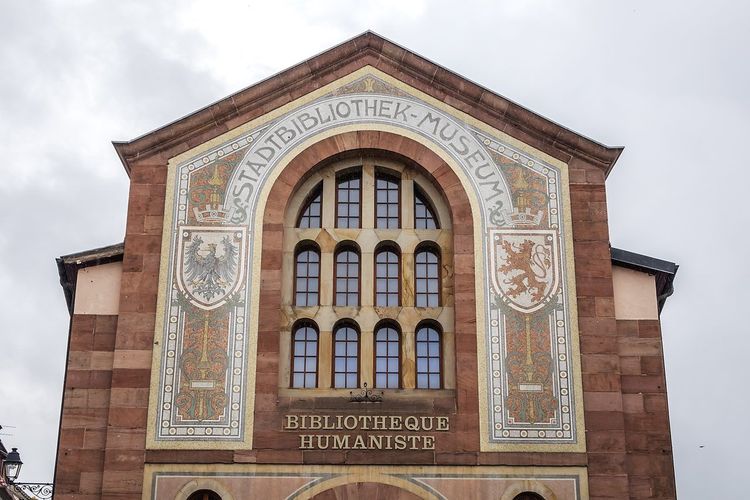
The Humanist Library of Sélestat has been inscribed on UNESCO's "Memory of the World" register since 2011. It holds one of the oldest public collections in France, founded in the 15th century by Beatus Rhenanus, with incunabula and rare manuscripts — including the first document to mention the name "America" (the Cosmographiae Introductio of 1507). Admission is €7.50 and the visit takes around an hour.
The Basilique Sainte-Foy (12th century) and the Église Saint-Georges (13th–15th centuries) face each other a few hundred meters apart. The interior of Saint-Georges, with its 19th-century stained glass windows and cathedral-like dimensions, impresses even visitors with little interest in sacred art. Both buildings are freely accessible.
Sélestat is also the most convenient starting point for the Château du Haut-Koenigsbourg (10 km to the west, access via the D159), the most visited castle in Alsace with over 600,000 visitors per year. A visit to the castle (adult admission: €12) and Sélestat can easily be combined in the same day from Colmar.
Dambach-la-Ville, Surrounded by Ramparts and Vines
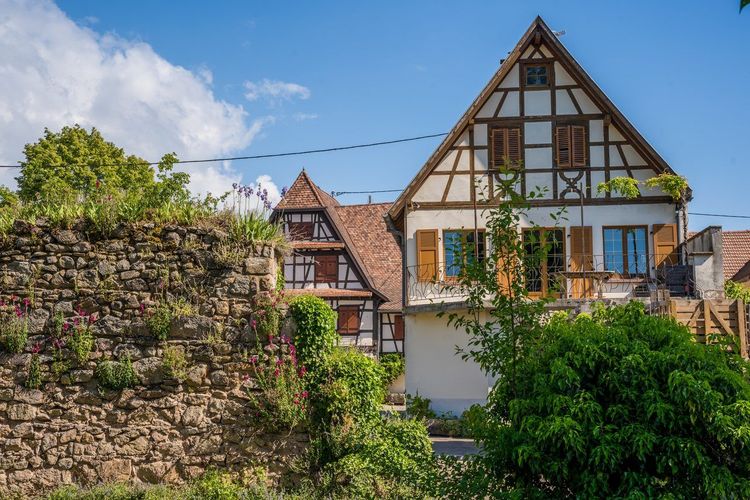
Dambach-la-Ville (67650 Dambach-la-Ville, rated 4.5/5 on Google with 2.0K reviews) (28 km north of Colmar) closes this selection with a unique characteristic: it is the largest wine-growing commune on the Alsace Wine Route by planted area, with nearly 900 hectares of vines. The village is almost entirely encircled by this vineyard, giving it a different atmosphere from the previous villages.
The medieval ramparts (14th century) are largely preserved, with three fortified gates and several round towers still standing. Inside, half-timbered houses from the 16th and 17th centuries line quiet, little-frequented streets. The Chapelle Saint-Sébastien (17th century), outside the ramparts, is decorated with Baroque choir stalls and a 17th-century carved wooden baldachin whose richness comes as a surprise in a village of this size.
The grand cru Frankstein of Dambach is a granite terroir particularly well suited to riesling and gewurztraminer. Several producers in the village open their cellars directly to the public, a convenient way to leave with a few bottles without going through an intermediary wine merchant.
How to Organize Your Visit to the Surroundings of Colmar
Two approaches are open to you depending on the length of your stay.
In one day from Colmar, choose one axis rather than trying to see everything: either the southern Wine Route (Eguisheim, Turckheim, Katzenthal), or the northern Wine Route (Riquewihr, Ribeauvillé, Bergheim, Hunawihr). One day is not enough to cover all ten villages seriously — it is better to visit three or four in depth than to skim through ten by car.
Over two days, organize the first day along the southern axis (Eguisheim, Turckheim, Kaysersberg, Katzenthal) and the second along the northern axis (Riquewihr, Ribeauvillé, Bergheim, Hunawihr, Sélestat). Dambach-la-Ville, the furthest away, can be fitted into an extra half-day or incorporated into a journey heading back toward Strasbourg.
For Colmar itself, the Ryo audio guide of Colmar offers 21 stops over 4.7 km on foot, an ideal complement for a morning or evening, before or after a day in the surrounding villages.
Practical Tips for Visiting These Alsatian Villages
By car: the Alsace Wine Route connects most of these villages via a waymarked departmental road (D35 and variants). Distances from Colmar are short (4 km for Turckheim to 28 km for Dambach) but car parks fill up in July and August, particularly at Riquewihr and Eguisheim. Arrive before 9 a.m. or after 5 p.m.
By bike: the Colmar–Turckheim cycle path is usable year-round. The Route Verte follows the vineyard toward Ribeauvillé and Riquewihr. The terrain is nearly flat on the plain; only Kaysersberg involves a climb when approached from the valley.
By train: Sélestat and Dambach-la-Ville are served by the TER Strasbourg–Basel line from Colmar (under 20 minutes). For the other villages, a car or electric bike remain the most practical options. Seasonal tourist shuttles serve certain villages along the Wine Route in July and August — check with the Colmar Tourist Office for details.
Best time to visit: from May to October for the greenery and cellar tastings. Alsace in December turns every village into a Christmas market setting, but crowds are intense on weekends. For gastronomy and local specialties to try in the villages' winstubs, our article on culinary specialties to taste in Colmar offers some good leads.



FAQ
Which is the most beautiful village to visit around Colmar?
Eguisheim consistently comes out on top: listed among the "Most Beautiful Villages in France" and voted "favorite village of the French" in 2013, it offers a unique medieval snail-shaped layout and a concentration of half-timbered houses in excellent condition. Kaysersberg and Riquewihr come close behind, with respectively a 13th-century imperial castle and a main street unchanged since the 16th century. The choice also depends on interests: for medieval history, Bergheim and Ribeauvillé; for serious wines, Riquewihr, Dambach-la-Ville and Katzenthal.
How much time should I allow to visit the villages around Colmar?
Allow at least a full day to properly cover three or four of them, including meal breaks and a few wine tastings. To cover all ten villages in this selection, a two-day weekend with Colmar as a base is the most efficient approach. Some villages can be explored on foot in 1.5 hours (Eguisheim, Katzenthal); others require half a day to be truly appreciated (Sélestat, Kaysersberg, Ribeauvillé).
What is the best season to visit the Alsatian villages?
May and June offer the best conditions: few visitors, lush vineyard landscapes, and geraniums beginning to decorate the facades. July and August are visually stunning but very busy, especially in Riquewihr and Eguisheim. Autumn (September–October) brings the colors of the vines and the harvest in the plots, an ideal period for wine lovers. December is unique with the Christmas markets, but the villages are packed on weekends.
How can I get around between villages without a car?
The region is cyclable on many stretches, particularly between Colmar, Turckheim and the northern Wine Route (Riquewihr, Ribeauvillé). Seasonal tourist shuttles serve certain villages departing from Colmar in July and August. Sélestat and Dambach-la-Ville are accessible by direct train from Colmar in under 20 minutes (TER Strasbourg–Basel line). For other villages, renting an electric bike from Colmar remains the most flexible option.
Are there any less touristy villages around Colmar?
Katzenthal, Bergheim and Hunawihr are noticeably less crowded than the big stars of the Wine Route. Katzenthal attracts almost exclusively wine enthusiasts on weekdays, and its streets are often deserted outside the harvest season. Bergheim is mainly frequented by locals who know its medieval ramparts. These three villages are perfect for a visit alongside the must-sees, to find a little calm after Eguisheim or Riquewihr.
Before heading out to the villages, many visitors spend a morning in Colmar. The Colmar audio-guided tour offered by Ryo covers the Petite Venise, the Place de l'Ancienne Douane and the tanners' quarter across 23 audio stops over 2.7 km, an excellent overview of the city before setting off to explore its surroundings.
À lire également