© Shutterstock
 Votre guide Ryo
Gardens and Parks in Montpellier: The Best Spots to Unwind in 2026
Typing 'Montpellier park' in a search engine often means looking for a place to truly unwind: the city ranks among the densest in green spaces per inhabitant, but the essential lies elsewhere, in gardens that each have a real personality. The Peyrou is a monumental terrace about fifty meters above the city, the Botanical Garden boasts four centuries of history, and the Méric hides an animal park in the middle of a pine forest. To explore the city between two green breaks, the Ryo audio guide tour Say Hello to the Gifted One connects the historic districts in 1h30. From the botanical garden founded in 1593 to the Grammont domain where all of Montpellier gathers for evening concerts, here are the green spaces truly worth visiting in 2026.
The Peyrou: The Royal Terrace Overlooking the City
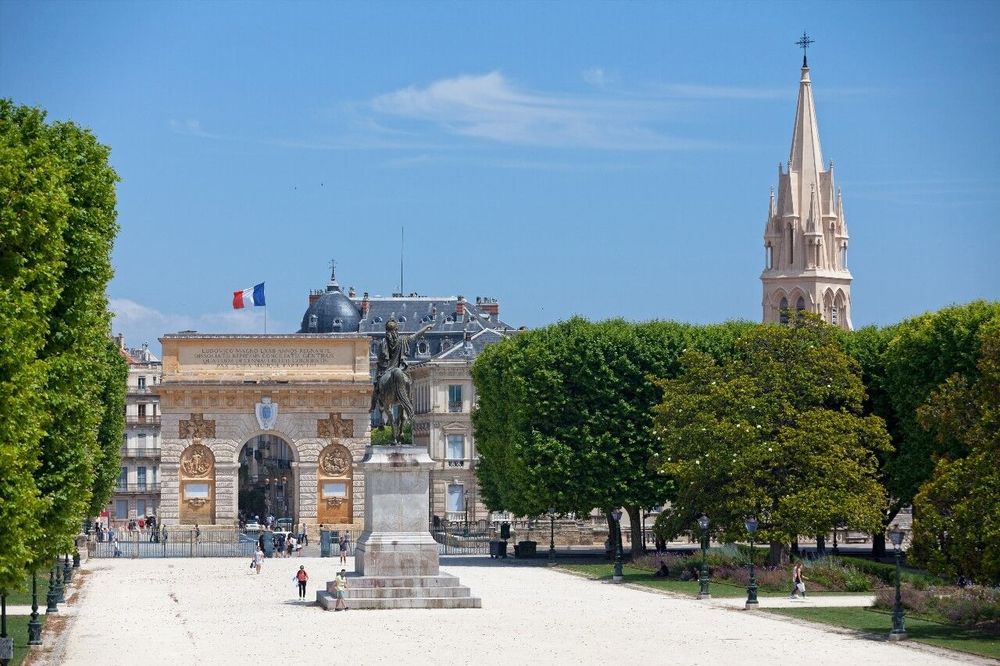
We go up to the Peyrou by reflex, because that's what everyone does, and for once, the consensus is right. This esplanade of nearly 290 meters long, developed from 1689 under Louis XIV, offers a clear view over the Cévennes, the Hérault plain and, on clear days, the sea. It's not just a viewpoint: it's a baroque architecture lesson in the open air, and one of the great parks of Montpellier that every visitor ends up crossing.
The Triumphal Arch, which marks the entrance to the promenade from the center, dates from 1691. The bas-reliefs tell of Louis XIV's victories. Take time to read them, most visitors pass underneath without looking up. In the center of the esplanade stands the equestrian statue of Louis XIV, erected in 1718. Behind the arch, the parterre opens onto two levels connected by a double ramp. At the highest point, the hexagonal water tower, adorned with Corinthian columns, marks the arrival of the Saint-Clément aqueduct visible below: a work of nearly 14 kilometers that has brought water from the Saint-Clément spring to the Peyrou since the 18th century, with a double row of arcades inspired by the Pont du Gard in the Arceaux district.
Montpellier residents come here early in the morning to walk or run, then at sunset for the light over the Cévennes. On weekdays, the benches remain accessible and the crowd is reasonable. On summer weekends, the Sunday morning market invades the bottom of the esplanade until 1 PM, plan to arrive before 9 AM or after 2 PM to enjoy the calm.
Access is entirely free, all year round, without fixed hours. The gardens that run along the Peyrou on the south side offer some shade, rare in this essentially mineral space. Bring water in summer: the fountains are not always in service.
The Botanical Garden: France's Oldest Botanical Garden

Founded in 1593 by letters patent from Henri IV, thus before those of Paris and Leiden, Montpellier's Botanical Garden (163 Rue Auguste Broussonnet, 34090 Montpellier, rated 4.4/5 on Google for 7,828 reviews) is France's oldest botanical garden. This is not a museum: it's a living place, attached to the medical school, which has maintained active collections for more than four centuries. Some of the trees planted several centuries ago are still there.
The garden covers nearly 5 hectares and brings together medicinal plants, exotic trees and a succulent collection that spills out of the greenhouses on fine days. The ginkgo biloba planted in 1795, which became the symbol of the resurrected medical school, is one of the most photographed trees in this Montpellier park; on Richer mountain also remains a phillyrea four centuries old, among the site's elders.
Compared to the neighboring Peyrou, the Botanical Garden surprises with its more contemplative atmosphere. The paths are bordered by trimmed boxwood, the lawns forbidden to walk on invite you to stay on the paths, which paradoxically forces you to look at the plants rather than cross diagonally. Explanatory panels exist, but the collections deserve a guide: the medical school regularly offers guided tours.
Entrance free for the outdoor collections. The garden is open all year except Monday, with reduced hours in winter (refer to the medical school website for exact times). Access from the Peyrou is on foot in less than 5 minutes via rue Foch. To better situate the garden in its historical and architectural context, the Ryo audio guide Say Hello to the Gifted One passes in front of the medical school and recalls Montpellier's founding role in European medicine.
Montcalm Park: Green Lung of the Écusson
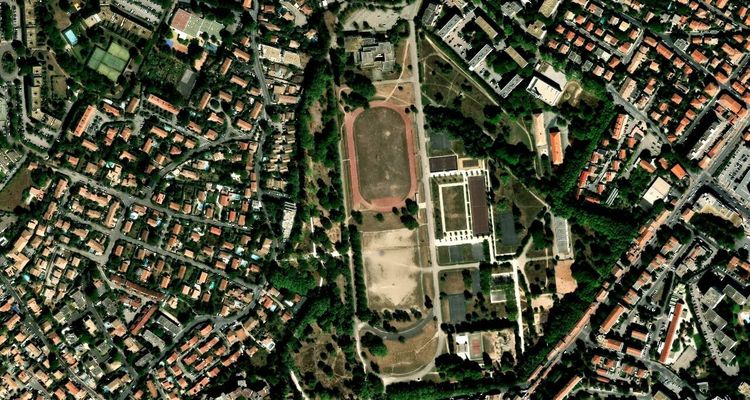
Located on the edge of the historic Écusson district, Montcalm Park (Place Auguste Gibert, 34000 Montpellier, rated 4.3/5 on Google for 2,942 reviews) is Montpellier's most central green space. About 4 hectares surrounded by buildings, with century-old trees that filter light in summer and a lawn large enough to lie down without touching your neighbor. It's the park for students, neighborhood families and remote workers who need a change of air between two calls.
The park owes its name to the Marquis de Montcalm, born in Candiac (Gard) and died at the Battle of the Plains of Abraham in 1759 while defending Quebec. A commemorative plaque recalls this link between Languedoc and Canada, little known, yet real. The park itself has nothing military about it: playgrounds for the youngest, benches scattered under the plane trees, a kiosk that hosts seasonal events.
Access is free and open. Fountains and water points are installed on the perimeter. The park is open from sunrise to sunset with gates that allow fluid circulation from several streets in the district. Useful feature: the Laissac market is held right next door, almost every morning. You can buy cheese and fruit, cross the street and picnic in the park without intermediary.
Unlike the Peyrou which attracts tourists, this Montpellier park remains a local space above all. If you're staying in the historic center, it's the address to sit for an hour in the morning before the heat sets in, or in the evening after visiting the Écusson museums.
La Méric: The Animal Park Where Children Meet Animals
The Méric Domain (235 Chemin de la Méric, 34080 Montpellier, rated 4.6/5 on Google for 2,533 reviews) resembles no other green space in Montpellier. It's a former wine estate of about twenty hectares converted into a natural park by the city, with an animal component that's nothing like a traditional zoo: no cages, enclosures in full nature, animals in large spaces. Deer let themselves be observed at their own pace, sheep graze in the meadow, donkeys patiently wait for visitors.
The park also hosts peacocks, rabbits and an aviary with regional species. What distinguishes the Méric from most similar spaces is the vegetation: an ancient pine forest with umbrella pines and holm oaks, wetlands along the stream, and meadows that change color with the seasons. In May, broom blooms in the untended corners. In autumn, deciduous trees take on an ochre tint that contrasts with the permanent green of the pines.
Picnic tables are installed in several places, including a sheltered area useful in case of rain or intense heat. The main path is about 2.5 km long, accessible to strollers on the majority of the route, with some more irregular areas at the back of the domain.
Entrance free, open all year. The Méric is located in the north of the city, accessible by bus from the center (TAM lines, allow about 20 minutes from Place de la Comédie). For families with children who like animals, it's probably the best quality-distance ratio among Montpellier parks: less known than Lunaret zoo but much more accessible.
Grammont Domain: Sports, Nature and Concerts by the Lez
On the right bank of the Lez, about ten minutes from the city center, the Grammont Domain (523 Avenue de la Méjeanelle, 34000 Montpellier, rated 4.5/5 on Google for 619 reviews) plays several roles simultaneously. Vast natural park of Montpellier during the day, open-air stage in the evening, this is where great summer musical nights are held, in front of a stage planted among the pines.
The domain's natural part includes marked trails through the garrigue, protected wetlands along the Lez and direct access to the river banks. The marking is sufficient not to get lost but doesn't replace a map if you wish to explore the domain's edges. Cyclists use the green way that runs along the Lez from the center, Grammont being a natural stop on this route that runs to Palavas.
The sports complex integrated into the domain (stadium, gyms, courts) is reserved for members and associations, but doesn't interfere with the walking area. Picnic areas are equipped with tables (barbecues are subject to summer fire regulations, check prefectural restrictions in July-August).
Park entrance is free. Musical events are paid and often sell out several weeks in advance. Apart from concerts, Grammont attracts morning joggers, weekend families and groups looking for a space large enough to organize a collective outing. If you're enjoying a weekend in Montpellier, the activities in Montpellier and surroundings guide lists other addresses beyond parks.
Guisane Park: Haven of Peace in Figuerolles District
Less publicized than the Peyrou, Guisane Park (Rue de la Guisane, 34000 Montpellier, rated 4.1/5 on Google for 420 reviews) is a discovery reserved for those who venture into the Figuerolles district, one of Montpellier's liveliest with its night grocery stores and world cuisine restaurants. The park itself is a 3-hectare space laid out around a hill that offers a surprising viewpoint over the district's rooftops.
The vegetation is mixed: palm trees and pines coexist with rarer Mediterranean species, planted during a renewal program in the 2010s. Grass areas allow for spontaneous picnics. A fountain and water jets serve as thermal regulation in summer, young children rush to them as soon as temperatures exceed 30°C.
The park is open continuously, with partial night lighting. Accessible on foot from Place de la Comédie in less than 15 minutes, or by tram (line 1, Saint-Roch station stop, then 5 minutes on foot). The Figuerolles district would deserve an article of its own for its colorful storefronts and world cuisine aromas, and this Montpellier park is its freshest gateway.
Lez Banks: Green Walk Along the Water
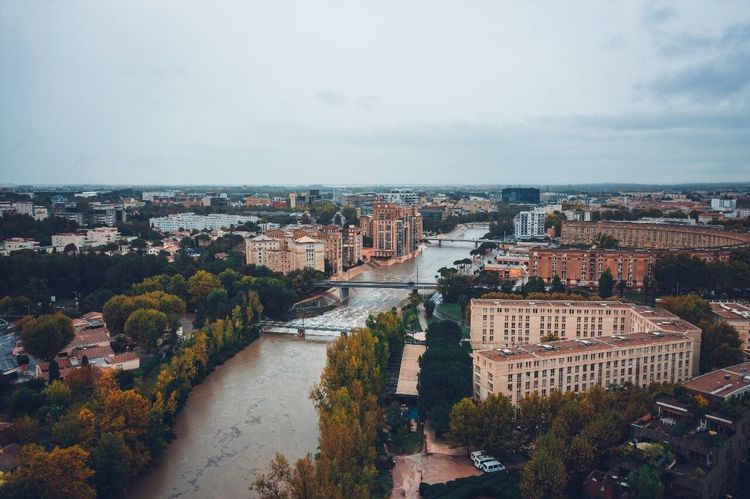
The Lez Banks development project (Berges du Lez, 34000 Montpellier, rated 4.4/5 on Google for 138 reviews) transformed a long inaccessible bank into a linear promenade of several kilometers, between the Antigone district to the south and the northern residential areas. It's not a park in the strict sense, no enclosure, no entrance, but a continuous green corridor that crosses the city from end to end.
Along the route: grass areas to sit, playgrounds for children, free-access sports equipment (bars, rings, workout benches) and several equipped picnic areas. The plane trees planted on the banks create a green tunnel effect particularly appreciated in mid-summer. The bike path that runs along the Lez to Palavas-les-Flots is used by hundreds of bikes every weekend.
The area around Trinquat Bridge, accessible from Antigone, is one of the spots most frequented by young Montpellier residents on summer evenings: people gather there with feet in the water or on the developed banks. It's an informal, lively and cosmopolitan space. If you wish to extend your escapade towards the Hérault, the hikes in the Hérault often start from Montpellier. The walk back towards the Écusson pairs nicely with our Montpellier audio walking tour.
Squares and Small Gardens in the Center: Breathing Between Two Alleys
Montpellier's medieval heart, the Écusson, doesn't leave much room for vegetation. But the city has slipped some green breathing spaces into the stone's cracks: pocket squares, shaded courtyards, small squares with one or two trees and a bench.
The Place de la Canourgue is the best known: a terrace bordered by plane trees, with a central fountain and a view over the gardens below. It's the meeting point for locals in the evening, particularly lively between 6 PM and 9 PM in summer. Not far away, Place Jean-Jaurès offers some trees and café terraces that spill onto the square.
The more discreet Square Planchon is located near Saint-Roch station. A few benches, remarkable trees, relative calm in the heart of a very busy district. This type of space is to Montpellier what the Palais-Royal is to Paris: a parenthesis you only find if you look for it. To discover these less visible corners during a structured walk, our Montpellier audio walking tour Say Hello to the Gifted One passes through the Écusson and precisely points out these breathing spaces in the historic center.
When to Visit Montpellier's Parks
Spring (April-May) is the best season: temperatures remain cool in the morning, gardens are in bloom, and parks like the Méric or Grammont are not yet saturated by summer crowds. In July-August, prefer visits before 9 AM or after 7 PM, Montpellier's heat is dry but intense, and lawns brown quickly. Autumn offers a renewal of freshness and interesting colors in wooded parks like Grammont. In winter, the Botanical Garden and Peyrou remain open and almost deserted.
Parks with Playgrounds for Children in Montpellier

Montpellier's best-equipped parks for children are the Méric (animal enclosures, natural spaces), Grammont Domain (large meadow areas), the Lez Banks (playgrounds installed at regular intervals) and Montcalm Park (classic playground, central, suitable for ages 3-10). The Guisane has water jets particularly appreciated in summer. For activities beyond parks, the what to do around Montpellier guide suggests nature outings within an hour.
Parks Open on Sunday and Practical Access
All parks mentioned in this guide are accessible on Sunday. Most are free with no fixed hours (Peyrou, Grammont, Lez Banks). The Botanical Garden is closed on Monday, open other days. Hours vary in winter: expect earlier closing in December-January. In terms of transport, Montpellier has a dense tram network (4 lines) and TAM buses. From Place de la Comédie, the Peyrou and Botanical Garden are accessible on foot in 10 minutes; the Méric and Grammont require 20-25 minutes by transport.
FAQ
What is the largest park in Montpellier?
The Grammont Domain is the city's largest green space, with a vast expanse of garrigue, pine forest and wetlands along the Lez. For a closer and equally natural park, the Méric Domain covers about twenty hectares with an integrated animal park.
Are there free parks in Montpellier?
Yes, almost all of Montpellier's public green spaces are free and open access: the Peyrou, the Botanical Garden (outdoor collections), Montcalm Park, the Méric, Grammont, the Guisane and the Lez Banks require no entrance ticket.
Can you picnic in Montpellier's parks?
Yes. The Méric, Grammont and the Lez Banks have equipped picnic tables. The Peyrou and Montcalm Park also allow you to settle on the grassy areas. In summer, barbecues are subject to prefectural restrictions in wooded areas, check before lighting anything in Grammont or the Méric.
Which parks are accessible by public transport from the center?
The Peyrou and the Botanical Garden are accessible on foot in less than 10 minutes from Place de la Comédie. Montcalm Park is 15 minutes on foot. For the Méric (TAM bus) and Grammont (tram + bus), allow 20-25 minutes. The TAM network covers the entire city with decent frequencies during the day.
Which Montpellier park do you recommend for children?
For children, the Méric is the most original choice: deer, sheep and peacocks roaming free in a large pine forest, without the constraints of a zoo. The Lez Banks also offer multiple playgrounds accessible without special transport from the center. The Guisane has water jets very appreciated on summer afternoons.
Conclusion
Montpellier is not a city you cross looking at its monuments from the street. It's also experienced in the hollow of its gardens, on the Peyrou benches, under Montcalm Park's plane trees or along the Lez banks. These green spaces are free, open almost permanently and varied enough to suit all moods: the solemnity of the Botanical Garden, the animation of the Méric on a Sunday morning, the wild vastness of Grammont at sunset.
To continue exploring the city after your green break, Ryo offers the audio-guided tour Say Hello to the Gifted One, 21 listening points, 3.5 km, 1h30 in the Écusson alleys and beyond.
À lire également