© Shutterstock
 Votre guide Ryo
What to Do around Montpellier: 12 Getaway Ideas for 2026
Step outside Montpellier and you step into another era. Less than an hour from the city, the Hérault gorges carve sheer limestone cliffs, medieval villages emerge between scrubland and vineyards, and the lagoons of the Languedoc coastline shimmer with an almost unreal brilliance at sunset. What you are looking for around Montpellier is precisely this ability the region has to whisk you away without taking you far. Before setting out to explore the surroundings with the Ryo audio guide to Montpellier, here are twelve destinations well worth the trip.
This guide takes you from the most picturesque village in the Hérault, listed among the most beautiful villages in France, to the flamingos of the Mediterranean lagoons. You will find a remarkably well-preserved 13th-century fortified city, a lake set amid unique volcanic red soils, a cathedral perched on a peninsula between the sea and the lagoons, and a network of limestone caves you can explore on foot. Perfect for a weekend, or for planning your next day trips out of the city.
Saint-Guilhem-le-Désert, the Village Outside of Time
Saint-Guilhem-le-Désert ranks among the most visited villages in the Hérault, and for good reason: nestled at the bottom of a limestone gorge carved over the centuries by the Verdus river, the medieval village has preserved a remarkable architectural coherence. Its lanes paved with river stones, its houses with faded shutters and its thousand-year-old abbey form an ensemble that feels lifted straight from a historical novel.
The Abbaye de Gellone (Place de la Liberté, 34150 Saint-Guilhem-le-Désert, rated 4.6/5 on Google based on 1,974 reviews), founded in 804 by Guillaume de Gellone, former Count of Toulouse and close associate of Charlemagne — a figure who later inspired the character of Guillaume d'Orange in the chansons de geste — preserves a fragment of the True Cross that made it one of the most important stops on the Santiago de Compostela pilgrimage route throughout the Middle Ages. The partially reconstructed cloister opens onto a square shaded by plane trees where you can catch your breath after the walk up from the car park. Allow around two hours for the village alone, more if you continue on the hike through the Verdus gorges that begins just behind the abbey. The abbey is today listed as a UNESCO World Heritage Site as part of the Routes of Santiago de Compostela.
Come on a weekday if you can. On weekends in July and August, the permanent residents find themselves swamped by several thousand visitors, and the lanes lose much of their charm. Outside the peak summer holidays, Saint-Guilhem reverts to its sleepy village feel and gives you the time to take in the details: a Romanesque window here, a rounded arch there, a Latin inscription on a door lintel. To make the most of the outing, combine your visit with the Grotte de Clamouse, just two kilometres away.
The Grotte de Clamouse, an Underground World
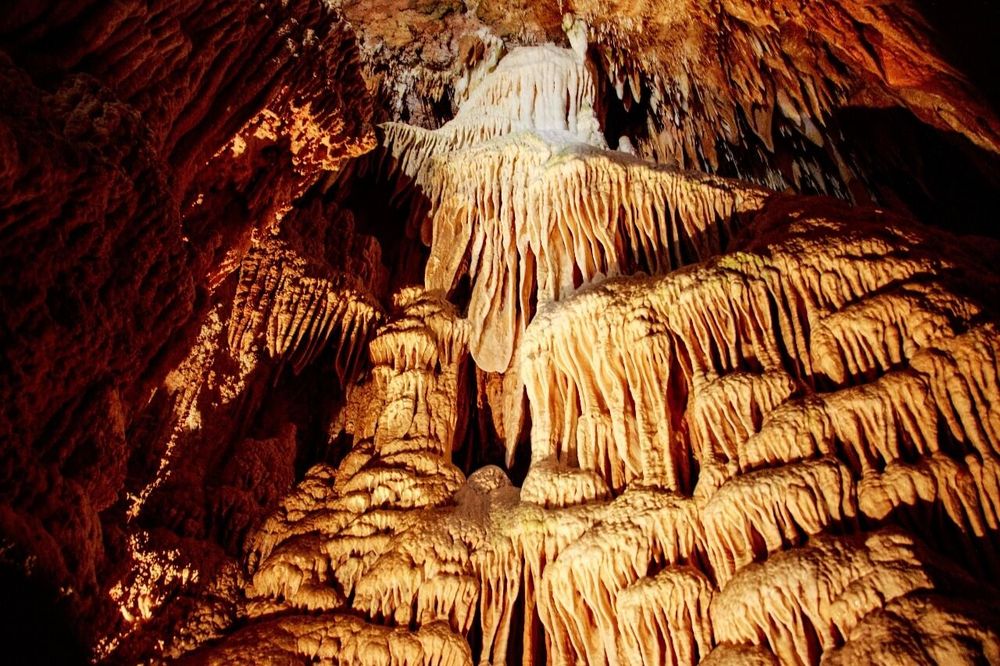
Right at the entrance to the Hérault gorges, the Grotte de Clamouse (Route des Gorges de l'Hérault, 34150 Saint-Jean-de-Fos, rated 4.7/5 on Google based on 7,457 reviews) opens into the limestone cliff like a mineral interlude. This network of galleries stretches over several hundred metres and houses an impressive collection of formations: translucent stalactites, aragonite crystals resembling frost flowers, and columns that took millennia to form.
The guided tour lasts around one hour. The cave maintains a constant temperature of around 17°C, making it a particularly pleasant escape in summer when Montpellier is pushing 36°C. Bring a light layer even in August. Tickets can be booked online, which helps avoid queues at peak times. For a full day out, do Clamouse in the morning and Saint-Guilhem in the afternoon — the two sites are five minutes apart by road.
The Pic Saint-Loup, Hiking above the Scrubland
You can spot it from the rooftops of Montpellier on a clear day. The Pic Saint-Loup rises to 658 metres and commands a landscape of scrubland, vineyards and hilltop villages stretching all the way to the sea in clear weather. It is the go-to hike for residents of the greater city — the one you do once a year to "get your legs back" and then repeat every autumn when the colours turn.
The most popular trail starts from the village of Saint-Mathieu-de-Tréviers: allow around three hours there and back for an elevation gain of roughly 400 metres. The final climb through woodland opens onto a limestone ridge offering a 360° panorama reaching as far as Mont Ventoux, the Cévennes and the Mediterranean on clear days. In a northerly wind, the summit can be cool even in midsummer — bring a jacket. For hikers already familiar with the Pic, our guide to the finest hikes in the Hérault covers other routes across the département, including the Séranne traverse and the Vis gorges.
Beyond hiking, the Pic Saint-Loup wine appellation produces well-regarded wines available for tasting at several estates. If you are passing through on a Saturday, the village of Corconne (Village de Corconne, 30260 Corconne) hosts a local market under the plane trees that is well worth a detour.
Aigues-Mortes, the Medieval City at the Edge of the Lagoons
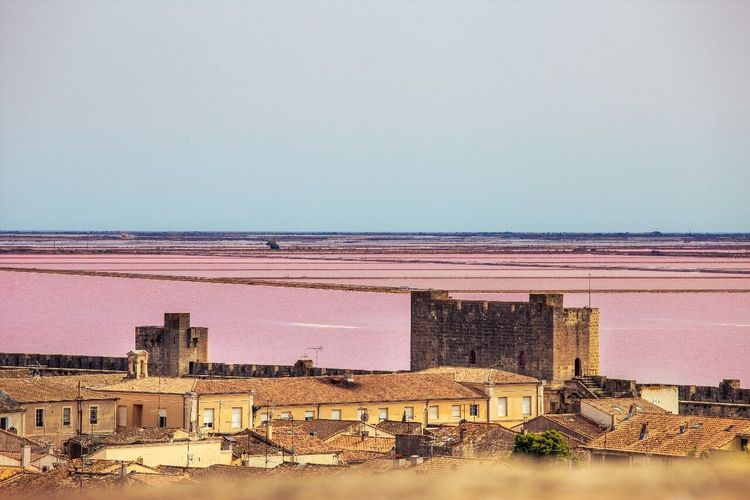
The road from Montpellier to Aigues-Mortes skirts the lagoons of the Gardoise Camargue for the final few kilometres, and the silhouette of the ramparts rising flat from the flood plain is quite a striking sight. The fortified city built by Saint Louis in the 13th century has barely changed since: six towers, ten gates and one and a half kilometres of ramparts enclose a historic centre laid out on a grid that you can explore in a morning.
The Tour de Constance (Boulevard Denfert-Rochereau, 30220 Aigues-Mortes, rated 4.6/5 on Google based on 3,602 reviews), some thirty metres tall and twenty-two metres wide, long served as a prison for Protestant women from the Cévennes following the revocation of the Edict of Nantes — a dark chapter of local history that the permanent exhibition recounts with care. From the top, you take in the full sweep of the ramparts and, beyond them, the Camargue salt pans tinted pink by the microscopic algae that give them their characteristic hue.
In autumn and spring, the neighbouring lagoons host hundreds of flamingos — a surprise for those unfamiliar with the local wildlife. Aigues-Mortes also rewards an evening visit: once the tourist coaches have departed, the little squares reclaim their old Languedoc town atmosphere, with pavement cafés and spice merchants. The drive from Montpellier takes around 45 minutes.
Sète, the City That Smells of Salt and Tielle
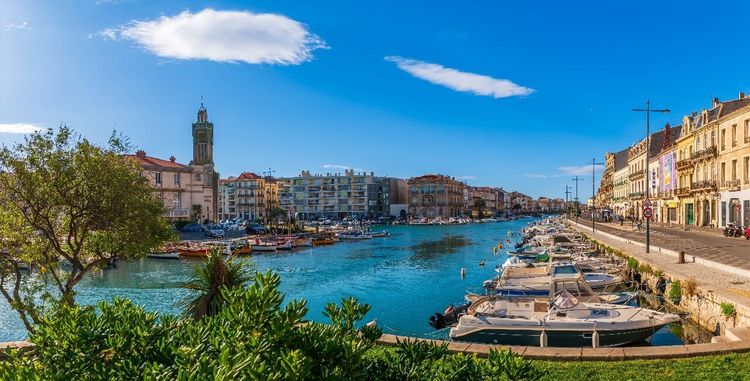
Sète is not really a one-hour day trip — it is a city in its own right, with its own codes, traditions and residents who do not consider themselves Languedocians but "Sétois", an important distinction. Perched on a rocky headland between the Thau lagoon and the Mediterranean, the city once lived by its fishing port, whose activity has declined but whose memory remains vivid in the lower quarters.
Take your time strolling along the quays of the Canal de Sète, lined with colourful buildings and pastel-shuttered facades. Stop at the Cimetière Marin, the one Valéry made famous — the view out to sea from among the white tombs is one of the most unusual panoramas in the region. For those interested in maritime heritage, the Musée de la Mer traces the centuries of trade and fishing that shaped the city.
On the food front, the tielle sétoise, a flaky pastry pie filled with octopus in a spiced tomato sauce, is the speciality you will find nowhere else. It is sold by a handful of artisan producers in the city centre. For fresh fish, the stalls at the Criée market supply several port restaurants serving Thau mussels and seafood platters of a freshness that is hard to match inland. For summer evenings by the water, our article on the best beach bars in the area will give you a few more addresses in this part of the coast.
The Lac du Salagou, Volcanic Red Soils
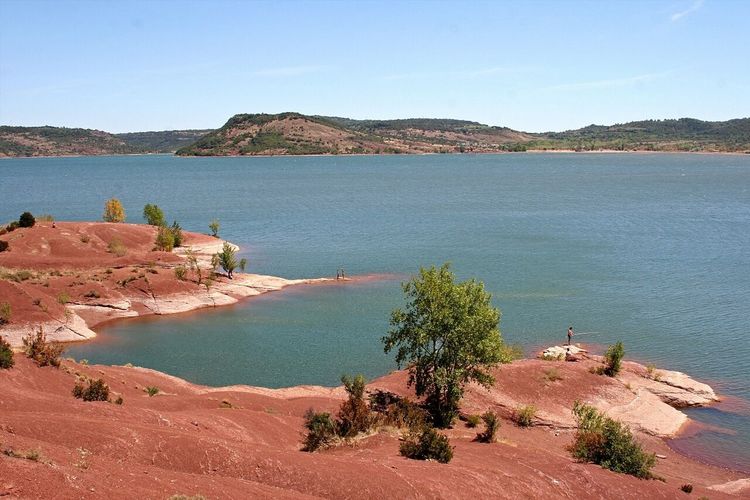
The first encounter with the Lac du Salagou (Lac du Salagou, 34800 Clermont-l'Hérault, rated 4.7/5 on Google based on 3,786 reviews) always comes as a surprise: as you approach the site, the landscape turns brick-red — a colour caused by the "ruffes", sedimentary rocks some 250 million years old that stain the banks and surrounding hills. This artificial lake, created in 1969 by a dam on the Salagou, covers around 750 hectares and offers a striking contrast between the blue water and the crimson earth.
In summer, the site is very popular: swimming, kayaking, windsurfing and pedal boats draw families from across the region. Out of season, it is one of the quietest and most visually impressive corners of the département, ideal for a hike around the lake (around 17 kilometres for the full circuit) or a photography session at sunrise when morning mist erases the distant hills. The village of Celles, which was due to be submerged when the dam was filled but was ultimately spared by the final water level, remained a near-ghost hamlet for decades; today you wander among buildings frozen in time, in an atmosphere quite unlike anywhere else.
The Cathédrale de Maguelone, between Sea and Lagoons
Few places in the area are as unexpected as the Cathédrale de Maguelone (Cathédrale de Maguelone, 34750 Villeneuve-lès-Maguelone, rated 4.5/5 on Google based on 3,446 reviews). Built in the 11th and 12th centuries on a peninsula between the Étang de Pierre Blanche and the Mediterranean, it is accessible only on foot or by bike from the Palavas-les-Flots car park — no vehicles can approach.
The two-kilometre path runs alongside the lagoon, then crosses a landscape of dunes and stone pines before opening onto the Romanesque façade of the building. The cathedral, once the seat of a powerful bishopric before its fortifications were dismantled on Richelieu's orders in the 17th century, now hosts concerts and exhibitions in a setting that blends the centuries with effortless grace. Allow at least half a day, and combine it with a cycle ride along the coast — our article on cycling routes around Montpellier details the cycle paths along this stretch of coast. And before you take to the road again, the city itself loops round in 1h30 of audio-guided walking.
Sauve and the Unusual Villages of the Scrubland
The village of Sauve, in the Gard, is the least well-known on this list and perhaps the most charming. Perched on a rocky spur above the Vidourle, it unfolds a labyrinth of medieval lanes, vaulted passageways and intimate little squares that you discover on an aimless wander.
Sauve is renowned for the micocoulier fork: a craft unique in Europe, the making of multi-tined forks from the naturally forked branches of the hackberry tree, a Mediterranean species abundant in the scrublands of the Gard. The last artisans keep this tradition alive, which the Conservatoire de la Fourche documents. Nearby, the villages of Quissac, Durfort and Saint-Hippolyte-du-Fort form a triangle of authentic small towns that summer crowds have not yet fully discovered.
The Méjean Nature Reserve, Flamingos within Binocular Range
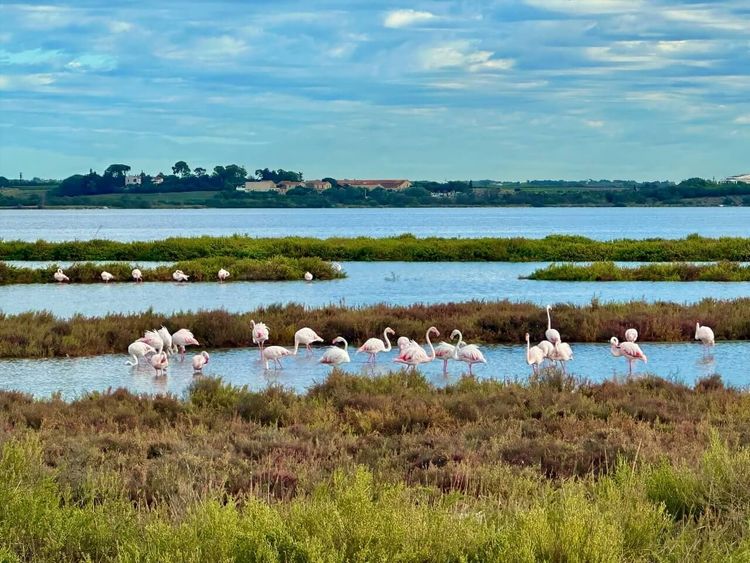
Less than ten kilometres from Montpellier, in the communes of Lattes and Pérols, the Méjean lagoon nature reserve (Étang de Méjean, 34130 Mauguio, rated 4.7/5 on Google based on 84 reviews) is the quickest getaway in this guide. This coastal lagoon, designated a Natura 2000 site, hosts one of the largest gatherings of flamingos in the area, along with a wide variety of ducks, herons and terns depending on the season.
Two marked discovery trails run along the banks and allow you to watch the birds from discreet hides. Entry is free, starting from the Maison de la Nature. Come early in the morning or late in the afternoon if possible: the flamingos feed actively at those times and let you observe them at close range. Bring binoculars and closed-toe shoes, as the paths can be muddy in winter.
The Pont du Diable and the Hérault Gorges
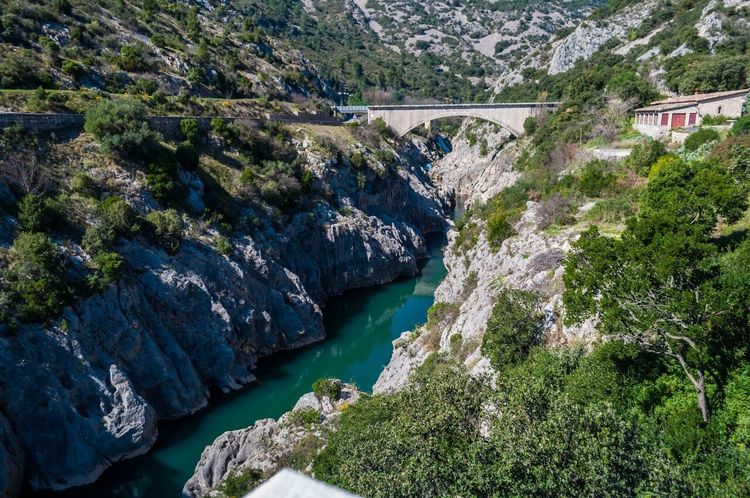
The Hérault gorges (Gorges de l'Hérault, 34150 Aniane, rated 4.8/5 on Google based on 290 reviews) are one of the finest waterside walks in the Hérault. Between Aniane and Saint-Guilhem-le-Désert, the river has carved a canyon with limestone walls tens of metres high that you can follow on foot.
The Pont du Diable, a medieval Romanesque structure (11th century) listed as a UNESCO World Heritage Site as part of the Routes of Santiago de Compostela, spans the river at the entrance to the gorges and offers a breathtaking view of the green water below. Built by the neighbouring abbeys of Aniane and Gellone to secure the crossing for pilgrims, it is one of the oldest Romanesque bridges in France. In summer, the rocks downstream from the bridge are packed with swimmers and cliff jumpers (note that some jumps are prohibited and signposted). Our article on visiting the Pont du Diable in the Hérault details access routes, car parks and safety advice for swimming in the gorge. For a more structured outing, local operators offer canoe or canyoning descents from Aniane.
Practical Tips: Planning Your Getaways in the Area
The vast majority of the sites mentioned in this guide can be reached in under an hour from the centre of Montpellier. A few useful pointers:
By car, this is the most flexible option. Most sites have car parks (paid in summer at Saint-Guilhem and Aigues-Mortes). Avoid the weekends between 14 July and 15 August on the Hérault gorges and at Saint-Guilhem — the access road turns into a traffic jam.
By train, Sète is accessible from Montpellier Saint-Roch in 20 minutes, with several trains per hour. Aigues-Mortes has a station with connections from Nîmes (40 min). For the gorges and Saint-Guilhem, no train serves the villages — a vehicle is essential.
With children, the most suitable sites for young children are the Lac du Salagou (supervised swimming), the Grotte de Clamouse (suitable from around age 5–6) and the Méjean reserve (flat path). The Pic Saint-Loup is appropriate for children aged 8–10 and up, depending on their fitness level.
To discover Montpellier itself before or after your day trips, the Ryo audio tour Dites bonjour à la Surdouée covers the 19 major points of interest in the historic centre in 1h30, with stories that printed guidebooks never tell.
FAQ
What are the most beautiful villages around Montpellier?
Saint-Guilhem-le-Désert is the most famous, listed among the "Most Beautiful Villages of France". Sauve (Gard), Mourèze and Brissac rank among the other remarkable villages within an hour's drive. For a complete tour of the Hérault villages, our article on the must-sees of the Hérault lists around fifteen of them with distances from Montpellier.
What can you do around Montpellier this weekend?
For a short weekend, combine Saint-Guilhem-le-Désert and the Grotte de Clamouse on Saturday morning, then head to Sète in the afternoon for the quays and the tielle. On Sunday, head to the Lac du Salagou for a walk and a swim. Three contrasting sites, under 200 kilometres in total.
What can you do with children around Montpellier?
The Lac du Salagou (swimming, kayaking), the Grotte de Clamouse and the Méjean reserve (flamingos, easy path) are the best options with children. In summer, the beach bars and beaches along the Sète and Grande-Motte coastline make a great addition to the programme.
What unusual places are there to discover in the area?
The Cathédrale de Maguelone, accessible only on foot or by bike on a peninsula between the sea and the lagoons, is probably the most unexpected spot. The preserved hamlet of Celles on the shores of the Lac du Salagou and the hackberry-fork workshops in Sauve are two other curiosities that few visitors know about.
Can you visit the surrounding area without a car?
Sète is accessible by train in 20 minutes from Montpellier Saint-Roch. Aigues-Mortes can be reached from Nîmes by train. For the Hérault gorges, Saint-Guilhem and the Pic Saint-Loup, a car is still necessary, or you can join organised day trips departing from Montpellier.
Which excursion is best in winter?
Winter is the best season for Saint-Guilhem-le-Désert (no crowds, golden light on the stones), for hiking up the Pic Saint-Loup (open ridge, views of the Pyrenees on clear days) and for the Méjean lagoon (flamingos remain present all year round). Sète in winter has a special charm, with its markets and restaurants open for locals.
The Area around Montpellier, a Wealth within Easy Reach
From limestone scrubland to Mediterranean lagoons, from limestone caves to medieval ramparts, what lies close to the city is a diversity that is easy to underestimate from the centre. These twelve destinations cover every profile — hikers, families, heritage enthusiasts, nature lovers and foodies alike — and each can be visited in a day.
Before heading out to explore the region, take the time to discover Montpellier itself with the Ryo audio-guided tour of Montpellier: 21 audio tracks to understand why this city, nicknamed "la Surdouée", is well worth lingering in before you venture out into the surrounding area.
À lire également