© Shutterstock
 Votre guide Ryo
The Most Beautiful Bridges in Paris to Walk Across in 2026
What is the most beautiful bridge in Paris? There is no single answer: the capital has 37 bridges spanning the Seine within its city limits alone, yet most visitors cross two or three before moving on. This guide takes you to the nine structures that deserve a pause, a detour, or even a round trip to fully appreciate their silhouette. From the oldest bridge in the capital to the most recent steel acrobat, each one tells a precise story of an era and an architectural ambition. To place these structures in their urban context before setting out, start with the Ryo Paris audio guide: 18 audio stops, 8.9 km, a way of connecting the bridges to the neighbourhoods they link.
There is plenty to be surprised by: Pont Alexandre III features 18 candelabras standing 17 metres tall and more than 200 gilded sculpted elements, forged for the 1900 World's Fair. Pont de Bir-Hakeim served as a backdrop in Inception and Midnight in Paris, its double-level metal structure remaining one of the most photographed in Europe. Passerelle Simone-de-Beauvoir, inaugurated in 2006, is the only pedestrian footbridge in the capital with a biconvex lens shape, featuring a central span of 190 metres crossing the Seine without intermediate support. Nine bridges, nine characters — here is how to cross them in their best light.
Pont Alexandre III: the Gilded Excess of the Belle Époque
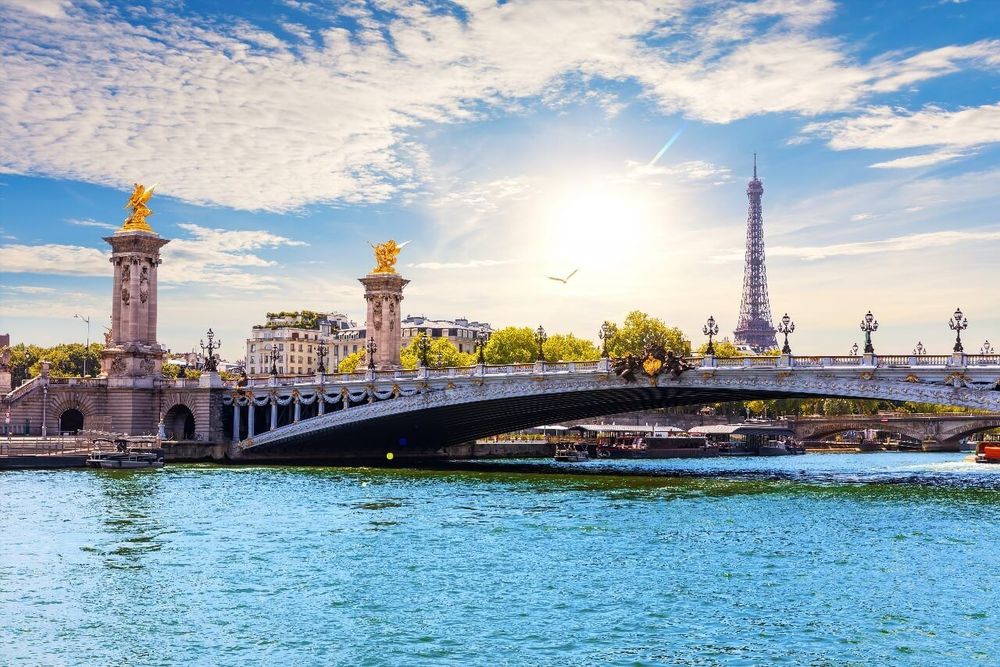
There is probably no other structure in Paris that concentrates so much goldsmithery on a single span. Pont Alexandre III was built between 1896 and 1900 for the World's Fair, as part of the Franco-Russian alliance of 1892: it bears the name of Tsar Alexander III, and the foundation stone was laid in October 1896 by Tsar Nicholas II and President Félix Faure. The official inauguration took place in 1900, alongside the neighbouring Grand Palais and Petit Palais.
The structure measures 160 metres long by 40 metres wide, a deliberately horizontal width so as not to obstruct the view of the Invalides from the Champs-Élysées. Its single steel span of 107 metres represented a considerable technical challenge: engineers Jean Résal and Amédée Alby had to keep the deck just 6 metres above the Seine.
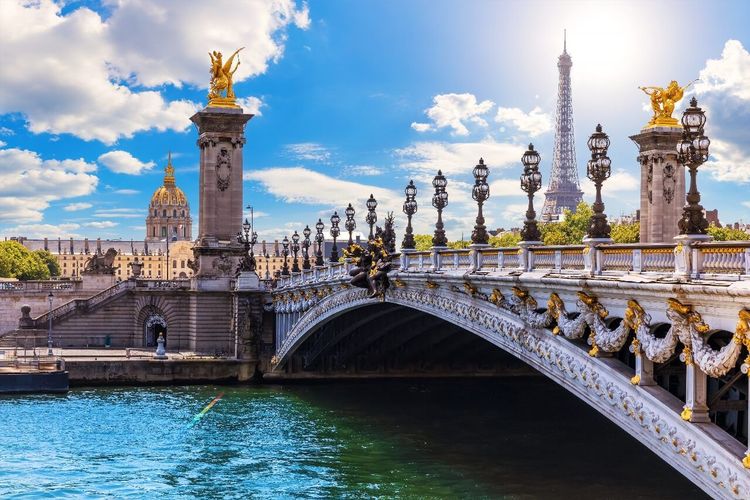
It is the ornamentation that places this structure in a category of its own. Four 17-metre pylons at the corners each support a gilded winged Fame. Along the parapets, 18 candelabras with multiple arms cast a warm light from dusk onwards. Among the allegories of the Seine and the Neva, the bronze sea nymphs and laurel garlands, one can count more than 200 sculpted elements; the gilding, restored in 1999 and partially again in 2014, recaptures its brilliance in raking light.
For photography: position yourself on the Quai d'Orsay on the Invalides side in the late afternoon to capture the pylons bathed in raking light with the gilded dome of the Invalides in the background. The bridge is fully illuminated at nightfall — arrive half an hour after sunset to have the blue sky and the gilding simultaneously.
Pont Neuf: the Oldest Has Kept the Best
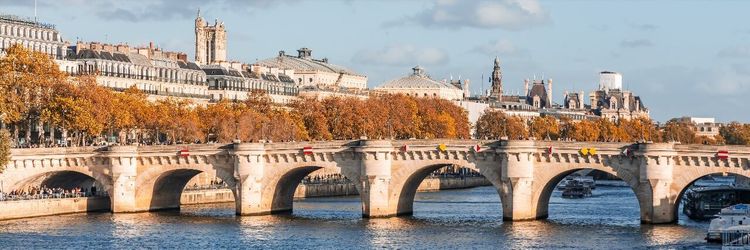
Its name is a paradox: Pont Neuf is the oldest bridge still standing in Paris. Begun under Henri III in 1578 and completed under Henri IV in 1607, it was the first Parisian bridge built without houses along its sides, an urban revolution that finally allowed people to look out over the Seine from the crossing.
The structure has 12 unequal arches distributed across two sections separated by the western tip of Île de la Cité, where Place Dauphine opens onto a triangular square planted with chestnut trees. The total length is approximately 232 metres with a width of 22 metres. The 381 mascarons carved on the corbels — grimacing or laughing faces, each different from all the others — form a fascinating catalogue of 17th-century baroque fancy.
At the centre of the bridge on the upstream side, the equestrian statue of Henri IV (inaugurated in 1818, a reconstruction of an original melted down during the Revolution) marks the exact point above the island's tip. It is one of the best vantage points over the Seine: looking downstream, Notre-Dame is in the axis; looking upstream, the panorama extends all the way to the Louvre. The Ryo audio guide From Mona Lisa to Notre-Dame passes through this very perspective and contextualises it in detail.
Practical tip: cross the bridge very early in the morning (before 8 a.m. in summer) to have it almost to yourself and watch the rising sun rake across the stone mascarons. The semicircular recesses carved into the parapets — those small cantilevered balconies above each pier — offer plunging views of the river with no railings in the way; sit in one of them to enjoy the same view as a 17th-century Parisian passerby.
Pont des Arts: the Artists' Footbridge
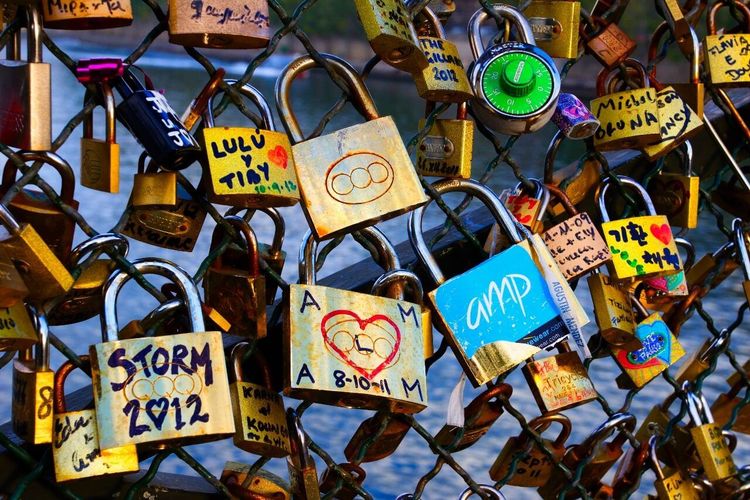
Pont des Arts was built between 1801 and 1804 under Napoleon, as Paris's first metal bridge and the capital's first fully pedestrian bridge. Its name came from the Palais des Arts (the former name of the Louvre), which it connected to the Institut de France on the left bank. Damaged several times by boat collisions, it was completely rebuilt between 1981 and 1984 with seven steel arches replicating the lightness of the original.
At 155 metres long, it offers one of the most celebrated panoramas over Paris: to the west, the perspective over Pont Neuf and the tip of Île de la Cité; to the east, the dome of the Institut and the rooftops of Île Saint-Louis; along the Seine's axis, Notre-Dame cathedral. The metal deck, slightly elevated above the quays, creates a sensation of floating above the river.
For decades, artists, sketchers and street musicians have established an open-air studio here. The transparent glass panels installed in 2015 replaced the old metal grilles, restoring the bridge's original transparency while preserving its atmosphere. Come in the evening: the Art Deco-style lampposts bathe the deck in warm light, and the nocturnal view of the illuminated Louvre is among the most beautiful in Paris. Our audio-guided tour From the Mona Lisa to the Notre-Dame Cathedral crosses this very deck, between the Institut de France and the cathedral.
Passerelle Léopold-Sédar-Senghor: Contemporary Transparency
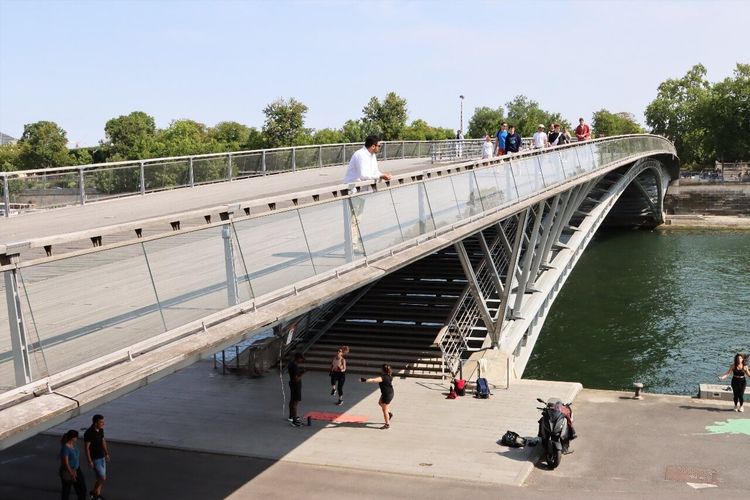
Opened in 1999 (and officially named in 2006 in honour of the first Senegalese president), Passerelle Léopold-Sédar-Senghor (Passerelle Léopold-Sédar-Senghor, 75001 Paris, rated 4.6/5 on Google from 1,369 reviews) connects the Musée d'Orsay on the left bank to the Jardin des Tuileries on the right bank via a single arch of 106 metres with no intermediate support. Designed by architect Marc Mimram, it replaced the former Passerelle Solférino, demolished due to lack of maintenance.
The structure combines steel and Brazilian ipê wood: the wooden decking absorbs the sound of footsteps and visually warms a structure that could otherwise have felt cold. Its pronounced humpback shape forces you to climb then descend, generating changing views over the Seine throughout the crossing. From the summit, the simultaneous view of the Eiffel Tower to the west and the gilded dome of the Invalides to the south-east is one of the most balanced in Paris.
The footbridge is exclusively pedestrian, with no motorised traffic — one of the rare spaces of relative silence in a noisy city. It is particularly beautiful at dawn, when raking light highlights the metal ribs and river traffic is still absent.
Pont de Bir-Hakeim: Two Levels, a Thousand Views
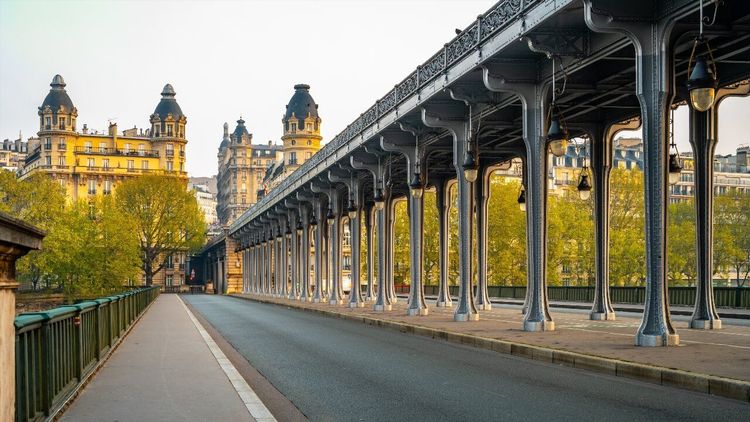
Pont de Bir-Hakeim (Pont de Bir-Hakeim, 75015 Paris, rated 4.7/5 on Google from 14K reviews) is one of the few Parisian bridges that is as much a spectacle to behold as it is to cross. Built between 1903 and 1905 under the direction of engineer Louis Biette and decorated by architect Jean-Camille Formigé, it was first known as the 'Passy viaduct' before being renamed in 1948. Its defining feature: a two-level superimposed structure, the lower level for pedestrians and cars, the upper level carrying metro line 6 above ground between the Bir-Hakeim and Passy stations.
The riveted steel framework rests on piers decorated with Art Nouveau motifs and on a central masonry arch anchored on Île aux Cygnes, a slender artificial strip of land planted with trees. At the downstream end of the island stands a reduced replica of the Statue of Liberty (installed in 1889), facing west towards New York.
From the lower pedestrian walkway, the Eiffel Tower appears framed in succession through the metal arches less than 600 metres away — the most cinematic view of the tower from any Parisian bridge. Last Tango in Paris (Bertolucci, 1972), Inception (Nolan, 2010) and Midnight in Paris (Allen, 2011) all made use of this perspective. The Ryo audio guide in the footsteps of Emily Cooper contextualises the series' locations in this neighbourhood spanning the 15th and 16th arrondissements.
For photography: position yourself on the left bank side along the longitudinal axis of the bridge from Quai de Grenelle, about 30 minutes before sunset. The rivets and arches create natural depth of field with the tower as the vanishing point.
Pont Marie: the Classical Soul of Île Saint-Louis
Pont Marie (Pont Marie, 75004 Paris, rated 4.7/5 on Google from 8K reviews) is one of Paris's most understated bridges, and one of the most historically rich. Built between 1614 and 1635 under the direction of Christophe Marie, the contractor who gave his name to the structure, it was one of the first permanent bridges connecting Île Saint-Louis to the right bank. Its construction was inseparable from the development of the island: Marie had obtained the concession of the island's land in exchange for building two bridges.
With its 5 ashlar stone arches and triangular cutwaters that break the current, the structure retains a silhouette very close to its original appearance. All that is missing are the cantilevered houses that once lined both sides of the deck, removed after the great flood of 1658 and never rebuilt. This absence now provides an open view of the private mansions on Quai d'Anjou and Quai de Bourbon, two of the best-preserved 17th-century façades in Paris.
The approach from Quai de Bourbon at the end of the day offers one of the most intimate views over the Seine: the classical façades of Île Saint-Louis are reflected in the calm water between the bridge's piers. To extend the walk on the island, the Ryo article on the islands of the Seine to explore details everything you can see from these quays.
Pont Royal: Classical Symmetry beneath the Louvre's Windows
The third oldest bridge in Paris, Pont Royal (Pont Royal, 75007 Paris, rated 4.6/5 on Google from 5K reviews) was built between 1685 and 1689 on the orders of Louis XIV, who financed it entirely — hence its name. Jules Hardouin-Mansart, architect of the Palace of Versailles, drew up the plans, and construction was entrusted to engineer Jacques Gabriel. The structure links the Tuileries district (right bank) to the Faubourg Saint-Germain (left bank), the axis that served as the royal court's official crossing.
Its 5 arches in pale ashlar stone have a sobriety that contrasts sharply with the baroque exuberance of Pont Alexandre III, built two centuries later. It is precisely this restraint that makes it one of the best viewpoints over the left bank: standing at the centre of the bridge, you can take in simultaneously the northern façade of the Musée d'Orsay to the west, the Jardin des Tuileries to the east, and the animated quays of the Louvre as a backdrop. The arches create an almost perfect reflection in the water on calm days.
Pont Royal is less frequented than its more famous neighbours, making it a prized stop for photographers seeking compositions free of human clutter. Settle onto one of the stone benches to watch the bateaux-mouches pass under the arches in the late afternoon.
Pont au Change: the Legacy of the Medieval Merchants
Its name recalls what it was before it became a bridge: a place of goldsmiths' and money changers' stalls that had been established there since the 12th century. The present Pont au Change was entirely rebuilt between 1858 and 1860 under Haussmann, as part of the grand renovation of Paris ordered by Napoleon III. The ashlar stone structure features three large segmental arches and parapets decorated with the imperial eagle and intertwined 'N' initials.
Its position is strategic: it connects the Palais de Justice on Île de la Cité to Boulevard du Palais and the Châtelet. From its deck, looking east, the view plunges towards Notre-Dame de Paris and the square towers of the Conciergerie; to the west, the arches of Pont Neuf close the perspective. Look at the bas-relief cartouches on the parapets: they bear construction dates and the coat of arms of Paris — the vessel on a red and blue background — a discreet signature present on every pier of a Haussmann-era bridge.
The bridge is almost always in motion — pedestrians, cyclists, buses — making it a fine observatory of everyday Parisian life. Very early in the morning, before the neighbouring law courts open, the structure is nearly deserted and the raking light reveals the fine chiselling of the cartouches.
Passerelle Simone-de-Beauvoir: the Most Daring Crossing
Passerelle Simone-de-Beauvoir (Quai de Bercy, 75012 Paris, rated 4.5/5 on Google from 934 reviews) is Paris's most recent pedestrian crossing: inaugurated in July 2006, it connects Quai de Bercy to Quai François-Mauriac, in front of the Bibliothèque nationale de France, in eastern Paris. Its designer, Austrian architect Dietmar Feichtinger, drew a structure in the shape of a biconvex lens: two arcs curving in opposite directions cross at the centre to form an enlarged platform at the midpoint, accessible via staircases and ramps.
A total of 304 metres long, it spans the Seine with a central span of 190 metres without intermediate support, a structural achievement recognised with the Équerre d'argent award at its inauguration. The Brazilian ipê wood deck echoes that of Passerelle Léopold-Sédar-Senghor, but the undulating form makes it a radically different experience: climbing to the upper level, you find yourself level with the treetops of the Parc de Bercy.
The footbridge pays tribute to philosopher and writer Simone de Beauvoir, born in 1908, whose The Second Sex (1949) remains a worldwide reference. The view from the central platform is particularly striking at sunset, with the Parc de Bercy on one side and the silhouettes of new Paris on the other. It is one of the most photogenic bridges in Paris that few visitors know.
Itinerary: Linking the Most Beautiful Bridges in One Day
Paris lends itself perfectly to a full day devoted to its bridges, with the landscaped riverbanks on both sides making it easy to move from one to the next without leaving the Seine's edge.
Recommended starting point: Pont de Bir-Hakeim at 8 a.m. (morning light on the Eiffel Tower, the quay still quiet). Head along the left bank towards Passerelle Léopold-Sédar-Senghor, allow 25 minutes walking along Quai Branly.
From the footbridge, continue downstream to Pont Royal (a photography stop in front of the Beaux-Arts façade of the Musée d'Orsay), then make your way to Pont des Arts and Pont Neuf by walking along Quai Voltaire. These three bridges in succession form the historical heart of the walk: allow 1 hour to explore them, especially the semicircular recesses of Pont Neuf.
From the tip of Île de la Cité, cross over to Île Saint-Louis, then walk to Pont Marie in 15 minutes. Head next to Pont au Change for the view over the Conciergerie and Notre-Dame.
For the second part of the day, head back along the right bank to Pont Alexandre III, perfect for sunset over the Invalides. The following morning, take the metro to Bercy for Passerelle Simone-de-Beauvoir, which is difficult to include in the same route without cutting the walk short. Total distance for the main circuit: approximately 10 to 12 kilometres, with no significant elevation change.
To enrich this walk with historical stories, the Ryo audio guide From Mona Lisa to Notre-Dame covers the heart of Île de la Cité and the historic riverbanks, while the Latin Quarter, Sorbonne and Panthéon route extends the walk southward along the left bank. For a more contemporary reading of the same banks, Emily Cooper's Guide to Paris comes back across the Pont Neuf.
FAQ
What is the most beautiful bridge in Paris?
It is a matter of taste as much as architecture. Pont Alexandre III is most often cited first for the richness of its Belle Époque decoration: gilding, 200 sculptures, 18 candelabras. But Pont Neuf (1607), the oldest, has a historical and urban presence that the Alexandre III does not. For lovers of structural modernity, Passerelle Simone-de-Beauvoir and its biconvex lens shape are a fascinating alternative.
What is the oldest bridge in Paris?
Pont Neuf is the oldest bridge still standing in Paris. Its construction was launched in 1578 under Henri III and completed in 1607 under Henri IV. Despite its name ('neuf' meaning 'new'), it has existed for more than four centuries and has survived history without being fundamentally rebuilt, unlike most of its contemporaries.
What is the lovers' bridge in Paris?
The expression 'lovers' bridge' commonly refers to Pont des Arts, a pedestrian footbridge between the Louvre and the Institut de France. The transparent glass panels installed in 2015 replaced the old metal grilles, restoring the bridge's original transparency while preserving its romantic atmosphere.
Which bridge offers the best view of the Eiffel Tower?
Pont de Bir-Hakeim offers the most cinematic view: the Eiffel Tower appears framed by the metal arches in succession at about 600 metres, a composition impossible to miss. For a frontal and unobstructed view of the tower as a whole, Pont d'Iéna (directly at its foot) is also remarkable.
Which bridges in Paris are exclusively for pedestrians?
Several structures are reserved for pedestrians: Passerelle Léopold-Sédar-Senghor (between Orsay and the Tuileries), Pont des Arts (between the Louvre and the Institut de France), Passerelle Simone-de-Beauvoir (between Bercy and the BnF) and the small Pont Saint-Louis footbridge between Île de la Cité and Île Saint-Louis. These four structures share the absence of motorised traffic, making them particularly pleasant to cross at a leisurely pace.
What time should you cross the bridges to photograph them?
The golden hour (30 to 60 minutes before sunset) and the blue hour (20 minutes after) are the ideal windows. Early morning before 8 a.m. on Pont Neuf and Pont Marie offers raking light without crowds. For Pont Alexandre III, sunset from the left bank is optimal as the bridge's axis runs east–west. At night, from 11 p.m. onwards, the illuminations reach their maximum intensity.
Conclusion
From the gilded ornamentation of Pont Alexandre III to the classical restraint of Pont Marie, the bridges of Paris form, on their own, an open-air museum along the banks of the Seine. Each structure is a gateway into a different century of the city's history, and each crossing, in the right light, reveals Paris from an angle that no museum can offer.
To extend these discoveries with contextual stories about the history of the neighbourhoods traversed, the Ryo Paris audio guide covers 8.9 km and 18 stops, a way of connecting the bridges, monuments and riverbanks in a single guided walk.
À lire également