© Shutterstock
 Votre guide Ryo
The 8 Islands of the Seine in Paris: Complete Guide to Exploring Them in 2026
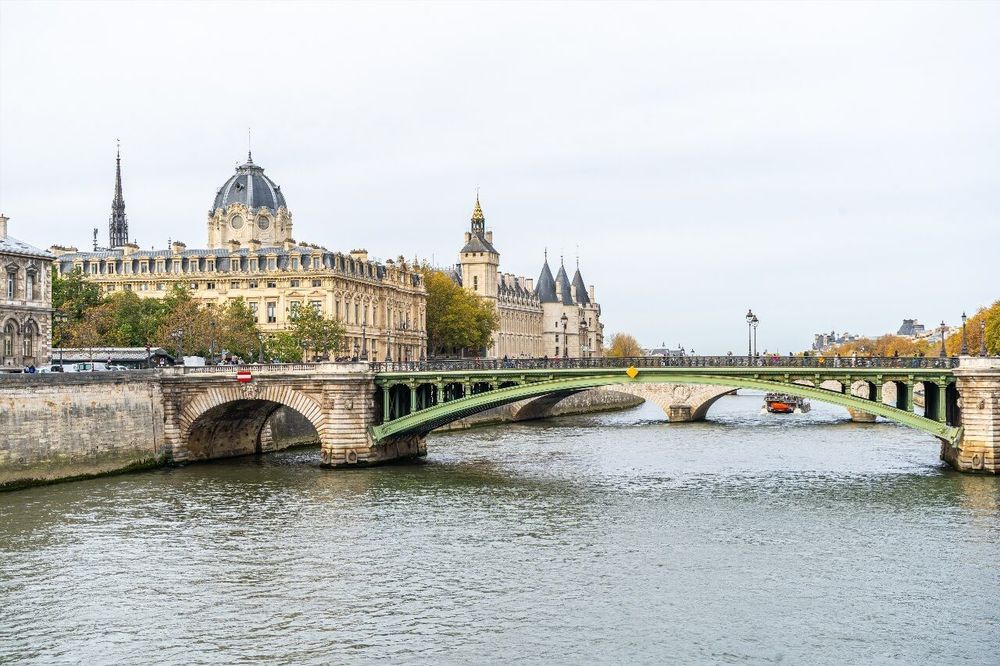
Paris isn't just a city built on the banks of the Seine — it was born in the Seine. Exploring the islands of the Seine in Paris means travelling back twenty centuries of history along the water: this guide takes you to the eight islands of the Seine to explore, from the medieval heart of the capital to its inner suburbs. The two islands that form its historic centre have long overshadowed the six others scattered along the river. Yet exploring these islands goes far beyond visiting Notre-Dame and queuing for a Berthillon ice cream. This guide offers a complete portrait of all eight islands, from the apse of Notre-Dame reflected at sunrise to the monumental sculptures of Île Saint-Germain, including the miniature Statue of Liberty on Île aux Cygnes that most visitors never suspect exists.
Some of these islands have disappeared beneath the asphalt — Île Louviers, joined to the right bank in 1843 when the Seine's branch was filled in — while others are undergoing full architectural rebirth, such as Île Seguin, a former Renault factory converted into a cultural complex. For each of these islands of the Seine to explore, you will find here what to see, how to get there and what classic guides tend to leave out. Complete your exploration with the Ryo audio-guided tour From Mona Lisa to Notre-Dame, 22 audio stops between the Louvre and the cathedral, to cover Île de la Cité and its surroundings in depth.
Île de la Cité: the Birthplace of Paris
Before Paris was called Paris, it was called Lutetia, and Lutetia spread across this limestone ellipse, 900 metres long. The Parisii, a Gallic people, settled on the island around 250 BC for its natural defensive position: water on all sides. Since then, the historical density of Île de la Cité has only grown thicker, to the point where you can cross twenty centuries in a single morning's walk.
The most obvious monument is Notre-Dame de Paris, whose western façade has overlooked the forecourt since the 12th century. After the fire of April 2019 and five years of reconstruction, the cathedral reopened its doors in December 2024. The new spire, rebuilt according to Viollet-le-Duc's original plans using modern materials, rises to 96 metres. Visiting the nave is free, but climbing the towers — now open to the public again — remains ticketed (€16), and online booking several days in advance is mandatory.
Two hundred metres to the west, the Sainte-Chapelle is one of the most breathtaking achievements of Rayonnant Gothic art. Commissioned by Louis IX to house the Crown of Thorns in 1248, it is best known for its 1,113 stained glass windows covering three-quarters of the upper chapel's walls. The effect is stunning on sunny days: the light filtering through the blues, reds and golds changes character every hour. Admission: €20 in high season (combined ticket for Sainte-Chapelle and the Conciergerie available for around €28, valid for two days).
The Conciergerie, adjacent to the Palais de Justice, was the residential wing of the royal palace before being converted into a prison during the French Revolution. Marie-Antoinette awaited her death sentence there in 1793 in a reconstructed cell that can be visited today. The monument is worth a stop for its immense Gothic Guards' Hall, one of the largest intact medieval halls in France, and its three 14th-century towers lining the Quai de l'Horloge.
The Place Dauphine, tucked behind the Palais de Justice, functions as a parenthesis in time. Created in 1607 by Henri IV, this triangular square bordered by brick and white stone houses is one of the quietest spaces in central Paris. Regulars play pétanque under the trees in summer, in an atmosphere that strikingly contrasts with the tourist flow around Notre-Dame's forecourt just a few hundred metres away.
The Pont Neuf, whose name is a contradiction since it is actually the oldest bridge in Paris, completed in 1607, is worth a detour for the view it offers. Its 12 arches span the upstream tip of the island. Its raised pavements once allowed pedestrians to avoid being splashed by carriages. Today it is one of the finest viewpoints over the Seine, with the Square du Vert-Galant, planted at the tip of the island, jutting into the river like the prow of a ship.
Before leaving the island, the Marché aux Fleurs Reine Elizabeth II (Place Louis Lépine, 75004 Paris, rated 4.5/5 on Google with 2,560 reviews), officially renamed in 2014, on the Place Louis Lépine, is worth five minutes. This covered market with its late-19th-century iron-and-glass architecture sells plants, cut flowers and seeds, and makes way on Sundays for a bird market with a retro charm that Parisians have frequented for generations.
Île Saint-Louis: a Village Suspended in the Seine
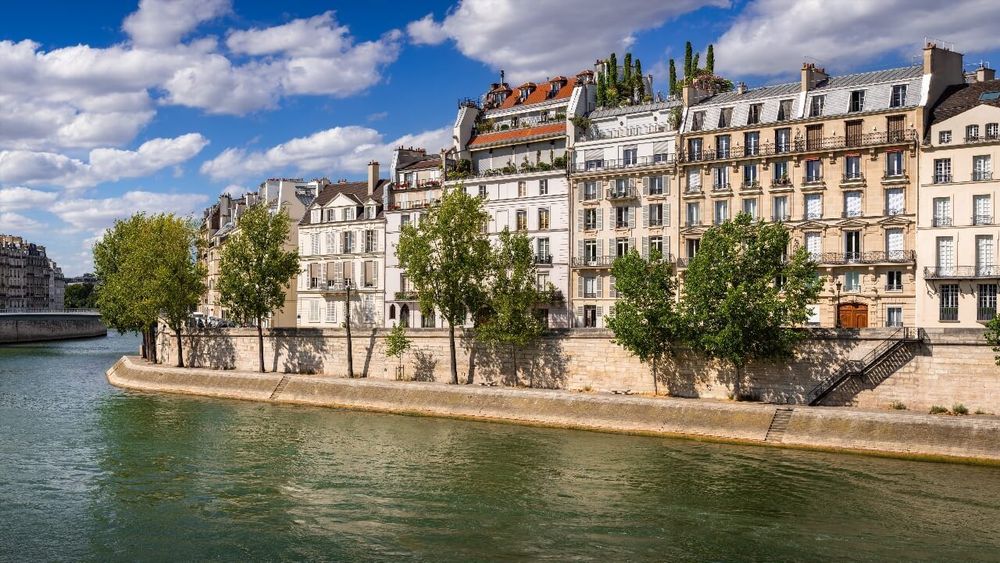
Cross the Pont Saint-Louis from Île de la Cité and you enter an enclave from another century. Île Saint-Louis, barely 600 metres long, has the unusual distinction of never having been developed in the medieval period. Two separate islets occupied the site until the 17th century: Île Notre-Dame and Île aux Vaches (cattle were indeed grazed there). Their merger and development between 1614 and 1664 produced an architecturally cohesive ensemble: the entire island is built in Louis XIII and Louis XIV style, with no significant later additions.
The Rue Saint-Louis en l'Île runs through the island from east to west like a commercial backbone. Cheese shops, art galleries, chocolatiers and craft boutiques follow one another over 600 metres. Towards the middle of the street, the Berthillon house has been a Parisian rite of passage since its founding in 1954. The house-made ice creams (salted caramel, glacé chestnut, intense blackcurrant) are often eaten standing in the queue that stretches on some evenings all the way to the quay — allow 15 to 20 minutes in high season.
The quays of Île Saint-Louis are well worth a stroll at sunset. The Quai de Bourbon on the north side offers a direct view of the Hôtel de Ville and the towers of the Conciergerie. On the Quai d'Anjou, Hôtel Lambert, built in 1641 by Louis Le Vau — the same architect who later designed the Palace of Versailles — is one of the most precious private mansions in Paris. Its façade looks out over the Seine without quite touching it, as if suspended above the water.
The Église Saint-Louis-en-l'Île (19 Rue Saint-Louis en l'Île, 75004 Paris, rated 4.6/5 on Google with 685 reviews), the island's only church, is deceptive with its modest façade. The Baroque interior is far more sumptuous than the street suggests: a painted dome, Flemish paintings and gilded side chapels. Entry is free and the church is one of the quietest spots on the island on weekdays.
Île aux Cygnes: 850 Metres of Promenade and a Surprise Liberty
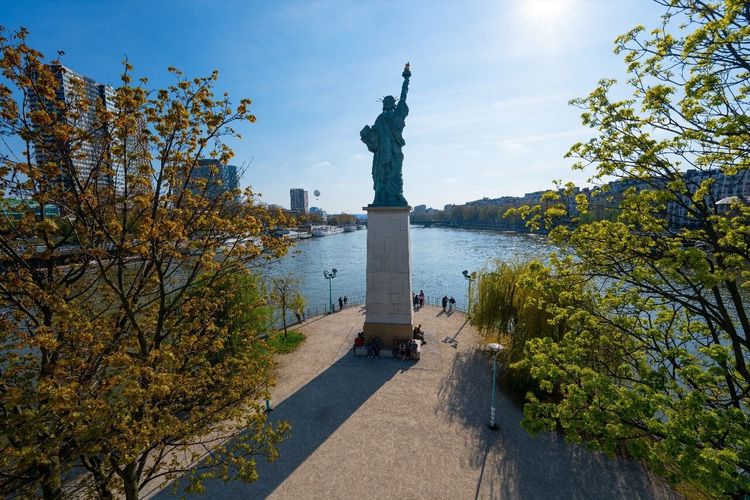
The Île aux Cygnes is not an island in the classic sense: it is an artificial structure 11 metres wide and 850 metres long, created in 1827 to stabilise the bank and protect the Port de Grenelle. Planted with elms and chestnut trees, the Allée des Cygnes (Allée des Cygnes, 75015 Paris, rated 4.6/5 on Google with 9K reviews) forms an elevated promenade between the Bir-Hakeim and Grenelle bridges, accessible from both banks and open free of charge at any hour.
At the western tip stands a replica of the Statue of Liberty at one quarter the size of the original, given by the American community in Paris in 1889 to commemorate the centenary of the French Revolution. Facing west, her gaze turned towards her larger sister in New York, she is easily missed from the quays. She is one of those Parisian curiosities discovered only by attentive walkers.
The pillars of the Pont de Bir-Hakeim cross the island at its midpoint and create an atmosphere that generations of filmmakers have exploited, including Christopher Nolan for Inception. In fine weather, the promenade offers an unobstructed panorama of the Tour Eiffel to the north and the Haussmann buildings of the 16th arrondissement to the south. The Allée des Cygnes is also included in several cycling routes running along the Seine.
Île Louviers: the Island Swallowed by the City
The Île Louviers has not existed as an island since 1843, when the Seine branch separating it from the right bank was filled in to create the Boulevard Morland. It was previously an active centre of the timber trade: merchants stored their floating stocks there before transporting them to the city's construction sites, which earned it the nickname 'Port aux Bûches' (Firewood Wharf).
The topography of the current 4th arrondissement retains a few traces of this former configuration. The Boulevard Henri IV roughly follows the course of the former Seine branch. Some basements in the neighbourhood still reveal foundations built on wooden piles driven into medieval silt. A discreet commemorative plaque on the boulevard marks the island's former existence. This is precisely the kind of silent disappearance that makes Paris so fascinating: the city literally absorbed one of its own islands.
Île Saint-Germain: Urban Forest and Contemporary Art
In Issy-les-Moulineaux, a few RER stops from Paris, Île Saint-Germain (Île Saint-Germain, 92130 Issy-les-Moulineaux, rated 4.6/5 on Google with 168 reviews) functions as a green lung in the middle of the Seine. Around 1.5 kilometres long, it is largely occupied by a landscaped park open to the public: wide lawns, shaded paths and waterside picnic areas. The atmosphere is very different from central Paris — more relaxed and primarily local.
What sets Île Saint-Germain apart from every other park in the region is the presence of Jean Dubuffet's Tour aux Figures. This monumental sculpture, 24 metres tall, completed in 1988 after several decades of work, represents an accumulation of figures and anthropomorphic forms combined into a single volume. Painted in white, black and red in the artist's characteristic graphic style, and classified as a Historic Monument since 2008, it stands as one of the most significant open-air sculptures installed on French soil.
Since its restoration, the Tour aux Figures can also be explored from the inside: a discovery space fitted out beneath the sculpture opens to the public on certain days, with free access on reservation. To reach the island, tram T2 or RER C, stop Issy-Val de Seine, are the most convenient options from Paris.
Île de la Jatte: Inside Seurat's Paintings
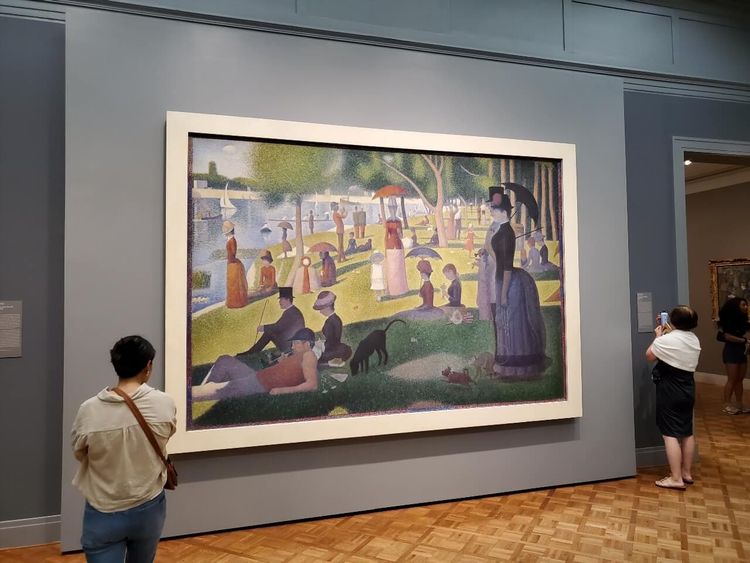
The Île de la Jatte (Île de la Jatte, 92200 Neuilly-sur-Seine, rated 4.6/5 on Google with 217 reviews), in Neuilly-sur-Seine, owes its worldwide fame to a painting made in 1886 by Georges Seurat: "A Sunday Afternoon on the Island of La Grande Jatte." This monumental canvas measuring 3 × 2 metres, held at the Art Institute of Chicago, fixed the image of a bourgeois population resting by the water beneath a pointillist sun. It remains one of the most cited works of Post-Impressionism.
Today's Île de la Jatte is quite different from the popular haven Seurat painted. It has transformed into a mixed-use space combining upmarket residences, architects' offices and riverside restaurants. The Quai de la Jatte brings together several establishments with large terraces, very popular on weekends between April and October. It is one of the only places in the inner Paris suburbs where you can have lunch with your feet almost in the water.
The northern part of the island retains some traces of its more popular past: warehouses converted into artists' studios and characterful houses reminiscent of the Belle Époque's riverside taverns. A commemorative plaque recalls Seurat's painting on the eastern bank. If you wish to combine the visit with a walk along the Seine from Paris, our Ryo selection of cycling routes along the Seine will take you to the island in 25 minutes by bike from the centre.
Île Seguin: From the Renault Factory to La Seine Musicale
The Île Seguin is undoubtedly the island with the most spectacular trajectory on the Parisian Seine. For sixty years, from 1929 to 1992, it was home to the largest car factory in Europe: the Renault Billancourt plant employed up to 35,000 workers at its peak in the 1950s. The closure in 1992, followed by demolition between 2004 and 2005, left the island bare for a decade of frustrated plans.
Today, Île Seguin is being reborn as a cultural and media hub. Its centrepiece is La Seine Musicale (Île Seguin, 92100 Boulogne-Billancourt, rated 4.5/5 on Google with 12,307 reviews), inaugurated in 2017, whose oval hull of wood and glass has become an architectural landmark of the Paris metropolitan area. The building houses two main venues: the Auditorium Patrick Devedjian, a 1,150-seat jewel dedicated to classical music, and the Grande Seine, a flexible hall that can accommodate up to 6,000 spectators for headline acts. A planted greenhouse facing the Tour Eiffel completes the complex. The programme blends classical music concerts, contemporary dance performances and international headline acts throughout the year.
The rest of the island is progressively welcoming office buildings and public spaces currently under development. To reach Île Seguin, tram T2 from La Défense or Issy-les-Moulineaux is the most direct option. Shows take place all year round — check La Seine Musicale's programme before planning your visit. Back in the heart of the city, our audio walking tour links the Louvre to Notre-Dame in 23 commented stops.
Île de Puteaux: the Discreet Nature Reserve
The Île de Puteaux (Île de Puteaux, 92800 Puteaux, rated 4.7/5 on Google with 101 reviews) is the most discreet of the Seine islands in the western suburbs. Classified as a sensitive natural area, it cannot be visited freely in its entirety. The part accessible to the public is a green space planted with willows and poplars, frequented mainly by local residents for fishing and quiet strolls under the trees.
A municipal sports complex occupies part of the island — water polo pools and courts open according to scheduled time slots. Access is via the Pont de Puteaux or footbridges from Courbevoie. For those wishing to complete the full tour of all the Seine islands, it is a twenty-minute detour from the Grande Arche de la Défense, easily combined with a visit to Île Seguin on the same day.
Practical Itinerary for Exploring the Islands of the Seine
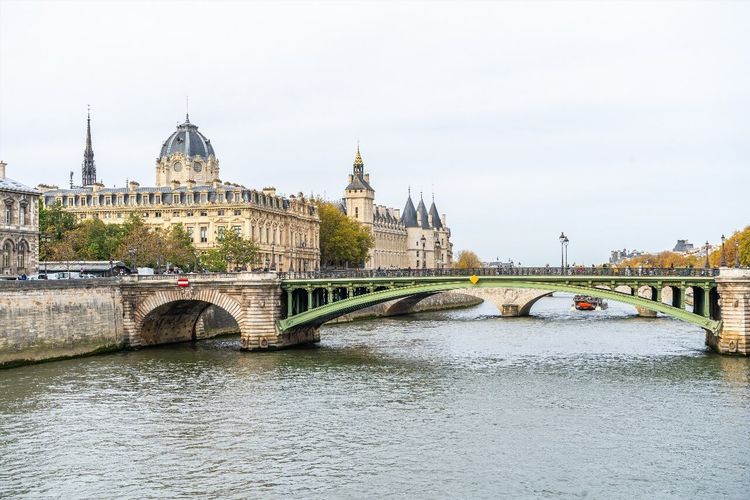
Covering all these islands of the Seine in a single day is possible, but requires organisation. Here is a breakdown based on the time available.
Half a day: focus on Île de la Cité and Île Saint-Louis. Start with Sainte-Chapelle as soon as it opens (9am) to avoid the queues, then move on to Notre-Dame (online booking mandatory for the towers), cross over to Île Saint-Louis for lunch on the Rue Saint-Louis-en-l'Île and finish with a Berthillon ice cream. Allow 4 to 5 hours in total, at a relaxed pace.
A full day: add Île aux Cygnes late in the morning via the Bir-Hakeim metro station (line 6, 10 minutes from Châtelet). Then take tram T2 to Île Seguin for the afternoon. La Seine Musicale can be visited freely outside of performances. End at Île de la Jatte at aperitif time, accessible from Pont de Levallois (metro line 3).
A weekend: on Saturday, devote yourself to the two central islands and Île aux Cygnes. On Sunday, the inner-suburb islands — Île Saint-Germain and Île de la Jatte — combine perfectly by bike along the riverbanks, allowing around 15 km from Paris. For those who enjoy being on the water, our Ryo guide to Seine river cruises lists all available options with up-to-date prices, from the Vedettes du Pont Neuf to restaurant boats.
To deepen your discovery of the capital beyond the islands, Ryo offers several themed audio-guided tours, including one dedicated to the Notre-Dame and Mona Lisa area, and another centred on Montmartre, covering the main neighbourhoods with 19 audio stops.
Getting Between the Islands of the Seine
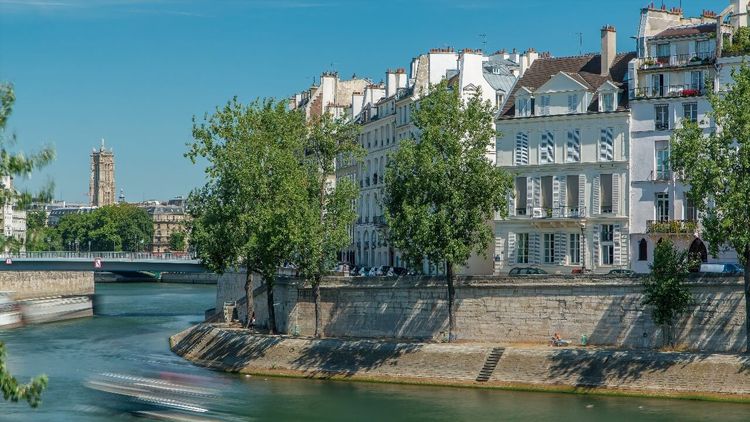
The two central islands are accessible on foot from the main central stations: Cité (line 4) for Île de la Cité, Pont Marie (line 7) for Île Saint-Louis, Saint-Michel (lines 4 and 10) or Châtelet (several lines) to reach both from the main railway stations.
For Île aux Cygnes, the Bir-Hakeim station (line 6) drops you directly onto the bridge that overlooks the island. Île Seguin is served by tram T2 (stop Île Seguin). Île Saint-Germain by RER C (stop Issy-Val de Seine) or tram T2. Île de la Jatte by metro line 3 (stop Pont de Levallois) then a 10-minute walk following the Seine.
None of these islands of the Seine have direct parking; always opt for public transport or cycling. The cycling routes along the Seine cover the Allée des Cygnes, the riverbanks towards Île de la Jatte and the surroundings of Île Saint-Germain without any notable interruption.
FAQ
How many islands are there in the Seine in Paris?
The Seine has eight islands in the Paris metropolitan area: Île de la Cité, Île Saint-Louis and Île aux Cygnes within Paris proper, and then Île Saint-Germain, Île de la Jatte, Île Seguin and Île de Puteaux in the inner suburbs. Île Louviers, formerly an island in central Paris (4th arrondissement), was joined to the right bank in 1843 when the Seine's branch was filled in; it often appears on lists, bringing the total to eight historical islands.
Can you visit Île aux Cygnes freely?
Yes, the Allée des Cygnes is a public space accessible free of charge at any hour. There are no gates, no opening hours and no admission fee. The promenade is open to walking, jogging and cycling. Both ends of the island lead to staircases connecting to the quays on either bank — the Bir-Hakeim side to the northeast and the Grenelle side to the southwest.
Is Île Seguin Open to the Public?
Partially. La Seine Musicale and its immediate surroundings are freely accessible outside of performance hours: you can walk on the island, discover the building's architecture from the outside and access the public spaces already developed. Other areas remain under construction. Access is via tram T2, stop Île Seguin, with no admission charge for the outdoor spaces.
What is the Difference Between Île de la Cité and Île Saint-Louis?
They are two adjacent islands connected by the Pont Saint-Louis. Île de la Cité is the historical birthplace of Paris (Lutetia, 250 BC) and is dense with monuments: Notre-Dame, Sainte-Chapelle, the Conciergerie and the Palais de Justice. It is the most visited island in Paris. Île Saint-Louis, built in the 17th century, is essentially residential with a remarkably homogeneous architectural style. It offers a calm village atmosphere, with shops, ice cream parlours and shaded quays, but no major monument as such. Many visitors prefer to return there after the density of Île de la Cité.
How Do You Get to Île de la Jatte from Paris?
By metro: line 3 to Pont de Levallois, Bécon, then a 10-minute walk following the bank of the Seine. By bike: allow 25 to 30 minutes from central Paris along the developed riverbanks. By car: the island is accessible from Neuilly or Levallois, with a few parking spaces on the quay, but this option is not recommended on weekends between April and October, when it is very busy.
Conclusion
The islands of the Seine form an arc from east to west, stretching from the medieval heart of the capital to former industrial wastelands reinvented as musical venues. Each has its own pace, character and era: Île de la Cité accumulates twenty centuries in less than a square kilometre, Île Saint-Germain rebuilds its identity through monumental sculpture, Île Seguin erases half a century of industrial concrete beneath a contemporary wooden hull. So many faces of the Seine to explore, on foot, by bike or drifting along on a river cruise.
To continue exploring Paris beyond the islands, the Ryo Paris audio-guided tour covers the capital's main neighbourhoods with 18 audio stops, from Montmartre to the Marais by way of Notre-Dame — a way to go deeper into what the islands only begin to reveal.
À lire également