© Shutterstock
 Votre guide Ryo
Bike Rides in Paris: 10 Itineraries to Explore the Capital in 2026
Bike rides in Paris have transformed in less than a decade. The world's most photographed city is often best discovered from a saddle rather than a crowded selfie-stick-filled pavement, and the French capital has undergone a spectacular cycling transformation since 2015. Its network now exceeds 1,000 kilometres of dedicated cycle paths, with total cycling infrastructure reaching nearly 1,600 kilometres as of 1 January 2025; the modal share of cycling has surged since 2010 to reach approximately 11% of journeys within the city limits in 2025. This is no longer the Paris where cyclists survived by squeezing between buses. It is a city where bike rides in Paris allow you to connect Notre-Dame to the Canal Saint-Martin without ever encountering a hostile car, or to reach Versailles from the left bank via a near-continuous greenway stretching 22 kilometres.
This guide brings together ten itineraries described in detail, from the iconic Seine riverbanks to the eastern canals, from Montmartre to the surrounding forests. You will also find car-free days to mark in your diary, rental options, a few safety tips and Île-de-France escapes for those who want to go further. To enrich each stop with historical anecdotes and hidden discoveries, the Ryo audio guide to Paris accompanies your bike rides in Paris with 18 commentaries recorded on location, available without an internet connection.
The Seine Riverbanks, the Founding Itinerary (18 km)
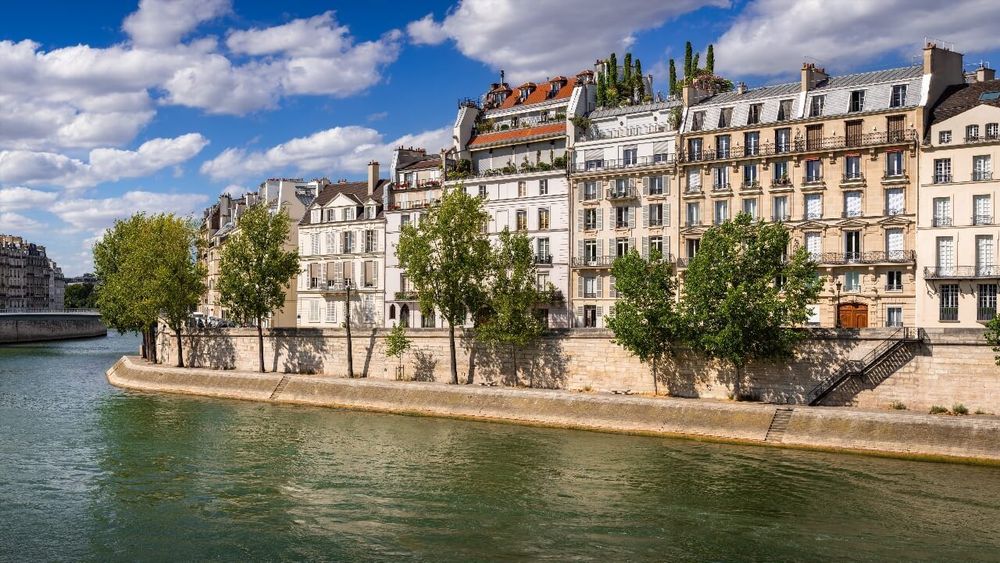
The Seine riverbanks itinerary is to Paris what the banks of the Garonne are to Bordeaux: obvious, almost too well known, yet ultimately far richer than expected. It is often the starting point for the most beautiful bike rides in the capital. Ever since the Voie Georges-Pompidou (Voie Georges-Pompidou, 75004 Paris) (right bank) and the Berges de la Seine (left bank) were returned to pedestrians and cyclists, these two axes form an 18-kilometre loop that is entirely flat and entirely dedicated to soft mobility.
This itinerary has a paradoxical history. The Voie Georges-Pompidou was built in the 1960s at the request of the president who gave it its name, with the explicit aim of easing traffic flow along the Seine. It was subsequently closed to cars in 2013 by the city council, a decision that divided Paris for years. Today, it is one of the most popular cycling promenades in the capital, and the anecdote says something about the city's capacity to reinvent itself without hesitation.
On the right bank, set off from the Pont de l'Alma (16th arrondissement) to reach the Île Saint-Louis by riding along the Seine. The path is wide and in good condition. You will pass the Musée d'Orsay (1 Rue de la Légion d'Honneur, 75007 Paris, rated 4.8/5 on Google with 114,689 reviews) visible from the Pont de la Concorde, the dome of the Institut de France, the bouquinistes who have set up on the stone parapets of the UNESCO-listed quays for several centuries, often described as the world's longest open-air bookshop with their hundreds of green boxes stretching nearly 3 kilometres, and then the towers of Notre-Dame whose reconstructed spire has once again risen since December 2024 after five years of work.
On the left bank, the Berges de la Seine developed between the Musée d'Orsay and the Pont de l'Alma form the section best suited to families with children: the physical separation from traffic is total, and leisure installations (climbing modules, raised gardens, floating café terraces) make the itinerary as recreational as a stroll through a park. The path width reaches 15 metres in places, allowing safe overtaking even during the busiest summer weekends.
For the central section, the Île de la Cité fits naturally into the route. The Parvis de Notre-Dame is accessible via the Pont Saint-Michel or the Pont au Change: the cathedral, reopened to the public on 7 December 2024 after full reconstruction, once again welcomes millions of visitors, and its illuminated façade in the evening as seen from the riverbanks is one of the most striking sights in Paris. If you are doing the itinerary at the end of the day, plan to be on the banks level with Notre-Dame between 6pm and 8pm.
For a complete loop, take the left bank on the way out and the right bank on the return, crossing via the Pont de Sully to the east and the Pont de l'Alma to the west. The loop measures 18 kilometres with barely any elevation gain, taking about an hour and a half at a leisurely pace on a Vélib'. If you want to continue eastward, the Port de l'Arsenal (12th arrondissement) extends the itinerary to the Bastille basin, a natural starting point for the Coulée verte or the Canal Saint-Martin.
A timing detail few guides mention: on Sunday mornings before 10am, even the section of the right bank still open to traffic is practically empty. It is the ideal moment for bike rides in the middle of the road with the Eiffel Tower behind you, the low light skimming the Seine, and a gentle post-celebration atmosphere that contrasts sharply with weekday Paris. In summer, the itinerary comes alive from 9am with dozens of Parisians jogging, walking their dogs or sipping a café on a terrace: the atmosphere changes, but the beauty of the place remains intact.
The Coulée verte René-Dumont, from Bastille to Vincennes (5 km)
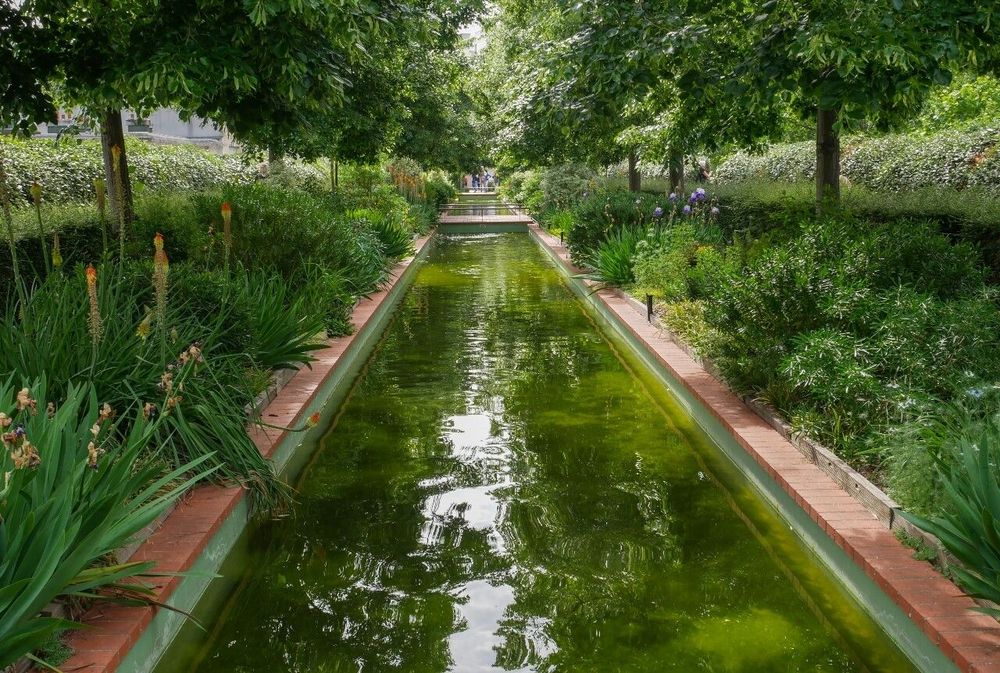
New York has its High Line, Paris has the Coulée verte René-Dumont: a former belt railway line converted into a tree-lined promenade that crosses the 12th arrondissement for nearly 5 kilometres, from Bastille to the edge of the Bois de Vincennes. The itinerary divides into two quite distinct experiences: the elevated section above the rooftops, and the ground-level section through the quiet residential fabric of the 12th. Among intra-muros bike rides, it is one of the most transporting.
The elevated section, known as the Promenade plantée, starts from the Opéra Bastille and runs for approximately 1.5 kilometres above the avenue Daumesnil, at the height of the third floor of the Haussmann buildings. The viaduct supporting it was built from 1859 for the Vincennes line, decommissioned in December 1969 with the arrival of RER A. Beneath the arches, the Viaduc des Arts now houses around forty exceptional craft galleries: upholsterers, cabinet-makers, luthiers, ceramicists, jewellery designers. You can make a cultural stop here by leaving your bike at one of the stations on either side of the viaduct.
The promenade surface is compacted gravel, which suits city bikes but may feel uncomfortable with tyres that are too narrow (less than 28 mm). The width is limited to approximately 2 metres on the narrowest stretches, which requires a moderate pace and some patience when overtaking pedestrians. It is more of a leisurely promenade than a sporting itinerary, and that is entirely the point: it is one of the rare places in Paris where bike rides slow down, not because of signage but because of the beauty of the surroundings.
After the elevated section, the itinerary descends to ground level to pass through the Square Charles-Péguy and the Jardin de Reuilly (Rue de Reuilly, 75012 Paris, rated 4.4/5 on Google with 2,886 reviews) before reaching the edge of the Bois de Vincennes. This section is less spectacular, but it reveals a quiet residential side of the 12th arrondissement, dotted with neighbourhood gardens that rarely appear in tourist guides. The paths are wide and the signage clear, with signs approximately every 500 metres.
In total, allow 1 to 1.5 hours for the one-way journey at a relaxed pace, or half a day if you explore the Viaduc des Arts galleries. For the return, the parallel Rue de Charenton offers a comfortable cycle path, or you can take metro line 8 from Daumesnil with a folding bike. The itinerary is accessible year-round, but the Promenade plantée is particularly beautiful in May (wisteria, roses) and October (russet foliage against the Parisian sky).
The Canal Saint-Martin and the Canal de l'Ourcq (15 to 30 km)
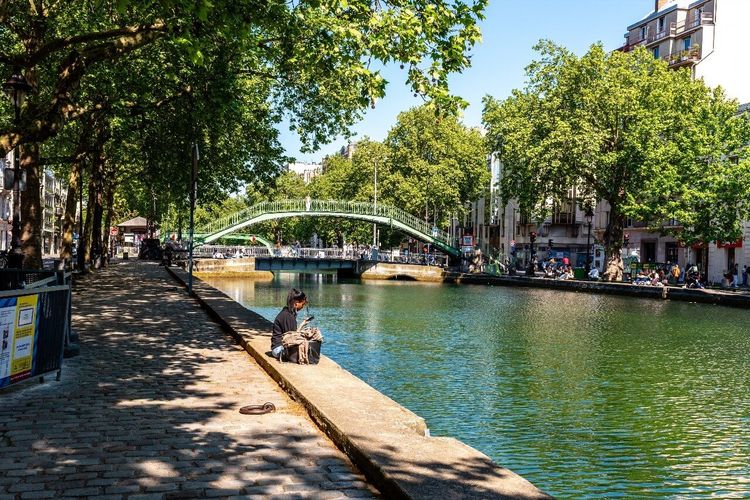
What Parisians simply call 'the canals' covers two distinct axes that can be combined to form one of the most comprehensive itineraries from the centre of Paris all the way to the gates of the north-east suburbs. The two together total between 15 and 30 kilometres depending on how far you go, with entirely flat terrain: it is one of the most immersive bike rides departing from the centre, with the atmosphere changing radically from one neighbourhood to the next.
The Canal Saint-Martin begins at the Place de la Bastille, where it disappears beneath the boulevard Richard-Lenoir for nearly 2 km, and reappears at the Rue du Faubourg-du-Temple (10th arrondissement) to run up to the rotonde de la Villette over 4.5 kilometres. Its charm is very particular: nine lock chambers between Bastille and la Villette, 19th-century cast-iron swing bridges that pivot to let barges through, industrial brick façades converted into restaurants and galleries, emerald-green water reflecting the plane trees and metal footbridges. The section between the Rue Bichat and the Rue de la Grange-aux-Belles is the most photogenic, with its shaded corners and cafés spilling onto the quaysides.
The canal has a less romantic history than its current image suggests: dug on the orders of Napoleon I to supply Paris with drinking water (before being repurposed for river transport), it came close to being filled in during the 1970s to make way for an urban motorway. It was local residents who saved its banks. Today, the quai de Valmy and the quai de Jemmapes are two of the most photogenic streets in Paris, and on weekends from around 2pm, the quaysides transform into a giant picnic area whenever the weather allows.
Just before la Villette, the canal widens into the Bassin de la Villette (19th arrondissement), the largest artificial stretch of water in Paris, at nearly 400 metres long and 3 metres deep. This is where the cycle paths become wide and smooth. The open-air swimming facilities (authorised since 2017) draw summer crowds at weekends, and the Géode and the Cité des Sciences are reflected in the basin to the east.
The Canal de l'Ourcq starts at the Bassin de la Villette and stretches 100 kilometres to the north-east. From Paris, you can pedal without interruption to Pantin (11 km) or Bobigny (around 17 km) along a cycle path following the east bank of the canal. The stretch between Pantin and Bobigny is street art territory: murals follow one after another on gable walls 10 to 15 metres high, with recurring names such as Seth Globepainter, JR and Remed. Allow 2.5 to 3 hours for the round trip to Pantin with a lunch break by the water: few bike rides pack such a concentration of street art just minutes from the city centre.
The Bois de Vincennes, the Urban Forest (3 to 15 km)
At 995 hectares, the Bois de Vincennes (Avenue Daumesnil, 75012 Paris, rated 4.5/5 on Google with 41,425 reviews) is Paris's largest green space, two and a half times the size of the Bois de Boulogne. What few visitors realise is that it contains a network of cycle paths separated from car traffic.
The most popular itinerary is the tour of Lac Daumesnil (12th arrondissement): a 3.3-kilometre circuit that is entirely flat, with a good surface and calm waters reflecting the île de Reuilly and its bandstand. This circuit is perfectly suited to families with children aged 5 to 6 and above. There is virtually no car traffic on this specific stretch, making it one of the rare places in Paris where children can ride freely without parents holding their breath at every junction.
For cyclists looking for more distance, the Lac des Minimes (in the eastern part of the wood) offers a second 2 km circuit, and the Route de la Pyramide connects the two lakes along approximately 3 km of wide forest avenue. By combining both lakes and the main avenues, you can easily cover 12 to 15 kilometres of bike riding on entirely forested terrain. Car roads in the wood are limited to 30 km/h, and several routes remain closed to vehicles on Sundays and public holidays. The connection with the Nogent-sur-Marne forest, accessible from the Porte Jaune, further extends the ride into the eastern suburbs.
The Château de Vincennes deserves a stop at the start or end of your ride: its 14th-century keep, one of the best-preserved in France at 52 metres tall, dominates the forest from the northern entrance. The battlements and the Flamboyant Gothic Sainte-Chapelle are open to visitors. And if you have children, the Zoo de Vincennes, fully renovated and reopened in 2014, is home to white rhinos, African lions, giraffes, wolves and a tropical vivarium, open all year round.
The Bois de Boulogne, the Green Lung of the West (5 to 20 km)
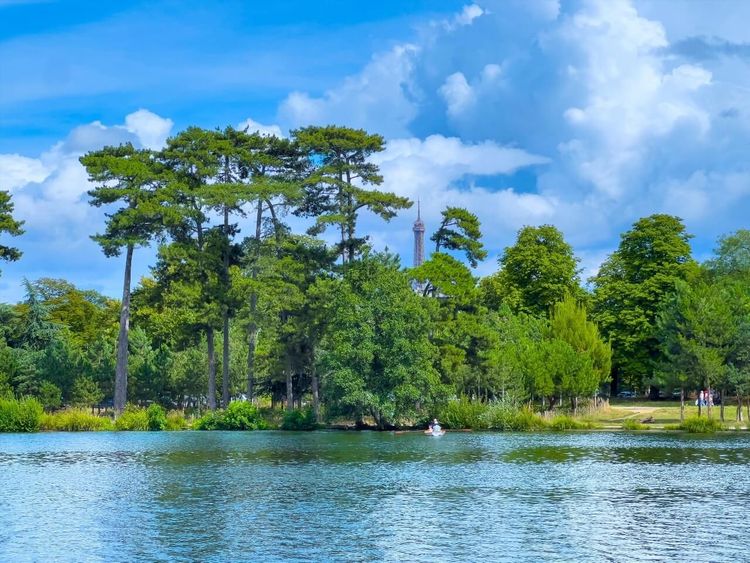
While Vincennes embodies a popular, family-friendly Paris, the Bois de Boulogne (16th arrondissement) carries a more aristocratic image linked to its racecourses and prestigious villas. In reality, its 846 hectares of roads and paths offer freely accessible circuits, some entirely separated from car traffic: a dream playground for bike rides, with a variety of settings that defies its upmarket reputation.
The Lac Inférieur is the classic starting point: you can reach it from Porte Dauphine metro station (line 2) in 5 minutes by bike. The road bordering the lake on its western bank offers a promenade of approximately 2.5 km with views over the rowing boats and the Chalet des Îles, a riverside café on an island accessible only by rowing boat ferry. Heading north, the Route des Lacs connects the Lac Inférieur to the Lac Supérieur along 3 km of shaded avenue, before reaching the Grande Cascade, an artificial waterfall built under Napoleon III.
For the full circuit from Porte Dauphine, allow 12 kilometres to connect the two lakes, ride alongside the Hippodrome de Longchamp (Route des Tribunes, 75016 Paris, rated 4.4/5 on Google with 3,927 reviews) and return via the Route de la Muette. Near the racecourse, the Fondation Louis Vuitton (architect Frank Gehry, opened in 2014) rises from the vegetation with its stacked glass sails, accessible from the wood via a shuttle from Porte Maillot. It is one of the most spectacular contemporary buildings in Europe, visible from the cycle path on a clear day.
Note: several roads in the Bois de Boulogne remain open to cars on weekdays. Stick to the inner paths marked in green on maps available at the entrance, and save Sundays for the most extensive bike rides, when traffic is at its lightest.
Cycling in Montmartre, the Challenge Worth the View
Saying you're cycling around Montmartre makes Parisians smile. The butte peaks at 130 metres and its streets are often cobbled. Yet the cycle paths encircling the hill and a few well-chosen streets make it possible to reach the plateau without exhausting yourself, provided you know the approach. These bike rides reward the effort with one of the finest moving views in the capital, and the descent ranks among the most enjoyable anywhere.
The gentlest approach starts from the Place de Clichy (17th/18th arrondissements) via the Rue Caulaincourt: a moderate incline, Art Nouveau buildings, the Cimetière de Montmartre on the left with the tombs of Stendhal, Berlioz, Dalida and Truffaut. From Caulaincourt, the Rue Lepic climbs towards the Moulin de la Galette, now a restaurant, and the Vignes de Montmartre (14 Rue Saint-Vincent, 75018 Paris, rated 4.5/5 on Google with 134 reviews), the only working vineyard within Paris intra-muros, producing approximately 1,500 bottles per year, auctioned off each October during the Fête des vendanges de Montmartre.
For those who prefer to avoid a head-on ascent, the approach via the Rue du Mont Cenis from the north offers a more gradual gradient with far fewer cars. The Sacré-Cœur reveals itself gradually as you climb this side, which is often more striking than arriving via the steps of the Parvis, crowded with tourists during peak season. To complement your visit with an audio commentary on the bohemians and cabarets, the Ryo tour of the butte Montmartre tells the story of the plateau in 18 stops recorded on location.
The descent via the Rue des Abbesses or the Rue des Trois Frères is one of the most enjoyable moments of the itinerary: independent shops line the way (vinyl record stores, comic book shops, delicatessens), and the gradient provides a perspective view over the zinc rooftops of the 18th and 9th arrondissements. From the Abbesses, you can ride on to Place Pigalle and then the Canal Saint-Martin via the cycle path along the boulevard de Rochechouart, for a total outing of 3 hours from the Place de Clichy.
Paris Left Bank, from the Eiffel Tower to the Quartier Latin
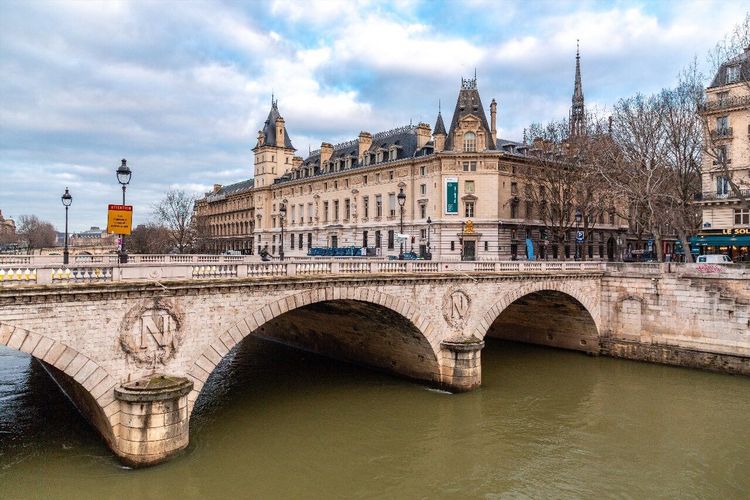
The left bank is often reduced to its museums and Saint-Germain in the tourist imagination. By bike, it reveals a succession of open spaces, gardens and vistas that make it one of the most enjoyable bike rides in Paris once you leave the main boulevards.
Start at the Champ-de-Mars (7th arrondissement), the large lawn at the foot of the Eiffel Tower. The park itself is closed to cyclists, but the quays bordering it to the north allow you to arrive by bike from the Seine riverbanks or the Pont d'Iéna. The view of the Eiffel Tower from the Pont d'Iéna is the one that appears on virtually every postcard: arrive in the morning or evening to avoid the dense midday crowds.
From the Eiffel Tower, head north-east towards the Invalides: the Esplanade des Invalides is accessible by bike, and the gilded dome of the Hôtel des Invalides is visible for 2 km on a clear day, distinguishable from other Parisian domes by its genuine gold leaf, reapplied during successive restorations.
To reach the Quartier Latin without facing the boulevard Saint-Germain during the week, the Rue de Vaugirard (the longest street in Paris at 4.4 kilometres) provides a quiet alternative that passes the Musée Rodin before opening onto the surroundings of the Jardin du Luxembourg. The garden itself is closed to cyclists, but the Boulevard Saint-Michel running along its façade has a continuous cycle path.
From there, the climb to the Panthéon via the Rue Soufflot is short (400 metres) but fairly steep. The 83-metre dome dominates the rooftops of the 5th arrondissement, and the square is often peaceful even in high season. To complete your exploration with an audio commentary, the Ryo audio-guided tour of the Quartier Latin, the Sorbonne and the Luxembourg is available offline via the app.
From Belleville to la Villette, Working-Class Paris
The east and north-east of Paris are often the blind spots of the bike rides featured in travel guides. That is precisely what makes them interesting.
Start from the Parc de Belleville (Rue Piat, 75020 Paris, rated 4.2/5 on Google with 6,280 reviews) (20th arrondissement), built on the heights of the hill at 108 metres above sea level. Its terraced lawn overlooks Paris to the west with a panoramic view of the Eiffel Tower, the dome of the Invalides and the Centre Pompidou. Most tourists are unaware of this viewpoint, yet it is one of the highest in the capital. The descent from the park via the Rue de Belleville or the Rue Ramponeau passes through a dense multicultural Paris, with Tunisian bakeries and African grocery shops coexisting within a few hundred metres of each other.
The Père-Lachaise (20th arrondissement) fits naturally into this itinerary. The exterior of the cemetery can be skirted by bike along the Rue de la Roquette and the Boulevard de Ménilmontant, two arteries that define the popular and creative character of lower Ménilmontant. The interior is closed to cyclists, but the Ryo audio tour of Père-Lachaise offers a guided walk past famous graves — Édith Piaf, Jim Morrison, Honoré de Balzac, Frédéric Chopin, Oscar Wilde — and through the history of the site since its creation in 1804.
From Belleville, make your way to the Canal de l'Ourcq and the Bassin de la Villette by descending towards the 19th arrondissement: 3 km of gradual downhill through the rapidly changing neighbourhood of la Chapelle. Connecting with the Parc de la Villette then allows you to continue along the canals or stop at the Grande Halle for its exhibitions. On weekday mornings, this area is one of the quietest in Paris for cycling. Just to the south, Père Lachaise unfolds as an audio-guided walk, from Chopin's grave to Édith Piaf's.
Car-Free Paris: Sundays and Cycling Days
Paris has established a system of temporary road closures that transforms certain axes into giant cycle paths, offering ideal conditions for bike rides. Knowing the schedule radically changes your experience of the city.
Paris Respire is the programme that closes several areas to cars on Sundays and public holidays from 9am to 5pm. The zones concerned include the Bords de Seine (right bank), the Marais (3rd/4th arrondissements), the Butte Montmartre (18th arrondissement) and the Mouffetard neighbourhood (5th arrondissement). In these zones, riding on the main carriageway becomes a radically different experience: you occupy lanes normally reserved for taxis and buses, with façades and monuments unobstructed on either side.
The Champs-Élysées are pedestrianised — and therefore open to cyclists — on the first Sunday of each month, from 10am to 6pm. Nearly two kilometres of the world's most beautiful avenue without a car in sight, century-old plane trees on either side and the perspective of the Arc de Triomphe at the far end. Arrive before 11am to enjoy the full width of the avenue while it is still relatively quiet.
In summer (from late June to early September), Paris Plages animates the Berges de la Seine with activities and sports areas. The cycle path remains usable, but the riverbanks are at their busiest on Sunday afternoons: opt for weekday mornings for a smooth ride along this stretch. On those car-free days, our audio-guided tour from the Concorde to the Eiffel Tower takes the Champs-Élysées without the traffic.
Bike Rental in Paris: Vélib' and Alternatives
The Vélib' Métropole is the logical starting point for your bike rides if you don't have your own wheels. The network has nearly 1,500 stations and approximately 20,000 bikes (including a large proportion of e-bikes), available on a self-service basis 24/7 in Paris and around sixty neighbouring municipalities.
2026 pricing: the Ticket-V at €3 gives you a single 45-minute ride, while the 24h Pass at €5 unlocks unlimited 30-minute rides throughout the day, with €1 per additional half-hour on a mechanical bike. For a multi-day stay, the 3-day Pass costs €20 and includes 60 minutes per ride. With a 24h Pass, the trick for bike rides of 2 hours or more is to dock the bike at an intermediate station (even briefly) and take it out again immediately: the counter resets on the free half-hour, keeping costs under control on a long outing.
Private rental shops around major stations and tourist sites offer e-bikes, folding bikes and cargo bikes for families. Expect to pay €15 to €30 per day depending on the model. This option becomes more worthwhile for outings of 3 hours or more, particularly to Versailles or in the Bois de Vincennes. For regular use, the monthly V-Plus subscription at €4.30 (free mechanical rides up to 30 minutes) or V-Max at €9.30 (up to 60 minutes included and e-bike rides at reduced rates) works out far cheaper than short-duration passes.
Safety Tips for Cycling in Paris
Paris has become far more cycle-friendly, but a few practical rules make the difference between an enjoyable day and a stressful one, so that your bike rides stay a pleasure throughout.
Axes to avoid on weekdays: the major boulevards (Haussmann, Sébastopol, Voltaire) are cyclable but dense and noisy. The cobbled streets of the Marais and Montmartre are tiring on the wrists with a standard city bike. The Seine quays, the canals and dedicated routes (Coulée verte, signposted cycleways) on the other hand offer excellent comfort.
The useful app: Géovélo (developed in partnership with Île-de-France local authorities) calculates routes prioritising separated paths and 30 km/h zones, with real-time updates on closures and roadworks. Google Maps includes cycling itineraries with reasonable accuracy but sometimes selects busier routes than necessary.
What to bring on your bike rides: a U-lock (even for Vélib' during longer stops), a water bottle (Wallace fountains are drinkable and free, with over a hundred spread across Paris), and a light waterproof jacket from November to April. A helmet is not compulsory for adults but is recommended on roads with residual traffic. Also bring a form of ID or a bank card to unlock a Vélib' if you have trouble with the app.
Escaping Paris by Bike: Itineraries in Île-de-France
Paris sits at the junction of several greenways that extend your bike rides well beyond the périphérique, with no car and no train required. Here are the three most accessible itineraries from the gates of the capital.
The most iconic itinerary is the Paris–Versailles link: from the Porte de Saint-Cloud or the Porte de Sèvres (15th/16th arrondissements), a near-continuous greenway of 22 kilometres follows the Seine to Saint-Cloud, passes through the Meudon forest and then the Versailles forest before reaching the Château de Versailles (Place d'Armes, 78000 Versailles, rated 4.6/5 on Google with 167,775 reviews) on the northern side. The cumulative elevation gain is moderate (160 metres in total) and the route is signposted with cycle signs from the Paris gates. Allow 1 hour 30 minutes for the outward journey at a relaxed pace. The return by RER C from the Versailles-Château-Rive Gauche station takes 35 minutes, and bikes are allowed outside peak hours. It is one of the best half-day cycling outings in Île-de-France, requiring no particular level of fitness.
The Bords de Marne form a second itinerary that is very easily accessible from the Bois de Vincennes: follow the Marne eastward from the Port de Joinville-le-Pont to Nogent-sur-Marne or Champigny-sur-Marne along 15 kilometres of shaded riverbank, with guinguettes still open at weekends in summer. The cycle path is continuous from the edge of the Bois de Vincennes, the terrain is entirely flat, and the riverside vegetation radically transforms the atmosphere compared to Paris intra-muros.
For more sporty cyclists, the voie verte de l'Aqueduc de la Vanne offers a lesser-known route from the Porte d'Orléans (14th arrondissement) towards the south of Île-de-France along a flat path following the former 19th-century water supply infrastructure built to serve Paris. The suburban setting is surprisingly rural in stretches, with rows of centuries-old plane trees and outer-suburbs landscapes that Paris gives no hint of. For off-road alternatives departing from Paris, our article on the best places for mountain biking in France details the single-track options accessible from the capital.
FAQ
What is the best bike ride in Paris for beginners?
The Berges de la Seine (left bank, 7th arrondissement) between the Musée d'Orsay and the Pont de l'Alma are ideal for a first ride: the path is entirely separated from traffic, completely flat and stretches approximately 2 kilometres in one direction. For a longer loop, cross via the Pont de Sully and return along the right bank for a total of 18 km with no technical difficulty. The circuit around Lac Daumesnil in the Bois de Vincennes (3.3 km, car-free) is another perfect option for a first outing, especially with children.
Can you cycle in Paris on Sundays?
Yes, and it is often the best time of the week. The Paris Respire programme closes several areas to cars on Sundays from 9am to 5pm: the Marais, the butte Montmartre, the Bords de Seine (right bank) and the Mouffetard neighbourhood. The Champs-Élysées are entirely pedestrianised and open to cyclists on the first Sunday of each month from 10am to 6pm. Outside these zones, car traffic is significantly lighter than on weekdays, making even usually busy roads far more pleasant to ride from 9am onwards.
How much does a Vélib' cost in Paris in 2026?
The 24h Pass costs €5 and includes unlimited 30-minute rides (€1 per additional half-hour on a mechanical bike). The Ticket-V at €3 gives you a single 45-minute ride, while the 3-day Pass costs €20 with 60 minutes per ride. For a full-day outing, the trick is to dock the bike at an intermediate station for a few seconds and take it out again to reset the free half-hour counter: a 2-hour ride then costs only the price of the 24h Pass. For regular use, the monthly V-Plus (€4.30) and V-Max (€9.30) subscriptions are significantly better value.
How many kilometres is a cycling tour around Paris?
The Bords de Seine loop (left bank outward, right bank return) measures 18 km and is entirely flat. To complete a full circuit of Paris intra-muros, the 'green belt' following the old railway lines and the boulevards des Maréchaux totals approximately 35 kilometres. It is not fully signposted, but the majority of the route has comfortable cycle paths. Allow 3 to 4 hours for the full tour by Vélib', including stops.
Is cycling in Paris suitable for children?
Yes, provided you choose the right areas. The Bois de Vincennes (Lac Daumesnil circuit, 3.3 km), the Berges de la Seine (left bank) and the Coulée verte René-Dumont (Promenade plantée section) are entirely safe and flat. Bike trailers are compatible with Vélib' bikes, and some private hire shops offer child seats fitted to e-bikes. Avoid the Marais, Montmartre and major avenues with young children, where interaction with pedestrians is less predictable.
Are there guided bike tours in Paris?
Several agencies offer guided group bike tours lasting 3 to 4 hours. To explore at your own pace while enjoying in-depth cultural commentary, our audio-guided tour of Paris features 19 geolocated audio commentaries across an 8.9 km route, downloadable without an internet connection and compatible with any bike or Vélib'. The app lets you pause and resume at your own pace, with no group constraints or fixed departure times.
Conclusion
Paris and cycling now form a duo that few European capitals can claim with as much conviction. The cycle paths, the pedestrianised Seine riverbanks, the canals, the surrounding forests and the Sunday roads trace an entirely different map of the city — at human scale and at the speed of a leisurely ride. Whether you have two hours or a full day, whether you arrive with your own bike or pick up a Vélib' at the Place de l'Hôtel de Ville, these bike rides adapt to your pace and your level.
To add a cultural dimension to every pedal stroke and uncover the hidden stories behind the façades you pass, the Ryo audio-guided tour of Paris guides you through the historic neighbourhoods with commentaries recorded on location, available offline. And if you feel like leaving the bike behind to explore the city on foot, our complete guide to visiting Paris in 3 days is the perfect complement to this cycling programme.
À lire également