© Shutterstock
 Votre guide Ryo
Saint-Germain-des-Prés: the Complete Guide to Paris's Iconic Neighborhood in 2026
If one image could sum up the Saint-Germain-des-Prés neighborhood in Paris, it would be a square kilometer wedged between the Seine and the Jardin du Luxembourg, where every street tells a different story. Here, a sixth-century abbey stands next to the smallest square in the capital, a century-old shop still sells rare spices in its fine food aisle, and a discreet plaque on rue de Verneuil recalls that one of France's greatest singer-songwriters lived there for twenty-two years without ever leaving. For those who want to feel the pulse of the Left Bank without getting lost in generic tourist guides, the Ryo Paris audio tour offers a useful starting point before diving into the neighborhood's details.
You'll cross paths with tourists paying nine euros for a coffee alongside fine arts students cutting through their school's inner courtyard to reach quai Malaquais in five minutes. Boulevard Saint-Germain alone is home to three historic bookshops, two cafés where Sartre and Camus used to put the world to rights, and a church whose bell tower-porch is the oldest in Paris. This guide covers the neighborhood's must-see landmarks, its lesser-known corners often missed by standard tours, and an itinerary to take in the essentials in half a day without rushing from one point to the next.
Saint-Germain-des-Prés Church and Its Iconic Square
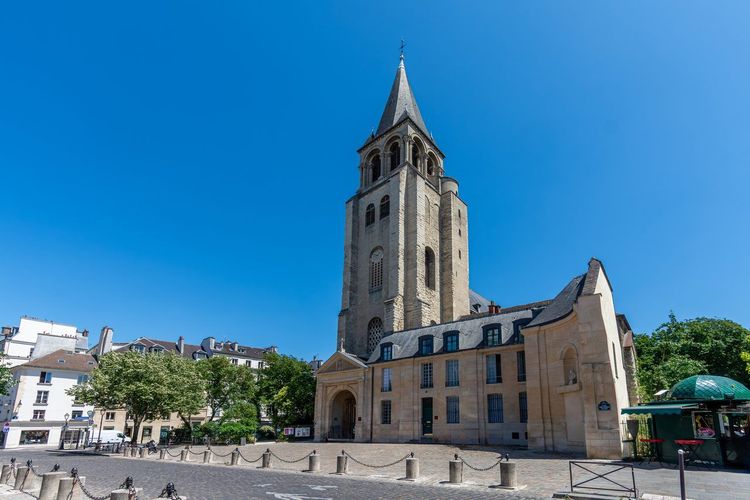
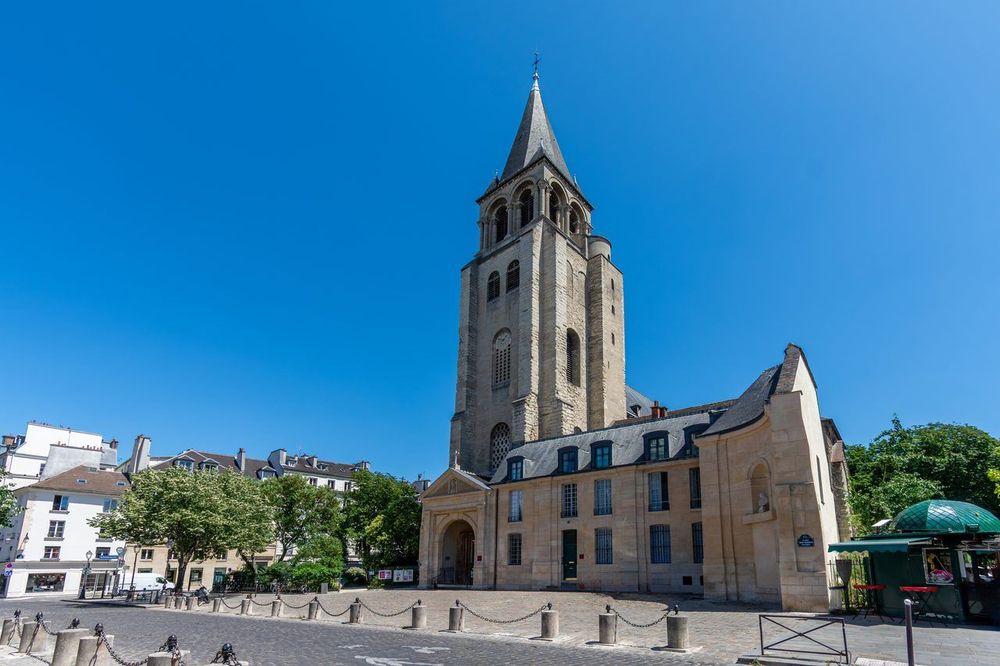
Everything logically begins with the monument that gave the entire neighborhood its name. Saint-Germain-des-Prés Church (3 Place Saint-Germain-des-Prés, 75006 Paris, rated 4.7/5 on Google from 6,360 reviews) is what remains of one of the oldest abbeys in France, founded in the sixth century by King Childebert I to house relics brought back from Spain. The Romanesque bell tower-porch, completed around the year 1000, is considered the oldest in the capital — something that often surprises visitors more accustomed to associating Paris with Notre-Dame or Sacré-Cœur.
The interior is worth a ten-minute stop, no more: the vaults painted in blue and gold in the nineteenth century, recently restored, stand in sharp contrast to the usual austerity of Romanesque churches. It was architect Victor Baltard who oversaw the nineteenth-century restoration campaign, entrusting the painted decoration to painter Hippolyte Flandrin, before a lengthy recent renovation (2016–2020) brought the frescoes back to their original brilliance.
Right in front, place Saint-Germain-des-Prés serves as a natural meeting point. Every June, the neighborhood's jazz festival of the same name is held here, with free open-air concerts drawing both locals and curious visitors alike. You'll also notice a bronze statue by Picasso, gifted by the artist to the city, quietly placed in a corner of the adjacent square — few passersby spot it on their first visit.
If you could only choose one stop in the neighborhood before moving on, this would be it: it brings together religious history, contemporary art, and neighborhood life within just a few square meters.
The Literary Cafés of Boulevard Saint-Germain
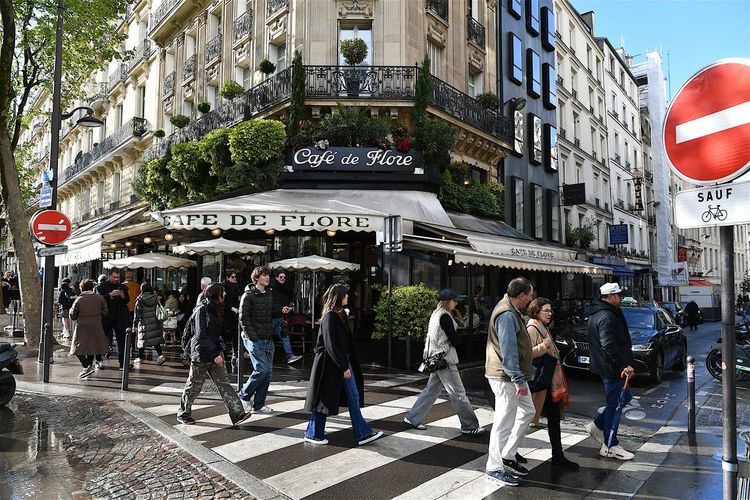
Just steps from the church, two establishments have been competing for a century over the title of the Left Bank's most mythical café. Café de Flore welcomed Apollinaire before the First World War, then Sartre and Simone de Beauvoir, who set up their writing desk there every morning — heating included in winter. Legend has it that Sartre wrote part of Being and Nothingness at his usual table on the first floor.
Just across the street, Les Deux Magots (6 Place Saint-Germain-des-Prés, 75006 Paris, rated 4.2/5 on Google from 11,949 reviews) takes its name from the two Chinese magot figurines that have adorned the interior since the café opened in 1885. The establishment launched its own literary prize in 1933, still awarded every year, and continues to attract a clientele that mixes neighborhood regulars with tourists who come as much for the photo opportunity as for the hot chocolate.
Let's be straightforward about the prices: a coffee here costs between 6 and 9 euros, well above the Parisian average. If budget matters more than legend, Brasserie Lipp, a little further along the boulevard, offers a comparable atmosphere with a menu of sauerkraut and Alsatian cuisine that draws a more local crowd. Many Parisians will tell you they prefer to sit on a terrace elsewhere and save the Flore or Les Deux Magots for a single visit — for the experience rather than the habit.
Place de Fürstenberg and the Delacroix Museum
Leaving the boulevard via rue de l'Abbaye, a surprise awaits around the bend of a narrow lane. Place de Fürstenberg ranks among the smallest and most photographed squares in Paris: four paulownia trees planted in a circle, a single central lamppost with five globes, and seventeenth-century façades that enclose the space like a theater set. Numerous fashion photographers have posed their models here, and the square has served as a backdrop in several films.
On this same square stands the Musée national Eugène-Delacroix (6 Rue de Furstenberg, 75006 Paris, rated 4.1/5 on Google from 2,142 reviews), housed in the painter's last studio and apartment, where he lived from 1857 until his death in 1863. The short visit allows you to see preparatory sketches and the private garden where Delacroix grew his own plants to study color. It is one of the least visited museums in the area, making it a welcome respite from the tourist density of the boulevard.
Allow about an hour for the square and the museum combined, ticket included. It is one of the rare spots in the neighborhood where you can pause for five minutes without a tour group crossing your path.
From the Pont des Arts to the Institut de France
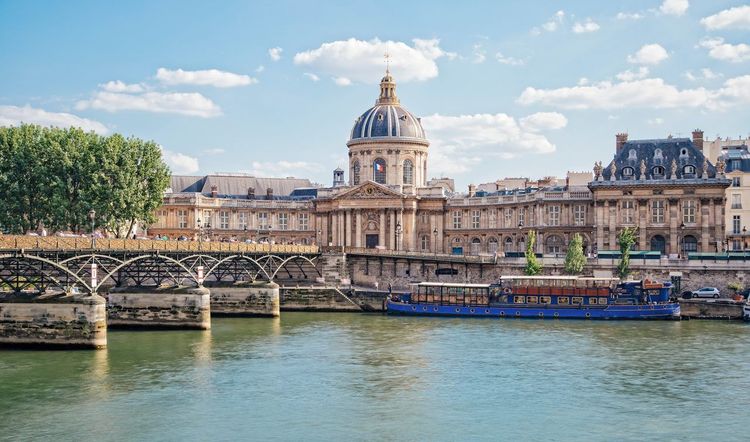
Heading back down toward the Seine along rue Bonaparte, the neighborhood changes character. The Institut de France, with its gilded dome visible from the opposite bank, houses the Académie française and four other learned academies founded under Mazarin in the seventeenth century. The building, financed by the cardinal's own bequest, remains one of the finest examples of classical architecture preserved along the Parisian quays.
Just in front stretches the Pont des Arts, a metal footbridge rebuilt in 1984 as an exact replica of the 1804 original. Long covered in love locks until their weight threatened the structure in 2014, it remains one of the best vantage points over the Île de la Cité and the Louvre. Walking across takes fewer than three minutes, but it is often the moment visitors grasp the geography of central Paris in a single glance.
On the other side of the river, the Île de la Cité comes into view, with Notre-Dame as a backdrop. To continue the walk in that direction, the audio-guided tour From the Mona Lisa to Notre-Dame covers precisely this stretch between the Louvre and the island, in direct continuity with Saint-Germain-des-Prés. Next to the Institut, the Monnaie de Paris (11 Quai de Conti, 75006 Paris, rated 4.4/5 on Google from 4,359 reviews) is also worth a detour: the oldest industrial institution in the world still in operation, it has been minting coins since 864 and now hosts contemporary art exhibitions in its eighteenth-century salons.
Le Bon Marché and Left Bank Shopping
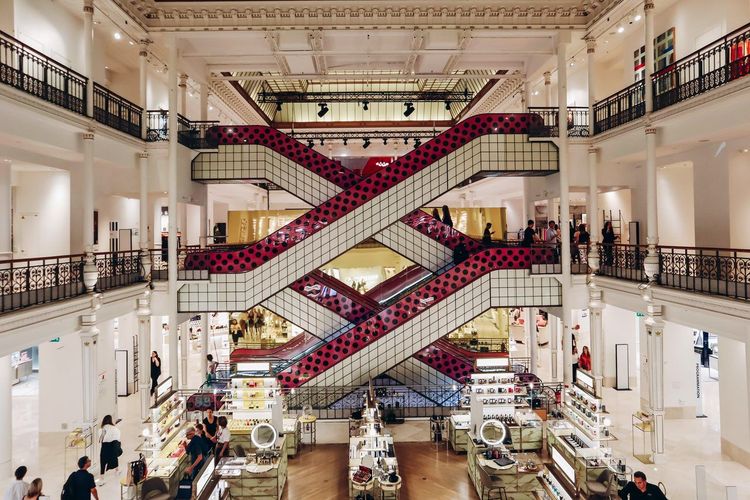
Saint-Germain-des-Prés is not just a neighborhood of museums and cafés: it is also one of the densest shopping destinations on the Left Bank. Le Bon Marché (24 Rue de Sèvres, 75007 Paris, rated 4.5/5 on Google from 22,005 reviews), opened in 1852, claims the title of the world's first department store, theorized by Aristide Boucicaut before inspiring Zola's The Ladies' Paradise. The metal and glass canopy built with Gustave Eiffel's involvement is still visible on the ground floor.
Right next door, La Grande Épicerie de Paris is worth a visit even with no intention to buy: aisles of products from around the world, meticulous presentation down to the last packet of pasta, and an international clientele that comes as much to photograph the displays as to fill a basket. Budget accordingly if you give in to temptation — prices match the venue's reputation.
Beyond these two flagship stores, the surrounding streets (rue du Cherche-Midi, rue de Grenelle) are packed with designer boutiques, concept stores, and leather goods workshops that change from season to season. This is one of the areas of Paris where wandering without a fixed agenda often proves more rewarding than following a rigid list of addresses.
The École des Beaux-Arts and the Art Scene
On quai Malaquais, the École nationale supérieure des Beaux-Arts (14 Rue Bonaparte, 75006 Paris, rated 4.5/5 on Google from 359 reviews) has occupied former monastic buildings since 1816. The inner courtyard, open to the public most days, displays casts of antique and Renaissance sculptures that historically served as models for students.
The institution has trained generations of painters and sculptors and continues to organize temporary exhibitions that are often free, announced on discreet posters near the main entrance. It is one of the rare spots in the neighborhood where you'll encounter as many paint-stained students as tourists.
Toward the Latin Quarter and the Jardin du Luxembourg
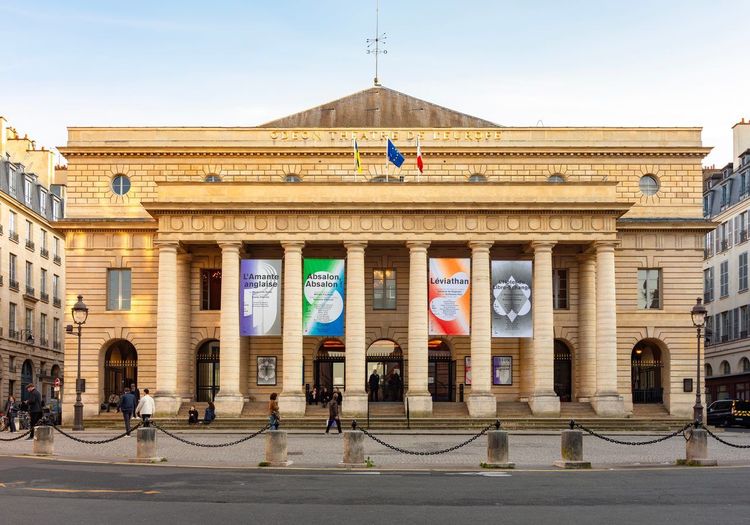
Continuing eastward, Saint-Germain-des-Prés gradually blends into the Latin Quarter, with no clear boundary other than a handful of streets. The Odéon-Théâtre de l'Europe, with its neoclassical columned façade, has been programming a European repertoire in the original language with supertitles since 1782 — a rare distinction among Paris's major stages.
A few streets away, Saint-Sulpice Church commands attention with its asymmetrical two-tower façade, left unfinished due to budget constraints in the eighteenth century. Inside, the astronomical gnomon installed on the floor gained unexpected fame after being mentioned in a puzzle novel that sold millions of copies, and visitors still come to verify the legend for themselves.
Finally, the Jardin du Luxembourg marks the neighborhood's natural southern boundary. Its 23 hectares encompass the Senate palace, an educational beehive maintained since 1856, and dozens of statues scattered among chestnut tree-lined paths. Parisians come here as much to read in a green chair as to sail a small toy boat on the grand basin — a tradition that spans several generations.
This transitional zone between the two neighborhoods is covered by the audio-guided tour of the Latin Quarter, the Sorbonne, the Panthéon, and the Jardin du Luxembourg, which naturally extends the walk for those who want to push on to the Sorbonne and the Panthéon.
In the Footsteps of Serge Gainsbourg and the Neighborhood's Iconic Figures
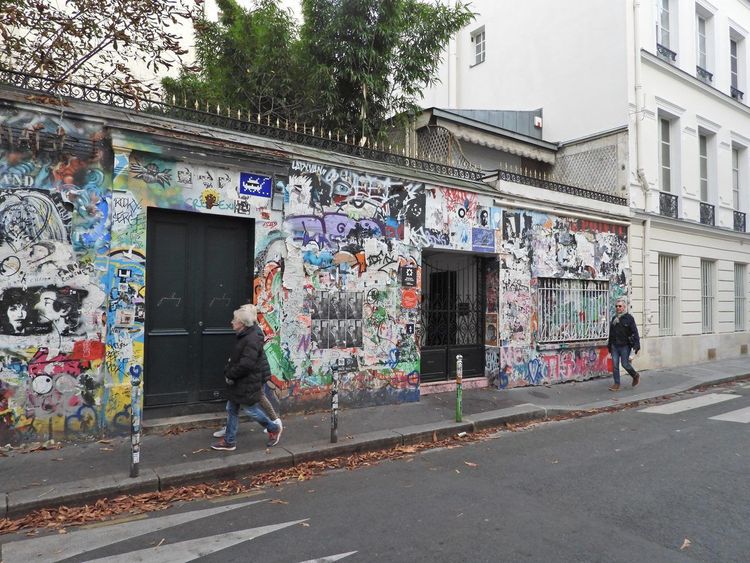
Saint-Germain-des-Prés owes part of its legend to a generation of artists who lived here more than they worked here. Serge Gainsbourg's house (5 bis Rue de Verneuil, 75007 Paris, rated 4.8/5 on Google from 6 reviews) on rue de Verneuil remains covered in tribute graffiti left by fans since his death in 1991: the city long tolerated this wall as an informal pilgrimage site before an official museum opened directly across the street in 2023.
A few meters away, several commemorative plaques recall that Boris Vian, Juliette Gréco, and Jean-Paul Sartre lived in or frequented these same streets during the postwar decades. The neighborhood then hosted a flourishing jazz scene, with basement clubs like Tabou hosting concerts until the early hours of the morning. Little remains of those physical venues today, but the plaques and street names are enough to mentally reconstruct that era while walking.
Where to Eat in Saint-Germain-des-Prés
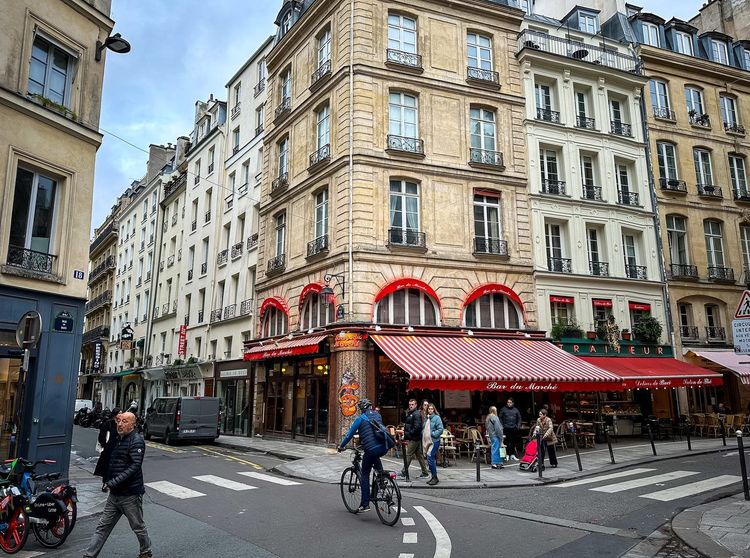
Between the tourist cafés on the boulevard and the discreet fine-dining tables tucked into side streets, the neighborhood's culinary offer covers every budget. For a quick and authentic lunch, the Marché Saint-Germain (4 Rue Lobineau, 75006 Paris, rated 4.3/5 on Google from 1,150 reviews), a covered and renovated market, offers fresh produce stalls and a few counters for a bite on the go, away from the hustle of the boulevard.
For a more serious gastronomic experience, several Michelin-starred restaurants have opened in the surrounding streets in recent years, capitalizing on the area's international clientele. Booking at least a week in advance remains essential for the most sought-after addresses, especially on weekends when the neighborhood is in full swing.
For those with a sweet tooth, Pierre Hermé's pastry shop on rue Bonaparte regularly draws a queue for its macarons, while a few more low-key tea rooms tucked inside inner courtyards offer a quieter alternative. The contrast between these two atmospheres — bustling on the boulevard, hushed the moment you step a hundred meters away — sums up the spirit of the neighborhood rather well today.
If you're looking to extend your culinary exploration of the capital beyond Saint-Germain, our article on the Musée d'Orsay also covers the best addresses on the neighboring quay, just ten minutes' walk away.
Where to Stay in Saint-Germain-des-Prés
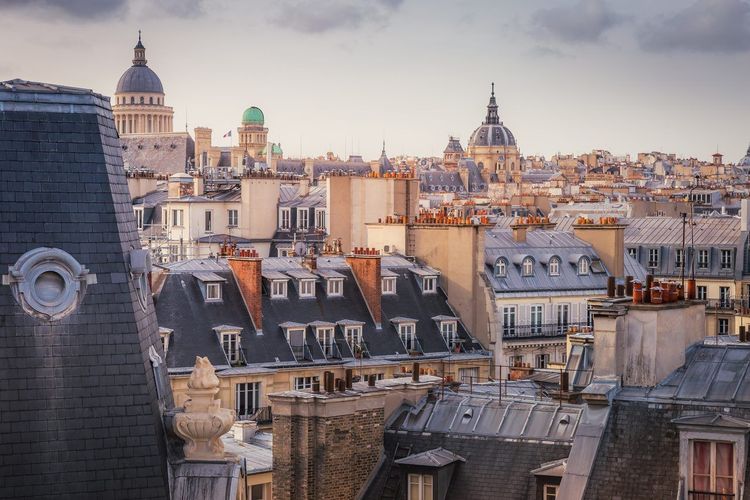
The Saint-Germain-des-Prés neighborhood in Paris has a high density of boutique hotels, often housed in former seventeenth- or eighteenth-century private mansions. Prices climb quickly: budget rarely less than 200 euros per night for a well-located establishment during peak tourist season.
For a tighter budget, streets toward boulevard Raspail or rue de Vaugirard offer more affordable options while remaining less than fifteen minutes' walk from the main points of interest. The proximity of metro lines 4 and 10 makes getting around the rest of Paris straightforward, whichever hotel you choose.
Practical Itinerary: Visiting the Neighborhood in Half a Day
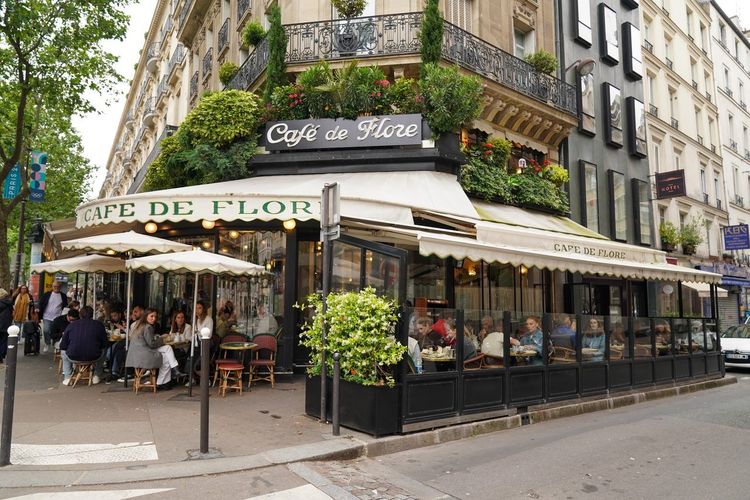
For those with three or four hours to spare, a logical sequence exists. Start at Saint-Germain-des-Prés Church and the square, then head to place de Fürstenberg and the Delacroix Museum, before descending toward the Seine via the Pont des Arts and the Institut de France. Allow time for a lunch break near Marché Saint-Germain, then head back up to the École des Beaux-Arts and finish at Le Bon Marché if shopping interests you.
This route covers roughly 2.5 kilometers on foot, easily walkable without any intermediate transport. For those who prefer a narrated framework rather than a checklist of addresses, the Ryo app offers an audio tour that follows much the same route, with historical anecdotes triggered automatically as you approach each site.
If time allows, extend the walk toward the Jardin du Luxembourg at the end: it's the ideal place to finish a stroll sitting in a green chair, rather than amid the noise of the boulevard, much like the Pont des Arts, another highlight along the Emily Cooper's Guide to Paris audio tour.
Good to Know: Access, Transport, and Best Time to Visit
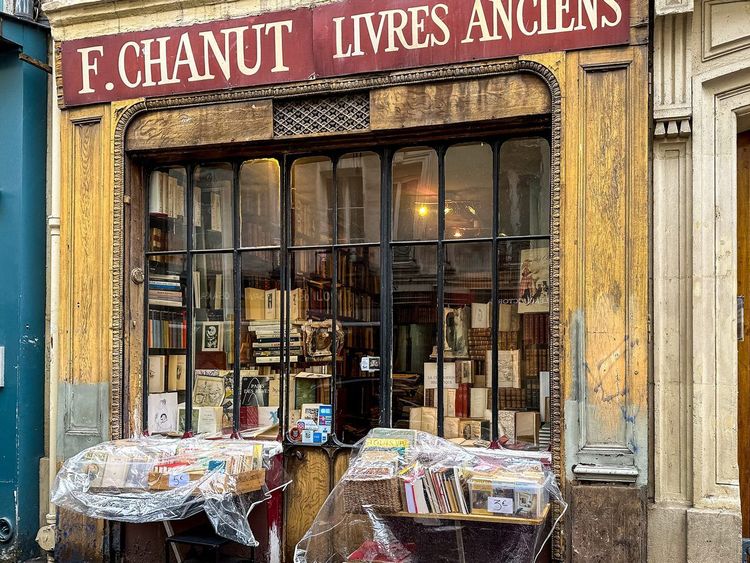
The Saint-Germain-des-Prés neighborhood in Paris straddles the 6th and 7th arrondissements, served by the metro stations Saint-Germain-des-Prés (line 4), Mabillon, and Odéon (line 10). No RER station serves the area directly, making it a neighborhood best explored on foot or by metro.
Spring and early autumn remain the most pleasant times to visit, with tourist crowds slightly less dense than in the height of summer. That said, allow yourself a comfortable budget: Saint-Germain-des-Prés remains, along with the Marais, one of the most expensive neighborhoods in the capital for dining and accommodation.
The Offbeat Side of Saint-Germain-des-Prés, Away from the Crowds
Behind the boulevard's tourist façade lie a few corners that most hurried visitors never suspect. The Cour de Rohan (Rue du Jardinet, 75006 Paris, rated 4.3/5 on Google from 12 reviews), accessed through a discreet passageway from rue du Jardinet, links three sixteenth-century cobblestone courtyards, one of which still has an iron mounting ring set into the wall that was once used by riders to mount their horses.
Further along, rue Visconti, barely 120 meters long, successively housed Balzac's printing press and Delacroix's studio before the painter moved to place de Fürstenberg. Few plaques mark these passages, but the street's atmosphere, almost entirely unchanged since the nineteenth century, gives a vivid sense of what the neighborhood looked like before the arrival of mass tourism.
Finally, many passersby are unaware that square Laurent-Prache, very close to the church, houses a work by Picasso offered to the city as a tribute to the poet Apollinaire. Unlike the Louvre or the Musée d'Orsay, access is free and open at any hour of the day, making it a quirky and quick pause between two paid visits.
FAQ
Where is the Saint-Germain-des-Prés neighborhood in Paris?
The neighborhood extends mainly across the 6th arrondissement, with an overlap into the 7th near the Bon Marché. It is roughly bounded by the Seine to the north, boulevard Saint-Michel to the east, and the Jardin du Luxembourg to the south.
Which arrondissement is Saint-Germain-des-Prés in?
Most of the neighborhood lies within the 6th arrondissement of Paris, one of the smallest but also one of the most expensive in the capital in terms of real estate and dining.
What to See in Saint-Germain-des-Prés in One Day?
The church and place Saint-Germain-des-Prés, place de Fürstenberg, the Delacroix Museum, the Pont des Arts, and the Bon Marché form the essential core, all walkable in half a day.
Where to Eat in Saint-Germain-des-Prés on a Budget?
The Marché Saint-Germain and streets away from the main boulevard offer more affordable options than the historic cafés, whose prices remain high.
Is Saint-Germain-des-Prés an Expensive Neighborhood?
Yes, it is one of the most expensive areas in Paris for accommodation and dining, comparable to the Marais or the streets around the Champs-Élysées.
How to Get to Saint-Germain-des-Prés by Metro?
Line 4 serves the Saint-Germain-des-Prés station directly, while line 10 serves Mabillon and Odéon, both just a few minutes' walk from the heart of the neighborhood.
Saint-Germain-des-Prés lends itself equally well to a two-hour whirlwind visit or a full day spent wandering between bookshops, hidden courtyards, and café terraces. What strikes visitors once on the ground is the density of stories packed into such a small area: a thousand-year-old abbey, academics, painters, and singers who all left a visible mark just a few meters from one another. To continue exploring beyond this single neighborhood, the Ryo Paris audio tour remains the best way to move on to neighboring districts without losing the thread of the city, picking the story back up at spots like the Jardin du Luxembourg or the Pont des Arts.
À lire également