© Shutterstock
 Votre guide Ryo
Cité des Sciences et de l'Industrie: The Complete 2026 Guide
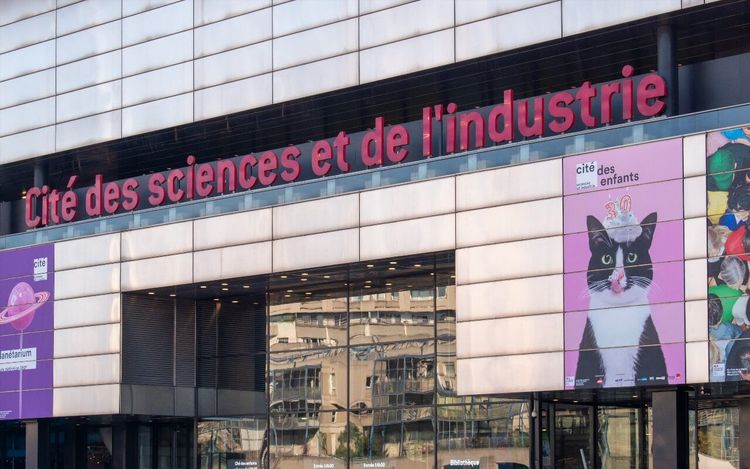
The Cité des Sciences in Paris is no ordinary museum. The moment you step into this 270-metre-long glass and steel building, you understand that something unusual is happening here: visitors don't circle exhibits behind glass — they handle things, experiment, knock things over and try again. Inaugurated in 1986 at the heart of the Parc de la Villette, in the 19th arrondissement, this former slaughterhouse shell converted by architect Adrien Fainsilber has become the largest science museum in Europe, welcoming nearly two million visitors a year.
This guide tells you everything you need to plan your visit: the spaces not to miss depending on your children's ages, the actual 2026 prices, how to avoid queues, and what to anticipate if you plan to spend a full day on site. A few useful realities before you go: the children's area runs on 1h30 time slots with mandatory booking, the Planetarium is often fully booked on weekends before noon, and La Géode, renovated by Pathé, reopened at the end of 2024 with a cutting-edge laser IMAX projector. Plan for plenty of time. If your visit is part of a longer stay in Paris, the Ryo Paris audio guide takes you through 18 audio stops and 8.9 km to discover the capital in a different way.
The History of a Monument Born from an Industrial Utopia
The history of the site begins in the slaughterhouses. Until 1979, the La Villette abattoirs processed hundreds of thousands of animals each year under conditions that local residents were increasingly unwilling to tolerate. When they finally closed after decades of deficits and controversy, what remained was a colossal reinforced concrete shell, half-built, in the middle of a 55-hectare wasteland on the banks of the Canal de l'Ourcq.
Valéry Giscard d'Estaing had launched a project for an international meat market. François Mitterrand turned it into something else entirely: one of the grand projects of his presidency, a science museum capable of rivalling the best in Europe. Architect Adrien Fainsilber won the international competition in 1980. He took the unfinished building shell and incorporated three founding principles: water (the canal and moats surrounding the structure), vegetation (the greenhouses planted at each end), and light (the enormous geodesic domes that diffuse natural light across several floors).
The Cité des sciences et de l'industrie (30 Avenue Corentin Cariou, 75019 Paris, rated 3.8/5 on Google based on 7,312 reviews) officially opened on 13 March 1986, in the presence of François Mitterrand. The building measures 270 metres long, 110 metres wide, and rises to 47 metres. No such structure had ever been dedicated to science in France. The wager was bold: convince the general public that science could be fascinating, accessible, and fun. Forty years on, with around two million visitors a year, that wager has been more than won.
What makes the building unique on a global scale is not its sheer dimensions but its architectural philosophy. Fainsilber refused to create a contemplative museum. Visitors don't file past display cases; they move through interactive installations, across suspended walkways, beneath skylights that bathe everything in diffuse light. Even without seeing a single exhibition, the building itself justifies the trip.
Explora: 30,000 m² of Science at Your Fingertips
Explora is the beating heart of the museum. It is the name of the permanent exhibition occupying floors 1 and 2 of the building, covering 30,000 m² dedicated to scientific discovery. Forget austere labels and dusty display cases — every module is designed to be touched, activated, and manipulated. You pull levers, peer through microscopes, run electric currents, observe three-dimensional holograms. It is a logic of learning through experience, applied on a grand scale.
The topics covered are organised into large thematic zones spread across two floors.
Floor 1: Life, Earth, and Society
This first floor focuses on living things in all their forms. You move through spaces dedicated to cell biology, everyday mathematics, and representations of the human body. One of the most popular installations is the earthquake simulator: you stand on a mobile platform and feel the vibrations of a tremor of varying magnitude. It's an effective way to understand what 'magnitude 6' actually means — far more striking than any infographic.
The mathematics section is remarkably well designed. Rather than explaining formulae, it makes them visible: installations on symmetry, fractals, and probability that capture the attention of children and adults alike. You regularly see entire groups spending twenty minutes in front of the same module without realising it.
Floor 2: Matter, the Universe, and Societies
On the second floor, the exhibitions shift towards physics, astronomy, and the great questions of the universe. The light and colour module is one of the highlights: you can break down the light spectrum, observe diffraction, and understand why the sky is blue and sunsets are red. It is didactic without feeling like a school lesson — a distinction that makes all the difference.
The space exploration area presents scale models of probes, reconstructions of lunar missions, and an interactive timeline of the space race. For astronomy enthusiasts, it is one of the most information-dense areas in the entire museum. Budget at least an hour for this section alone if the subject captivates you.
Installations Not to Miss
- The tropical greenhouse (floor 2): an ecosystem reconstruction with living plants and demonstrations on photosynthesis.
- The cloud wall: create your own cloud formations and understand the water cycle through direct experimentation.
- The sound modules: record your voice, understand how waves propagate, experience the Doppler effect in real time.
- The mathematics of nature installations (floor 1): Fibonacci sequences, logarithmic spirals, fractals in plants — accessible and fascinating.
How Long Does Explora Take?
The classic mistake is trying to cover everything in order. Explora is not linear. Identify two or three themes that interest you — life, space, physics, digital technology — and focus on those areas. You will easily spend two hours there without ever getting bored. A complete visit to Explora takes between three and five hours depending on your curiosity. If you are visiting with young children, the children's area will take up most of the morning, and Explora can be done in the afternoon — choose two or three spaces as priorities.
The Cité des Enfants (Ages 2–6): Learning by Touching
The Cité des Enfants is a fully separate space from Explora. It has its own entrance, its own ticket, and its own visiting logic: 1h30 time slots, in limited groups, with mandatory booking. There are two distinct areas by age: one for ages 2–6 (formerly 2–7), and another for ages 5–10. The 2–6 area reopened in June 2026 after a complete refurbishment. Both operate on successive sessions throughout the day. Worth noting: a Cité des Bébés space now welcomes toddlers aged 0 to 2, in a shorter format.
The 2–6 area is built on a simple principle: at this age, understanding comes entirely through the body. You don't read, you don't watch — you do. The space is divided into five large thematic zones.
The "Water and Light" Zone
Child-height basins allow children to play with locks, water mills, and miniature canals. Hand pumps send jets through transparent tubes. Light interacts with water to create rainbows projected on the walls. Bring a change of clothes — children invariably come out wet, and that is entirely by design. It means it worked.
The "Building" Zone
Giant foam blocks, structures to assemble, and large-scale construction sets help children understand gravity and load-bearing structures without ever using those words. An accompanying adult can join in without feeling out of place — the zone is designed for play to be shared between children and parents.
The "The Body" Zone
Distorting mirrors, sensory perception installations, a space on shadows and silhouettes. One module projects a child's body shadow onto a screen and asks them to 'fill it in' by moving their arms and legs — simple, effective, and captivating for long stretches.
The "Sounds" Zone
Instruments to explore freely, acoustic tubes that carry voices across the space, and an installation that visualises sound waves in real time. Children instinctively grasp that sound is vibration the moment they place their fingers on a vibrating membrane.
The "Building Site" Zone
Hand-cranked cranes, pallets to move, scaffolding to build. This zone recreates a mini construction site where children operate real machines scaled to their size. The hard hat provided at the entrance considerably enhances immersion.
Booking can be done online or on site on the morning from opening. On weekends and during school holidays, morning slots (10:30am, 12pm) sell out within hours. If you have a child under 6, book your time slot before even purchasing your Explora ticket — that is the golden rule for family visits.
The Cité des Enfants (Ages 5–10): Science in Action
The 5–10 area runs on the same 1h30 slot system, but the content is noticeably different. Children are more independent here; adults accompany without taking over. The goal is for the child to formulate hypotheses, test them, observe the results, and draw conclusions. It is the scientific method, in its most enjoyable form.
Human Body Sciences
Stations let children measure their own grip strength, understand how lungs work through a giant bellows that simulates breathing, and examine CT scan and MRI images. A module on vision lets visitors explore blind spots and optical illusions — often among the most popular in the session.
Communication and Media
A miniature television studio where children can film a report, edit their sequence, and watch themselves broadcast on air. A module on information transmission explains how digital data travels through optical fibres, with striking light visualisations. Children aged 9–10 grasp and retain these concepts with an ease that often surprises their parents.
Engineering Sciences
Build bridges capable of bearing maximum weight, programme a robot to follow a course, design a small wind turbine and measure the energy it produces. These modules are the ones that keep children engaged the longest — some repeat the same experiment over and over to optimise their result. That is precisely the spirit of scientific enquiry: try, measure, correct.
Environment and Resources
How does an electricity grid work, where does tap water come from, what happens inside a landfill. These modules address ecology and sustainable development without any moralising — purely through understanding the mechanisms at play.
A practical tip: if your child is between 5 and 6, the 2–6 area may be better suited, as its modules are more sensory and less demanding in terms of reading. At 9–10, the programming and robotics modules in the 5–10 area will be far more stimulating.
La Géode: Finally Reopened in 2026
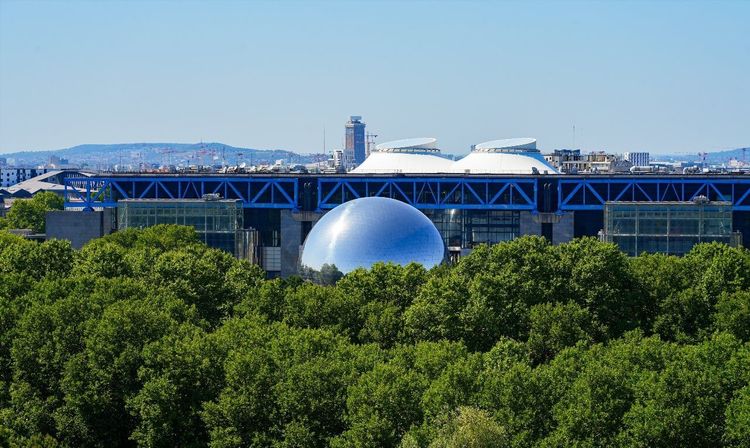
La Géode is one of the most recognisable symbols of the site. This 36-metre diameter sphere, entirely clad in mirror-polished stainless steel triangles, reflects the sky, the trees, and the surrounding façades in a play of distorted images that has fascinated generations of visitors.
Inaugurated in 1985, a year before the museum, it remained closed for several years during major renovation works. Good news for 2026: La Géode (26 Avenue Corentin Cariou, 75019 Paris, rated 4.2/5 on Google based on 1,425 reviews) reopened on 18 December 2024, now operated by Pathé. It houses the first IMAX Laser 4K dome projector installed in France, paired with an IMAX 6.0 sound system. Spectators sit in 286 reclining seats facing a hemispherical screen of nearly 1,000 m² — one of the largest in the world — that completely envelops the field of vision.
In practice, you can once again watch immersive documentaries and blockbusters projected on an enormous screen. La Géode has its own schedule, broader than the museum's: open Tuesday to Sunday from 9:30am to 10pm, and Monday from 1pm to 10pm. Its ticket is separate from Explora; a combined Géode-plus-exhibitions ticket is available if you want to do both in a single day. The sphere itself remains free to admire from the esplanade, and the distorted reflection of the main building in its steel panels is worth a few minutes of contemplation in its own right.
The Planetarium: Under the Starry Vault
The museum's Planetarium is one of the least-known spaces among the general public, yet one of the most impressive. Located inside Explora, it seats 280 people in a tilted dome auditorium. Visitors recline in adjustable seats and look up at a projection covering the entire curved ceiling — a rare contemplative experience in a science museum.
Sessions last between 20 and 35 minutes depending on the programme. Several shows rotate throughout the season: star formation, black holes, exoplanets, the history of the observable universe. Some are suitable for children from age 6; others are aimed more at teenagers and adults.
Planetarium access is included in the Explora ticket — no extra charge. However, you must collect a session ticket at the desk or kiosk as soon as you arrive at the museum. As capacity is limited, weekend slots fill up quickly. Collect your Planetarium ticket first, before you even start exploring Explora, even if the session is two hours away.
A practical detail often overlooked: the Planetarium is air-conditioned in summer and heated in winter. It is a perfect space to catch your breath in the middle of a long day's visit.
Temporary Exhibitions
Alongside Explora, the museum permanently hosts several temporary exhibitions on current scientific topics. These exhibitions occupy dedicated rooms and typically change every six months to a year. In 2025–2026, recurring themes revolve around artificial intelligence, climate change, genetics, and neuroscience.
These exhibitions are often more in-depth than the permanent modules of Explora, addressing audiences who want to go beyond basic science communication. They regularly invite scientists for lectures and practical workshops. Check the full programme on the official website before your visit: a well-chosen temporary exhibition can become the highlight of your day.
Access is generally included in the Explora ticket, but some special exhibitions require a separate ticket. Check this when purchasing to avoid any unpleasant surprises at the entrance.
The Médiathèque and the Carrefour Numérique
Two complementary spaces deserve a mention, often overlooked by passing tourists.
The Médiathèque de la Cité is a science library open to everyone, free of charge, on presentation of a valid ID. It holds a collection of 300,000 documents: books, scientific journals, videos, and digital resources. Entry is free and entirely independent of the Explora ticket. For secondary school students and undergraduates working on science projects, it is a valuable and vastly underused resource.
The Carrefour numérique² is a space dedicated to innovation: 3D printers, laser cutters, coworking areas, robotics workshops. It also hosts open-access Fab Labs during certain time slots. This is where the venue steps beyond its role as a museum and becomes a genuine tool for collective creation. Both spaces are accessible from the esplanade without going through the Explora ticket desks — useful if you want to extend your day without an additional ticket. For the rest of the trip, our audio walking tour from the Louvre to Notre-Dame runs to 23 stops along the Seine.
Opening Hours and Prices 2026
Opening Hours
The museum is open:
- Tuesday to Saturday: 10:00am – 6:00pm
- Sunday: 10:00am – 7:00pm
- Closed on Mondays, 1 January, 1 May and 25 December
For the children's area, sessions begin at 10:30am (first slot) and the last session ends around 5:30pm for the 2–6 area and 6pm for the 5–10 area. Arrive before 10am if you want to secure a spot in the first session without queuing.
Explora Prices 2026
| Visitor | Price | |---------|-------| | Adult (full price) | €15 | | Reduced rate (ages 6–25, teachers, large families, sustainable mobility) | €12 | | Under 2 years | Free | | Job seekers, recipients of minimum social benefits | Free |
Good to know: contrary to a common misconception, 18–25-year-olds residing in the European Union do not benefit from the free admission reserved for national museums here. At the Cité, they are eligible for the reduced rate of €12.
Cité des Enfants Prices 2026
The children's area is charged separately from Explora, per person per session (adults and children at the same rate):
| Session | Price per person | |---------|------------------| | Full price | €15 | | Reduced rate | €12 |
Combined Tickets
A combined ticket allows you to pair Explora and the children's area for around €19 at full price — slightly less than the sum of the two individual tickets. If you plan to visit several spaces in a single day, buy this combined ticket online before you arrive; you will also avoid queuing at the cash desk. Online sales generally open 30 days in advance.
Permanent Free Admission
The following visitors are always admitted free to Explora, regardless of the time of year:
- Children under 2 years old
- People with disabilities and their accompanying carer
- Job seekers (proof required)
- Recipients of RSA and minimum social benefits
Is the Cité des Sciences Free on Sundays?
This is one of the most frequently asked questions, and the answer often comes as a surprise: no, admission is not free on Sundays.
Many visitors confuse it with the national museums (the Louvre, Musée d'Orsay, etc.) which open for free on the first Sunday of the month from November to March. The La Villette site is managed by the public institution Universcience, not by the national museums. It therefore does not participate in the free first Sunday scheme. Sundays are paid-entry days just like any other opening day, and the Explora ticket remains at the standard price of €15.
So How Can You Get in for Free?
Free admission does exist, but it depends on your profile, not the day of the week. The following are admitted free year-round: children under 2, job seekers, recipients of RSA and minimum social benefits, and accompanied people with disabilities. Visitors aged 6–25 benefit from a reduced rate of €12.
There are also occasional free-entry windows: during the Fête de la Science in early October, access to Explora is generally free for an entire weekend. It is the ideal opportunity to discover the site at no cost, though it gets very busy — arrive at opening time. For the rest, check the official calendar before your visit, as special promotions can vary from season to season.
Getting There: Access and Transport
The museum is very well served by Paris public transport.
By Metro
The Porte de la Villette station (line 7) drops you off a 5-minute walk from the main entrance. Line 7 passes through the Opéra, Châtelet, and Place d'Italie, making it easy to reach the site from most tourist areas of Paris. From Gare du Nord, take line 5 to Stalingrad, then line 7 one stop north.
By Tram
The T3b stops at Porte de la Villette — convenient if you are coming from the eastern arrondissements of Paris (Nation, République, Vincennes).
By Bus
Lines 139, 150 and 152 serve the Porte de la Villette stop. Slower than the metro, but useful if your starting point is poorly connected by rail.
By Bike
Vélib' stations surround the site. The Parc de la Villette is criss-crossed by cycle lanes, and you can lock your bike at the racks at the park entrance. In summer, the ride along the Canal de l'Ourcq from the Bastille is one of the most pleasant in Paris — allow around 30 minutes of easy cycling.
By Car
Not recommended at weekends. Car parks around the Parc de la Villette are limited and often full by 11am. An underground car park is accessible from Avenue Corentin Cariou, but it fills up quickly on busy days. Public transport is strongly preferable — it will save you considerable frustration.
Tips for a Successful Visit
Book in Advance, Without Exception
For the children's area, online booking is not merely advisable — it is essential during school holidays and weekends. Morning slots (10:30am, 12pm) can sell out within hours. The official website allows booking up to 30 days in advance. Lock in your slot as soon as your visit date is confirmed; do not leave it until later.
For the Planetarium, no online booking is possible: session tickets can only be collected on site upon arrival. Get them first, before you even step into Explora.
Plan by Age
Under 6: morning session in the 2–6 children's area (10:30am or 12pm slot), a quick lunch, then free exploration of the most accessible Explora zones (sound, light, water). Avoid modules that require reading or following complex instructions.
Ages 6–10: start by collecting your Planetarium ticket at opening, then explore Explora floor 1 (body, mathematics, life), have lunch, and finish with the 5–10 children's area in the afternoon.
Teenagers and adults: prioritise Explora, focusing on areas that match your interests. The Carrefour numérique² is often overlooked by tourists — it is worth an hour.
The Lunch Break
The on-site restaurant (Explora floor 1) is convenient but pricey for a family. An alternative: step outside to the Parc de la Villette with a picnic bought in advance. You can leave the building for lunch and re-enter with your all-day ticket.
Avoiding Peak Hours
Opt for Tuesdays and Wednesdays outside school holidays — these are the quietest days. Friday afternoons after 2pm are also calm. The worst times are Saturday between 11am and 3pm, and school holiday afternoons. If you visit on a Sunday, arrive at opening: attendance rises sharply by mid-morning.
Exploring Paris Differently
If your stay extends across several days, our Ryo app offers audio tours through the capital's great neighbourhoods. The Ryo Paris audio tour covers 18 stops and 8.9 km. What You Can't See in a Single Day
Let's be honest: a full day on site is not enough to see everything. Nobody leaves having visited every corner of the museum. The idea is to identify what matters to you and to go deep into those spaces, rather than skimming across twenty. If you live in the Île-de-France region, an annual pass pays for itself in two visits — the offer changes regularly with the temporary exhibitions.
The Parc de la Villette: What to Do Before or After
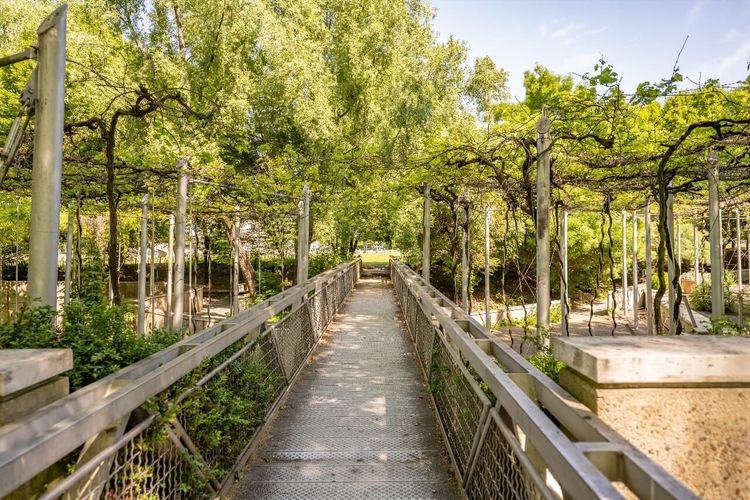
The museum is just one element of the Parc de la Villette. Designed by architect Bernard Tschumi between 1982 and 1998, the park spans 55 hectares on either side of the Canal de l'Ourcq — it is the largest urban cultural park in Paris, with a density of facilities that no other Parisian green space can match.
The Philharmonie de Paris
To the south of the park, the Philharmonie de Paris (inaugurated in 2015, designed by Jean Nouvel) is one of the most acclaimed concert halls in Europe. Its silvered aluminium façade engages in a visual dialogue with the sphere of La Géode — a striking effect when seen from the esplanade. If you are in Paris on a weekend evening, check the programme: concerts typically begin at 8:30pm, and discounted discovery sessions are available for under-28s.
The Grande Halle de la Villette (211 Avenue Jean Jaurès, 75019 Paris, rated 4.5/5 on Google based on 5,035 reviews)
The former main hall of the slaughterhouses, listed as a historic monument, is today a versatile venue for performance and exhibition. Its 19th-century metal structures host trade fairs, salons, concerts, and theatre productions. It opens its doors for major cultural events — check the programme if you are passing through.
The Follies, Gardens, and the Canal
The park is dotted with 26 small red pavilions known as 'follies', designed by Tschumi to punctuate the space. Some house children's workshops, cafés, and information points. Between the follies, themed gardens succeed one another: the Jardin des dunes et des vents, the Jardin des frayeurs, the Jardin des miroirs. These spaces are free and open to all year-round.
Walking along the Canal de l'Ourcq heading east towards Pantin is a pleasant stroll on foot or by bike. The canal has been redeveloped in recent years with floating cafés and lively outdoor spaces. This rapidly changing neighbourhood reveals a side of Paris that classic tourist itineraries completely ignore.
In summer (generally July–August), the park hosts an Open-Air Cinema on the triangle lawn: free nocturnal screenings, often themed, drawing several thousand spectators seated on the grass. It is one of the most popular free evenings in Paris — arrive early to choose your spot.
FAQ
Is the Cité des Sciences Free on Sundays?
No. The site is managed by Universcience, not by the national museums, so it does not participate in the free first Sunday of the month scheme. Sundays are paid-entry days like any other opening day. Free admission depends on your profile, not the day: children under 2, job seekers, recipients of RSA and minimum social benefits, and accompanied people with disabilities are admitted free year-round. Visitors aged 6–25 benefit from a reduced rate of €12. Occasional free weekends do exist, notably during the Fête de la Science in October.
What Are the Opening Hours of the Cité des Sciences in 2026?
The museum is open Tuesday to Saturday from 10am to 6pm and Sunday from 10am to 7pm. It is closed on Mondays, as well as on 1 January, 1 May and 25 December. For the children's area, sessions begin at 10:30am and the last session ends between 5:30pm and 6pm depending on the space. La Géode, operated by Pathé, has extended hours (until 10pm). These hours may be adjusted on special public holidays, so always check before visiting.
Is La Géode Open in 2026?
Yes. After several years of closure for renovation, la Géode reopened on 18 December 2024, now operated by Pathé. It is equipped with the first IMAX Laser 4K dome projector installed in France and an IMAX 6.0 sound system, in a 286-seat auditorium facing a hemispherical screen of nearly 1,000 m². It has its own schedule (Tuesday to Sunday until 10pm) and a separate ticketing system from Explora.
From What Age Can Children Visit the Cité des Enfants?
The 2–6 area welcomes children from age 2, and a Cité des Bébés space is now open to toddlers aged 0 to 2. Between 2 and 5, each child must be accompanied by an adult. The 5–10 area is aimed at older children, with one adult per two children accepted. Children between 5 and 6 may use either space depending on their reading ability.
How Much Time Should I Allow to Visit the Cité des Sciences?
For a visit including Explora and a session in the children's area, allow a full day — around 7 to 8 hours on site. If you only visit Explora without the children's area, half a day of 3 to 4 hours covers the main zones. The Planetarium adds 20 to 35 minutes depending on the programme, and La Géode around 45 minutes per screening. Families with young children often find their pace slowed by the interactive modules — children spend far longer there than adults expect, which is a good thing.
How Do I Book for the Cité des Enfants?
Booking is done online on the official website by selecting your preferred date and time slot. Tickets can also be purchased on site, but during school holidays and weekends, morning slots are often sold out before opening time. Bookings are made in your name but can be modified or cancelled up to 24 hours before the session. Buy your children's area ticket and your Explora ticket together in a single transaction to access the combined ticket, which saves a few euros overall.
Conclusion
The Cité des sciences et de l'industrie remains, forty years after its inauguration, one of the most richly layered and singular cultural experiences in Paris. This is not a museum where you look — it is a place where you do, where you test, where you fail and try again. Whether you come with toddlers for the children's area, with curious teenagers for Explora and the newly reopened La Géode, or alone for an immersive dive into the temporary exhibitions on artificial intelligence, the site offers a depth of content that few cultural venues in Paris can equal.
Prepare your visit in advance, book your children's slot as soon as your date is confirmed, and allow plenty of time. And if your stay extends across several days in Paris, the Ryo audio-guided tour of Paris is waiting for you to explore the capital on foot: 19 audio stops, 8.9 km, the monuments and neighbourhoods that make up the soul of the city.
À lire également