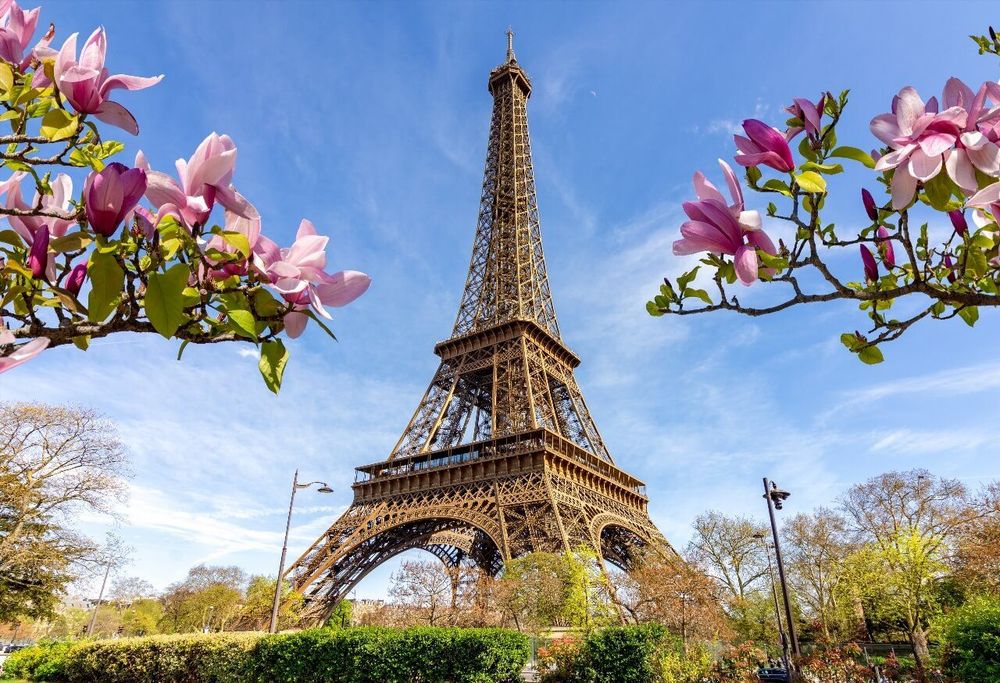
© Shutterstock
 Votre guide Ryo
Paris Monuments: Complete Guide to the 20 Must-See Sites in 2026
Paris boasts historical monuments like no other European capital: over 2,000 years of history can be read in stone, from the Roman forum beneath the Latin Quarter to the glass windows of the Louvre Pyramid. Some visitors arrive with a list of five names; they leave with the feeling of having barely scratched the surface. To explore all of Paris's monuments coherently, you need a mental map of the neighborhoods, not just a ranking. The Ryo audio-guided tour of Paris covers the Champs-Élysées over 8.9 km in 3h40, and is an excellent starting point for understanding the geography of Parisian heritage.
In this guide, you'll find the 20 essential monuments: the Eiffel Tower and its structure of 7,300 tons of puddled iron, Notre-Dame de Paris whose reconstructed spire now rises to 96 meters, the Louvre which houses over 35,000 works on display, the Opéra Garnier with its Grand Staircase in Carrara marble, Père-Lachaise where 70,000 concessions rest. For each monument, you'll find historical context, impressive data and practical advice that truly changes the visit. Our audio walking tour from the Concorde square to the Eiffel Tower links several of them across 8.9 km, from the Madeleine church to Avenue Kléber.
1. The Eiffel Tower
It's hard to imagine that the Eiffel Tower was greeted with a protest petition signed by three hundred artists and intellectuals in 1887. Gustave Eiffel defended his project against all odds: a metallic structure of 330 meters (including antennas), entirely bolted without welding, designed for the 1889 Universal Exhibition and initially intended to be dismantled after twenty years. It is today the most visited paid monument in the world, with over 7 million visitors per year.
The structure weighs 7,300 tons of puddled iron, assembled in 18,038 metal pieces connected by 2.5 million rivets. It expands by 15 cm in strong heat and sways slightly in strong wind, a phenomenon foreseen in Eiffel's calculations. Three levels are accessible to the public: the first (57 m), the second (115 m) and the summit (276 m by elevator). The view from the second floor offers the best balance between proximity to details and panorama of the Seine; the summit, in strong wind, can be disappointing if visibility is poor.
Practically speaking, book online absolutely several weeks in advance for evening slots, particularly popular. The stair fare (up to the 2nd floor on foot, €14.80) is much cheaper than the elevator (€36.70 for the summit) and allows you to discover the mechanics of the structure from the inside. On weekdays in the morning, queues remain manageable.
A little-known curiosity: Gustave Eiffel had a private apartment at the summit, which can now be glimpsed with its reconstructed period furniture. Thomas Edison visited him during the Universal Exhibition. The tower lights up every evening at dusk with 20,000 bulbs; every hour, a five-minute sparkle makes it recognizable from any point in the capital.
2. Notre-Dame de Paris
On December 8, 2024, after five years of titanic work, Notre-Dame de Paris reopened its doors. The fire of April 15, 2019 had destroyed the medieval spire and a large part of the roof; the reconstruction mobilized 2,000 craftsmen from all over France and donations exceeding €840 million collected worldwide. The new spire, identical to Viollet-le-Duc's, rises to 96 meters and is once again visible from the Seine quays.
The cathedral is a masterpiece of French Gothic. Its construction began in 1163 under Bishop Maurice de Sully and was completed around 1345. The western facade with its three sculpted portals, of the Last Judgment, the Virgin and Saint Anne, constitutes an open book of stone on medieval theology. The rose windows, including that of the north transept (13 meters in diameter), miraculously remained intact during the fire and shine with renewed brilliance since their cleaning.
Since reopening, the interior benefits from LED lighting specially designed to highlight the restored cut stone and cleaned stained glass. The visit is free but requires online reservation to manage flows. The towers, accessible separately, allow you to see the gargoyles up close and embrace Île de la Cité in one glance. To deepen the links between the Louvre and Notre-Dame, the Ryo route From Mona Lisa to Notre-Dame connects the two monuments in 22 audio tracks over 7.3 km.
3. The Louvre
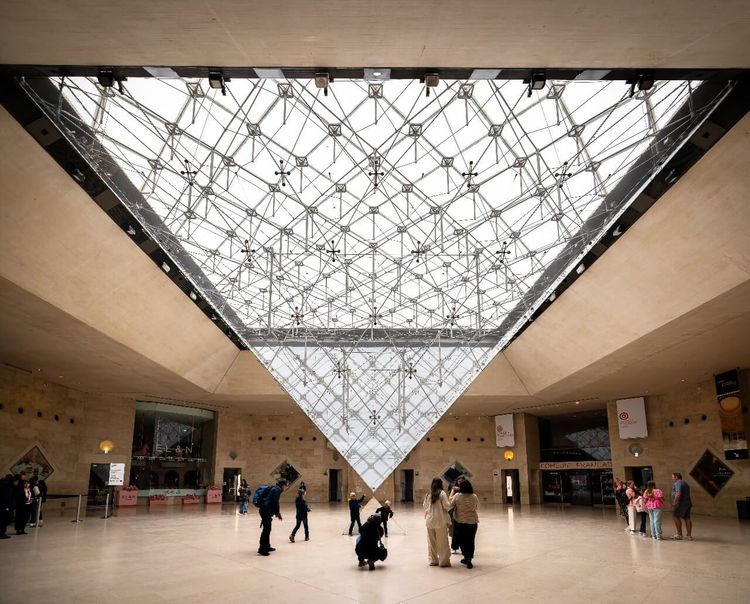
The Louvre Museum (Rue de Rivoli, 75001 Paris, rated 4.7/5 on Google for 367,656 reviews) is, by the surface area of its displayed collections, the largest museum in the world: 72,735 m² of exhibition space distributed across three wings (Richelieu, Sully, Denon). Over 35,000 works are presented there from the 380,000 in the total collection. This figure says it all: even running, you cannot see everything in one day.
The building itself is a monument. A medieval fortress erected around 1190 by Philip II Augustus, transformed into a royal palace from Francis I, expanded for four centuries by each monarch, it embodies the history of France in its stones. The Glass Pyramid by I. M. Pei, inaugurated in 1989, shocked as much as the Eiffel Tower in its time; it is now inseparable from the Parisian landscape.
Strategically, choose your angle of attack before entering. If you come for the Mona Lisa, know that it measures 77 × 53 cm and is located in room 711 of the Denon wing, surrounded by a permanent crowd that makes contemplation difficult. The Venus de Milo (Sully wing, room 346) and the Victory of Samothrace (Daru staircase, Denon wing) offer a much more serene contemplation experience at the same time. Entry is free on the first Friday of the month after 6 PM for those under 26 residing in France. For a contextualized visit of the masterpieces, consult our complete guide to the Louvre Museum.
4. The Arc de Triomphe
The Arc de Triomphe has dominated Place Charles-de-Gaulle since 1836, at the heart of the network of twelve avenues that radiate in a star towards all cardinal points of Greater Paris. Commissioned by Napoleon after his victory at Austerlitz in 1805, it was completed thirty years later under Louis-Philippe. Its 50 meters in height and 45 meters in width make it one of the most imposing triumphal arches in the world.
The high relief on the eastern facade, entitled 'La Marseillaise' and sculpted by François Rude, is considered one of the masterpieces of 19th-century French sculpture: a winged figure of Liberty leads soldiers into battle with almost violent energy. Under the arch lies the Tomb of the Unknown Soldier, surmounted by an eternal flame rekindled every evening at 6:30 PM since 1923. The summit terrace offers the only viewpoint allowing you to truly measure the Napoleonic perspective, from the Louvre Pyramid to La Défense.
Access via the underground tunnel under the Champs-Élysées: never cross the roundabout on foot, it's strictly forbidden and dangerous. Count 284 steps to the terrace, without elevator for the public. The price is €16 for an adult; free for those under 18, and for 18-25 year olds residing in the European Union. The Arc de Triomphe and the Champs-Élysées are two of the 19 stops on our audio-guided tour running from Concorde to the Eiffel Tower.
5. The Sacré-Cœur
The Sacré-Cœur basilica dominates Paris from Montmartre hill at 130 meters altitude. Its construction began in 1875, after the defeat of 1870 and the Paris Commune, in a context of national fervor and collective penitence. Architect Paul Abadie was inspired by the Romano-Byzantine style: white domes, travertine limestone whose particularity is to whiten when aging under the effect of rain, which explains its dazzling whiteness despite a century and a half of exposure to the elements.
Access on foot via the Parvis stairs offers a progressive ascent over the neighborhood, each step revealing a little more of the panorama over Haussmann rooftops. The dome is accessible separately for a 360-degree view from 83 meters. The interior apsidal mosaic, representing Christ in glory with open arms, extends over 480 m² and is among the largest in France. Entry to the basilica is free.
To explore the entire neighborhood with its cobbled streets, historic cabarets and Place du Tertre, the Ryo audio guide on Montmartre and the Sacré-Cœur offers 19 audio tracks on this unique route, taking in the Wall of Love along the way. The dedicated article on visiting Sacré-Cœur and Montmartre usefully complements this visit.
6. The Panthéon
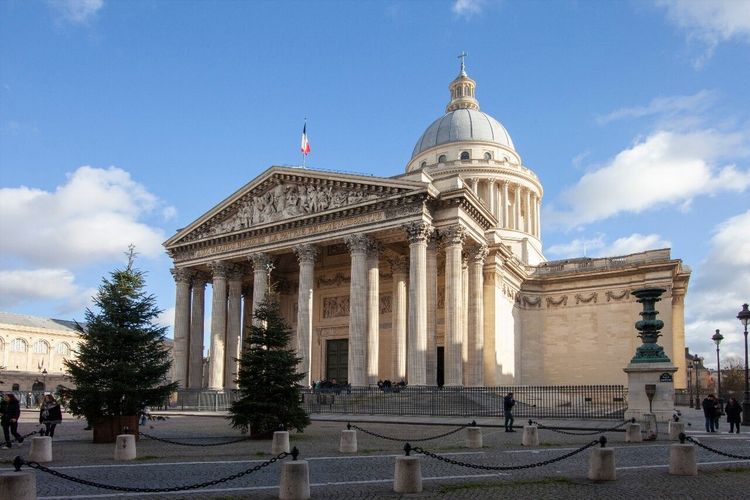
The Panthéon (Place du Panthéon, 75005 Paris, rated 4.6/5 on Google for 67,743 reviews) in the Latin Quarter is both a neoclassical masterpiece and a national tomb. Begun in 1758 by architect Soufflot as Sainte-Geneviève church, it was transformed into a revolutionary mausoleum in 1791. Its dome at 83 meters high is directly inspired by the Pantheon in Rome and St. Paul's Cathedral in London.
Under its slabs rest 80 personalities from French history: Victor Hugo, Émile Zola, Marie Curie (first woman to enter the Panthéon, in 1995), Louis Braille, Simone Veil (entry in 2018), Joséphine Baker (entry in 2021). The frieze of names carved in stone constitutes in itself a condensed lesson in republican history. Inside, Foucault's pendulum, a replica of the one installed by Léon Foucault in 1851 to demonstrate Earth's rotation, oscillates from the dome with hypnotic regularity. To tour the Panthéon, the Sorbonne and the Luxembourg Gardens in their historical context, Ryo's Latin Quarter audio-guided tour of Paris offers a complete thematic route.
7. The Sainte-Chapelle
The Sainte-Chapelle, built between 1242 and 1248 on the orders of Louis IX to house the relics of Christ's Passion, is one of the least known treasures to the general public among Parisian monuments. It is located within the Palais de la Cité, now occupied by the Palais de Justice, which causes it to often be neglected in favor of nearby Notre-Dame.
The upper chapel is a feat of Rayonnant Gothic: the stone walls have been reduced to their minimum expression to make room for 1,113 m² of 13th-century stained glass. Fifteen windows 15 meters high tell sacred history in 1,130 figured scenes. The light filtering through these red and blue glass panels creates an almost mystical effect that even the most successful photographs struggle to capture. Arrive between 3 PM and 5 PM for the most spectacular light effect; in the evening, baroque music concerts are regularly organized there. The ticket is €16, combinable with the Conciergerie at €23.
8. Les Invalides
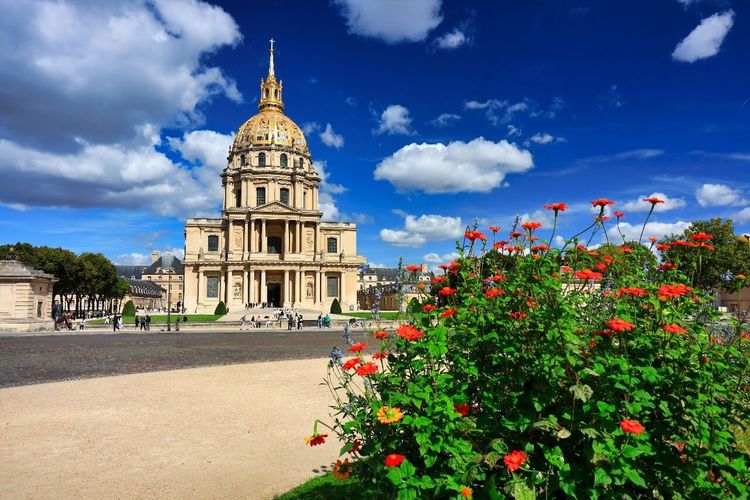
The monumental complex of Les Invalides is one of the most imposing architectural complexes in Paris. Louis XIV had this royal hotel built from 1670 to accommodate wounded or disabled soldiers: up to 6,000 pensioners resided there in the 18th century. Today, the site houses Napoleon Bonaparte's tomb, the Army Museum, the Order of Liberation Museum and the Relief Maps Museum.
The Invalides dome, topped with its gleaming gilding visible from many points in the 7th arrondissement, rises to 107 meters and is covered with 12 kg of gold leaf. Under the dome lies Napoleon's tomb, inscribed in six nested coffins and placed on a red granite base from Finland. The staging is deliberately intimidating: the circular gallery overlooks the sarcophagus below, forcing visitors to bow to look. The visit to the Army Museum allows you to trace two millennia of French military history. Our article on the Army Museum details the collections.
9. The Palais Royal
The Palais Royal is one of the places in Paris where history was made with the least apparent ceremony. Built from 1629 for Cardinal Richelieu, then transmitted to the Crown, it became in the 18th century a place of promenade, commerce and political effervescence. It was from its covered galleries that one Camille Desmoulins launched the call to revolt on July 12, 1789, two days before the storming of the Bastille.
Today, the interior garden is one of the most serene in Paris, protected from noise by its commercial galleries. Buren's columns, 260 columns with black and white stripes installed in 1986, created a controversy comparable to that of the Louvre Pyramid and have become an unmissable photographic meeting place. Garden entry is free; on weekdays, it's a haven of calm two steps from the Louvre, often ignored by classic tourist circuits.
10. The Conciergerie
The Conciergerie, on Île de la Cité, is one of the best-preserved medieval remains in Paris. Former residence of the Capetian kings transformed into a state prison under the Revolution, it embodies the dark side of Parisian heritage. Marie-Antoinette was imprisoned there from August 2, 1793 until her execution on October 16, 1793; her reconstructed cell mixes archives and period furniture.
The medieval towers, the Clock Tower (1370, Paris's first public clock), the Caesar Tower and the Silver Tower, form a Gothic silhouette on the quay. Inside, the Hall of the Men-at-Arms is a jewel of Capetian Gothic: 1,900 m² of ribbed vaults built around 1310, one of the largest preserved medieval halls in Europe. Between 1793 and 1795, nearly 2,700 condemned passed through there before their execution.
11. The Opéra Garnier
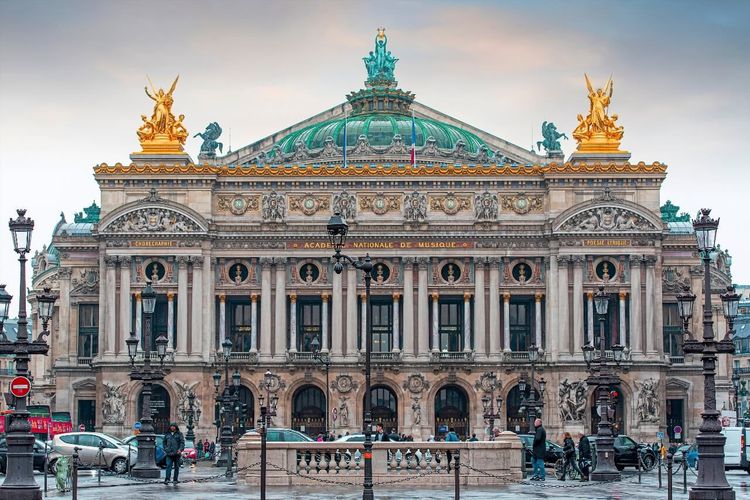
The Opéra Garnier (Place de l'Opéra, 75009 Paris, rated 4.7/5 on Google for 58,818 reviews) is one of the most spectacular buildings of Haussmann Paris, and probably the most extravagant. Commissioned by Napoleon III in 1861 and inaugurated in 1875, it was designed by young architect Charles Garnier after a competition won over 170 candidates. When Empress Eugénie asked him in what style the opera was built, he replied with aplomb: 'In the Napoleon III style, Madame.'
The facade is a festival of sculpture, mosaics and gilding. But it's the interior that stupefies. The Grand Staircase in Carrara marble, designed to be seen as much as used, Garnier thought of it as a theater within the theater, where spectators watch each other climb, remains one of the most photographed spaces in Paris. The Grand Foyer, 54 meters long, is decorated with mirrors, chandeliers and allegorical paintings that make it equal to the galleries of the greatest European palaces.
The hall can accommodate 1,979 spectators under a ceiling painted in 1964 by Marc Chagall, a controversial replacement of the original but now unanimously admired. Under the foundations lies a water table, the famous underground lake that inspired Gaston Leroux's 'Phantom of the Opera' in 1910. Visits outside performance days are possible most mornings for €14; arrive at opening to access the hall without a group.
12. The Centre Pompidou
The Centre Georges-Pompidou, inaugurated in 1977, caused an aesthetic shock in 1970s Paris: an industrial structure of colored pipes exposing its entrails outside, red for circulation, blue for air conditioning, yellow for electricity, planted in the heart of the Marais district. The controversy matched the scale of the project. Renzo Piano and Richard Rogers won the international competition over 681 projects.
Today, Beaubourg houses the National Museum of Modern Art, Europe's most important collection for the 20th century, with over 100,000 works, a public library and performance spaces. The view from the 6th floor terrace over the rooftops of Paris is worth the trip alone. To deepen the visit, our Centre Pompidou guide gives the keys to not getting lost in the collections.
13. The Musée d'Orsay
The Musée d'Orsay (1 Rue de la Légion d'Honneur, 75007 Paris, rated 4.8/5 on Google for 113,976 reviews) is housed in a former railway station built for the 1900 Universal Exhibition, the large clock on the Seine facade recalls its original vocation. Inaugurated as a museum in 1986, it houses the world's largest collection of Impressionist art: 3,000 paintings, 600 sculptures and thousands of art objects covering the period 1848-1914.
Monet, Renoir, Degas, Van Gogh, Cézanne, Gauguin, Courbet, Manet: the 5th level rooms constitute a sort of pantheon of modern painting. The central nave, with its original glass windows, gives the visit natural light that few museums can offer. Avoid Thursday evening (late night until 9:45 PM) if you seek tranquility, it's paradoxically the busiest slot. Our complete guide to the Musée d'Orsay helps plan the visit according to your interests. The ticket is €16; entry is free on the first Sunday of the month.
14. Place de la Bastille
The Place de la Bastille (Place de la Bastille, 75011 Paris, rated 4.5/5 on Google for 14K reviews) is one of the most symbolically charged places in Paris, although the eponymous prison was entirely demolished in 1790, the year following its storming. The fortress plan is traced on the ground in different colored paving stones, allowing visitors to locate themselves in the space it occupied.
In the center of the square rises the July Column, 51.5 meters high, erected not to commemorate 1789 but for the victims of the revolutionary days of July 1830. Its summit is crowned by the golden Genius of Liberty. Under the column, in the crypt, rest the 504 victims of these Three Glorious Days. The Bastille-Nation district is today one of the liveliest in Paris for nightlife and culture, with the Opéra Bastille inaugurated in 1989.
15. Place de la Concorde
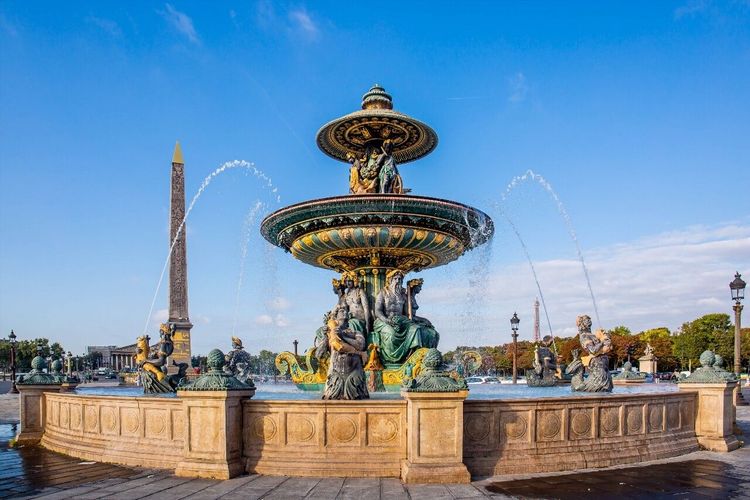
With its 84,000 m², Place de la Concorde is the largest square in Paris. It was the theater of revolutionary executions: Louis XVI, Marie-Antoinette and Robespierre himself perished there under the guillotine. Two monumental fountains (1840), two colonnades and eight statues representing major French cities border the esplanade.
The Luxor Obelisk, offered by Egypt's Viceroy Mehemet Ali in 1830 and weighing 230 tons, has reigned in the center since 1836. Over 3,300 years old, it comes from the Luxor temple under Ramesses II, it's the oldest monument in Paris. The perspective from the square is striking in both directions: towards the Louvre to the east, towards the Arc de Triomphe to the west along the Champs-Élysées.
16. Paris City Hall
The Paris City Hall (Place de l'Hôtel de Ville, 75004 Paris, rated 4.5/5 on Google for 5,039 reviews) has been the seat of the mayoralty since the Middle Ages. The current building, in French Renaissance style, was reconstructed identically after the fire of the Paris Commune in 1871. Its facade on Place de Grève, historically a place of public executions, whose name gave the expression 'to strike,' is decorated with 108 statues representing illustrious personalities linked to Paris.
The temporary exhibitions in the entrance hall are free and often of excellent quality. The building is not open for free visits outside Heritage Days (third weekend in September), but the square itself constitutes a beautiful belvedere over the right bank, with the view of Pont d'Arcole and the Seine. In winter, an ephemeral ice rink is regularly installed there.
17. Pont Alexandre III
The Pont Alexandre III is unanimously considered the most beautiful bridge in Paris. Inaugurated in 1900 for the Universal Exhibition, it symbolized the Franco-Russian alliance: the first stone was laid by Tsar Nicholas II in 1896. Its Art Nouveau architecture with its gilded lampposts, its nymphs, its cupids and its winged lions make it a sculptural promenade in its own right.
The metal deck, deliberately low (6 meters above the Seine) to not interrupt the perspective between the Grand Palais, Petit Palais and Les Invalides, is supported by cables hidden in a cast iron structure. The walk on foot in the evening, when the gilding lights up and light plays on the Seine, is one of the most spectacular walks in Paris. Our articles on emblematic bridges of Paris and the most beautiful Parisian walks extend this theme.
18. Père-Lachaise
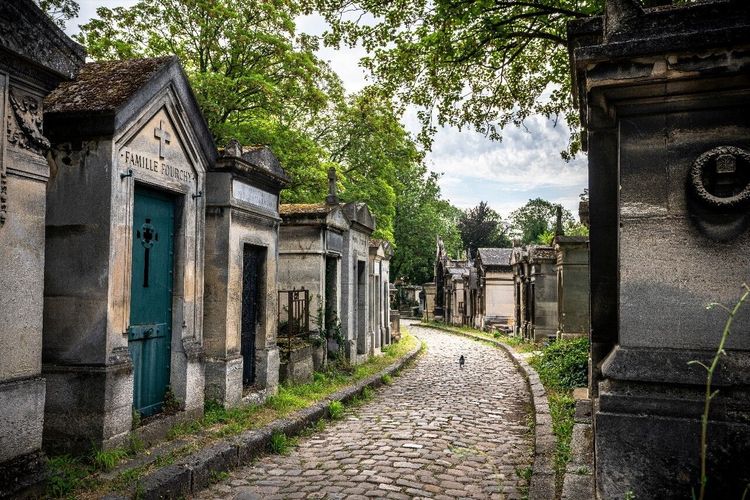
The Père-Lachaise cemetery is not just a cemetery: it's a city within the city, an open-air museum, a possible walk in any weather. Opened in 1804 on the hillside of the 20th arrondissement, it extends over 44 hectares and contains more than 70,000 concessions, including those of personalities from around the world.
The most visited graves are those of Jim Morrison (division 6), Oscar Wilde (division 89, covered with lipstick marks until a protective glass was installed), Édith Piaf (division 97), Frédéric Chopin (division 11) and Marcel Proust (division 85). But Père-Lachaise is also the place of victim monuments: the Federates' Wall, against which 147 Communards were shot on May 28, 1871, remains a place of recollection charged with historical emotion.
Architecturally, the 19th-century funerary monuments represent a catalog of neo-Gothic, neoclassical and eclectic architectures. The tree-lined avenues bordered by chestnut trees create a particularly striking atmosphere in autumn. A map is available at the main entrance, it is essential, as the labyrinth of alleys can be disconcerting. Allow at least two hours for an in-depth visit. Ryo's Père-Lachaise audio walking tour allows you to discover the most remarkable burials with their historical and artistic context.
19. Montmartre and the Butte
Montmartre is at once a historical monument, a preserved village and an artistic myth. Butte Montmartre rises to 130 meters, the highest point in Paris, and was for a century the laboratory of European modern art. Picasso, Braque, Modigliani, Utrillo, Toulouse-Lautrec worked there in conditions of destitution that did not prevent them from revolutionizing world painting.
The Bateau-Lavoir, on Place Émile-Goudeau, was the first collective studio of modern art: Picasso painted 'Les Demoiselles d'Avignon' there in 1907. Burned in 1970, it was reconstructed but keeps its commemorative plaque. Place du Tertre is the symbol of Montmartre for tourists, and one of the most saturated places in Paris in summer. Street painters have been offering portraits and souvenirs there for over a century. Arrive before 9 AM in the morning to see it almost deserted.
The cobbled streets off the tourist axes, Rue Lepic with its market, Rue Cortot (the oldest on the Butte), Rue Norvins, constitute the real Montmartre promenade. The vines of Clos Montmartre, the only active Parisian vineyard, produce each year about 1,500 bottles sold at auction for social works. The Moulin de la Galette (Moulin Radet), immortalized by Renoir in his painting of 1876, is still standing at the corner of Rue Lepic and Rue Girardon.
For a complete exploration of the district with its mythical places and picturesque geography, the Ryo audio guide on Butte Montmartre and the Sacré-Cœur accompanies you on 18 audio steps between Pigalle and the basilica.
20. The Catacombs of Paris
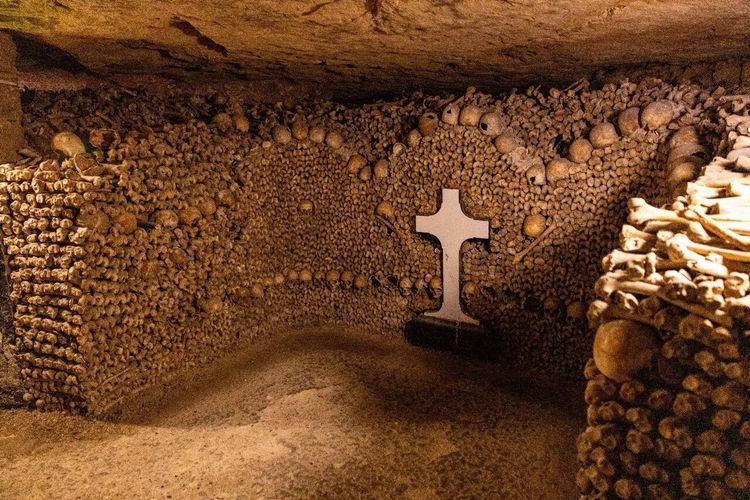
The Catacombs of Paris (1 Avenue du Colonel Henri Rol-Tanguy, 75014 Paris, rated 4.1/5 on Google for 10,527 reviews) constitute one of the most singular monuments in the world: 300 kilometers of underground galleries, of which a 2 km section open to the public houses the bones of over 6 million Parisians transferred from saturated cemeteries starting in 1786.
The descent into the municipal ossuary is a radically different experience from other Parisian monuments. After 130 steps downward, at 20 meters deep, the corridors give off a permanent coolness of 14°C. The inscription carved at the entrance, 'Stop! This is the Empire of Death,' sets the tone. The bones are arranged with almost aesthetic rigor: skulls arranged in regular lines, tibias and femurs stacked several meters high. Online reservation is mandatory, places often sell out weeks in advance. Our dedicated article on the Catacombs contains all practical advice.
FAQ
How Many Historical Monuments Does Paris Have?
Paris has over 2,500 classified or registered historical monuments, the highest concentration in France and one of the most important in the world. This figure includes civil, religious, military and funerary buildings. Several are UNESCO World Heritage sites as part of the 'Paris, Banks of the Seine' site: Notre-Dame, Sainte-Chapelle, the Louvre, the Eiffel Tower, Les Invalides and the Grand Palais.
Which Paris Monument Is Free to Visit?
Several important monuments are freely accessible: the Sacré-Cœur (interior of the basilica), City Hall during Heritage Days, the Palais Royal (gardens), Notre-Dame (interior since reopening, by reservation), the Petit Palais (permanent collections). The Louvre and Musée d'Orsay permanent collections are also free on the first Sunday of each month.
What Is the Most Visited Monument in Paris?
The Eiffel Tower is the most visited paid monument in Paris, with approximately 6 to 7 million visitors per year. If we include free-access monuments, Notre-Dame de Paris before the fire attracted over 13 million people annually. The Louvre, with its 8 to 9 million visitors, is the most visited museum in the world.
Which Paris Monument Is the Oldest?
The Luxor Obelisk in Place de la Concorde is the oldest monument in Paris: it dates from the reign of Ramesses II, 13th century BC, approximately 3,300 years ago. If we look for the oldest building constructed in Paris, the remains of the Gallo-Roman baths of Lutetia (Musée de Cluny) date back to the 2nd century AD, as does the Lutetia Arena in the 5th arrondissement.
How Long Does It Take to Visit All Paris Monuments?
Visiting all the major monuments of Paris in depth requires at least 5 to 7 days on site. Counting 2 to 3 hours for the Louvre, 1.5 hours for Les Invalides, 2 hours for the Panthéon and Sainte-Chapelle, 1 hour for Notre-Dame and travel between arrondissements, ten major monuments per day isn't realistic without sacrificing quality. Better to choose 4 or 5 monuments per day according to their geographical proximity. Our article on 3 days in Paris offers an optimized itinerary.
Where Can You See Paris Monuments from the Rooftops?
The best panoramic views from heights are found at the top of the Eiffel Tower (276 m), the Arc de Triomphe terrace (50 m, view of the historic axis), the Sacré-Cœur dome (83 m, 360° panorama) and from the Centre Pompidou terrace (view over the Marais and 4th arrondissement). The Tour Montparnasse (210 m) offers the particularity of including the Eiffel Tower in its panorama, which the Eiffel Tower itself cannot do.
Paris is better read on foot than from a tour bus. Twenty monuments in two thousand years of history is both little and immense: each building describes an era, an ambition, a political break. The entire city is an open-air museum, and the best moments are often those unplanned, an alley in the Marais opening onto a medieval facade, an interior courtyard glimpsed through a half-open door. To connect these monuments to their context and understand the stories played out there, the Ryo Paris audio-guided tour with its 19 audio tracks gives you a solid thread to begin your exploration of the capital.
À lire également