© Shutterstock
 Votre guide Ryo
Paris on Foot: The Best Walks to Explore the City in 2026
Paris rewards those who walk slowly. Not the tourist rushing from the Eiffel Tower to the Louvre with a heavy bag hunched on their back, but the real wanderer: the one who pauses in front of a half-open building courtyard, climbs a cobbled alleyway without knowing exactly where it leads, and discovers a forgotten Wallace fountain tucked in the corner of a square. Walking through Paris neighbourhood by neighbourhood is an art of living in its own right, and the city is built for it — with its 480 km of pavements, its UNESCO-listed riverbanks, and its timeless covered passages. In this guide, you will find the most beautiful itineraries to explore Paris quarter by quarter: from the Seine Riverbanks to Montmartre, from the Canal Saint-Martin to the covered passages of the 2nd arrondissement. Some walks last an hour, others a full half-day. To go even further and understand what you are walking through, the Ryo audio-guided tour of Paris accompanies you across 18 stops over 8.9 km.
The Seine Riverbanks: from Notre-Dame to the Trocadéro
The Seine riverbank walk is probably the most iconic stroll in Paris, and one of the few where you literally walk inside a UNESCO World Heritage Site. The route connecting the tip of Île de la Cité to the Trocadéro allows you to cross more than twenty centuries of history without ever leaving the waterside.
Start from the forecourt of Notre-Dame de Paris, whose restored façade has been gleaming since the December 2024 reopening. Take the time to walk around the cathedral from the east side to see the apse and flying buttresses — a view most visitors miss. From there, head down to the riverbanks towards the Left Bank via the Pont Saint-Louis.
The Left Bank Seine Riverbanks, developed into a pedestrian promenade in 2013, stretch 2.3 km between the Pont de l'Alma and the Musée d'Orsay. Deckchairs, floating terraces, and garden planters: the urban furniture is designed for unhurried wandering. At the level of the Musée d'Orsay, head back up to the embankment to admire the neoclassical façade of the former station, then continue to the Pont de Bir-Hakeim, the two-level bridge you may recognise from Inception.
From there, the Eiffel Tower rises to the right, its pillars framing the sky. Walk along the Champ-de-Mars to reach the Trocadéro: the view of the Iron Lady from the esplanade of the Jardins du Trocadéro (Place du Trocadéro, 75016 Paris, rated 4.6/5 on Google based on 149,904 reviews) remains one of the most photographed in the world, and for good reason. Allow 1h30 to 2h for this 4.5 km walk, not including stops. To enrich this route with anecdotes about each monument, the Ryo audio guide From Mona Lisa to Notre-Dame covers this area over 7.3 km and 23 commented stops.
Montmartre and the Butte: Art, Staircases, and Panoramas
Montmartre is the only village in Paris that still resists Haussmann-era uniformity. Its sloping streets, its vineyards, its still-standing windmill, its artists' studios converted into souvenir shops: the Butte is both a picture-postcard backdrop and a living, breathing neighbourhood — sometimes exhausting to climb but always magnificent to wander through.
Most visitors arrive by funicular or up the Sacré-Cœur steps. Resist: instead, climb via Rue Lepic from Pigalle, a spiralling uphill street lined with cheese shops, cafés, and the old Moulin de la Galette — the Moulin de la Galette — which Renoir painted in 1876. The climb takes ten minutes, but the street deserves twice as long.
At the top, the Sacré-Cœur imposes its white travertine silhouette. The interior is understated, but the forecourt offers a view stretching 30 km on a clear day. Head back down towards the Place du Tertre, crowded with portrait artists — an institution since 1635 — then slip into the small streets behind: Rue Norvins, Rue Saint-Rustique (the oldest on the Butte, cobbled since the Middle Ages), Rue des Saules with its vineyards and the famous Lapin Agile cabaret.
To finish, descend via the staircase on Rue Chappe to Abbesses and its independent boutiques — the Abbesses metro station has one of the rare Art Nouveau Guimard glass canopies still preserved in Paris. This full circuit covers around 3 km for 1h30 to 2h of walking. The Ryo audio-guided tour Pigalle, the Butte Montmartre and its Sacré-Cœur explores each of these sites, from the Place du Tertre to the Lapin Agile, with its anecdotes and historical context.
The Marais: Mansions, Galleries, and Rue des Rosiers
The Marais is the only major Parisian neighbourhood to have escaped the Haussmann demolitions of the Second Empire. The result: a nearly intact medieval urban fabric, with its cobbled courtyards, its 17th-century mansions, and its winding alleyways. Today, it is also one of the most vibrant neighbourhoods in Paris, with a rare concentration of contemporary art galleries, designer boutiques, and trendy bistros.
Start at the Place des Vosges, the oldest square in Paris, built under Henri IV and inaugurated in 1612. Its 36 pavilions of pink brick and white stone form a perfectly symmetrical square that even Parisians return to see regularly. Beneath the arcades you will find art galleries, antique dealers, and the Carette restaurant, whose terrace is perfect for a coffee while watching children play under the chestnut trees.
From the Place des Vosges, head up towards the Musée Picasso via Rue de Bretagne and its covered market, the Marché des Enfants Rouges (39 Rue de Bretagne, 75003 Paris, rated 4.4/5 on Google based on 4,892 reviews), open since 1615 — the oldest covered market in Paris, still active, still lively at weekends with its Japanese, Moroccan, and Caribbean food stalls. Further north, Rue des Rosiers holds the remnants of the old Jewish quarter: kosher bakeries, Hebrew bookshops, and falafel stands renowned across Paris.
End your walk at the Centre Pompidou and its public square, where jugglers and musicians put on impromptu performances. The 'inside-out' façade of the building by Renzo Piano and Richard Rogers, inaugurated in 1977, remains one of the most radical architectural shocks in the capital. The Marais walk covers around 3.5 km for 2h of leisurely strolling.
The Latin Quarter and Saint-Germain-des-Prés
The Latin Quarter stretches around the Sorbonne, founded in 1257: it is the oldest university quarter in Europe, and the only place in Paris where you can walk alongside 2nd-century Roman arenas and sit down two minutes later on the terrace of a brasserie that opened in 1686. The proximity of eras is dizzying.
Begin at the Panthéon, whose neoclassical colonnade dominates the 5th arrondissement. The crypt holds the tombs of Voltaire, Rousseau, Victor Hugo, and Marie Curie — the only woman to have entered on her own merits. Then walk down Rue Soufflot to the Jardin du Luxembourg: 23 hectares of formal French parterres, a puppet theatre, and green metal chairs arranged around an octagonal basin — one of the most pleasant green lungs in Paris for a mid-walk break.
From there, cross over to Saint-Germain-des-Prés: the abbey church of the same name is the oldest in Paris (6th century, with Romanesque towers from the 11th). The Café de Flore and Les Deux Magots opposite are reminders of the era when Sartre, de Beauvoir, and Camus wrote their manuscripts there. To dig deeper into the history of this neighbourhood, the Ryo audio-guided tour of the Latin Quarter, the Sorbonne, the Panthéon, and the Jardins du Luxembourg offers a complete route with 23 audio tracks.
The Promenade Plantée: the Elevated Garden of the 12th
Before New York had the High Line, Paris had its Promenade Plantée (Viaduc des Arts, 75012 Paris, rated 4.5/5 on Google based on 607 reviews). Inaugurated in 1993, this 4.5 km green walkway follows the former Bastille-to-Vincennes railway line, elevated around 10 metres above street level. From the Viaduc des Arts to the Bois de Vincennes (Route Circulaire, 75012 Paris, rated 4.6/5 on Google based on 28K reviews), the promenade passes through roses in summer, lime trees in autumn, and bamboo in every season.
The most spectacular entry point is the Place de la Bastille: climb the staircase behind the Opéra Bastille and you find yourself suspended above Avenue Daumesnil, looking down at the craft artisans installed in the arches of the viaduct. Luthiers' workshops, furniture designers, painting restorers: the underground section of the viaduct is home to rare trades that would not have looked out of place in the 18th century.
The promenade sees few tourists, but is much loved by residents of the 12th arrondissement for running or walking the dog on Sunday mornings. It ends with a descent into the Bois de Vincennes, making it an ideal combination with the walk described below.
The Canal Saint-Martin and the Bassin de la Villette
The Canal Saint-Martin has changed its face several times. Opened in 1825 to supply Paris with clean water, it long served as the backdrop for noir films (Arletty's dive in Hôtel du Nord). In the 2000s, it became the symbol of Parisian gentrification, with its trendy cafés, vinyl record shops, and waterside terraces. Today, it is simply a pleasure to walk at any hour.
The most interesting walk starts at the Canal Saint-Martin from the Place de la République, runs down alongside the locks — fascinating to watch when barges pass through, which happens several times an hour in season — and continues up to the Bassin de la Villette (Quai de la Seine, 75019 Paris, rated 4.3/5 on Google based on 1,778 reviews), the largest artificial body of water in Paris. Pedalo boats, rowboats, and games of pétanque on the waterside give the basin the feel of a permanent Sunday afternoon.
Continue to the Cité des Sciences et de l'Industrie in the 19th arrondissement: the 270,000 m² building set beside the Parc de la Villette is the largest science museum in Europe. La Géode, a steel sphere 36 metres in diameter, reflects the sky and the park's trees in a distortion that is worth the detour on its own. Allow 3 to 4 km for this walk, depending on whether you go as far as the Géode or stop at the basin.
The Parc des Buttes-Chaumont: Paris as an English Romantic Landscape
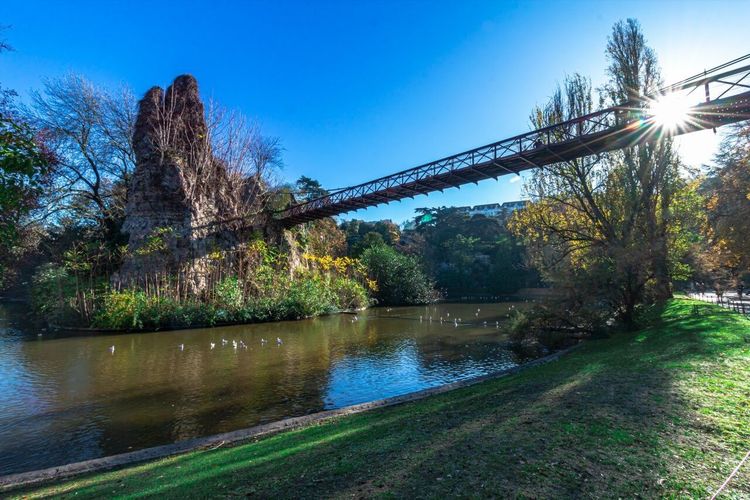
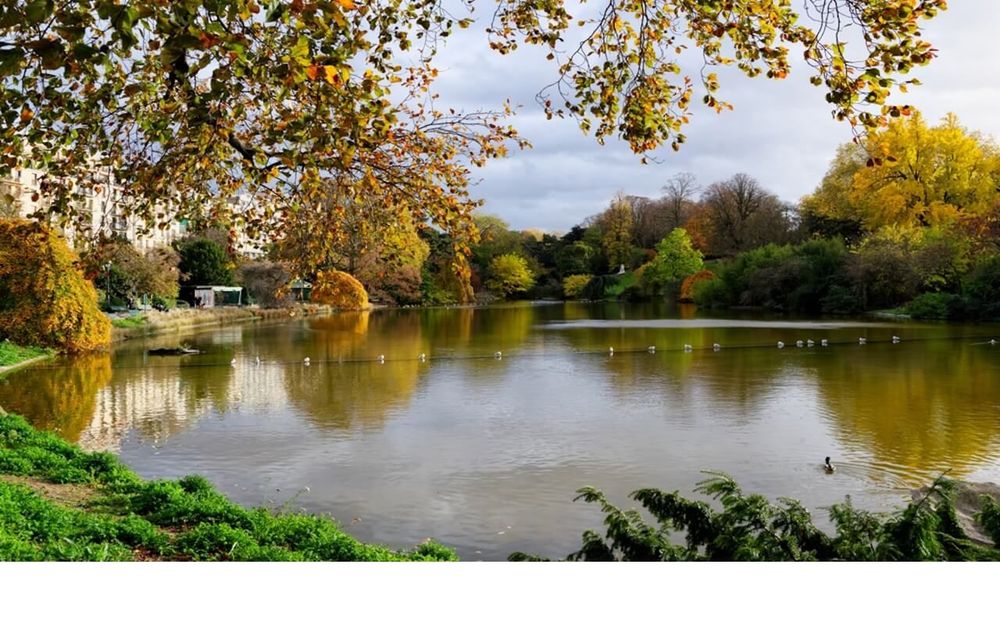
The Buttes-Chaumont is Paris's secret park. Less frequented than the Tuileries or the Luxembourg, less famous than Vincennes, it is nonetheless one of the most beautiful parks in the world for its character. Napoleon III entrusted engineer Alphand with transforming a former quarry and rubbish dump into a 25-hectare landscaped park: artificial cliffs, a lake, an island with a Greek temple at its summit, caves with stalactites, and a suspension bridge.
Climb up to the Temple de la Sibylle on the Île de Belvédère: the view over the rooftops of northern Paris, with the Sacré-Cœur on the horizon, is one of the capital's most beautiful 'secret' panoramas. The park is open 365 days a year, from dawn until 9 pm in summer (10 pm in August). Ideal on a Sunday morning before 10 am, when only joggers and dog walkers are there to enjoy it.
The Covered Passages: a Journey into 19th-Century Paris
Paris still has 24 covered passages, out of the hundred or so that existed in the 19th century. These private glass-roofed galleries, born before the department stores, housed shops, restaurants, and reading rooms. Today, they are half-preserved in amber: second-hand booksellers, stamp dealers, old-fashioned tea rooms, and a few designer boutiques that have understood the appeal of the setting.
The most enjoyable covered passages circuit takes place in the 2nd arrondissement. Begin with the Galerie Vivienne (the most elegant, with mosaic floors and glass canopies), continue to the Passage des Panoramas (11 Boulevard Montmartre, 75002 Paris, rated 4.4/5 on Google based on 5K reviews) — the oldest, opened in 1800, covered in period painted advertisements — then cross over to the Passage Jouffroy and the Passage Verdeau just opposite.
This short circuit of under 2 km takes between 1h30 and 2h if you browse the shops. It is an ideal Paris walk on a rainy day, since you are sheltered throughout. Sunday afternoon is the best time: most bookshops are open, and the light filtering through the glass canopies is particularly beautiful in the late afternoon.
The Bois de Vincennes and Its Lakes
Vincennes is the green lung of eastern Paris. At 995 hectares, it is twice the size of the Bois de Boulogne and far easier to reach from the centre. From the Château de Vincennes station (Avenue de Paris, 94300 Vincennes, rated 4.5/5 on Google based on 17,978 reviews) (RER A, line 1), you can reach the first lakes on foot in 15 minutes.
The Vincennes Lakes — Lac Daumesnil, Lac des Minimes, Lac de Saint-Mandé — are perfect for a rowing boat outing or simply for strolling along the shaded banks beneath the chestnut trees. The Château de Vincennes, a 14th-century royal fortress with its 52-metre keep still intact, is worth a stop. More unexpected: the Parc Floral de Paris, 35 hectares of botanical gardens with jazz concerts in summer. Allow half a day to properly explore this area.
The Tuileries and the Champs-Élysées Axis
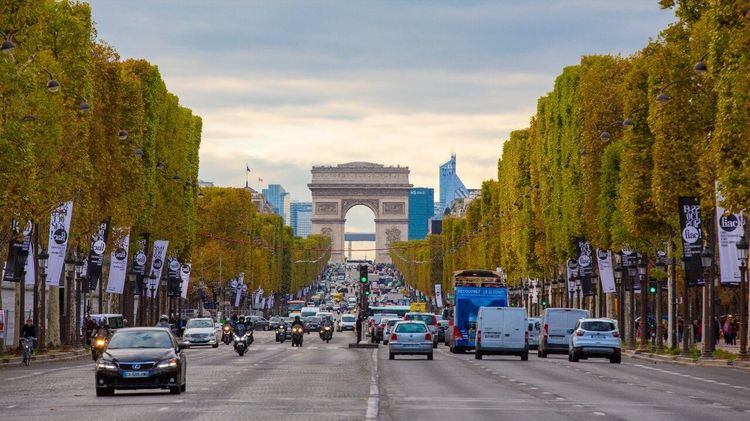
This is the greatest urban perspective in Europe: from the Louvre Pyramid to the Grande Arche de la Défense, passing through the Arc de Triomphe, the axis stretches 8 km in a straight line. A walk along this axis is as much about urban planning as it is about the monuments themselves.
The Jardin des Tuileries is the ideal starting point. Designed by Le Nôtre, this 26-hectare formal French garden stretches between the Louvre and the Place de la Concorde. Take the time to look at the sculptures by Maillol and Giacometti, and the oval basins where children sail their toy boats. Heading up towards the Place de la Concorde, notice the obelisk and the fountains — the square is one of the largest in Europe, and also one of history's most bloodstained, with more than 1,300 executions during the Revolution.
From there, the Avenue des Champs-Élysées climbs straight towards the Arc de Triomphe over 1.9 km. Climb to the top of the Arc (entrance €16 to €22 depending on the season, free for under-18s and under-26s from EU countries) for a view that reconciles you with the city even at peak hours. That axis is the one our audio-guided tour follows, from the Concorde square to the Arc de Triomphe and on to the Eiffel Tower.
Père-Lachaise: a Walk between History and Contemplation
Père-Lachaise is far more than a cemetery. Its 44 hectares make it one of the largest green spaces within Paris intra-muros, and an open-air museum of funerary sculpture, with tombs created by the greatest sculptors of the 19th century.
An hour's walk is enough to see the most famous graves: Édith Piaf, Jim Morrison, Frédéric Chopin, Marcel Proust, and Oscar Wilde, whose tomb — once covered in lipstick kisses — has been protected by a glass panel since 2011. The cemetery unfolds along shaded, gently sloping alleys with tree-lined perspectives that make you forget the urban surroundings. Maps are available at the main entrance (Boulevard de Ménilmontant), but getting deliberately lost is an equally satisfying option. To enrich this stroll with anecdotes about the personalities buried here, use the Ryo audio-guided tour of Père-Lachaise.
Romantic Paris Walks: the Most Romantic Spots
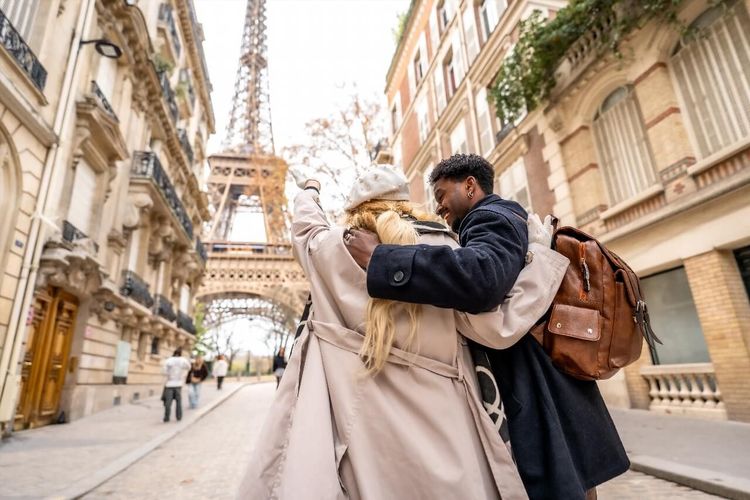
Despite being the most visited city in the world, Paris still has corners that remain surprisingly crowd-free and retain that particular quality we call, for lack of a better word, romance. Here are the most beautiful spots for a walk with a loved one.
The Île Saint-Louis, connected to Île de la Cité by the Pont Saint-Louis, is the only place in Paris where you can still have the feeling of a human-scale city: a single main street (Rue Saint-Louis-en-l'Île), 17th-century mansions, and the Berthillon ice cream shop with reasonably manageable queues outside of summer.
The Square du Vert-Galant, at the tip of Île de la Cité beneath the Pont-Neuf, is a garden set below the embankment level — reached by a discreet staircase — that offers the most enveloping view of the Seine: the two arms of the river on either side, barges passing slowly, bouquinistes on the quays. For a sunset walk with the cinematic backdrop of Paris as your setting, the Ryo route In the Footsteps of Emily Cooper offers a 7.1 km itinerary across the series' filming locations.
Paris Family Walks: Parks and Activities for Children
Paris with children requires different planning: long cobbled walks tire them out quickly, queues frustrate them, but great surprises delight them. Here are the most suitable walks.
The Jardin d'Acclimatation in the Bois de Boulogne is a historic amusement park (1860) reinvented as a modern leisure park with rides, a farm, a mini-train, and play areas. Entrance is paid and covers most attractions. Accessible from Les Sablons station (metro line 1) in 10 minutes on foot.
The Muséum National d'Histoire Naturelle (57 Rue Cuvier, 75005 Paris, rated 4.5/5 on Google based on 7,360 reviews) at the Jardin des Plantes is another perfect family option: the Grande Galerie de l'Évolution, with its taxidermied animals in procession (including a giraffe and an elephant), fascinates children aged 3 to 13. The garden itself, one of France's oldest botanical gardens (1635), is home to a menagerie with exotic animals. For Sunday family walks, the Parc de la Villette area combines open lawns, artistic play structures, and la Géode.
Sunday Walks in Paris: Good Addresses and Markets
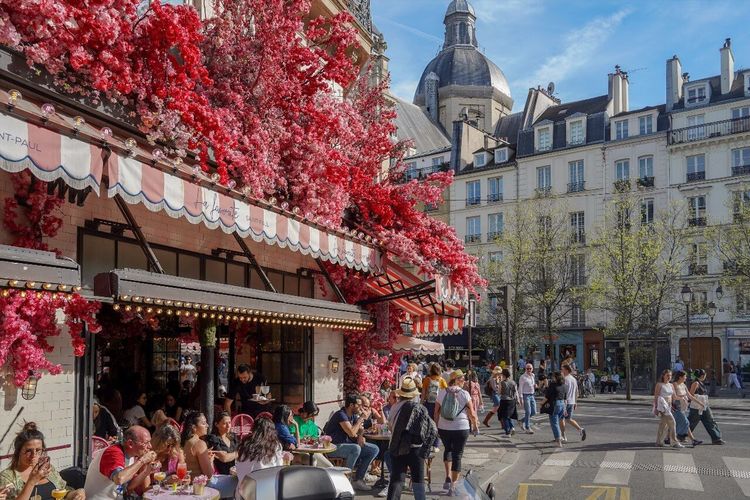
On Sundays, Paris changes pace. The riverbank roads fill with roller skaters and cyclists, markets reach their peak between 9 am and 1 pm, and some neighbourhoods — particularly the Marais — become the liveliest of the week thanks to open shops (unlike the rest of Paris, the Marais is an international tourist zone where boutiques open on Sundays).
The Marché d'Aligre (Place d'Aligre, 75012 Paris, rated 4.1/5 on Google based on 10 reviews) in the 12th arrondissement is one of the most authentic and affordable markets in Paris: fresh produce, second-hand clothing, and bric-a-brac, all within a 200-metre radius. The Marché des Batignolles (17th arrondissement, organic) and the Marché Bastille (Boulevard Richard Lenoir) are among the other Sunday morning must-visits.
In the afternoon, the Voies sur Berge are closed to traffic (on weekday evenings and all weekend on certain stretches), turning the quays into a de facto riverside promenade. Take the opportunity to head to the tip of the Île aux Cygnes, an artificial island beneath the Pont de Bir-Hakeim, where a replica of the Statue of Liberty looks out towards New York.
Paris Walks by Arrondissement: Which Area to Choose?
Paris has 20 arrondissements arranged in a spiral. Each has its own character, and your choice of starting point radically changes the experience.
1st–4th arrondissements (Historic centre): Louvre, Marais, Notre-Dame, Île Saint-Louis. Very touristy but unmissable for a first visit. 5th–6th (Intellectual Left Bank): Sorbonne, Luxembourg, Saint-Germain. Perfect for wandering without a plan. 18th (Montmartre): the Butte, vineyards, artists' studios. Unmissable but best avoided on weekends after 10 am. 11th–12th (Popular and trendy Paris): Bastille, Canal Saint-Martin, Promenade Plantée. Less touristy, more authentic. 19th–20th (East Paris): Buttes-Chaumont, Père-Lachaise, Belleville. For those who want to step away from the well-trodden routes and see a Paris inhabited by its own residents.
For a first walk in Paris, the 4th arrondissement remains the best compromise: maximum historical density, short distances, and a variety of atmospheres from the Marais to Île Saint-Louis.
How to Plan Your Walk in Paris
A few practical pointers before you lace up your trainers.
Shoes: essential — Parisian cobblestones are beautiful but merciless on thin soles. Pack walking shoes even for a 'light' day.
Transport: the metro is the backbone, but the Vélib' bike-share and the tram (lines T3a and T3b around the ring road) offer new perspectives. The Navigo Liberté+ (no subscription, pay-as-you-go) is the most flexible option for visitors.
Weather: Paris has a damp climate for much of the year. Keeping a compact raincoat on hand is a useful habit. The covered passages and national museums (free admission on the first Sunday of the month for many of them) make perfect refuges.
App: to avoid walking without understanding what you are seeing, our Ryo app offers audio-guided routes designed by history enthusiasts, available offline once downloaded.

FAQ
What is the most beautiful walk in Paris?
There is no universal answer — it all depends on what you are looking for. For scenic beauty and historical density, the Seine Riverbanks between Notre-Dame and the Trocadéro remain the absolute benchmark (4.5 km, 1h30). For a preserved village atmosphere, Montmartre is unmatched. For off-the-beaten-path charm, the Promenade Plantée in the 12th arrondissement is often cited by Parisians themselves.
How long does it take to visit Paris on foot?
Paris intra-muros covers around 105 km², a modest area, but with an unrivalled density of sites. To cover the main walks described in this guide, allow a minimum of 3 to 4 days of walking, at a pace of 6 to 8 km per day. A well-planned Sunday is enough to cover an entire neighbourhood (the Marais, Montmartre, or the Latin Quarter) in 3 to 4 hours.
What are the best romantic walks in Paris for couples?
Île Saint-Louis, the Square du Vert-Galant (the tip of Île de la Cité), the gardens of the Palais-Royal, and the Canal Saint-Martin at sunset are the most romantic options. For a guided itinerary with a cinematic backdrop, the Ryo route 'In the Footsteps of Emily Cooper' covers 7.1 km across the most photogenic filming locations from the series.
Can you enjoy a great walk in Paris with children?
Yes, as long as you choose the right areas. The Jardin des Plantes (with its menagerie), the Jardin d'Acclimatation in the Bois de Boulogne, the Parc de la Villette, and the Bois de Vincennes are the best destinations for children, with open spaces and short distances.
Which walks in Paris are best on a Sunday?
On Sundays, the morning markets (Aligre, Bastille, Batignolles) are unmissable until 1 pm. In the afternoon, the riverbank roads closed to traffic offer a car-free waterside stroll. The Marais is one of the few major commercial neighbourhoods open on Sundays, a distinctive feature that makes it a popular destination for a leisurely Sunday among Parisians.
Is there an app for walking tours in Paris?
Several apps offer walking itineraries in Paris. Ryo in particular offers themed audio-guided tours: the main Paris route (19 audio tracks, 8.9 km, 3h40) covers the Champs-Élysées and the city-centre monuments; sub-routes specifically cover Montmartre, Père-Lachaise, the Latin Quarter, and the footsteps of Emily Cooper. Content can be downloaded and works offline.
Conclusion
Paris reveals itself to those who accept the invitation to slow down. Every arrondissement hides secret courtyards, forgotten fountains, and façades that even the guidebooks overlook. The city rewards curiosity over speed — a principle you can apply any Sunday, with or without a precise plan.
To turn every walk into a genuine experience of understanding the city — not merely a stroll between two monuments — the Ryo audio-guided tour of Paris accompanies you at your own pace, with the stories and anecdotes that give meaning to everything you walk through.
À lire également