



Walk
From the Concorde square to the Eiffel Tower
Paris, France
Walk
From the Concorde square to the Eiffel Tower
Paris, France
8.9 km
Distance
3h40
Durée
19
Audios
Loop
Parcours
Shutterstock
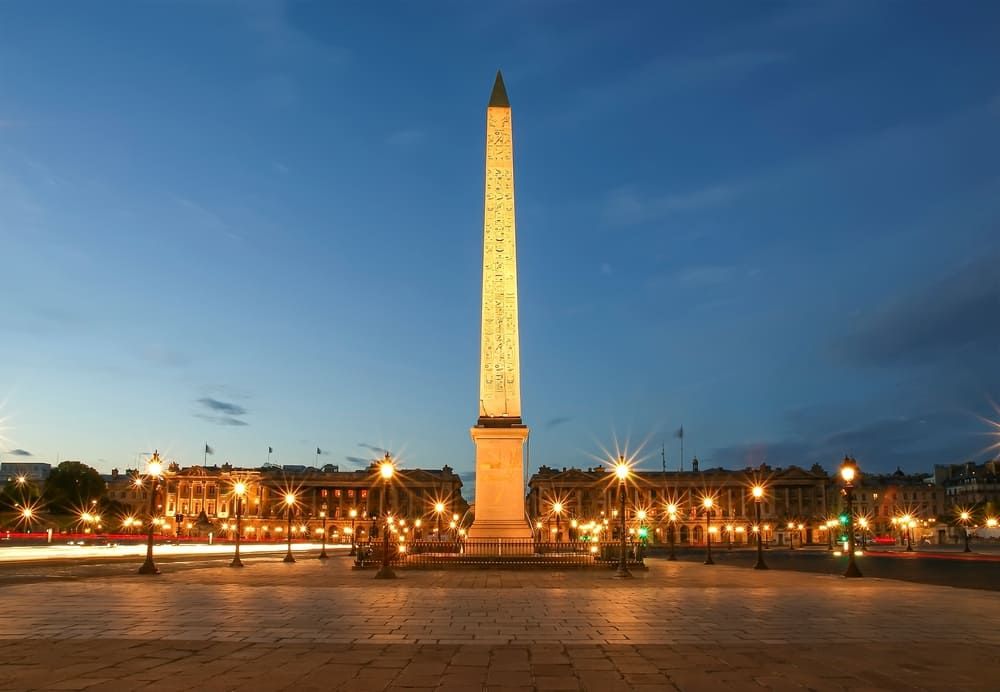
The Paris audio-guided tour leads you to the Place de la Concorde, the largest square of the capital and one of the most beautiful, where the history of France meets a grandiose perspective towards the Champs-Élysées.
The square was created at the end of the eighteenth century at the request of Louis XV, under the direction of the king's first architect, and first took the name of Place Louis XV, adorned at its centre with a statue of the sovereign. During the Revolution, become the Place de la Révolution, it was the scene of executions, including those of Louis XVI and Marie-Antoinette. Under Louis-Philippe, it was decided to turn this page by renaming it Place de la Concorde, a name that expresses the desire to overcome divisions. The architect Hittorff remodelled it by installing two monumental fountains and the Luxor obelisk, given in 1830 by the viceroy of Egypt Mehemet Ali; this granite monolith of some 23 metres and 220 tonnes was raised on 25 October 1836.
At the centre of the square, the Luxor obelisk, covered with hieroglyphs and topped with a gilded point, dialogues across the centuries with the Arc de Triomphe, in a perfect alignment. The two monumental fountains and the statues that mark the corners complete this setting of rare elegance. From here, the gaze embraces the Champs-Élysées on one side and the Tuileries garden on the other: an unforgettable viewpoint over Paris.
The Place de la Concorde is between the Tuileries garden and the lower end of the Champs-Élysées, in the 8th arrondissement of Paris. An open-air public space, it can be discovered freely at all hours and on the level, along the walk.
After its revolutionary past, it was renamed under Louis-Philippe to symbolise the overcoming of divisions and the aspiration to a more united society.
From the temple of Luxor, in Egypt; given to France in 1830 by Mehemet Ali, it was raised on the square in 1836.
Aucun avis pour le moment