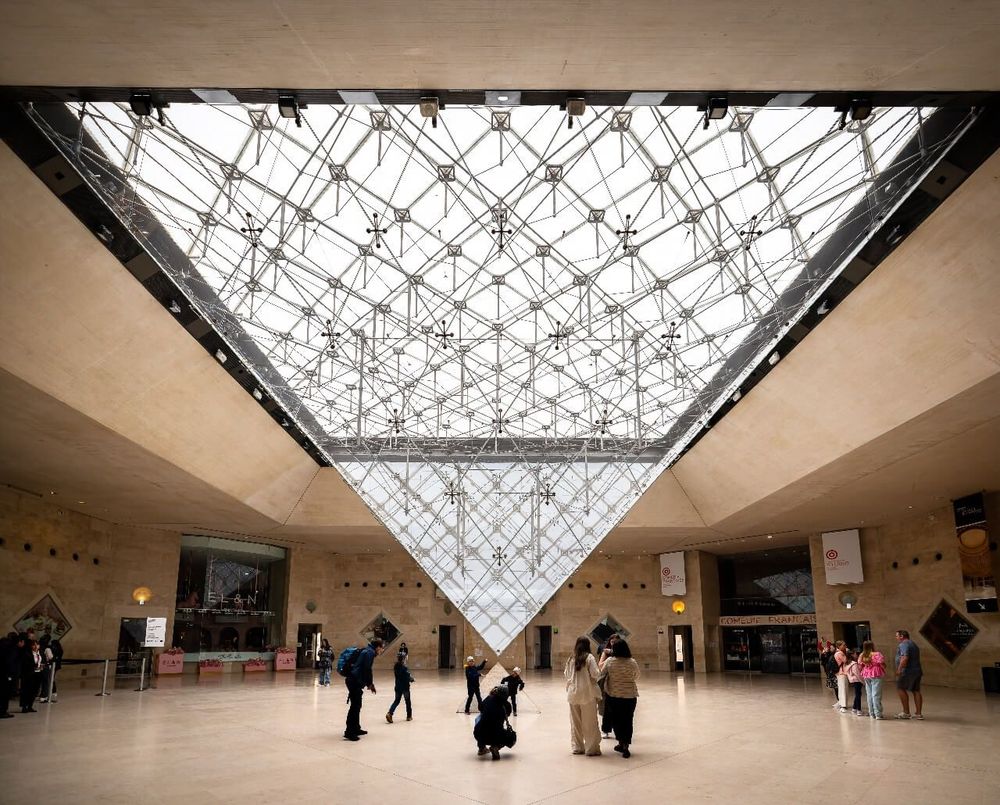
© Shutterstock
 Votre guide Ryo
The 20 Best Museums in Paris to Visit in 2026
Choosing the best museums in Paris is nearly impossible: the city is home to over 130 museums, from world-famous giants to neighborhood addresses that even Parisians overlook. Before diving into this list, a useful word of warning: the Louvre and Orsay, regarded as unmissable stops, attract queues that can exceed three hours in high season, while the Musée de Cluny or the Musée Guimet, just a few hundred meters away, sometimes welcome fewer than a hundred visitors per hour. This selection covers the twenty museums that truly deserve a visit, from universal masterpieces to collections the crowds have yet to discover. If you want to extend your exploration beyond the gallery walls and take in the city itself, the Ryo audio-guided tour From Mona Lisa to Notre-Dame takes you on a 3-hour, 7.3 km walk between the greatest monuments at the heart of Paris.
A few pointers to help you avoid unpleasant surprises: the Petit Palais is entirely free at all times, whereas most national museums charge between €12 and €22 for admission. The Cité des Sciences has a separate planetarium (additional ticket) and a nuclear submarine docked on site. The Musée Marmottan Monet holds the largest collection of Monet in the world, 300 works, housed in a private mansion that looks nothing like a conventional museum. Finally, one major calendar point for 2026: the Centre Pompidou has been closed since September 2025 for a major renovation that will last until 2030. We keep it on this list for reference, but there is no point planning a visit before the end of the decade.
1. The Musée du Louvre
The Musée du Louvre (Rue de Rivoli, 75001 Paris, rated 4.7/5 on Google from 367,896 reviews) is the largest museum in the world by floor area: 72,735 m² of permanent exhibitions spread across three wings (Richelieu, Sully, Denon) and nine levels. Its collection exceeds 380,000 works, of which around 35,000 are on permanent display. It receives nearly 9 million visitors per year, making it also the most visited museum on the planet.
A successful Louvre visit is built before you even walk in. Download the official map the night before and pick two or three rooms based on your interests: the Winged Victory of Samothrace (Daru staircase), the Venus de Milo (room 16, Denon), and the Mona Lisa (room 711) are in three distinct areas of the Denon wing — plan a logical route. If you arrive without a map, you can easily lose forty minutes trying to find your way.
The Glass Pyramid, designed by I. M. Pei and inaugurated in 1989, is today as iconic as the palace itself. Below it, the Napoléon Hall provides the main entrance, but ticket holders who booked online can also enter via the Richelieu passage (Rue de Rivoli) or through the Carrousel du Louvre — both significantly less crowded. The museum opens at 9 a.m. and is closed on Tuesdays. Book your tickets online (€22 full price, free for EU residents under 26): entering without a reservation means queues of two to three hours in summer.
A lesser-known tip: the Egyptian Antiquities galleries (ground floor, Sully wing) are consistently under-visited compared to the Italian paintings. Yet their mummies, sarcophagi, and the Karnak Decree make up one of the richest collections outside Cairo. If you have an extra hour, that is where you will spend it best.
For dining, skip the on-site cafeterias and head to the Palais-Royal gardens five minutes away on foot — prices are more reasonable and the terrace more than makes up for the short walk. Our From the Mona Lisa to Notre-Dame audio walking tour sets off from the Louvre palace and crosses the Pont des Arts.
2. The Musée d'Orsay
The Musée d'Orsay (1 Rue de la Légion d'Honneur, 75007 Paris, rated 4.8/5 on Google from 114,048 reviews) occupies a converted railway station built for the World's Fair of 1900: the great glass roof spanning the collections is a reminder of the iron-and-glass nave's past. The museum holds the world's most important collection of Impressionist and Post-Impressionist works, more than 3,000 paintings and 600 sculptures covering the period 1848–1914.
The names that define the museum: Monet, Renoir, Degas, Van Gogh, Cézanne, Gauguin, Seurat. The Van Gogh room (level 5, Seine wing) brings together The Bedroom, The Church at Auvers-sur-Oise, and several portraits from his Provençal period. The Monet room displays the large series of Rouen Cathedrals and preparatory Water Lilies before their monumental version at the Orangerie.
The building itself is an attraction: head up to level 5 to peer through the enormous glass clock and photograph Paris through the dial. This view over the Seine and the Tuileries is worth the trip even if art is not your passion.
Good to know: the museum is closed on Mondays. On Thursdays, it stays open late until 9:45 p.m. — an evening time slot that helps avoid the busiest daytime tourist flows (the evening rate drops to €12 from 6 p.m.). Full price for the rest of the week: €16, free on the first Sunday of the month. Online booking is strongly recommended: physical queues outside the main entrance on Rue de la Légion d'Honneur can exceed an hour in July and August.
An architectural detail often overlooked: the hotel that adjoined the station (now integrated into the museum, on the restaurant side) was one of the most luxurious in Paris during the Belle Époque. The museum's restaurant, with its gilding and painted ceiling, retains all that splendor — a lunch break here doubles as a heritage experience.
3. The Centre Pompidou
The Centre Pompidou (Place Georges-Pompidou, 75004 Paris, rated 4.4/5 on Google from 125 reviews) still provokes as many reactions as it did at its inauguration in 1977: this glass-and-steel "factory" painted in the colors of its systems (blue for air, green for water, yellow for electricity, red for circulation) stands as one of the most photographed buildings in Paris. Renzo Piano and Richard Rogers turned the building inside out, with all the technical structures on the outside and the space left free inside.
Key information for 2026: the Centre Pompidou is closed. The building shut its doors on 22 September 2025 for a major renovation (complete asbestos removal from the facades, fire safety upgrades, accessibility improvements, energy performance). Reopening is scheduled for 2030. No visits to the permanent collections or the terrace are possible before that date: if you are reading this guide to plan a trip, remove Beaubourg from your itinerary and refer to the other addresses on this list.
The Musée national d'Art moderne it houses holds more than 120,000 works, making it the largest collection of modern and contemporary art in Europe: Matisse, Kandinsky, Picasso (Cubist period), Duchamp, and a contemporary section from Warhol to Basquiat. During the closure, part of that spirit continues off-site through the "Constellation" program and, from spring 2027, through the Centre Pompidou Île-de-France, which will open in Massy, in Essonne.
While waiting for 2030, the best alternative for modern and contemporary art in Paris remains the Musée d'Art moderne de la Ville de Paris (number 13 on this list), whose permanent collection is free and covers the same great names of the 20th century. The Place Beaubourg, in front of the closed entrance, remains animated by street artists: it is still worth a look during a stroll through the neighborhood.
4. The Musée Rodin
The Musée Rodin (77 Rue de Varenne, 75007 Paris, rated 4.7/5 on Google from 20,409 reviews) occupies the Hôtel Biron, an 18th-century private mansion that the sculptor rented from 1908 and lived in until his death in 1917. Auguste Rodin bequeathed his entire body of work to the French state on the condition that this place become his museum — the agreement was reached and the museum opened in 1919.
The visit is divided between the mansion itself (marble sculptures and bronzes in the interior rooms, drawings, watercolors) and the garden of 3 hectares: this is where the most celebrated pieces are found. The Thinker stands at the center of the rose garden, The Burghers of Calais face the main building, and The Gates of Hell, a monumental composition measuring 6 meters by 4 that synthesizes his entire body of work, stands at the back of the garden. Explore the Ryo audio-guided tour of Paris around the Champ-de-Mars to extend your day in this part of the 7th arrondissement.
The garden alone is accessible for €4, without entering the museum's indoor galleries — one of the most affordable prices in Paris to find yourself surrounded by masterpieces in a green setting. In May and June, the blooming rose bushes make the atmosphere particularly striking.
Full admission: €14, free for under 18s. Closed on Mondays. Allow 1h30 to 2h to cover the whole site, more if you take time to sit in the garden. Avoid weekends in May and June: the garden draws both Rodin enthusiasts and local strollers.
5. The Musée de l'Orangerie
The Musée de l'Orangerie (Jardin des Tuileries, 75001 Paris, rated 4.6/5 on Google from 23,895 reviews) is a rare case in the Parisian museum landscape: a museum built entirely around a single work. Claude Monet's Water Lilies, painted between 1914 and 1926 when the painter was nearly blind, occupy two oval rooms in which the canvases wrap around for 100 meters. Monet himself supervised the arrangement of these rooms, which he never saw inaugurated — he died in December 1926, six months before the opening.
The Water Lilies rooms are lit by natural zenithal light, filtered through translucent panels to replicate the diffuse light of the Giverny studio. The effect produced — total immersion in a fragmented aquatic landscape — is difficult to capture in photographs. Arrive at opening time (9 a.m.) on a weekday: the first minutes in these rooms, almost alone, rank among the most intense artistic experiences Paris can offer.
The rest of the museum is not to be overlooked: the basement houses the Jean Walter and Paul Guillaume collection, presenting around a hundred works by Cézanne, Renoir, Matisse, Picasso, and Modigliani in a dense and rather intimate hang. This is a substantial bonus that many visitors miss by heading straight out after the Water Lilies.
Admission: €12.50, free on the first Sunday of the month and for EU residents under 26. Closed on Tuesdays. The Water Lilies room sometimes closes temporarily for maintenance — check before your visit if you are coming solely for them.
6. The Musée Picasso
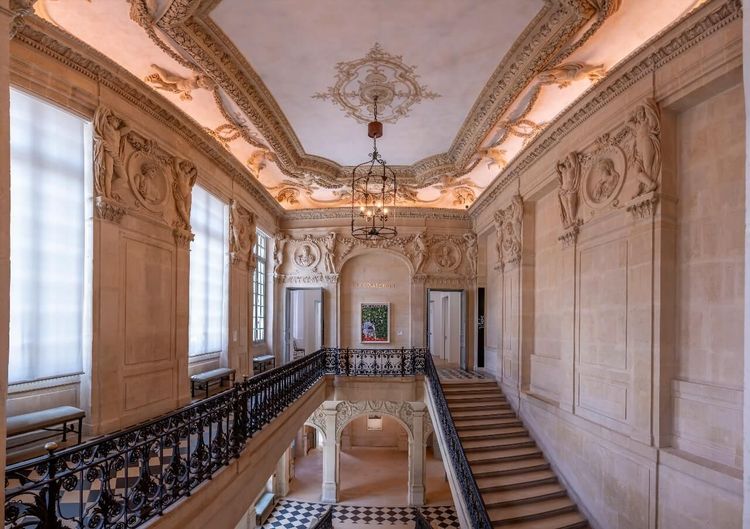
The Musée Picasso (5 Rue de Thorigny, 75003 Paris, rated 4.4/5 on Google from 14,994 reviews) occupies the Hôtel Salé, a Marais mansion dating back to 1659. It reopened in 2014 after five years of renovation and now houses the largest collection of Pablo Picasso's works belonging to a single museum: more than 5,000 pieces in total (paintings, sculptures, ceramics, drawings, prints, archives).
The permanent collection traces his major stylistic periods: Blue and Rose, Analytic and Synthetic Cubism, Neoclassicism, Surrealism, and late works. An entire room is devoted to Guernica — not the original canvas, which remains at the Reina Sofia in Madrid, but to the preparatory studies and Dora Maar's photographs documenting the creation of the work. These archives constitute an extraordinary record of the creative process.
The building itself is worth attention: the carved stone staircases, period parquet floors, and 17th-century French ceilings contrast with the 20th-century works — a successful architectural dialogue.
Admission: €16, free on the first Sunday of the month. Closed on Mondays. As the Marais is one of the most vibrant neighborhoods in Paris, combine the visit with a stroll through the surrounding streets to the Place des Vosges, fifteen minutes on foot.
7. The Musée du Quai Branly: Jacques Chirac
The Musée du Quai Branly (37 Quai Branly, 75007 Paris, rated 4.6/5 on Google from 20,340 reviews) is dedicated to the arts and civilizations of Africa, Asia, Oceania, and the Americas — a field long sidelined by Paris's great encyclopedic museums. Inaugurated in 2006, the building designed by Jean Nouvel is distinguished by its 800 m² green facade on the Seine side and by its colorful stilts that allow the garden to spread freely beneath the structure.
The permanent collections bring together more than 300,000 objects, of which around 3,500 are on rotating display in the permanent galleries. The scenography is deliberately immersive: winding paths in semi-darkness, targeted lighting on each piece, no rigid partitions between geographical zones. It is easy to get lost — and that is often where the best discoveries are made: Kuba masks from the Congo, Nok heads from Nigeria dating back 2,500 years, Papuan canoes, or Amazonian feathered headdresses.
The Tower (cylindrical structure at the entrance) is dedicated to musical instruments: more than 8,000 pieces are housed there, some visible through display cases. The museum garden, freely accessible from the Quai Branly, is one of the least-known green spaces in the 7th arrondissement — a real hidden gem for Parisians and visitors alike.
Admission: €14. Closed on Mondays. Late opening on Thursday evenings until 10 p.m. Temporary exhibitions (archaeology, photography, textile design) are often of excellent quality and programmed on themes found nowhere else in Paris.
8. The Petit Palais: Musée des Beaux-Arts de la Ville de Paris
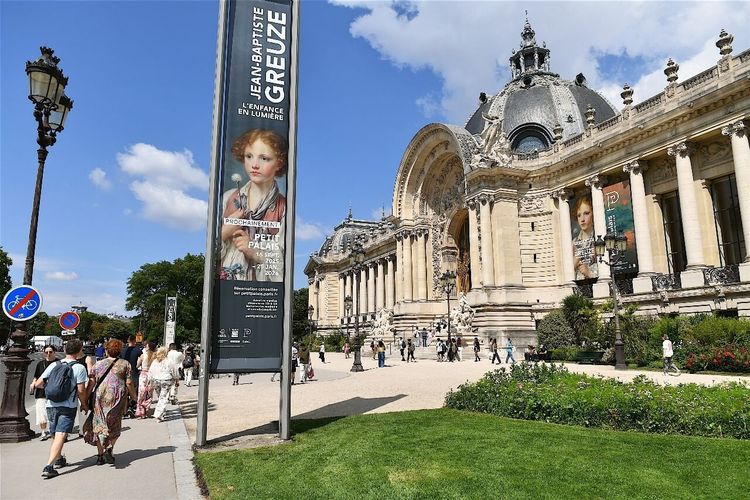
The Petit Palais is one of the Right Bank's best-kept secrets: permanent admission is entirely free, its collection is remarkable, and it remains consistently less crowded than its neighbors the Grand Palais or the Champs-Élysées. Built for the World's Fair of 1900, this quietly beautiful neoclassical building houses the municipal collections of the City of Paris.
Inside you will find paintings from Antiquity to the early 20th century, a French and international decorative arts collection, sculptures by Ingres and Gustave Courbet, and several rooms devoted to Art Nouveau, including René Lalique furniture rarely seen outside specialist museums. The Central Rotunda with its mosaics and arcaded galleries opens onto a semi-circular interior garden — café included — which is one of the most elegant spaces in Paris for a lunch break.
The Petit Palais is also one of the most photogenic museums in Paris, with its interior architecture complementing the collections without overwhelming them. Take advantage of the Ryo audio guide of the Latin Quarter for a half-day on the Left Bank before coming back here in the late afternoon.
Permanent collection admission: free. Temporary exhibitions: €13–€16. Closed on Mondays. Open until 8 p.m. on Fridays for certain exhibitions.
9. The Musée national des Arts asiatiques: Guimet
The Musée Guimet (6 Place d'Iéna, 75016 Paris, rated 4.6/5 on Google from 8,382 reviews) is Europe's foremost museum of Asian art: its collection spans the arts of South Asia, Central Asia, Japan, China, Korea, and Southeast Asia, covering a period from the 3rd millennium BCE to the present day. Founded by the Lyon industrialist Émile Guimet in 1879, transferred to Paris in 1888, it today holds more than 60,000 works.
Highlights of the collection: the Khmer works (Cambodia, 6th–12th centuries) with several remarkably fine deity heads, the Himalayan Arts gallery (Tibetan thangkas, Nepalese bronzes), Chinese ceramics, and a remarkable ensemble of Japanese lacquerware. Gandharan Buddhism from Pakistan — a crossroads between Hellenistic Greek and Indian art — occupies an entire gallery, a collection unique in France.
The Buddhist Pantheon Gallery (annex a short distance from the museum, free admission) presents Japanese sculptures and paintings in a Zen garden — an unexpected stop in the 16th arrondissement. Main museum admission: €13, free on the first Sunday of the month, closed on Tuesdays.
10. The Musée Carnavalet: History of Paris
The Musée Carnavalet (23 Rue de Sévigné, 75003 Paris, rated 4.7/5 on Google from 12,082 reviews) is the only museum entirely dedicated to the history of Paris, from prehistory to the present day. Housed in two Marais mansions — the Hôtel Carnavalet and the Hôtel Le Peletier de Saint-Fargeau — it reopened in 2021 after four years of renovation and now offers a route through 100 rooms across more than 4,000 m².
Permanent admission is free — a little-known fact that should draw far more visitors. The collection brings together 625,000 works: paintings, sculptures, furniture, Ancien Régime shop signs, scale models of Paris at different periods, revolutionary posters, architectural elements salvaged from demolitions. One of the most striking display cases is dedicated to the Paris Commune (1871): photographs, rifles, and reconstructed traces of barricades.
An entire room reproduces Marcel Proust's bedroom, transferred here from his apartment on Boulevard Haussmann: cork-lined walls, his writing desk, and the bed in which he wrote part of In Search of Lost Time. This is the kind of historical contextualization that few museums anywhere in the world are able to offer.
The inner courtyards of both mansions are adorned with sculptures and fountains — take time to wander between the buildings. Closed on Mondays. Allow 2 to 3 hours for a complete visit.
11. The Musée de Cluny: Musée national du Moyen Âge
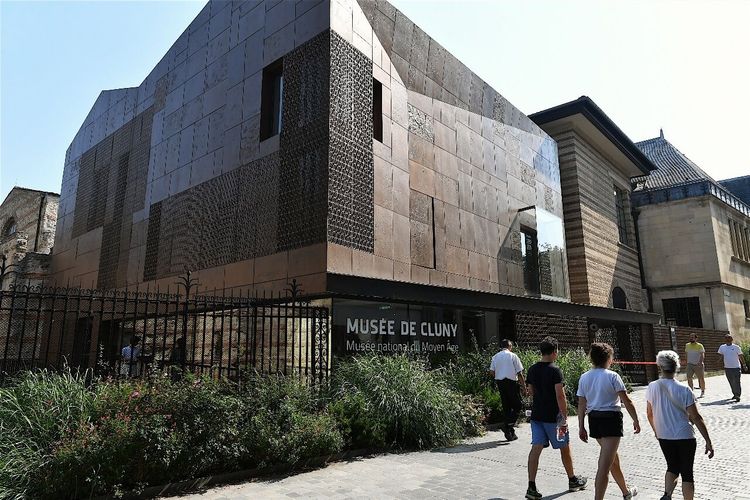
The Musée de Cluny (28 Rue du Sommerard, 75005 Paris, rated 4.5/5 on Google from 7,397 reviews) occupies an exceptional site: a 15th-century Gothic abbatial mansion built on the ruins of 2nd-century Gallo-Roman baths. This millennium and a half of history surfaces throughout the building — the Roman thermal arches survive in the lower rooms, while the flamboyant Gothic vaults of the chapel dominate the upper floor.
The medieval collection is one of the richest in Europe: Carolingian ivories, Limoges enamels, 13th-century stained glass, Merovingian jewelry. But the absolute centerpiece is The Lady and the Unicorn, a series of six Flemish tapestries from the 15th century displayed in a specially designed circular room. These six allegorical panels — five representing the senses, the sixth titled "To My Only Desire" — constitute one of the most enigmatic and beautiful textile works of the Middle Ages. Arrive early: the room sees little traffic on weekdays before 11 a.m.
The museum reopened in 2022 after renovation, with a new medieval garden planted with period plant species. Admission: €12, free on the first Sunday of the month. Closed on Tuesdays.
12. The Muséum national d'Histoire naturelle
The Muséum national d'Histoire naturelle refers not to a single building but to a collection of institutions spread across several Paris sites. The most spectacular is the Grande Galerie de l'Évolution (36 Rue Geoffroy-Saint-Hilaire, 75005 Paris, rated 4.6/5 on Google from 16,322 reviews), in the Jardin des Plantes (5th arrondissement): a 19th-century glass-and-metal nave converted into a permanent exhibition gallery where a parade of taxidermied animals — elephants, giraffes, rhinoceroses, antelopes — processes toward the light across three floors.
The scenography was designed by René Allio (1994) and retains its full impact: the central platform presents savanna and tropical forest species arranged as if marching in procession, lit by amber light that shifts between zones. On the third floor, the endangered and extinct species room — including a dodo reconstruction — is one of the most moving in the museum.
The same ticket gives access to the Galerie de Paléontologie et d'Anatomie comparée (dinosaur skeletons, historic human skull collection). The Jardin des Plantes surrounding the site is freely accessible — a strolling space right in the center of Paris.
Grande Galerie admission: €13 for adults, closed on Tuesdays. The site also includes a separately ticketed zoo.
13. The Musée d'Art moderne de la Ville de Paris
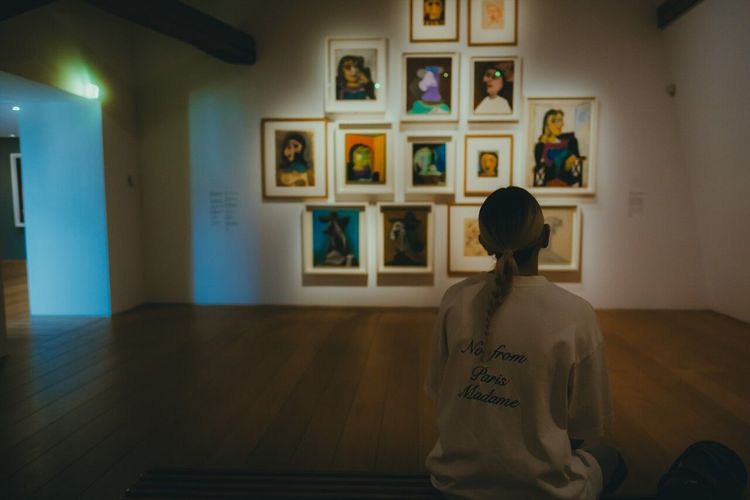
The Musée d'Art moderne de la Ville de Paris (MAM) has, since the closure of the Centre Pompidou, become the go-to address for modern and contemporary art in Paris. Its permanent collection, entirely free, presents 15,000 works from the early 20th century to the present day, with strong representation of French Fauvist and Cubist artists (Matisse, Derain, Braque, Léger).
The centerpiece of the collection is La Fée Électricité by Raoul Dufy: a fresco of 600 m² painted in 1937 for the International Exhibition, depicting the history of electricity from Aristotle to the modern era. It is one of the largest paintings in the world on view in a museum.
The atmosphere at MAM is calm, the rooms uncrowded, the guards unobtrusive. You can spend as long as you like in front of a work without feeling any pressure. The building (east wing of the Palais de Tokyo) overlooks the Seine, and the terrace is accessible in summer. To make the most of the 16th arrondissement, the Ryo audio-guided tours of Paris guide you through the city's most historically rich neighborhoods.
Permanent collection admission: free. Temporary exhibitions: €14–€16. Closed on Mondays.
14. The Cité des Sciences et de l'Industrie
The Cité des Sciences et de l'Industrie (30 Avenue Corentin Cariou, 75019 Paris, rated 3.8/5 on Google from 7,238 reviews) at La Villette is the largest science museum in Europe: 30,000 m² of permanent exhibitions dedicated to science, technology, and industry. Inaugurated in 1986, it was designed by Adrien Fainsilber with an ambition directly built into the structure: three geodesic domes filter natural light into the halls, water features surround the structure, and integrated greenhouses bring vegetation into the public spaces.
The permanent exhibition Explora (levels 1 and 2) covers mathematics, physics, life sciences, information technology, and astronomy, with a decidedly participatory approach and numerous interactive installations. The Cité is particularly well-suited to families with children from age 6, but adults who are not afraid to handle a gyroscope or test their perception of optical illusions can easily spend three to four hours here.
Separate attractions: the Géode (reflective sphere next to the main building, hemispherical IMAX cinema), and the nuclear submarine Argonaute, moored in the basin and separately visitable. Both attractions require separate tickets. The Parc de la Villette surrounding the site is the largest urban park in Paris — ideal for a full half-day.
Explora admission: €13. Closed on Mondays.
15. The Palais Galliera: Fashion Museum
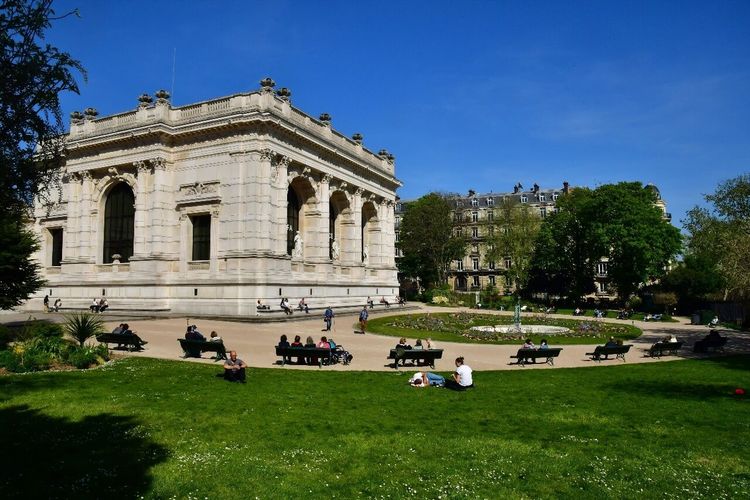
The Palais Galliera (10 Avenue Pierre 1er de Serbie, 75016 Paris, rated 4.4/5 on Google from 4,479 reviews) is the only museum in Paris entirely dedicated to fashion and the art of dress. Housed in a late-19th-century Renaissance palace, it holds one of the world's richest fashion collections: 200,000 pieces spanning the 18th century to the present day, including couture dresses by historic designers (Balenciaga, Chanel, Saint Laurent, Dior), accessories, fashion photographs, and couture house archives.
The Galliera does not display permanent exhibitions: as the collection consists of textiles that are fragile in light, the museum organizes thematic temporary exhibitions (two to three per year) that highlight selected ensembles. Admission is free when there is no temporary exhibition.
Recent exhibitions dedicated to Gabrielle Chanel, fashion under the Occupation, and masculine tailoring in haute couture have regularly sold out. Check the program before you visit: without a current exhibition, the permanent rooms are closed. Exhibition admission: €15. Closed on Mondays.
16. The Musée des Arts et Métiers
The Musée des Arts et Métiers (60 Rue Réaumur, 75003 Paris, rated 4.6/5 on Google from 9,969 reviews) is one of the most unusual museums in Paris: it occupies the former abbey of Saint-Martin-des-Champs, whose 13th-century Gothic chapel now houses cars, aircraft, and steam engines suspended between medieval vaults. This contrast between religious architecture and the industrial revolution produces a striking effect.
Founded in 1794 on the initiative of Abbé Grégoire to preserve instruments and machines useful to the arts and trades, it is one of the oldest technical museums in the world. The collection brings together more than 80,000 objects: Watt's early steam engines, the original Foucault pendulum (hung in the chapel nave, demonstrating the rotation of the Earth), Vaucanson's automata, and prototypes from the history of communications from Pascal to Chappe.
The chapel is a spectacle in its own right: Marie-Antoinette's carriage, Bartholdi's hammered copper Statue of Liberty (scale model), and Blériot's airplane share the space with Gothic ribs. The museum as a whole is rarely crowded even in high season — a rare luxury in Paris.
Admission: €12, free for under 26s. Closed on Mondays.
17. The Musée Marmottan Monet
The Musée Marmottan Monet (2 Rue Louis Boilly, 75016 Paris, rated 4.6/5 on Google from 9,832 reviews) holds the largest collection of Claude Monet in the world: 300 works housed in a private mansion near the Bois de Boulogne, bequeathed by Michel Monet (the painter's son) to the Académie des Beaux-Arts in 1966. It is a fundamentally different museum from the national institutions — more intimate, less overtly spectacular, but with a density of Monet impossible to find anywhere else.
The crown jewel of the collection is Impression, Sunrise (1872), the painting that gave the Impressionist movement its name, stolen in 1985 and recovered in 1990 from a villa in Corsica. It is displayed in the basement room alongside other works from the Le Havre harbor series.
Beyond Monet, the museum presents exceptionally fine medieval illuminated manuscripts (Wildenstein collection) and works by Renoir, Sisley, Berthe Morisot, and Gustave Caillebotte. Its location on the edge of the Bois de Boulogne, far from the tourist flows of the center, also makes it a pleasant destination for those who wish to combine culture with a leisurely walk.
Admission: €15. Closed on Mondays.
18. The Musée de l'Armée: Hôtel des Invalides
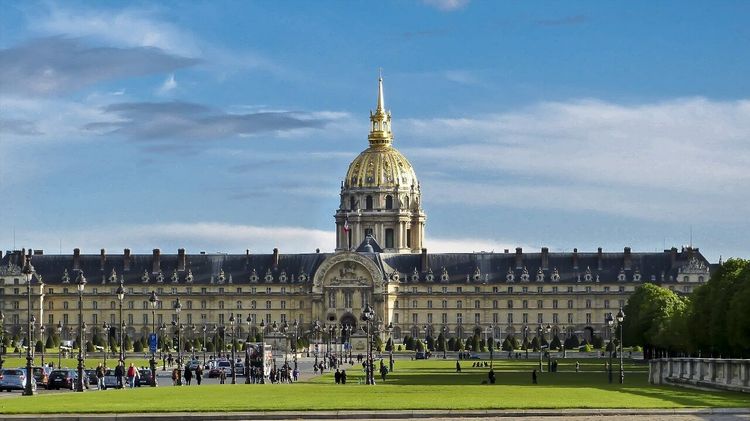
The Musée de l'Armée (129 Rue de Grenelle, 75007 Paris, rated 4.6/5 on Google from 28,058 reviews) is one of the largest military museums in the world, installed since 1905 in the Hôtel des Invalides, a monument built by Louis XIV in 1670 to shelter wounded and disabled soldiers. The architectural ensemble — gilded chapel, courtyard of honor, dome rising to 107 meters — is in itself one of the finest urban compositions in Paris.
The museum is divided into several departments: medieval and Renaissance armors (including the royal armors room with the harnesses of François I and Henri II), weapons from the 17th to the 19th century, Napoleonic Wars uniforms, and a modern and contemporary department covering the First and Second World Wars with remarkable archives, uniforms, equipment, and reconstructions.
The tomb of Napoléon I is housed in the chapel of the Invalides, beneath a red porphyry sarcophagus weighing 40 tonnes, at the center of a circular crypt. It is one of the most visited monuments in Paris, and one of the rare ones to retain a genuine atmosphere of solemnity despite the crowds. The Ryo audio-guided tour of the Champ-de-Mars area covers several monuments in the 7th arrondissement, from the Invalides to the Eiffel Tower, 19 stops over 8.9 km in total.
Admission: €15 (includes Napoleon's tomb and all museum rooms). Closed on the first Monday of the month.
19. The Fondation Louis Vuitton
The Fondation Louis Vuitton (8 Avenue du Mahatma Gandhi, 75116 Paris, rated 4.5/5 on Google from 24,711 reviews) is the most recent building on this list: inaugurated in 2014 in the Bois de Boulogne, this Frank Gehry structure resembles a wind-filled glass sail — twelve curved glass "sails" over a frame of white concrete and wood. The effect is spectacular from the outside, and the interior galleries allow visitors to move between the sails from several panoramic terraces.
The Foundation's permanent collection is oriented toward contemporary art and modernity: Gerhard Richter (whose 2014 donation represents one of the most significant ever made to a private institution), Jean-Michel Basquiat, Cindy Sherman, Ellsworth Kelly. The temporary exhibitions are ambitious and attract top-tier international institutional loans.
Access from central Paris is by shuttle bus from Avenue de Friedland (€1), or a 20-minute walk from Porte Maillot. The building is worth a visit even for those unfamiliar with contemporary art: it is an architectural object that redefines the very idea of a museum.
Admission: €16, free for children under 3. Closed on Tuesdays.
20. The Grand Palais
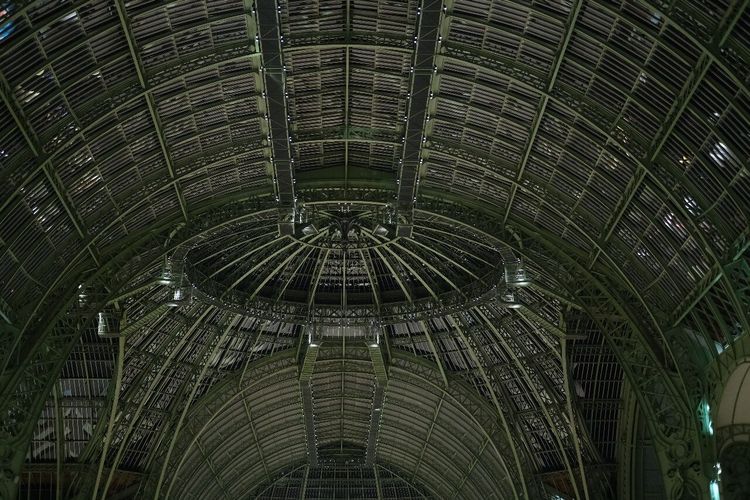
The Grand Palais reopened its doors in 2025 after five years of renovation. This building, constructed for the World's Fair of 1900, is one of the most iconic in Paris: its glass-and-steel nave of 45,000 m² is the largest glass roof in France. The restoration consolidated the structure, modernized technical equipment, and created new spaces accessible to the public.
The Grand Palais is not a museum with permanent collections but an institution dedicated to major temporary exhibitions. These are what have built its international reputation — historical retrospectives (Picasso, Hopper, Turner, Klimt in the 2010s) or large-audience thematic exhibitions regularly attracted between 300,000 and 600,000 visitors in a matter of weeks.
Since its reopening in 2025, the Grand Palais also hosts sporting events (it hosted fencing and taekwondo during the Paris 2024 Olympics), fashion shows, and contemporary art fairs. The central nave is now accessible during certain public events — check the official website so as not to miss a rare opening.
Exhibition admission: varies by program (generally €16–€22). No free permanent collection.
FAQ
What is the most visited museum in Paris?
The Musée du Louvre is the most visited museum in the world, with around 9 million visitors per year. In second place among Paris museums, the Musée d'Orsay welcomes between 3 and 3.5 million visitors annually. To avoid the crowds at the Louvre, opt for weekday mornings and buy your tickets online well in advance, especially between June and September.
Which Paris museums are permanently free?
The Petit Palais (permanent collection), the Musée Carnavalet (permanent collection), and the Musée d'Art moderne de la Ville de Paris (permanent collection) are free all year round. In addition, almost all national museums are free on the first Sunday of the month (Louvre, Orsay, Orangerie, Guimet, Cluny, Picasso, etc.) and permanently free for visitors under 26 who are residents of the European Union.
Which museum should you visit in Paris with children?
The Cité des Sciences et de l'Industrie (La Villette) is the best-designed museum for children from age 6, with its interactive installations and a submarine to explore. The Grande Galerie de l'Évolution (Jardin des Plantes) is also very family-friendly, with its parade of taxidermied animals. For younger children, the Musée de la Magie (not listed here, Marais) offers close-up magic shows integrated into the visit.
Do you need to book in advance for Paris museums?
Online booking is essential for the Louvre and Orsay during high season (June to September). Without a reserved ticket, physical queues regularly exceed two to three hours. For less-visited museums (Guimet, Carnavalet, Marmottan Monet, Arts et Métiers), it is generally possible to enter without a reservation even in summer. Note that the Centre Pompidou, closed until 2030, is no longer open to visitors.
Which museum pass offers the best value in Paris?
The Paris Museum Pass (48 h to 144 h, between €52 and €78) covers more than 50 museums and monuments, including the Louvre, Orsay, Versailles, and Fontainebleau. It also allows you to skip the ticket queues at most sites. It becomes worthwhile from three major visits in two days. Entry to free museums (Petit Palais, Carnavalet, MAM) is not included because it is already free.
What is the best museum in Paris for Impressionism lovers?
The Musée d'Orsay remains the world reference for Impressionism (Monet, Renoir, Degas, Pissarro, Sisley). For a more Monet-focused experience, the Musée de l'Orangerie (Water Lilies) and the Musée Marmottan Monet (300 works, including Impression, Sunrise) are less crowded but equally rich alternatives. All three museums can be visited in one well-organized day.
Paris is among the rare cities in the world where one can spend several weeks visiting museums without ever seeing the same collection twice. This list of twenty addresses covers the essentials, from universal giants to hidden museums that deserve a visit just as much as their more famous neighbors. To explore Paris beyond museum doors, Ryo offers several audio-guided walking tours, including an itinerary specially designed between the Right Bank and Notre-Dame to extend a day at the Louvre or Orsay.
À lire également