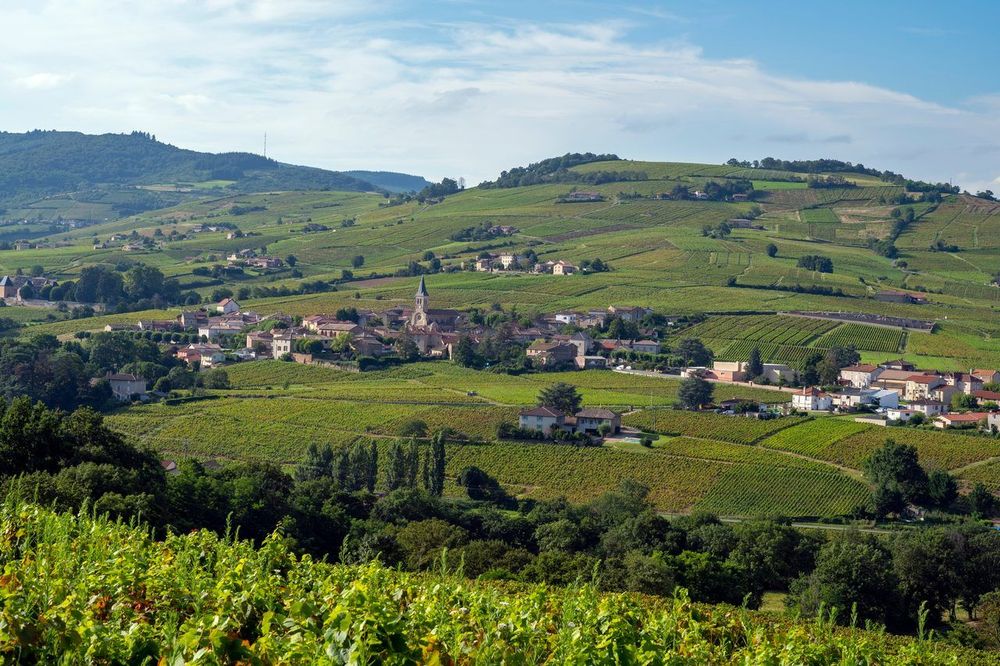
© Shutterstock
 Votre guide Ryo
The 9 Most Beautiful Villages in Beaujolais: Treasures to Discover in 2026
Finding the most beautiful village in Beaujolais often feels like a question of light: the answer changes with the hour, the season, and what you come looking for. Oingt, perched on its rocky spur of golden limestone, has ranked among the most beautiful villages in France since 1982 and still surprises even Lyonnais who thought they knew the region. A few kilometres away, Juliénas produces one of the ten grand crus of Beaujolais in an almost medieval setting, while Chiroubles, the highest of the ten Beaujolais crus, offers from its panoramic terrace a view of the Alps that most regional guides pass over in silence.
This guide takes you through the 9 villages of Beaujolais that truly deserve your time in 2026. Two landscapes coexist in this region. In the south, the land of the Pierres Dorées: houses built in ochre limestone that blaze at sunset, nearly intact medieval lanes, and cooperative wine cellars open for tastings without an appointment. In the north, the cru villages, surrounded by vineyards ranked among the most renowned in France — Moulin-à-Vent, Fleurie, Saint-Amour. Some are reachable in 35 minutes from Lyon, others require a little more road. None leaves you indifferent.
Good news for time-pressed travellers: Beaujolais is compact. You can drive from Oingt to Beaujeu in under an hour. Still, allow at least two days minimum to do things properly — enough to linger on the village squares, duck into a few wine cellars, have a leisurely lunch, and leave without feeling you've rushed. This guide covers the nine essential villages, practical itineraries by geographic area, and frequently asked questions about organising a circuit through the region. For those who like to complement their exploration with an audio guide, the Ryo app offers narrated tours of many villages and towns across France, available to download before you set off.
Oingt, the Medieval Gem of the Pierres Dorées
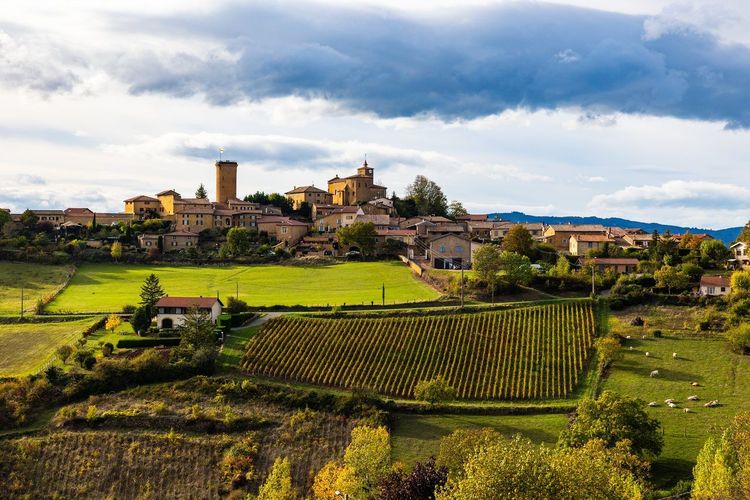
Some villages can be explained; others must be felt. Oingt belongs to the second category. Listed among the most beautiful villages in France since 1982, this medieval town of around 800 inhabitants rises on a rocky pinnacle at 410 metres above sea level, commanding the vines and hills of Beaujolais with an almost impudent nonchalance.
The Porte de Nizy, the main gateway carved from rock in the 13th century, transports you to another era from your very first step. Cobbled lanes wind between houses of golden limestone — that famous blonde stone, rich in iron oxide, which gives the entire Pierres Dorées region its characteristic colour, ranging from honey to deep ochre. In the mid-afternoon, when the light strikes the façades head-on, the hue veers almost toward orange. At sunset, certain lanes seem to glow from within.
The 12th-century keep can be visited freely from the top of the village. From its 17-metre height, you take in at a glance the vineyards of Beaujolais to the east, the wooded hills of the Lyonnais to the west, and on clear days the first foothills of the Massif central to the south. The climb takes under five minutes and is worth the trip on its own. An orientation table installed at the top identifies the visible landmarks in fine weather.
At the foot of the village, the église Saint-Matthieu houses a 15th-century polychrome stone Entombment that lovers of medieval art never miss. The building is understated, without any tourist fuss — a good summary of the philosophy of the place. The 12th-century nave retains several finely carved capitals, visible even without a guide.
Practical notes: Oingt is not overwhelmed by crowds on weekdays, but summer weekends can be busy. Park at the car park at the village entrance (free) and come in the morning if possible to enjoy the raking light on the façades and avoid the heat in the narrow lanes. Several craft workshops and art galleries occupy the ground floors, generally open Thursday through Sunday. If you are hungry, the Halte gourmande below the village offers a selection of local products — regional charcuterie, cheese, and bottles of Beaujolais Villages sourced from neighbouring producers.
One last detail that makes all the difference: Oingt is known for its terraced micro-vineyards, some tended by the same families for several generations. In September, during the harvest, village life takes on a vivid dimension that photographs cannot capture. If your stay coincides with the harvest period (mid-September to early October), try to pass through early in the morning: you will cross paths with the harvesters making their way back between the houses with full harvesting baskets, in a scene unchanged for centuries.
Châtillon-d'Azergues, between Medieval Castle and Vineyard
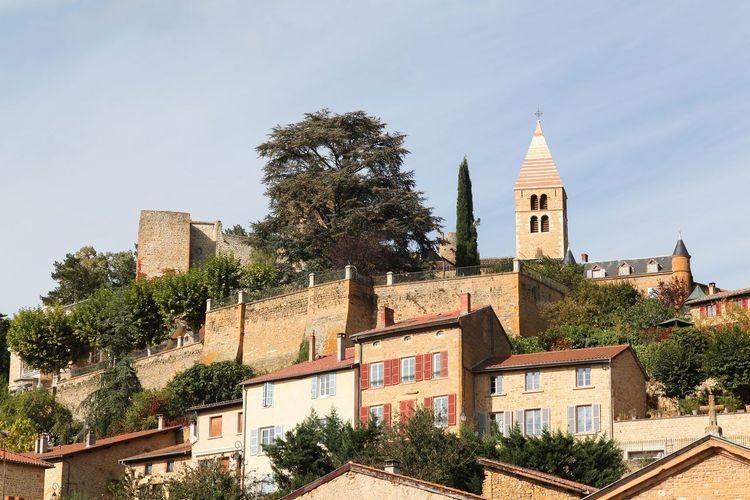
Just 5 kilometres from Oingt along the small roads of the Pierres Dorées, Châtillon-d'Azergues holds an architectural surprise that many visitors miss: its medieval castle, one of the best preserved in Beaujolais, has dominated the village from a wooded ridge since the 12th century.
The fortress of the lords of Beaujeu still boasts its round towers and an almost intact curtain wall. The castle can be visited in summer (July–August) with local volunteer guides, admission by donation, relaxed atmosphere. For the rest of the year, the exterior view from the road is already enough to justify a stop. On the main square, the Romanesque église Saint-Jean-Baptiste adds a note of grace to the whole: sculpted tympanum, Romanesque bell tower, interior that is plain and bright in the middle of the day.
The village itself can be explored in an hour. The golden-stone houses step down below the castle, surrounded by a few vines producing Beaujolais Villages and Coteaux du Lyonnais. The village cooperative cellar sells directly to visitors and makes a good starting point for a first tasting in the region — prices remain very reasonable, well below what you find at the private estates nearby.
Bagnols, a Seigneurial Village Suspended in Time
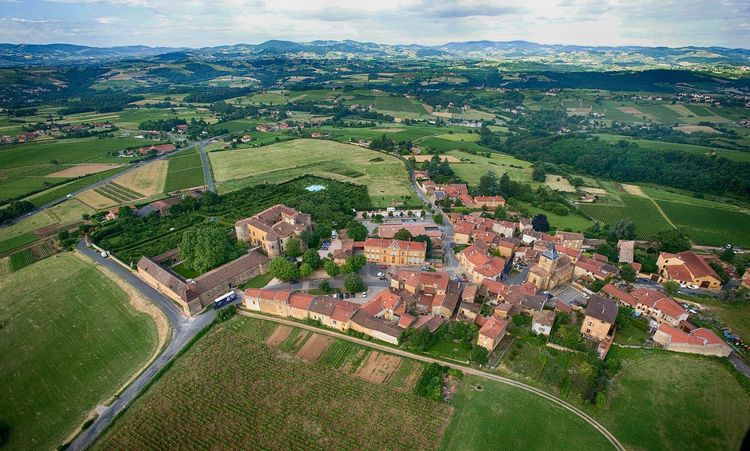
It is hard not to stop at Bagnols. This Pierres Dorées village, perched on a ridge between vines and forests some twenty kilometres north of Lyon, has a rare architectural coherence: almost every house dates from the Middle Ages or the Renaissance, and modern interventions are virtually nonexistent. This is one of the rare cases where a village was spared the reconstructions of the 20th century.
The Château de Bagnols, a private property converted into a luxury hotel, dominates the village with its round towers and formal gardens. Off-limits to passing visitors, it nevertheless makes a striking backdrop from the access road. To enter the intimate heart of the village, follow the lanes that extend from the place de la Grenette, flanked by a covered medieval market hall where a small market is held on weekend mornings in season.
The defining quality of Bagnols is its quietness. Less well known than Oingt, it draws photographers and seasoned walkers rather than organised groups. On a weekday out of season, you will have the lanes to yourself. This village perfectly illustrates a constant of the Pierres Dorées: the light plays differently according to the hour. In the morning, the stone tends toward pale beige; in the late afternoon, it takes on amber tones that look as though they have stepped out of a Flemish painting. Bring a camera. For lunch, the village inn offers simple regional cooking — charcuterie, local cheese, and wine from nearby producers.
Salles-Arbuissonnas-en-Beaujolais, the Cluniac Heritage
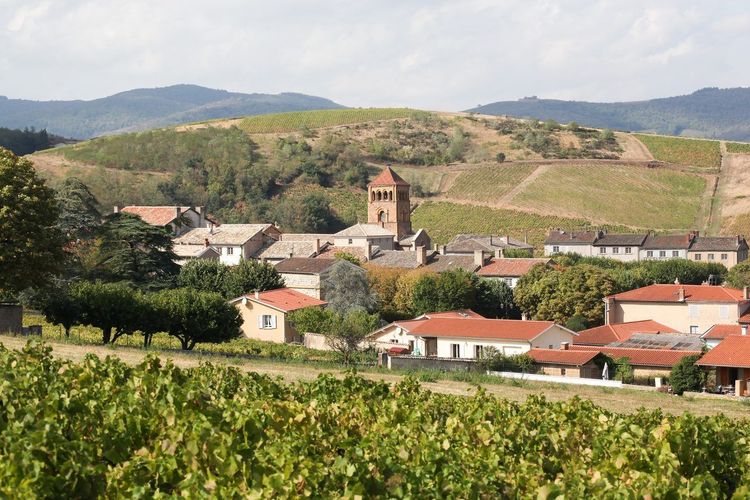
The name is long, but the stop is worth every syllable. Salles-Arbuissonnas-en-Beaujolais is home to one of the finest Romanesque buildings in the Rhône département: an 11th-century Cluniac priory, whose chapter house and cloister have survived nearly a thousand years with little damage. It is one of the best-preserved witnesses to the influence of the Abbey of Cluny in Beaujolais.
The cloister in particular commands silence. Its paired columns in pale limestone, its capitals carved with scrollwork and fantastic animals, make Salles one of the rare places in Beaujolais where the historical heritage rivals the landscape. The visit is guided and done in small groups; allow 45 minutes and book at the inter-communal tourist office during high season.
Around the priory, the village is modest — a few dozen inhabitants, an adjoining church, stone houses among the vines. That is precisely what makes the stop so appealing: Romanesque grandeur on a very human scale. The surrounding vineyards produce Brouilly and Beaujolais Villages.
Vaux-en-Beaujolais, the Soul of Clochemerle
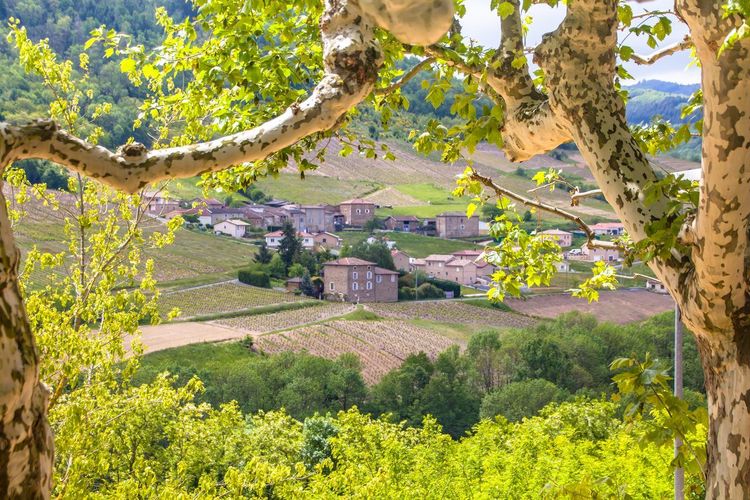
If you have read Gabriel Chevallier, the name will ring a bell. Vaux-en-Beaujolais is the real-life model for Clochemerle, the fictional village whose quarrels over a public urinal brought worldwide fame to the novel published in 1934. Gallic humour, local politics, and wine flowing freely: Chevallier had found it all by observing Vaux during the Roaring Twenties. The novel has been translated into twenty-two languages and adapted twice for the cinema, including a version partly filmed in the village itself in the 1970s.
The village plays the literary reference card with gusto. The Cave de Clochemerle (Place de l'Église, 69460 Vaux-en-Beaujolais, rated 4.5/5 on Google from 378 reviews), a cooperative founded in 1929, welcomes visitors for Beaujolais Villages tastings — free for two glasses, pay what you wish beyond that. The bottles bear the Clochemerle label, and the staff are happy to recount the story of the novel and the filming. Every summer, a Clochemerle festival animates the streets for a week with street theatre shows and wine evenings.
Beyond the literary wink, Vaux deserves a visit for its own charm. The village clings to the hillside, with vine terraces dropping toward the Saône valley below. The view from the church terrace carries far — on a clear day, you can make out the rooftops of Villefranche-sur-Saône and, in the distance, the first ridges of the Bugey.
Practically, Vaux is also a good starting point for a morning hike through the vines. Several waymarked paths leave the village and cross Gamay parcels before reaching the crests of the Ballons du Beaujolais. Allow 2 to 3 hours for the main loop, approximately 8 km. The cooperative cellar provides trail maps at the welcome desk.
This village illustrates something we sometimes forget: Beaujolais is not just a wine appellation, it is a region with its own culture, its stories, its characters. Vaux is one of its most flavourful embodiments.
Beaujeu, the Historic Capital of Beaujolais
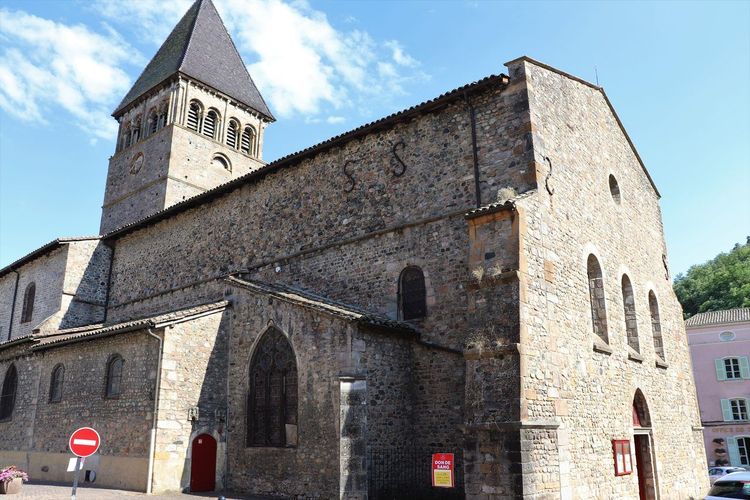
Few visitors know that Beaujolais takes its name not from the wine, but from a town: Beaujeu. This small town of around 2,000 inhabitants, nestled in the valley of the Ardière, was the capital of the lords of Beaujeu, who ruled the region from the 10th to the 12th century before yielding to the Bourbons and then to the French Crown. The town has declined since, but it has kept something that regional capitals often lose: a keen sense of its own past.
The main attraction is the Maison des Beaujolais (Rue de la République, 69430 Beaujeu, rated 4.5/5 on Google from 360 reviews), a museum and tasting cellar housed in an 18th-century mansion. Open year-round, it offers a selection of the ten Beaujolais crus to taste in elegant surroundings — a good place to get your bearings before heading out into the vineyards, especially if you are just beginning to explore the region. The explanatory notes on each cru are among the clearest you will find in the area.
The église Saint-Nicolas, built between the 11th and 15th centuries, merits a twenty-minute stop for its 15th-century wooden choir stalls, remarkably well preserved. Opposite, the ruins of the castle of the lords of Beaujeu form a melancholy public garden that lends the town all its charm — a few arches survive, draped in ivy, overlooking a view of the rooftops of the lower town.
Beaujeu is also known for its Sunday morning market, where wine producers, cheesemakers, and charcutiers from the valley fill the central square. If you plan your stay accordingly, it is one of the best moments to feel local life and stock up on provisions for a picnic among the vines.
Juliénas, First of the Grand Crus
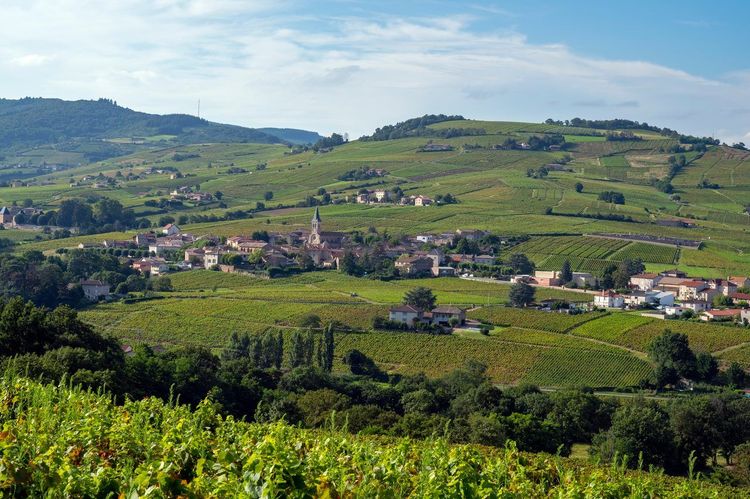
Juliénas — the name sounds like a promise. This village of 800 inhabitants in the north of Beaujolais produces one of the 10 official crus of the appellation: a full-bodied red wine made exclusively from Gamay, which ages far beyond what the reputation of Beaujolais Nouveau might suggest. The finest cuvées hold easily 5 to 10 years in the cellar and develop over time notes of candied fruit, spice, and leather that few people spontaneously associate with the region.
The village itself is elegant without trying to be. Grey-stone winemakers' houses cluster around a central square adorned with a fountain and a centuries-old plane tree. The Château du Bois de la Salle (Route du Bois de la Salle, 69840 Juliénas), property of the Juliénas winegrowers' cooperative, offers cellar visits and guided tastings Wednesday through Sunday. In September, the Fête des Juliénas draws several thousand visitors for two days of music and wine under the estate's chestnut trees.
Local legend has it that the village is of Roman origin and takes its name from Julius Caesar, whose legions supposedly planted the first vines on these hills. Well-founded history or a winemaker's tall tale? Opinions are divided, but it gives you one more reason to order a second bottle and explore the question further.
Food lovers will note that Juliénas is home to several acclaimed tables within a few kilometres. The Auberge du Cep, in the heart of the village, has worked the local terroir with dedication for decades. Reservations essential at weekends.
Fleurie, the Queen of the Crus
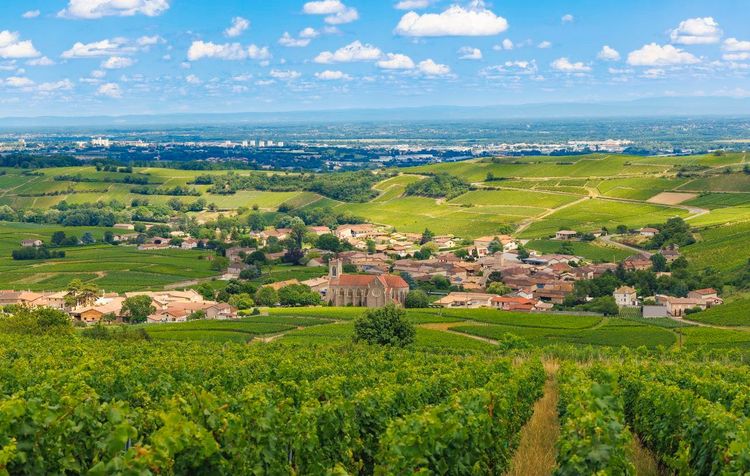
Fleurie owes its nickname, "the queen of Beaujolais", to its fragrant, rounded, and delicate wines, whose reputation crossed borders long before the Beaujolais Nouveau phenomenon. The village produces around 5 million bottles a year from 880 hectares of vines planted on the pink granite soils characteristic of this part of Beaujolais.
The village is tranquil and well kept. The église Saint-Jean-l'Évangéliste marks the geographic centre, surrounded by a handful of shops and winemakers' houses with flower-covered façades. The Cave des producteurs de Fleurie (Rue du Bon Vent, 69820 Fleurie, rated 4.4/5 on Google from 166 reviews), founded in 1927, is one of the oldest cooperatives in Beaujolais. It opens its doors to visitors for tastings Monday through Saturday, with a selection of vintages ranging from Beaujolais Villages to the estate's premium cuvée.
What sets Fleurie apart beyond the wine is its landscape. The vines descend from the hill of the Chapelle de la Madone toward the plain in tightly packed terraces — a particularly beautiful sight in autumn, when the Gamay leaves turn red and gold. The chapel itself, a tiny white building perched at 400 metres, offers a 360° view of the surrounding villages. Allow 20 minutes to walk up from the village on a waymarked path.
Chiroubles, the High-Altitude Vines
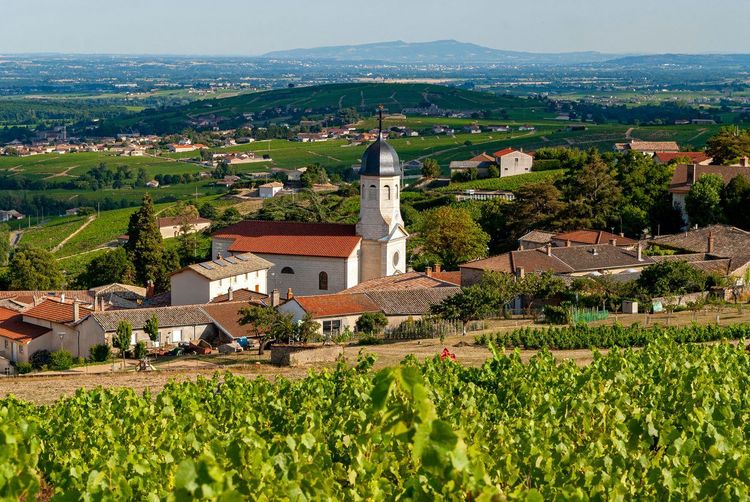
With vines that rank among the highest in Beaujolais (up to around 450 metres), Chiroubles is the highest and freshest of the ten crus. This altitude is no mere detail: it gives the wines a characteristic acidity and lightness, much appreciated by lovers of Beaujolais to drink young — ideally in the year following the harvest, when the fruit is still lively and the palate fresh.
The panoramic terrace at Chiroubles, set at around 740 metres above the village and listed as a geosite of the UNESCO Beaujolais Geopark, is worth the detour on its own. On a clear day, the eye reaches the Alps to the east — Mont Blanc sometimes appears in December and January — and the Massif central to the west. This double panorama, viticultural and mountainous, is one of the most spectacular in the entire region.
The village itself is modest: a few hundred inhabitants, a cooperative cellar open at weekends, and an end-of-the-world atmosphere that hikers love. Several waymarked paths head toward the crests of the Monts du Beaujolais, toward Avenas, the Croix Rosier, or the Chapelle de la Déserte. Allow half a day for the shorter routes (10 to 14 km, moderate elevation gain).
The Pierres Dorées Circuit: a Practical Itinerary
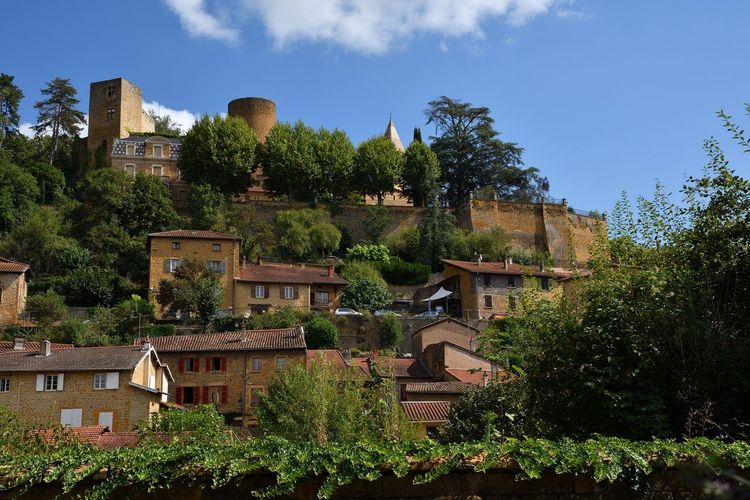
The four Pierres Dorées villages (Oingt, Châtillon-d'Azergues, Bagnols, Salles-Arbuissonnas) form a natural circuit in the southern part of Beaujolais. The best way to connect them is by car, along small departmental roads that are as much a pleasure to drive for their own sake as for the destinations they lead to — the D19, D38, and D70 wind through the hills with a particular regard for viewpoints.
The classic itinerary starts from L'Arbresle (reachable by train from Lyon Part-Dieu in 30 minutes), heads up toward Châtillon-d'Azergues, passes through Oingt and Bagnols, drops down to Salles-Arbuissonnas, and ends at Villefranche-sur-Saône for the return leg. By car, excluding stops: approximately 45 km, less than an hour of driving. With photo stops and lunch on a terrace: allow a full day.
For the cru villages (Juliénas, Fleurie, Chiroubles), the organisation differs. They cluster around Belleville-sur-Saône and Villié-Morgon in the north of Beaujolais. A one-day circuit can take in Beaujeu, Juliénas, Fleurie, and Chiroubles — around 50 km of small roads winding through the vines, with panoramas over the Saône and the Alps on the horizon.
The two circuits do not combine easily into a single day. The ideal is to plan two days: the first in the Pierres Dorées in the south, the second in the crus in the north. You can sleep in Villefranche-sur-Saône (good transport hub, hotels at every price point) or in one of the many gîtes and bed-and-breakfasts scattered through the villages themselves.
On the budget side: tastings at cooperative cellars are generally free or pay-what-you-wish for 2–3 glasses. Guided visits to priories or châteaux range between €4 and €8. Lunch at a local inn comes to €15–25 per person excluding drinks. Overall, Beaujolais remains a very accessible destination, especially compared with the neighbouring appellations of Burgundy, where tastings at private estates are often paid and by appointment only.
For those who like to travel with a narrated guide in their pocket, the Ryo app covers many French villages and towns with audio-guided tours available to download before you set off. The Ryo article on the village of Chabeuil, in the Drôme less than two hours south of Beaujolais, illustrates the kind of discoveries the platform makes possible in towns well off the beaten track.
How to Get to the Villages of Beaujolais
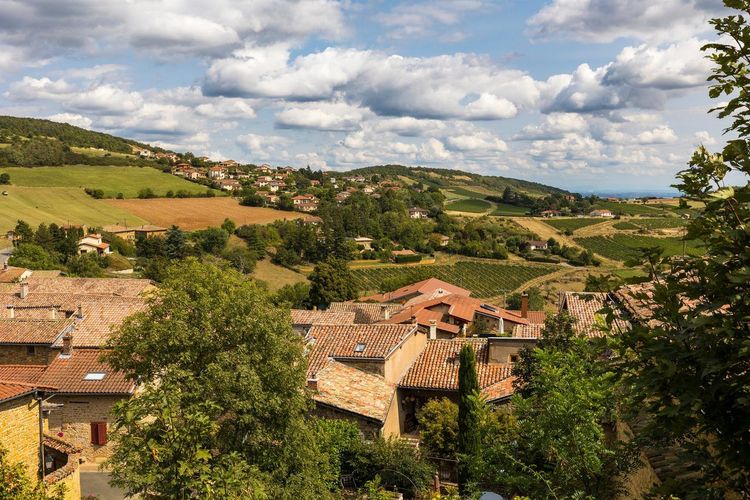
From Lyon: the simplest option is by car, via the A6 toward Villefranche-sur-Saône and then the departmental roads. Allow 35 to 45 minutes for Oingt or Châtillon-d'Azergues. The train to L'Arbresle (direct line from Lyon Part-Dieu, 30 min, around €7) gives access to the Pierres Dorées without a car, but public transport between the villages themselves is scarce — check timetables before you leave.
From Paris: TGV Lyon–Paris in 2 hours, then see above. Lyonnais agencies also offer coach excursions from Lyon-Perrache station for the Pierres Dorées.
From Mâcon: fewer than 40 minutes by car to reach Juliénas or Beaujeu via the D17 along the hills of northern Beaujolais.
Electric bike rental is growing across the region. Villefranche-sur-Saône and L'Arbresle both have rental points. The elevation of the Pierres Dorées (fewer than 200 m of cumulative climbing on the main circuit) is manageable on an e-bike for confident cyclists. For the northern crus, the terrain is more pronounced but still accessible on an e-bike with a good battery range.
FAQ
Which is the most beautiful village in Beaujolais?
Oingt is most often cited at the top: listed among the most beautiful villages in France since 1982, it combines an intact medieval setting, panoramic views from its 12th-century keep, and a preserved atmosphere. That said, "the most beautiful" depends largely on personal taste. Lovers of religious heritage will prefer Salles-Arbuissonnas and its Romanesque priory. Wine enthusiasts will favour Juliénas or Fleurie. Literature lovers will choose Vaux-en-Beaujolais, the Clochemerle of Gabriel Chevallier.
What are the Pierres Dorées of Beaujolais?
The Pierres Dorées refer to a geographic area in the southern part of Beaujolais, between Lyon and Villefranche-sur-Saône, characterised by its buildings made of ochre limestone rich in iron oxide. This stone, quarried locally since the Middle Ages, gives the villages a hue ranging from pale beige to deep gold depending on the time of day and the weather. About fifteen communes make up this area, including Oingt, Châtillon-d'Azergues, Bagnols, and Salles-Arbuissonnas.
What is the best season to visit the villages of Beaujolais?
Spring (May–June) and autumn (September–October) are the best periods. In spring, the vines bud and the countryside is a luminous green. In autumn, the Gamay leaves turn and the harvest brings the cellars to life. Summer works too, but July–August weekends can be busy at the most popular sites. In winter, roads are generally passable and the villages almost deserted — a unique experience for those who appreciate the quiet.
Can you visit the villages of Beaujolais without a car?
Partially. L'Arbresle, reachable by train from Lyon in 30 minutes, is a good base to start the Pierres Dorées circuit on foot or by e-bike. But the villages themselves are not connected by public transport. For the cru villages (Juliénas, Fleurie, Chiroubles), a car is practically essential. Organised tours departing from Lyon offer alternatives for travellers without a vehicle.
Are there wine tastings in the villages of Beaujolais?
Yes, in almost every village featured here. The cooperative cellars in Vaux-en-Beaujolais, Fleurie, Juliénas, and Châtillon-d'Azergues offer free-admission or pay-what-you-wish tastings, without an appointment, generally Monday through Saturday. Some private estates also open for visits by appointment. Beaujolais is one of the most accessible wine regions in France for beginner wine tourists — relaxed atmosphere, no intimidating protocol.
How much time should you allow to visit the villages of Beaujolais?
Two days allow you to do things properly: one day in the Pierres Dorées in the south (Oingt, Châtillon-d'Azergues, Bagnols, Salles-Arbuissonnas), one day in the crus in the north (Beaujeu, Juliénas, Fleurie, Chiroubles). A long three-day weekend leaves room for extended tastings, a hike in the Monts du Beaujolais, and unhurried meals — which, in this region, is no luxury at all.
Are the villages of Beaujolais suitable for children?
Yes, on the whole. Oingt and its gently sloping lanes are easily manageable with children. The panoramic terrace at Chiroubles and the keep at Oingt fascinate younger visitors. The vineyards in September during the harvest make for a vivid, concrete, and educational spectacle. Bring comfortable shoes for the medieval cobblestones, and for toddlers a sturdy pushchair or baby carrier — not all the lanes are flat.
Beaujolais rewards those who take the time to leave the main roads and venture down the small lanes. These 9 villages, from the medieval Pierres Dorées in the south to the wine-growing grand cru north, paint a picture that can hold its own against France's most celebrated regions — and at a fraction of their tourist footfall.
To extend your exploration of French villages with a guide in hand, Ryo offers narrated tours of many destinations across France. Among the app's recent discoveries, the Ryo guide to the village of Trentemoult, a charming boatmen's village on the outskirts of Nantes, shows just how many surprises France's villages still hold well beyond Beaujolais. Whether you come for a weekend or pass through the region on a longer itinerary, the villages of Beaujolais will make you want to return.