
Créé par Romane, le 15 mai 2026
Votre guide Ryo
© Shutterstock
Looking for fun things to do in Munich that go past the obvious postcard list? Munich operates on a different frequency than most European cities. It is loud when it wants to be, Oktoberfest draws 6 million visitors every September, and then completely quiet on a Tuesday morning when the Isar runs green and cold through stone beaches that most tourists never find. The sheer range of options is the first challenge: river surfing at a landlocked intersection, a palace garden larger than New York's Central Park, and a museum with 73,000 exhibits spread across 70 departments. The Ryo audio guide for Munich's secret capital walk covers the historic core across a 3-hour, 7.4 km route with 21 audio stops, a solid anchor for your first morning before you branch out.
This list covers 30 experiences across the full spectrum: the charismatic (surfing the Eisbach, hunting down the best Weissbier at an outdoor Biergarten), the historic (the Residenz treasury, Dachau Memorial), the surprising (a cinema in a 19th-century museum, a beer cellar buried below street level), and the genuinely practical (how to reach Neuschwanstein without queuing three hours). Expect facts you can use, honest timing advice, and no padding.
1. Ride the Eisbach Wave in the English Garden
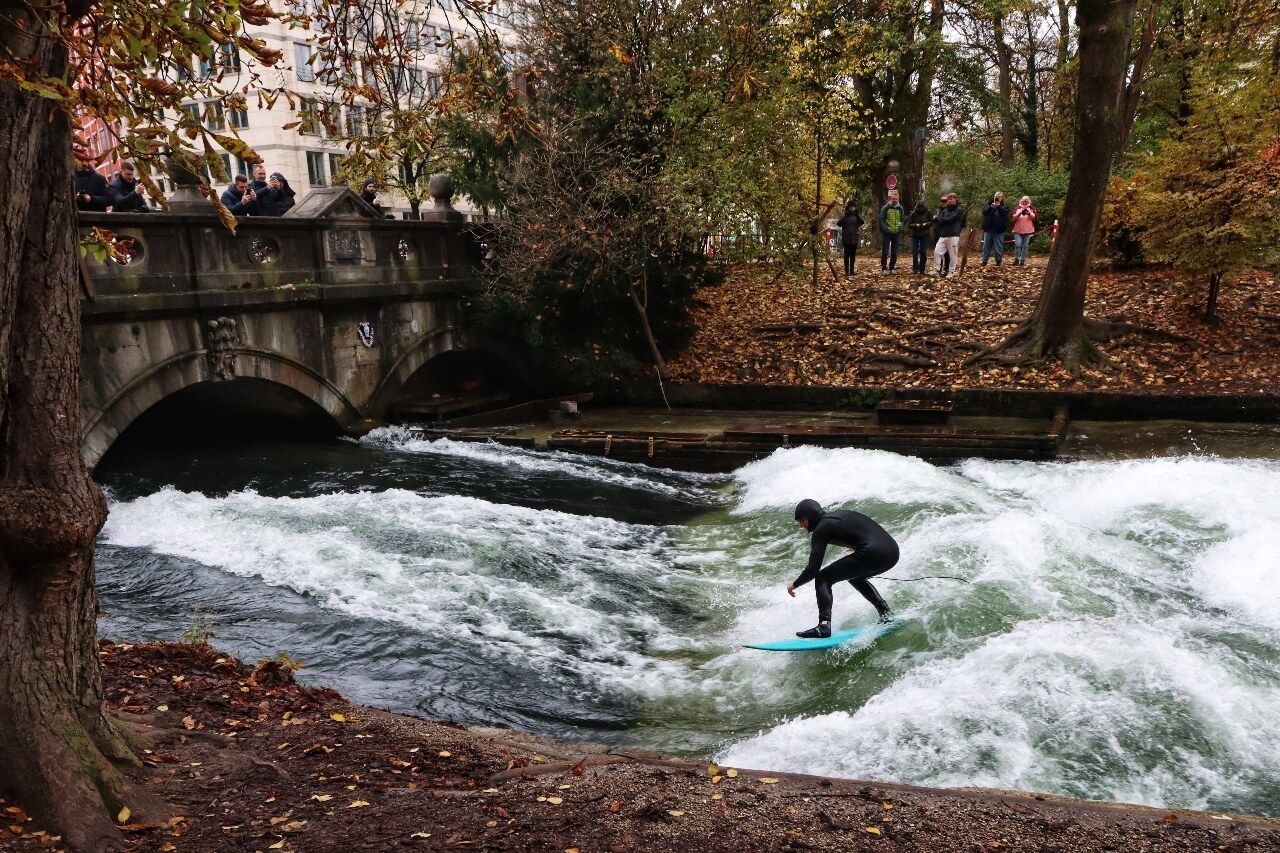
At the southern edge of the Englischer Garten, a standing wave known as the Eisbach attracts surfers year-round, regardless of the weather. The channel is narrow, barely five metres wide, and the water runs at roughly 7°C for most of the year. Surfers queue, take their turn, and get washed off within seconds. It sounds anticlimactic until you watch it: the athleticism involved in holding a position on a wave surrounded by Munich's urban traffic is genuinely extraordinary. There is no charge to watch. Arrive early on weekends to get a spot on the bridge railing.
2. Explore the English Garden (Englischer Garten)
The Englischer Garten (Englischer Garten 1, 80538 Munich, rated 4.8/5 on Google (47K reviews)) covers 3.7 km², larger than Hyde Park and Central Park combined, and it has been Munich's principal outdoor playground since Elector Charles Theodore opened it to the public by decree in 1789. Ludwig I later contributed the Monopteros temple (1837) and other monuments, but the park itself was already a popular destination during the Napoleonic era. The northern section, which most visitors skip, contains meadows used for sunbathing (some of which are clothing-optional), a Japanese tea house built for the 1972 Olympics, and a Chinese pagoda surrounded by one of the city's most atmospheric beer gardens. The southern tip, near the Eisbach, is more groomed and tourist-facing.
In summer, you will find impromptu drumming circles, cyclists, joggers, and families sharing blankets across every open stretch. In winter, the open-air beer garden at the Chinesischer Turm keeps serving so long as the temperature stays above zero. Plan at least two hours if you want to reach the northern half, most visitors only see the 20% closest to the city centre.
3. Down a Masskrug at the Hofbräuhaus
You already know the Hofbräuhaus exists. What the tourist brochures underplay is how it actually works. The royal brewery was commissioned by Duke Wilhelm V in 1589, the current building on Platzl dates to 1897, and the hall has hosted everyone from Lenin to diplomatic delegations to the Rolling Stones' post-concert dinners. The ground-floor Schwemme seats well over 1,000 people and operates more like a controlled festival than a restaurant. Tables are communal, the oompah band is loud, and the service is brisk.
Order the Hofbräu Original, a malty, amber-tinted lager served in a one-litre Masskrug, alongside an Obatzda (a Bavarian cheese spread with radishes and pretzels) if you want to eat. Peak tourist hours run from noon to 3 pm and again from 7 pm onwards. If you arrive at 11 am on a weekday, you will find the hall at about a third of capacity, the music just starting, and a completely different atmosphere. Avoid the seating area immediately next to the souvenir shop, it is the most chaotic corner in the building.
4. Climb the Olympic Tower for a 360° View
The Olympiaturm (Spiridon-Louis-Ring 7, 80809 Munich, rated 4.7/5 on Google (10 341 avis)) stands 291 metres tall in the Olympiapark. On clear days, most common between October and February, the entire Bavarian Alps fill the southern horizon, including a sightline to the Zugspitze, Germany's highest peak at 2,962 metres. Observation deck tickets cost around €9 and the wait is rarely more than 15 minutes outside peak summer.
5. Wander Through Marienplatz and Watch the Glockenspiel
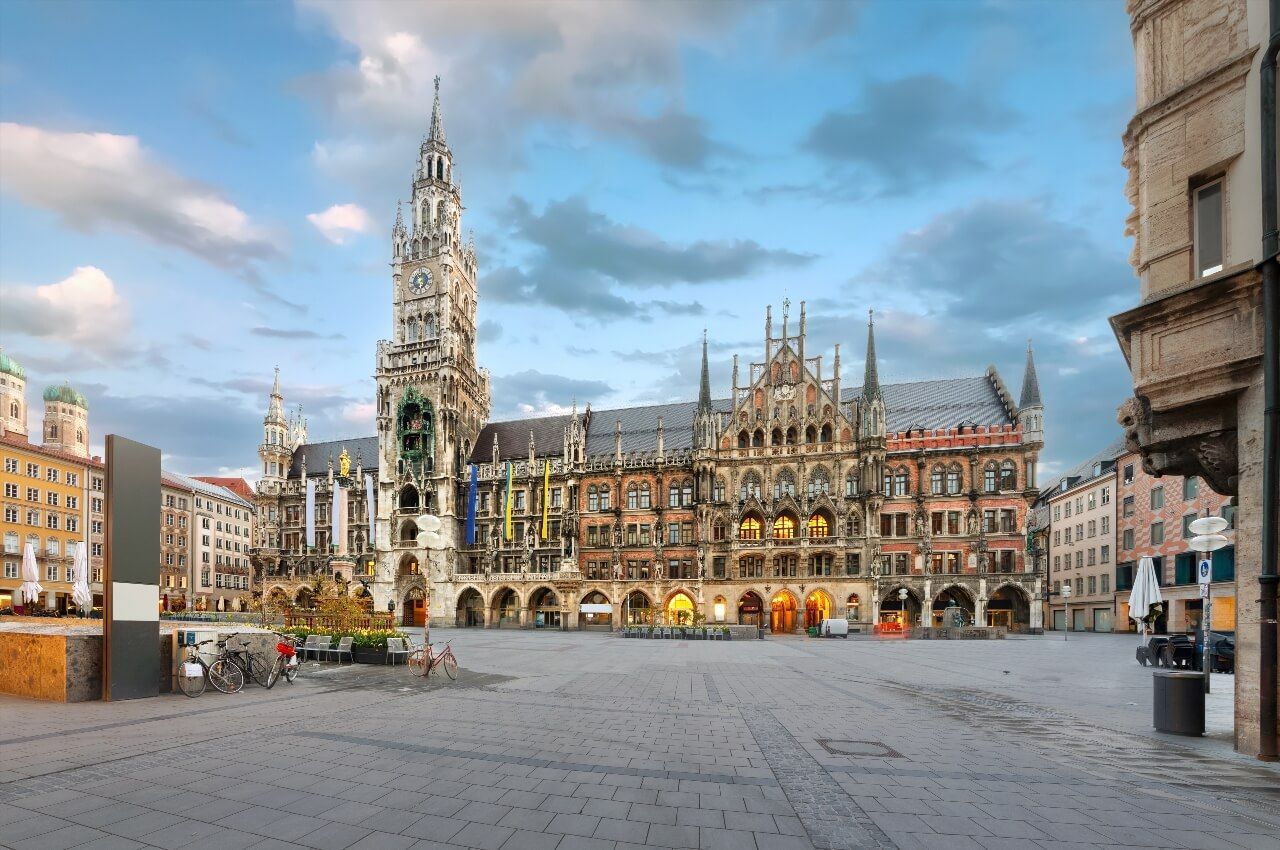
Marienplatz (Marienplatz, 80331 Munich, rated 4.7/5 on Google (149 086 avis)) has been Munich's central square since 1158. The Mariensäule column at its centre was erected in 1638 to mark the city's survival of the Thirty Years' War and the bubonic plague. The square is surrounded by the Neues Rathaus (New Town Hall) and the older Altes Rathaus, now a toy museum. The Glockenspiel on the Neues Rathaus tower performs daily at 11 am and noon (also at 5 pm from March to October), re-enacting a knightly tournament and the Schäfflertanz, a dance performed by barrel-makers in 1517 to celebrate the end of a plague outbreak.
The Glockenspiel uses 43 bells and 32 life-sized figures, and the performance lasts about 12 minutes. Most visitors watch from the square below, a better vantage point is from the terrace of the Café Rischart on the south side, which gives you a slight elevation and somewhere to sit with a coffee while you wait for the show to start.
6. Discover Nymphenburg Palace and Its Grounds
Nymphenburg Palace (Schloß Nymphenburg 1, 80638 Munich, rated 4.6/5 on Google (38 749 avis)) sits 5 km west of central Munich and remains one of the most undervisited major palaces in Europe despite its scale. The main building stretches 632 metres across its full facade, flanked by a formal canal, a vast English-style park, and four smaller pavilions scattered through the grounds. It was the summer residence of Bavarian royalty for three centuries, and King Ludwig II was born here in 1845 in the southwest pavilion that still bears a small commemorative plaque you can find from the courtyard.
The interior rooms are exceptional. The Great Hall's ceiling fresco by Johann Baptist Zimmermann covers the full vault in trompe-l'oeil detail, framed by stucco work so refined that the boundary between paint and sculpture becomes hard to read from the floor. The Gallery of Beauties, 36 portraits commissioned by Ludwig I of women he considered the most beautiful in Bavaria, regardless of their social status, remains one of the stranger and more compelling rooms in any European palace. The painting of Lola Montez, the Irish dancer who became Ludwig's mistress and essentially caused a constitutional crisis in 1848, hangs alongside a cobbler's daughter from Burghausen, a butcher's wife, and assorted aristocrats. The democratic flatness of the selection still feels radical.
The grounds are free to enter and worth at least an hour on their own. The Amalienburg hunting lodge inside the park is architecturally more interesting than the main palace, a compact rococo building with a mirror room that outshines Versailles in concentrated detail. Cuvilliés designed the lodge in the 1730s as a private retreat for Electress Maria Amalia, and the central hall, lined with hand-blown mirrors and silver-leaf stucco, was one of the most ambitious interior projects of the Bavarian rococo. The Pagodenburg, Badenburg, and Magdalenenklause complete the pavilion set, each themed differently and each more elaborate than the modest exterior implies. Audio guides for Ryo's Munich walking route include context on the royal history that ties directly to Nymphenburg. Combined ticket for all buildings and collections runs approximately €15.
7. Spend a Morning at the Viktualienmarkt
Viktualienmarkt has operated as an open-air food market in the centre of Munich since 1807. It covers roughly 22,000 m² and hosts approximately 140 permanent stalls selling Bavarian cheeses, fresh pretzels, sausages, honey, seasonal produce, and flowers. The market is open Monday through Saturday, and unlike most tourist-facing markets in European capitals, it serves primarily local residents, the prices and selection reflect that.
The central beer garden opens daily from spring through autumn and is one of the few outdoor drinking spots in Munich where you can bring your own food from the surrounding stalls. On weekdays before 10 am, the market is at its most local and least crowded. The Maypole at the centre, painted with symbols of Munich's traditional trades, dates from a medieval custom that every Munich district still maintains.
8. Dive Into the Deutsches Museum
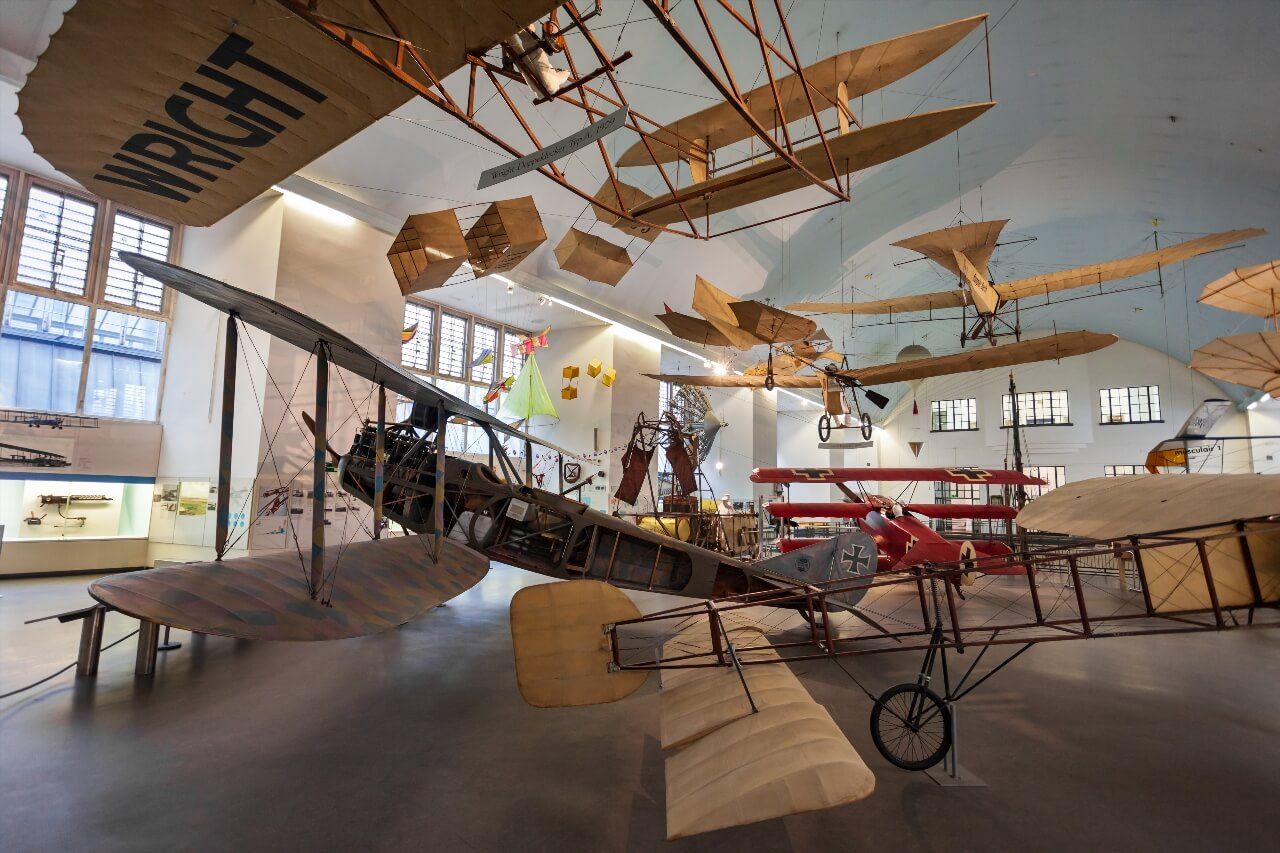
The Deutsches Museum (Museumsinsel 1, 80538 Munich, rated 4.5/5 on Google (42 395 avis)) is the largest science and technology museum in the world by exhibit count. Housed on an island in the Isar River, the Museumsinsel, it covers 73,000 exhibits across 70 departments and spans subjects from ancient mining techniques to nuclear fission. The building itself takes up the entire island and would take three full days to see properly. Most visitors allocate half a day and leave having seen perhaps 15% of the collection.
Prioritise the following departments if time is limited: the Aeronautics Hall, which contains original Wright Brothers-era aircraft alongside the first Lufthansa jet; the Mining section, a walk-through reconstruction of underground mine tunnels across multiple geological eras; and the Astronomy Tower, which requires a timed entry ticket but houses one of the oldest working planetarium projectors in Europe.
The museum was founded in 1903 by engineer Oskar von Miller, who wanted to make science legible to ordinary people rather than only to specialists. That founding philosophy shows in the exhibit design even today, most displays prioritise hands-on interaction and working models over static glass cases. Budget at least four hours for a focused visit. The island location means you approach across a bridge with the Isar on both sides, which sets the mood before you even enter.
9. Explore BMW World and the BMW Museum
BMW Welt (Am Olympiapark 1, 80809 Munich, rated 4.7/5 on Google (39 210 avis)) (BMW World) opened in 2007 as a combined delivery centre and exhibition space adjacent to the BMW Museum and the company's main Munich factory. Entry to BMW Welt is free, it houses rotating exhibitions, concept cars, and the full current model lineup alongside a rooftop terrace with views toward the Olympic complex. The adjacent BMW Museum charges entry (around €10) and covers the brand's full history from 1916 aircraft engines to current motorsport programmes.
The architecture of BMW Welt itself is worth seeing: a double-cone steel structure designed by Coop Himmelb(l)au that has won multiple international design awards. Factory tours of the adjacent production plant are available but must be booked weeks in advance through BMW's official website, they fill up quickly and are among the more unusual industrial experiences available to tourists in Germany.
10. Catch a Match at Allianz Arena
The Allianz Arena (Werner-Heisenberg-Allee 25, 80939 Munich, rated 4.6/5 on Google (85 945 avis)) opened in 2005 and holds 75,000 spectators for FC Bayern Munich home matches. The facade, made of 2,874 inflatable ETFE plastic panels, glows red for Bayern matches, white for Germany internationals, and blue for TSV 1860 Munich (when they play in the arena). Even without a match, the exterior at night is one of the more genuinely striking pieces of stadium architecture in Europe.
Tickets for Bundesliga matches sell out months in advance for premium fixtures, but midweek games and less high-profile opponents can still be available weeks out. The stadium tour runs daily and is considerably cheaper than match-day tickets. The arena is located in the northern suburb of Fröttmaning, accessible by U-Bahn U6, roughly 30 minutes from Marienplatz.
11. Visit the Residenz and Its Treasury
The Munich Residenz (Residenzstraße 1, 80333 Munich, rated 4.6/5 on Google (22 222 avis)) is the largest urban palace complex in Germany and served as the seat of the Wittelsbach dynasty, Bavaria's ruling family, for four centuries from 1508 to 1918. The complex expanded continuously from the 14th century onwards and now contains 130 rooms open to visitors, ten courtyards, and two separate museums: the Residenz Museum covering the state apartments, and the Schatzkammer (Treasury), which houses the dynastic collection of jewellery, reliquaries, and ceremonial objects.
The Treasury deserves more time than most visitors give it. The collection spans over 1,000 years of Bavarian royal patronage and contains objects of extraordinary workmanship: a 9th-century prayer book with a cover studded with cameos and semi-precious stones assembled from Roman-era pieces; the Crown of an English Queen, made for a daughter of Henry IV of England who married into the Wittelsbach line; and a series of portable altarpieces with enamelwork so fine that the detail only becomes visible under magnification. The 16th-century Statuette of Saint George, sheathed in gold, enamel, and several hundred diamonds, is the single object most visitors pause longest in front of and is worth the wait through the crowd that tends to form around its case in mid-afternoon.
The Antiquarium, a Renaissance hall on the ground floor of the main palace, is 66 metres long and decorated with 102 painted views of towns, markets, and palaces across the historic Duchy of Bavaria, executed between 1581 and 1600 under Wilhelm V and his son Maximilian I. It is the largest secular Renaissance interior north of the Alps. Duke Albrecht V had originally commissioned the room in 1568 to display his collection of antique sculptures, hence the name. Most visitors walk through it in three minutes. Sit on one of the benches and look at the ceiling frescoes, the workshop of Peter Candid painted 16 allegorical scenes in the vault crown depicting fame and the virtues, and the grotesque ornamentation around the windows is among the finest in Northern Europe. The combined ticket for both museums costs approximately €13. Ryo's audio walking route through Munich passes through the Residenz quarter and puts the palace's position in the city's urban development into sharper context.
12. Go Swimming at the Isar River Beaches
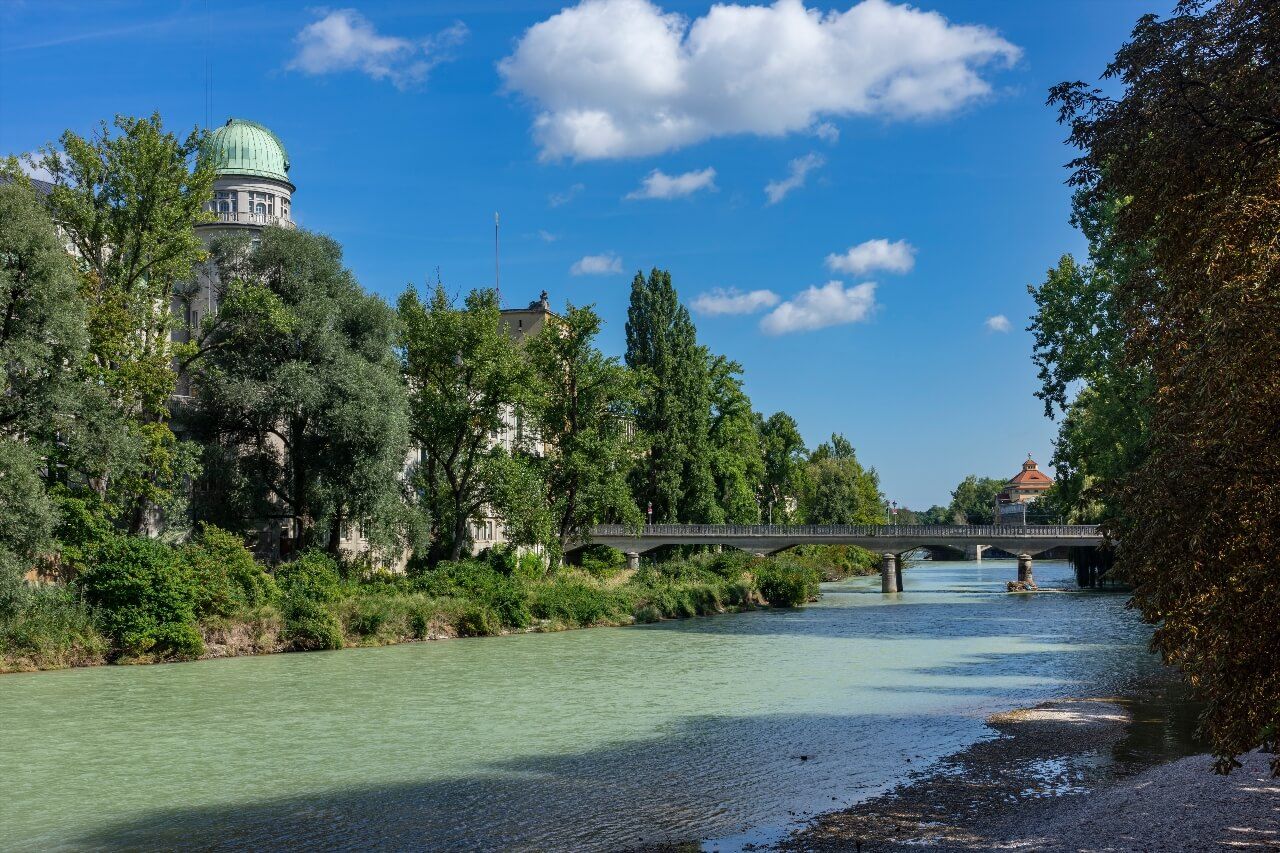
The Isar River runs through the heart of Munich and, following a major ecological restoration project completed in 2011, now has clean enough water for swimming along several central stretches. The Flaucher area, roughly 4 km south of Marienplatz, is the most popular: a wide gravel bank flanked by trees where Munich residents have been gathering on hot days for generations.
The water temperature rarely exceeds 18°C even in peak summer, and the current is faster than it looks. Swimming is strongly discouraged after heavy rain, when runoff raises bacterial counts. But on a clear July afternoon, the Isar beaches are among the more unusual urban swimming experiences in central Europe, cold, fast, local, and completely free.
13. Sample Bavarian Cuisine at a Beer Garden
Munich has approximately 180 beer gardens operating within the city limits, a number protected by Bavarian law since 1999. The largest, the Hirschgarten (Hirschgarten 1, 80639 Munich, rated 4.4/5 on Google (13 608 avis)), holds 8,000 people and operates inside a deer enclosure in the west of the city, actual deer graze behind low fences a few metres from the tables. The most atmospheric is the Chinesischer Turm in the English Garden. The most architecturally interesting is the Augustiner-Keller, a garden attached to a 19th-century brick vaulted beer cellar on Arnulfstrasse.
Bring cash, many beer gardens do not accept cards, particularly at the self-service food counters. The Bavarian tradition allows guests to bring their own food to beer gardens (though not their own drinks). A full-size Masskrug of draught lager costs between €8 and €12 depending on the venue. Arrive by noon on weekends or lose your seat.
14. Explore the Kunstareal Munich Museum Quarter
The Kunstareal is a dense concentration of art museums covering roughly four city blocks in the Maxvorstadt district. The cluster includes the Alte Pinakothek (old masters, 14th : 18th century), Neue Pinakothek (19th century), Pinakothek der Moderne (20th : 21st century), Museum Brandhorst, Glyptothek, and Antikensammlungen. No other area of comparable size in Germany contains a comparable density of major collections.
On Sundays, the entrance fee at several Kunstareal museums drops to €1, one of the better-kept budget secrets in Munich. The Pinakothek der Moderne holds works by Picasso, Warhol, Beuys, and a dedicated design wing covering 20th-century industrial design. The Museum Brandhorst, which opened in 2009, contains one of Europe's strongest private collections of Cy Twombly and Andy Warhol donated to the Bavarian state.
15. Visit the Dachau Memorial and Concentration Camp
Dachau Concentration Camp Memorial is located 16 km northwest of Munich and is one of the most important historical sites in Germany. Dachau was the first concentration camp established by the Nazi regime, opened in March 1933, barely weeks after Hitler came to power, and operated until American forces liberated it in April 1945. Over those twelve years, more than 200,000 prisoners were held there and at least 41,500 documented deaths occurred on site.
The memorial is free to enter and open Tuesday through Sunday. A documentary film is shown at regular intervals and provides historical context before you walk the site. The former prisoner barracks, roll call square, and crematorium are all preserved or reconstructed. The distance from the entrance gate to the far end of the camp grounds is farther than it looks on maps, allow at least three hours for a thorough visit. The S-Bahn S2 runs directly from Munich Hauptbahnhof to Dachau in about 20 minutes, followed by a bus to the memorial.
Visiting Dachau is not comfortable and is not supposed to be. It is, however, one of the most direct ways to engage with the history that defined 20th-century Europe and whose consequences still shape the Germany you are visiting.
16. Discover the Glyptothek and Antikensammlungen
The Glyptothek on Königsplatz was built between 1816 and 1830 and houses one of the finest collections of Greek and Roman sculpture outside of Italy and Greece. Its crown jewel is the Barberini Faun, a sleeping, drunk satyr carved in marble around 220 BCE with a physical frankness that is still striking nearly two and a half millennia later. The Aegina pediment sculptures, recovered from a temple on the Greek island of Aegina, were controversially restored by the Danish sculptor Thorvaldsen and have been debated by art historians ever since.
The building itself is a neoclassical statement by Leo von Klenze, funded by Ludwig I, who wanted Munich to rival Athens as a centre of culture. The adjacent Antikensammlungen (Antiquities Collection) covers ceramics, bronzes, jewellery, and glass across Greek, Etruscan, and Roman periods. Together they take about two hours and rarely feel crowded.
17. Stroll Through Schwabing and the Leopoldstrasse
Schwabing was Munich's bohemian quarter at the turn of the 20th century, Thomas Mann, Paul Klee, Wassily Kandinsky, and Lenin (during his years of political exile) all lived within a few blocks of each other in the streets north of Münchner Freiheit. The Leopoldstrasse is the main boulevard, lined with café terraces, bookshops, and a rotating cast of street performers in the warmer months.
The residential streets east and west of Leopoldstrasse are where the quarter's character survives best. Look for the Jugendstil (Art Nouveau) apartment buildings on Georgenstrasse and Ainmillerstrasse, facades covered in stylised botanical motifs that were considered revolutionary at their construction in the 1900s and still look striking today. Schwabing is primarily a residential neighbourhood now, which makes walking through it feel less performative than many European tourist quarters.
18. Watch Surfers in the Heart of the City
If you missed the Eisbach wave (Prinzregentenstraße, 80538 Munich, rated 4.7/5 on Google (21 792 avis)) on your first pass through the English Garden, it is worth a second visit at a different time of day. The queue dynamic shifts completely between morning and afternoon, serious riders tend to come early, while the afternoon brings more casual surfers and a larger watching crowd on the bridge above. The sound of water echoing off the bridge underside, the cold air coming off the channel, and the complete incongruity of surfing in a landlocked city centre combine into one of those specific Munich experiences that stays with you.
The wave itself was created by accident in the 1970s when engineers installed concrete blocks to break the river's flow under the Prinzregentenstraße bridge, an early attempt at flood mitigation that produced a near-perfect standing wave instead. Surfers discovered it shortly afterwards, and after decades of being technically illegal, the practice was officially recognised by the city in 2010. The Eisbach is now considered one of the most challenging urban river-surf spots in the world. The water never warms above 8 to 10°C even in mid-summer, and the entry is gravelly and steep. The riders wear thick wetsuits with hoods. You will see boards stacked against the railings, mostly short, narrow shapes adapted for river riding, and the queue operates on an unwritten honour system that everyone respects.
Bring a coat if you come in autumn or winter. The spectators stand in wind that funnels through the gap under the bridge, and a Glühwein from the kiosk on Prinzregentenstraße helps considerably.
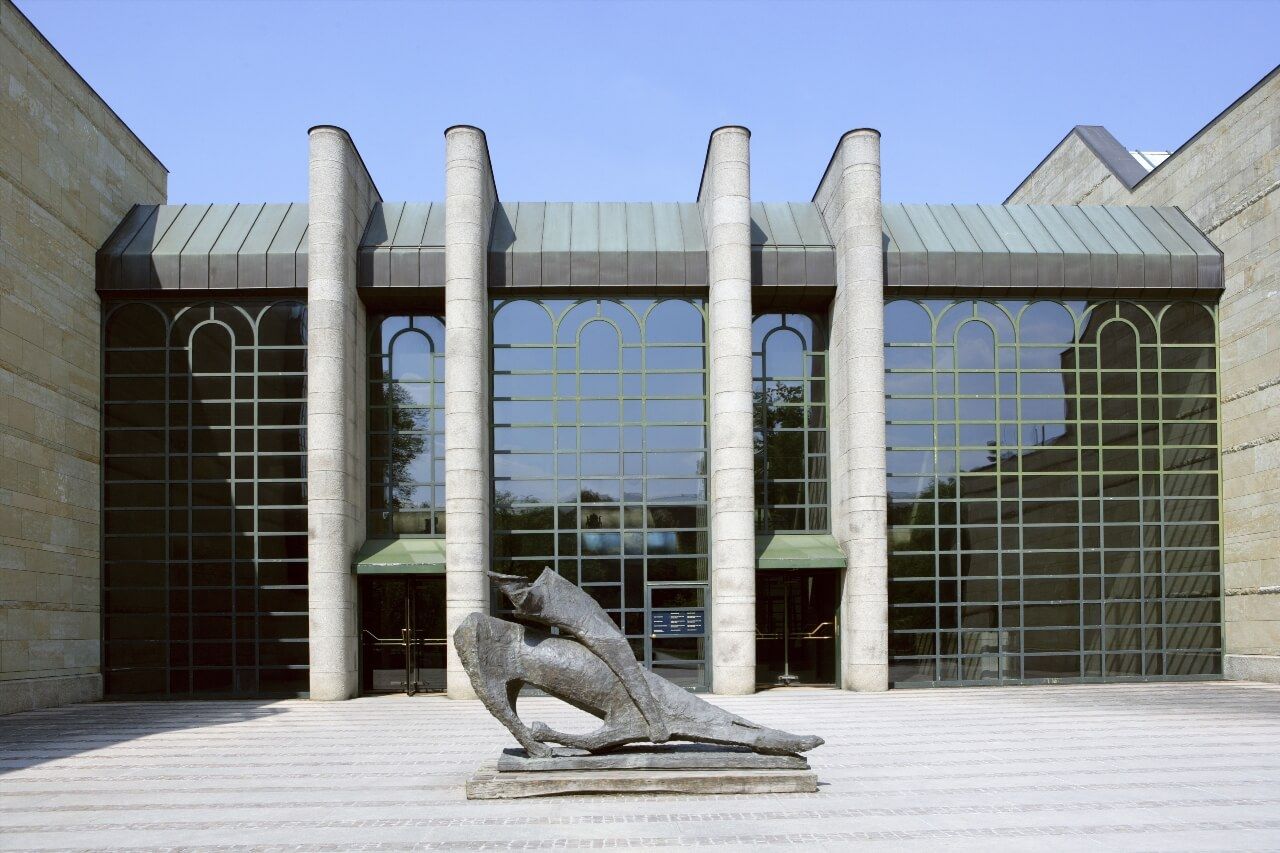
19. Visit the Neue Pinakothek
The Neue Pinakothek (Barer Straße 29, 80799 Munich, rated 4.5/5 on Google (1 912 avis)) covers European painting and sculpture from roughly 1780 to 1910, Romanticism, Realism, Impressionism, and Art Nouveau, across a building that was entirely rebuilt in 1981 after the original was destroyed in World War II. The collection is strongest on German Romanticism (Caspar David Friedrich's landscapes in particular) and on French Impressionism, with significant Monet, Manet, and Van Gogh holdings.
The room containing Van Gogh's Sunflowers (one of the series of seven; this version was painted in Arles in 1888) is typically one of the busiest in the building. The German Romantics are typically the most underappreciated. Friedrich's views across Baltic coastlines and forest interiors communicate a specific melancholy that became central to German cultural identity in the 19th century and is worth understanding in context here rather than through reproductions.
20. Take a Day Trip to Neuschwanstein Castle
Neuschwanstein Castle (Neuschwansteinstraße 20, 87645 Hohenschwangau, rated 4.6/5 on Google (111 399 avis)) is 90 minutes from Munich by road or rail and is the most photographed castle in Germany. Built by Ludwig II of Bavaria from 1869 onwards, it was intended as a private retreat and theatrical homage to medieval Germanic legends, Ludwig was an obsessive patron of Richard Wagner and designed the castle partly as a stage set for the operas. He lived in it for a total of 172 days before dying under disputed circumstances in 1886. The castle was opened to the public weeks after his death and has been drawing visitors ever since. Walt Disney used it as the model for Sleeping Beauty's castle.
The practical reality of visiting requires careful planning. Tours of the interior are timed and ticketed, book online at least two to three weeks ahead in peak season (June : August), as same-day tickets are effectively impossible to obtain. The walk from the village of Hohenschwangau to the castle takes 30 : 40 minutes uphill. The Marienbrücke (Mary's Bridge), a steel footbridge suspended over a gorge directly behind the castle, gives the iconic postcard view, arrive before 9 am if you want to photograph it without a crowd in the frame.
The Ryo audio guide covers Munich's historic core in detail, giving you the Bavarian royal family context that makes Neuschwanstein considerably more interesting than a single castle visit, Ludwig II's story starts in the city before it ends in the mountains.
21. Discover the Augustiner-Keller Beer Cellar
The Augustiner-Keller (Arnulfstraße 52, 80335 Munich, rated 4.4/5 on Google (38 775 avis)) on Arnulfstrasse is both a beer garden and a series of 19th-century vaulted underground cellar rooms originally used for lagering beer before mechanical refrigeration existed. The garden seats 5,000 people and is spread beneath old chestnut trees that have been growing since the cellar was built in 1812. Inside, the brick-vaulted rooms host private events and seasonal festivals, and are among the most atmospheric dining spaces in Munich.
Augustiner is Munich's oldest continuously operating brewery, founded in 1328, older than the Hofbräuhaus by more than two centuries. The beer served here is drawn from wooden barrels rather than metal kegs, which gives it a slightly different texture and flavour than the same beer served elsewhere. Order the Helles (pale lager) rather than the Märzen if you want to taste the difference most clearly.
22. Explore the Residenztheater and Bavarian State Opera
Munich's Bayerische Staatsoper (Max-Joseph-Platz 2, 80539 Munich, rated 4.7/5 on Google (3 995 avis)) (Bavarian State Opera) is one of the largest opera companies in the world by annual productions, performing in the National Theatre on Max-Joseph-Platz, a neoclassical building that was rebuilt twice after wartime destruction, most recently reopening in 1963. The opera season runs from September through July, with ticket prices ranging from around €20 for standing room to several hundred euros for premium seats on opening nights.
The Residenztheater next door is the company's drama house, presenting contemporary and classical theatre in German. If you do not speak German, the opera is the better option, the musical experience transcends language. The building itself, with its six Corinthian columns and the equestrian statue of Max I Joseph in the square outside, is one of the more imposing cultural venues in central Europe and worth seeing even from the outside on an evening walk.
23. Take an Isar Rafting Trip
From May through September, traditional wooden raft trips run on the Isar River from Wolfratshausen, about 30 km south of Munich, into the city centre. The rafts are flat wooden platforms with long steering poles, they carry between 40 and 80 passengers, operate with an onboard bar serving Masskrugs of beer, and the entire journey takes around five hours. The Isar through the upper valley is genuinely beautiful: mountain-fed, clear blue-green water running between forested banks with the Alps visible on clear days.
This is an established Bavarian tradition, not a manufactured tourist experience, Münchners have been rafting the Isar for leisure since the 19th century. Book through licensed operators (Floßfahrt München is the main organiser) at least a week ahead in high season. Bring waterproofs regardless of the forecast.
24. Visit the Olympiapark
The Olympiapark was built for the 1972 Summer Olympics on a site that had previously been a rubble field cleared after World War II. The design, a sweeping landscape of artificial hills, a lake, and tent-like tensile roof structures covering the main stadium, was a deliberate architectural statement about a new, open Germany. The park today hosts concerts, sporting events, and public recreation year-round.
The Olympiastadion runs guided tours that cover both the architectural history and the 1972 Olympics, which remain controversial due to the attack on the Israeli Olympic team in which 11 athletes and coaches were killed. The memorial to the victims is on the eastern side of the park and is worth finding. The lake at the centre is used for swimming in summer and ice skating in winter when conditions allow.
25. Discover the Alte Pinakothek
The Alte Pinakothek (Barer Straße 27, 80333 Munich, rated 4.7/5 on Google (12 784 avis)) is one of the oldest painting galleries in the world, opened by Ludwig I in 1836 to display the Wittelsbach royal collection of old masters. The building is a long neoclassical block that was partially destroyed in World War II and reconstructed, the deliberate visible scars in the brickwork, left rather than concealed during the postwar repairs, are an architectural decision worth noticing.
The collection covers painting from the 14th through the 18th century and is strongest in Dutch and Flemish masters, German Renaissance, and Italian Baroque. Dürer's Self-Portrait from 1500, the one in which he paints himself in a Christ-like frontal pose, is here and is one of the most discussed self-portraits in Western art. Rubens is represented by dozens of major canvases, including a room of enormous mythological compositions that demonstrate the scale at which 17th-century court painting operated. The Raphael and Titian holdings are smaller but include several canonical works.
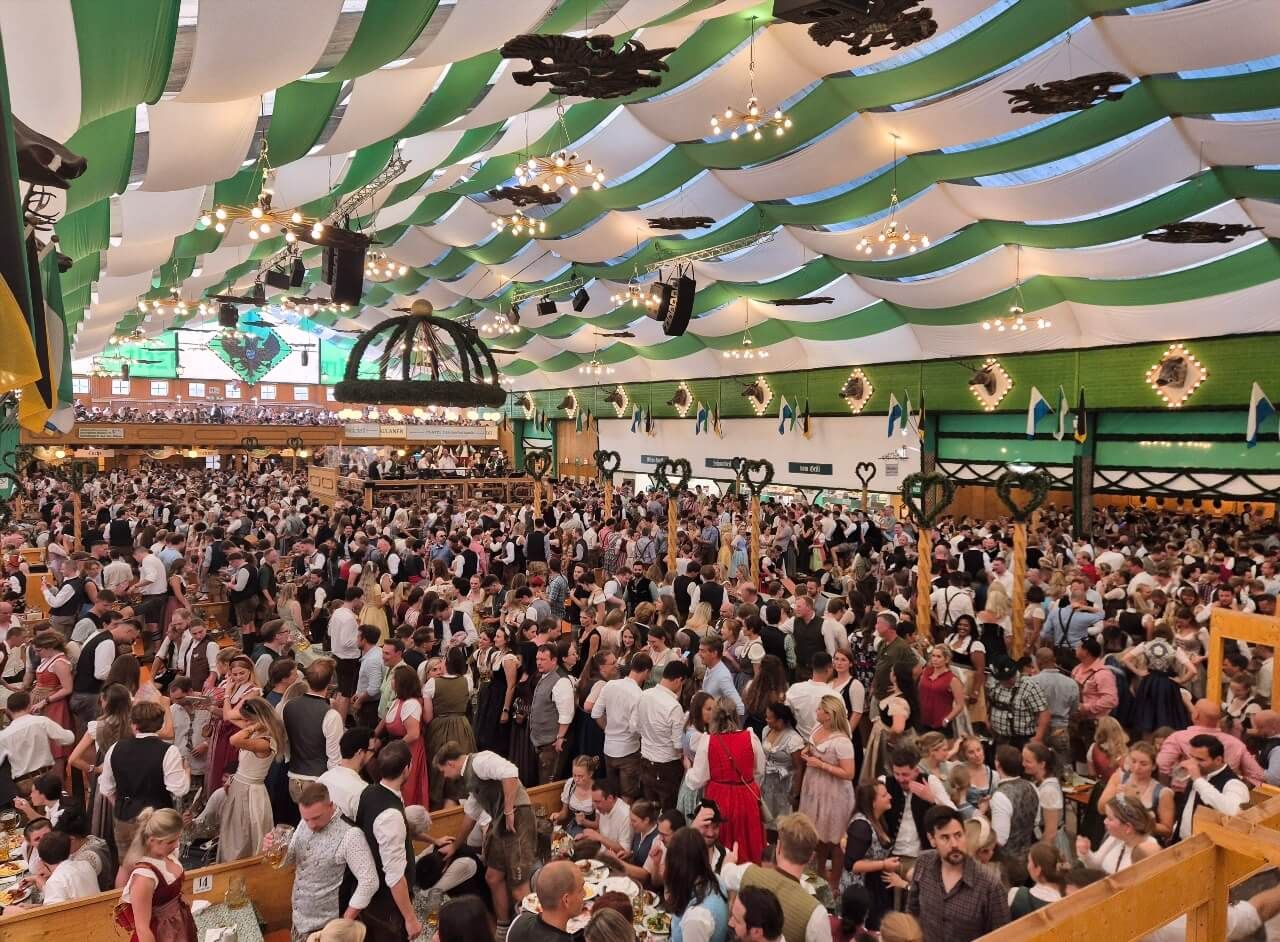
26. Experience Oktoberfest (or the Theresienwiese Year-Round)
Oktoberfest runs for 16 to 18 days from late September into the first weekend of October on the Theresienwiese, a large open field named after Princess Therese of Saxony-Hildburghausen, on the occasion of whose 1810 wedding the first festival was held. The modern event consumes approximately 7 million litres of beer per year and functions as a major commercial event that Munich's entire logistics system is redesigned to accommodate.
If you are visiting outside the Oktoberfest period, the Theresienwiese is worth seeing for the Bavaria statue at its western end: a 18.5-metre-tall bronze female figure completed in 1850 that can be climbed via an internal staircase, with a viewing platform inside her head that looks out over the field.
Visiting during Oktoberfest itself requires planning: book accommodation 6 : 12 months in advance, reserve Biergarten tables through official channels (Reservierungssystem), and arrive at the main tents by 9 am if you want a seat without a reservation. The atmosphere inside a full tent at 2 pm on a Saturday, 10,000 people singing in synchrony, is one of those experiences that is either completely overwhelming or completely exhilarating, usually both.
27. Visit the Munich Toy Museum
The Munich Toy Museum (Spielzeugmuseum) occupies the tower of the Altes Rathaus at the eastern end of Marienplatz. The collection, assembled by Czech-American caricaturist Ivan Steiger, includes antique dolls, tin soldiers, early mechanical toys, and American comic art from the late 19th century to the 1960s. Two hours is enough, but the medieval tower setting gives it a personality that larger museums often lack.
28. Walk the Maximilianstrasse and See the Maximilianeum
Maximilianstrasse is Munich's most architecturally distinctive boulevard, built by Maximilian II in the 1850s in a style he called the Maximilian Style, a hybrid of English Gothic, Byzantine, and German Romanesque that is unlike anything else in Europe. The street runs east from the Altstadtring, lined with high-end shops and hotels, before crossing the Isar on the Maximiliansbrücke and ending at the Maximilianeum, an ornate building on a hill above the east bank of the Isar, originally built as an educational foundation for gifted Bavarian students and now housing the Bavarian State Parliament.
The view back along the boulevard from the Maximilianeum steps toward the city centre is one of the more photogenic in Munich, particularly at dusk when the street lamps and illuminated facades create a long perspective.
29. Watch a Film at the Filmmuseum München
The Filmmuseum München (St.-Jakobs-Platz 1, 80331 Munich, rated 4.6/5 on Google (178 avis)) on St.-Jakobs-Platz is one of Germany's best cinematheques, screening classic films, retrospectives, and restorations in a 180-seat cinema inside the city museum complex. Programming leans toward German expressionism and archive work. Tickets cost around €8. Check the Filmmuseum website in advance, popular screenings sell out.
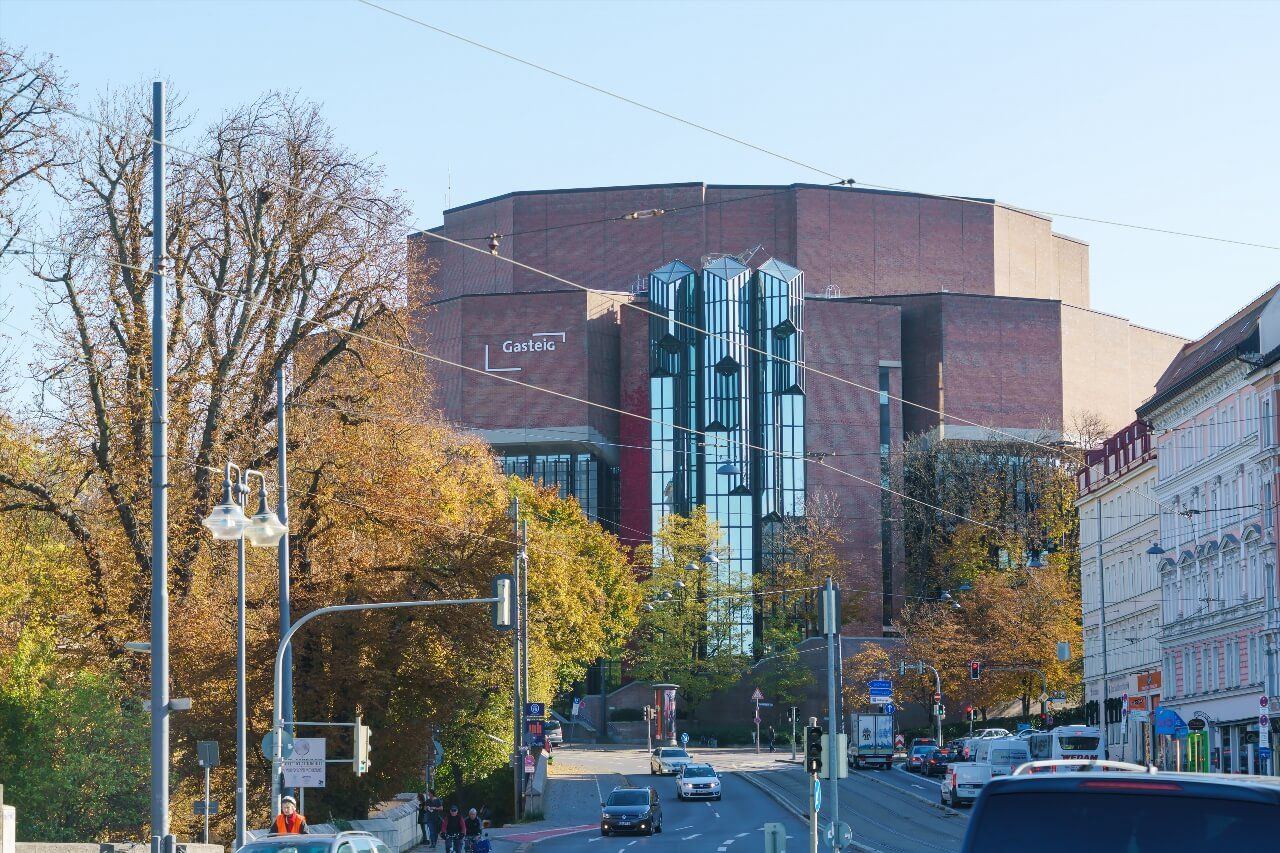
30. Explore the Gasteig Cultural Center
The Gasteig was Munich's main cultural centre from its opening in 1985 until its temporary closure for renovation in 2021, and it is currently operating from the Gasteig HP8 (Hans-Preißinger-Straße 8, 81379 Munich, rated 4.5/5 on Google (2 102 avis)), a converted industrial building in the Haidhausen district, while the original building undergoes a major overhaul expected to complete around 2028. The temporary venue has turned out to have a character of its own: raw brick, exposed steel, and large communal spaces host the Munich Philharmonic, the city's public libraries, adult education programmes, and a year-round programme of concerts, readings, and events.
The HP8 is in the Haidhausen neighbourhood east of the Isar, a district that has developed into one of Munich's more interesting areas for restaurants, independent cafés, and the kind of low-key cultural life that does not appear in tourist brochures. An evening here, concert or no concert, gives you a different side of the city from the palace and beer hall circuit. The Ryo audio city guide for Munich covers the districts closer to the historic core, but Haidhausen is worth the additional 15-minute walk east.
FAQ
What is the best time of year to visit Munich?
Late spring (April : June) and early autumn (September : October) offer the best combination of weather and manageable crowds. July and August are warm but the English Garden and beer gardens are at maximum capacity. Oktoberfest (late September) brings exceptional atmosphere but requires accommodation booked months in advance. December is cold but the Christmas markets at Marienplatz and Schwabing are genuinely atmospheric.
Is Munich expensive compared to other German cities?
Yes, Munich consistently ranks as the most expensive German city. Accommodation and restaurant prices run 20 : 40% higher than Hamburg or Berlin. That said, many of the best experiences are free or very cheap: the English Garden, the Isar beaches, the Viktualienmarkt, and Sunday museum entry at €1. A reasonable daily budget for accommodation, two meals, and two paid attractions runs around €150 : 200 per person.
How do you get around Munich without a car?
The MVV network (Munich's integrated public transport system) covers the city and its surroundings efficiently. A day ticket (Tageskarte) for the inner zones costs around €9 and covers all U-Bahn, S-Bahn, tram, and bus within the city. For day trips to Dachau, Neuschwanstein, or the lakes, the Bayern-Ticket (€29 for one person, incrementally more for groups) covers all regional trains from 9 am within Bavaria for the day.
Do I need to book Neuschwanstein in advance?
Yes, booking online in advance is strongly recommended. In peak season (June : August), same-day tickets at the ticket office are frequently sold out by mid-morning. Book through the official Neuschwanstein ticket website at least two to three weeks ahead for summer visits. Shoulder season (April : May, September : October) gives more flexibility but advance booking is still advised for weekends.
Is Oktoberfest worth attending, or is it too touristy?
Oktoberfest is both genuinely worth attending and undeniably heavily attended by international tourists, these two things coexist. The experience inside a major tent at full capacity is unlike anything else in Europe. The outer fairground, rides, traditional food stalls, the Schaustellermarkt, tends to have more locals and a less pressurised atmosphere than the beer tents themselves. If you go with modest expectations and arrive early, it rewards you considerably.
What should I eat in Munich?
Start with Weisswurst (white veal sausage, traditionally eaten before noon with sweet mustard and a pretzel), Obatzda (a Bavarian cheese spread with butter, onion, and paprika), and a proper Schweinebraten (roast pork) at any traditional Wirtshaus. The Viktualienmarkt is the best single destination for tasting a range of Bavarian products without committing to a sit-down meal. Munich also has a serious Vietnamese and Italian dining scene in the Schwabing and Glockenbach districts if you want to step away from Bavarian food.
Munich is a city that rewards slowing down. The obvious itinerary, Marienplatz, Hofbräuhaus, English Garden, Nymphenburg, covers real ground and is obvious for good reason: those places are genuinely worth your time. But the city's character lives in the smaller details: a morning at Viktualienmarkt before the tour groups arrive, an afternoon beer garden where you brought cheese from the stall across the road, a late screening at the Filmmuseum in a building that has been part of Munich's cultural life for decades. Among all the fun things to do in Munich, the ones you remember tend to be the slower discoveries rather than the headline acts.
The Ryo Ryo's audio guide to Munich's secret capital gives you a 3-hour, 21-stop walk through the historic core with context that turns a sightseeing walk into an actual understanding of how this city was built, by whom, and why. Use the Ryocity route as your first morning, then spend the rest of the trip going deeper.