© Shutterstock
 Votre guide Ryo
Observing the Northern Lights in Iceland: The Complete Guide 2026
The sky tore open at 11:14 PM. A pale green filament at first, almost imperceptible above the ridge line. Then, in forty seconds, everything lit up: from violet to acid green, a luminous drapery undulating like a sheet shaken by the wind, up there, a hundred kilometers high. Chasing the northern lights in Iceland is this: the northern lights in Iceland don't resemble any photo, any video. They look like an error in reality. To prepare the days between two nights of hunting, the Ryo audio-guided tour of Reykjavik, the bay of smokes reveals the Icelandic capital from another angle.
This guide answers the real questions: between September and March, which to choose? What to do when the KP-index is good but the sky is overcast? How to read Vedur.is cloud maps in real time? Which spots give the best photos, Jökulsárlón with its icebergs reflecting the green sky, the black sand beach of Reynisfjara with the basalt columns in silhouette, the Snæfellsnes peninsula without a light on the horizon? And how to stay outside at -12°C without losing your fingers after an hour. Everything you regret not knowing before leaving.
Why Iceland Is the Ideal Country for Northern Lights
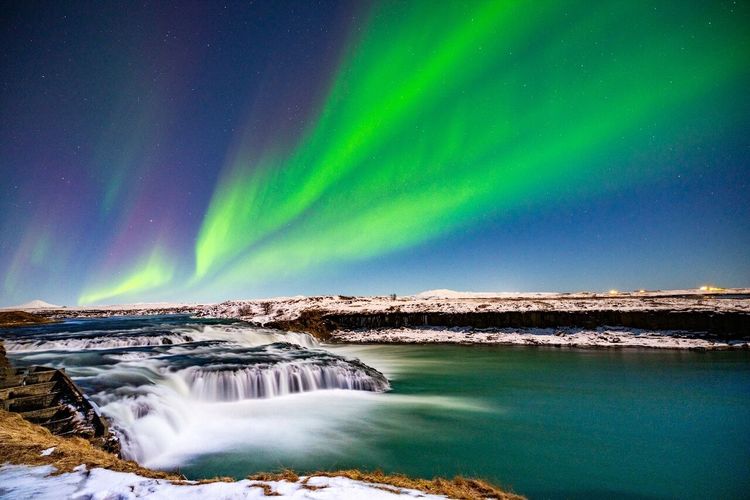
Iceland sits exactly under the auroral oval, this annular zone centered on the magnetic North Pole where solar particles penetrate the Earth's atmosphere and produce the lights. This isn't a trivial geographical coincidence: unlike Swedish Lapland or northern Norway, the island is served from Paris in 3 hours direct flight, making it the most accessible northern lights destination for French travelers.
But position alone wouldn't be enough. Iceland combines three decisive advantages that its Nordic competitors don't all have together.
The first: virtually no light pollution outside Reykjavik. With 375,000 inhabitants spread over 103,000 km², the entire island fits within Iceland. Leave the capital 40 kilometers in any direction and you get a sky worthy of the most remote areas of Scandinavia. The second: a road network practicable in winter over almost the entire country. The Ring Road (route 1), which circles the island for 1,322 km, generally remains passable from November to March, with occasional closures during the most severe storms. The third: a tourism infrastructure refined over decades, with accommodations offering aurora wake-up services, weather apps specialized in Icelandic, and professional guides trained in night hunting.
The counterpart is the weather. Iceland is an island in the North Atlantic subject to almost permanent disturbances. Two or three cloudy nights in a row are the norm rather than the exception. The golden rule: plan a minimum of five to seven nights on site. With less than three nights, chance becomes overwhelming.
When to Go: The September to April Window
Auroras require darkness. In June and July, the Icelandic sun barely sets, the "white night" is a spectacle in itself, but it's incompatible with aurora hunting. The window opens from mid-August, when nights become dark enough for geomagnetic activity to be visible to the naked eye, and closes around early April.
Each period of this window has its personality.
September, October: nights only last 6 to 9 hours, but autumn weather is often milder than in the middle of winter. Nighttime temperatures remain above 0°C most of the time, making long waiting sessions bearable without arctic equipment. Daytime landscapes are exceptional: orange moss, purple heather, low light. This is the favorite period for photographers who want to combine two light ambiances in the same trip. Aurora chances are real from KP3, and KP5+ nights are not rare in September during equinox peaks.
November, January: statistically the best window in terms of darkness volume. In December, night lasts 18 to 20 hours in Reykjavik. More time in the dark mechanically means more chances of crossing a clear spell at the right moment. The disadvantage is severe: snowstorms regularly close sections of the Ring Road, temperatures drop below -15°C in the interior lands, and Atlantic humidity penetrates everything. December remains popular for the festive atmosphere of Reykjavik combined with the possibility of seeing auroras from the city center during high KP.
February, March: many local guides consider this period as the optimum. Nights still last 10 to 14 hours depending on the date. Days become generous in light again for exploring the country. Weather conditions stabilize slightly compared to January. Roads are in better general condition, and snowy landscapes remain omnipresent. In March, days can reach 12 hours of clarity, giving time to cover long distances between two night sessions.
The question of the solar cycle deserves a separate mention. Solar activity follows an 11-year cycle. We are currently at the peak of cycle 25, with exceptionally strong geomagnetic activity. KP5 to KP8 events, visible well south of Iceland, some as far as France and Germany, have been recorded several times in 2024 and 2025. For travelers going in 2026, this is a particularly favorable window: even low-intensity auroras (KP2-3) produce remarkable visual spectacles during the peaks of this cycle.
A last parameter: the geomagnetic equinox. The weeks around the spring (mid-March) and autumn (mid-September) equinoxes statistically see more intense auroras. Earth's position relative to solar wind favors geomagnetic interaction during these periods. If you can choose your date precisely, aiming for mid-September or mid-March maximizes chances.
Understanding the KP-Index and Reading Forecasts
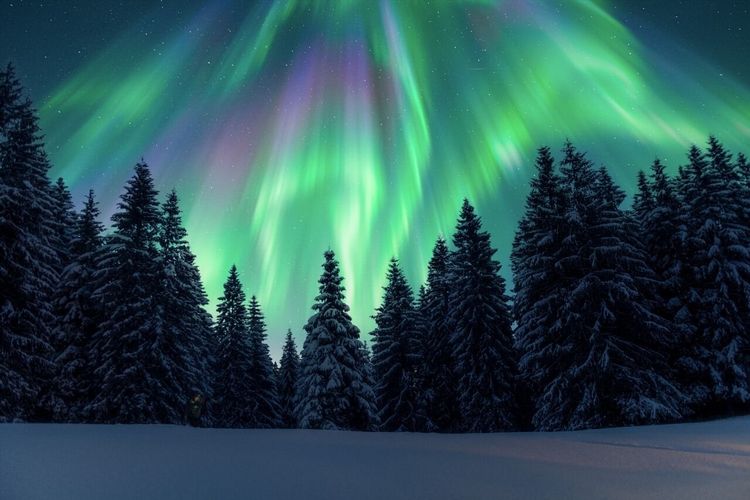
Aurora hunting relies on two completely independent variables: geomagnetic activity and cloud coverage. High KP with an overcast sky gives zero visible aurora. A perfectly clear sky with KP 0 gives the same result. Both must coincide.
The KP index measures geomagnetic activity intensity on a scale from 0 to 9. Here's how to read it practically for Iceland:
- KP 0-1: very low activity, rare auroras even in rural areas
- KP 2-3: first auroras visible to the naked eye in the absence of light pollution. Often a discreet greenish veil on the northern horizon
- KP 4-5: clear auroras over a large part of the sky, visible from Reykjavik's outskirts
- KP 6-7: intense spectacle, auroras covering the entire sky, visible from downtown Reykjavik and beyond
- KP 8-9: rare and intense events. Auroras descend well below the Arctic Circle, visible in France during exceptional solar storms
For forecasts, two sources are reference. The NOAA Space Weather Prediction Center provides 1, 3, and 27-day forecasts. 27-day forecasts have limited reliability, they're based on the previous solar rotation activity. Those at 1-3 days are usable for planning outings. The Vedur.is site, the Icelandic Meteorological Institute, is the absolute local reference for hourly cloud coverage maps. All professional guides consult it first.
An often underestimated point: the full moon hinders weak auroras. It doesn't prevent observing a KP5 or higher aurora, but it erases discreet veils (KP2-3) and reduces contrast in photos. New moon nights are photographers' favorite nights. If you plan your trip with flexibility, positioning the most promising nights around the new moon is a simple optimization.
Finally, know that aurora forecasts beyond 3 days are unreliable. X-class solar flares can occur without warning and transform an ordinary night into a KP7 spectacle. Conversely, a KP5 forecast can yield nothing if a solar disturbance dissipated before reaching Earth. The winning attitude is flexibility: check each evening around 9 PM, adapt your plan.
Essential Apps
Three apps cover 90% of a well-organized aurora hunt's needs.
Aurora Forecast (iOS and Android) displays the predicted KP for the coming hours, aurora probability maps by geographical zone, and overlays a cloud layer. The personalized alert is one of its most useful functions: set a threshold (e.g., KP3) and you'll receive a notification even while sleeping. The free version is sufficient.
My Aurora Forecast offers a more readable interface for beginners, with a colored indicator (green/orange/red) that simplifies the decision to go out or not. It's particularly appreciated by travelers making their first aurora trip who don't want to spend time interpreting graphs.
Vedur.is, the official Icelandic weather app, is irreplaceable for cloud coverage. It provides hourly radar maps and lets you see precisely where clear sky breaks are located, up to 48 hours in advance. If the sky is overcast above Reykjavik but clear 70 km to the east, Vedur shows you in 30 seconds.
Night Strategy: Mobility and Decision
The winning behavior is simple but requires discipline. Check forecasts each evening between 9 PM and 10 PM. If the predicted KP is greater than or equal to 3 and cloud coverage is less than 30% in your area, go out immediately. If the local sky is overcast but a break exists 50-80 km away, take the car without hesitation. Weather zones change very quickly in Iceland over short distances, aurora hunters regularly report having crossed a complete cloud front in 35 minutes of driving.
A classic mistake: waiting in your room for things to "get better." Auroras don't wait. A 20-minute clear spell can produce the night's spectacle, and if you're not in position when it arrives, you miss it.
Go out dressed, with your equipment ready. Find your spot in advance during the day, note its access in the dark. And if the night is disappointing, it's the next one that might be the best.
Reykjavik: Observing Auroras from the Capital
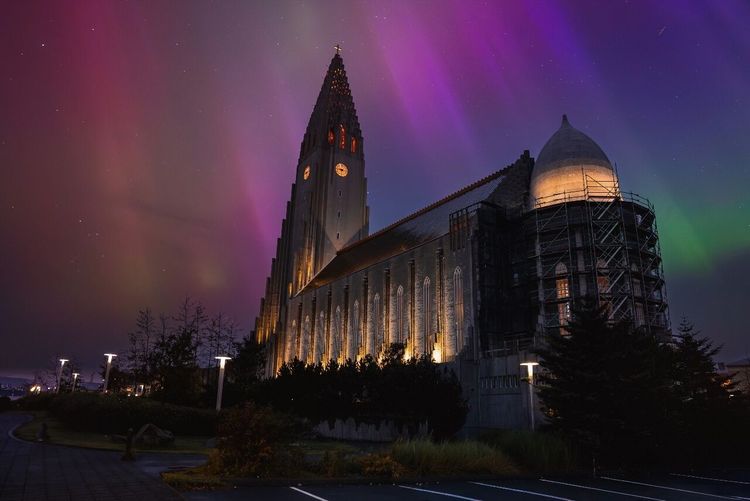
Reykjavik is the natural logistics base for any stay in Iceland. The question systematically returns: can you really see the northern lights from the capital? The answer is yes, but with important nuances depending on activity intensity.
Light pollution from the metropolitan area (about 140,000 inhabitants in Greater Reykjavik) makes low-intensity auroras difficult to distinguish from downtown. KP2-3 produces a greenish veil that easily confuses with urban lighting reflections. However, from KP5 and above, the spectacle remains impressive even from the old port quays or the top of the Hallgrímskirkja tower, the white concrete silhouette of the Lutheran church then stands out under green light curtains.
Several spots limit light interference in the city and its immediate surroundings. Nauthólsvík beach, to the southwest, offers a clear view toward the sea with few direct light sources in the viewing axis. The Grótta point, at the tip of the Seltjarnarnes peninsula (15 minutes on foot from the center or by bus), is known to all locals. Its isolated lighthouse and clear marine horizon to the north make it the best peri-urban spot in the capital. During strong geomagnetic activity, auroras dance above the white lighthouse with a foreground difficult to match for photography.
But for most nights, meaning KP3-4 activities, the solution remains taking the car. At 30 to 40 km from Reykjavik, light pollution almost completely disappears. The road to Þingvellir (45 min) or toward the Reykjanes peninsula to the south (40 min) offers accessible options even without a specific evening program. The audio-guided tour of Reykjavik, the bay of smokes is ideal for discovering the city during waiting days: the Ryo audio guide covers the waterfront and old port with stories about the Viking history of the capital.
If you organize your days in Reykjavik alongside night outings, plan your cultural visits in early afternoon rather than evening, keep the evening to monitor forecasts and rest before potential night outings.
Þingvellir: Auroras Above the Rift Lake
At 45 kilometers east of Reykjavik, Þingvellir National Park is a UNESCO World Heritage Site. Historically, this is where the first Icelandic parliament, the Althing, sat from 930 AD. At night, its exceptional geology makes it one of the most spectacular aurora spots in the country.
The park occupies a rift depression formed by the separation of the Eurasian and North American plates. The basalt walls of Almannagjá, a fissure several kilometers long, protect from wind while leaving the sky entirely open to the north. Lake Þingvallavatn, Iceland's largest natural lake (84 km² surface), reflects auroras in calm, windless weather. On KP3-4 nights, reflections on the water produce images that photographers regularly rank among the most successful in Iceland.
The main parking lot, called Hakið, gives access to park trails and remains open all night. Walking 20 minutes north from this parking lot, you reach areas without any artificial lighting, where the Milky Way is visible to the naked eye during high activity. The lake then reads like a dark mirror under the green sky.
Thingvellir is the classic stop of the Golden Circle, which means guided evening excursions from Reykjavik regularly pass through. If you come by rental car, arrive before 10 PM to find a quiet position. In winter, check road conditions on Safetravel.is before leaving, route 36 can be closed during snowstorms. The road is one of the first cleared after snowfall, but caution in January and February.
For photographers, Þingvellir offers something few spots in Iceland provide: an architectural foreground (the basalt columns of Almannagjá) combined with a reflecting water body. At night, with a good intensity aurora, the double aurora effect, that of the sky and that of the water, is remarkable. Plan manual focus on a bright star before the lights begin.
The South Coast: Vik, Reynisfjara and the Dyrhólaey Cliffs
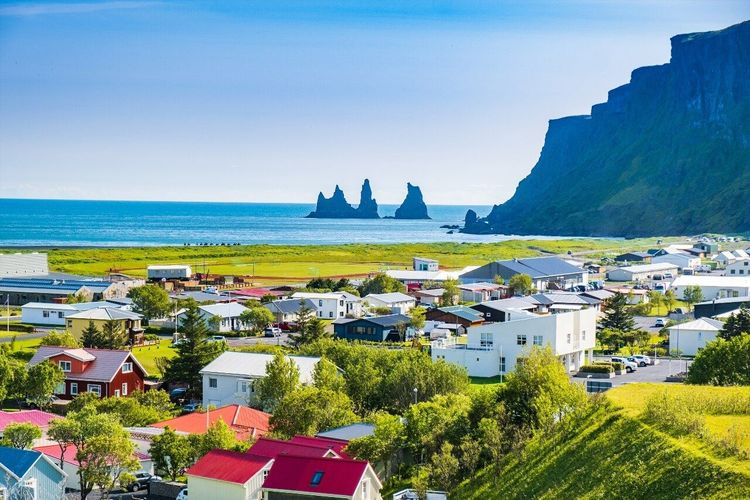
Vik is Iceland's southernmost village, perched between the Atlantic and the lava flows of Mýrdalsjökull. With fewer than 300 permanent residents, it's a stop on the Ring Road, but also a first-class aurora spot thanks to a setting you won't find anywhere else.
The Reynisfjara beach, black volcanic sand, Atlantic waves, is bordered by the Reynisdrangar, hexagonal basalt needles rising from the water a few hundred meters from shore. At night, under a strong aurora, these columns stand out as dark silhouettes against the luminous curtain. The beach faces southwest rather than north, which isn't optimal orientation for weak auroras, but during intense activities (KP5+), the phenomenon covers the entire sky and the Reynisdrangar become a striking foreground.
A firm warning: Reynisfjara is one of Iceland's most dangerous beaches. "Sneaker waves," rogue waves that surge without warning, have caused several fatal accidents. At night, in winter, maintain at least 30 meters distance from the surf. Stay on the high part of the sand, clearly visible from the parking area.
For north-facing spots, take route 1 east for a few kilometers to the Dyrhólaey parking (Dyrhólaey, 871 Vik, rated 4.8/5 on Google for 4,759 reviews). The peninsula is closed during nesting season (May-June), but fully accessible in winter. The view is 360°: to the north, the interior lands and glacier; to the south, the open Atlantic. Light pollution is virtually zero. The Mýrdalsjökull ice cap reflects aurora light with a spectacular effect, producing a white glow below the green sky.
Vik is 185 km from Reykjavik (about 2h20 drive). Plan at least one night on site rather than making the round trip in one night. Several accommodations in Vik and its surroundings offer aurora wake-up service.
Jökulsárlón and Diamond Beach: The Ultimate Photography Spot
There's a place in Iceland where auroras seem to actually touch the earth. The Jökulsárlón glacial lagoon is located 375 km from Reykjavik on route 1, at the border between the south and east regions of the island. It's perhaps the most iconic photography site in the country, and at night, under auroras, no competitor equals it.
The lagoon today covers 20 km², it has doubled in area since the 1970s due to the retreat of the Breiðamerkurjökull glacier. Hundreds of icebergs of all sizes drift slowly toward the Atlantic, tinted deep blue and white. Some weigh several tons, others are simple translucent fragments. At night, illuminated from within by aurora light, they create an unparalleled spectacle.
The Jökulsárlón parking lot, on the lagoon's north shore, is accessible 24/7. In winter, the lagoon partially freezes at certain periods, which attracts photographers seeking to approach icebergs on foot, but this practice is dangerous and officially discouraged. Ice can break without warning. Stay on shore and work with focal length.
At 500 meters east of the main parking is Diamond Beach (Diamond Beach, 781 Höfn, rated 4.8/5 on Google for 4,892 reviews): icebergs stranded on black volcanic sand shine under aurora light or flash like crystal blocks. This is photographers' favorite spot, and its attendance can be high on certain weekend nights. Arrive before 10 PM to find positioning without other people in the field. The iceberg-black sand-green aurora combination is one of the most reproduced compositions in travel photography, and yet, in reality, nothing exhausts it.
Two essential practical remarks. First, Jökulsárlón is 4h30 drive from Reykjavik, don't make the round trip in one night without having slept beforehand. Plan at least one night in Höfn (80 km east), the nearest town with decent accommodations, or in one of the guesthouses a few kilometers from the lagoon. Second, the Ring Road section between Vik and Höfn crosses areas regularly blocked during winter storms. Check Safetravel.is before each departure. The road can remain closed for two or three days during the most severe snow episodes.
The lagoon and Diamond Beach constitute the highlight of most "northern lights Iceland" itineraries. No competitor really contests this. The only risk is betting everything on these two sites and hitting three consecutive cloudy nights, all the more reason to plan several nights in this zone rather than just one. Waiting days fill up easily enough: the short Reykjavik audio walking tour takes care of a morning.
Snæfellsnes Peninsula: Off the Beaten Path
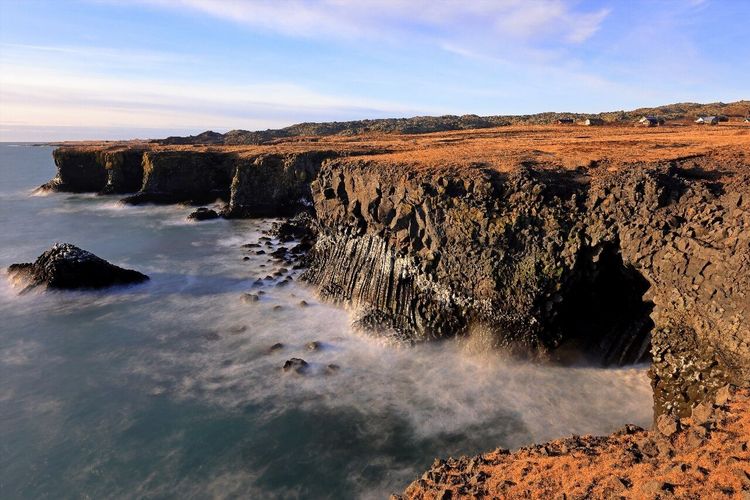
The Snæfellsnes peninsula stretches 90 kilometers west of Reykjavik, crowned by the Snæfellsjökull volcanic glacier, made famous by Jules Verne in Journey to the Center of the Earth. Less frequented than the Golden Circle or south coast, it offers an alternation of wild coves, fishing villages, and black lava cliffs that lend themselves particularly well to nighttime observation.
The Snæfellsjökull National Park covers the peninsula's western tip. Route 574 circles it for 70 kilometers and passes several remarkable spots: Djúpalónssandur beach (black sand, rocks torn into strange shapes), Arnarstapi cape (spectacular volcanic arch cliffs even by day), and the Hellnar coastal plain. Each offers a clear northward view without light obstruction.
Snæfellsnes is particularly recommended between mid-February and late March. Daylight has become generous again, up to 12 hours in March, and the glacier's snowy landscapes offer exceptional photographic conditions both day and evening. The glacier itself acts as a natural reflector under auroras, producing a bluish glow on snowy slopes.
The peninsula is 2h30 to 3h from Reykjavik depending on the chosen route. It's ideally visited over two days: a first day to explore the national park and north coast villages, one night on site to watch for auroras, and a morning return to the capital. The village of Arnarstapi has a few well-situated guesthouses. Accommodations are fewer than in Vik or Höfn, book well in advance during winter season (December-January).
A practical tip often omitted: bring something to eat for evening and night. The rare restaurants on the western tip close early outside high season. A thermos of hot soup and some snacks can make the difference during a long waiting session at -8°C.
Akureyri and Northern Iceland
Akureyri (Akureyri, 600 Akureyri, rated 4.5/5 on Google for 3K reviews) is Iceland's second city, with its 20,000 inhabitants nestled at the bottom of the Eyjafjörður fjord. It's 400 km from Reykjavik by Ring Road (4h30 drive), or 45 minutes by domestic flight from the capital with Air Iceland Connect. Northern Iceland is less often mentioned in aurora guides than the south coast, but it presents real advantages.
Akureyri's theoretical advantage is its latitude: closer to the Arctic Circle than Reykjavik, the city benefits from a slight increase in probability for low-intensity auroras (KP1-2). In practice, the difference is minimal for KP3 or higher auroras, visible everywhere in Iceland the same way.
What really distinguishes the north is the quality of combined experiences. From Akureyri, boat excursions on Eyjafjörður offer twilight outings in winter: whale watching (belugas, orcas) in late afternoon, then return to port under the night's first auroras. Lake Mývatn and its volcanic pseudo-craters, 100 km east of Akureyri, constitute one of Iceland's strangest landscapes, and at night, its deserted shores give access to a sky virtually free of light pollution. The Goðafoss falls ("waterfall of the gods"), 50 km from Akureyri, offer a spectacular foreground for aurora photos: steaming water in winter, partial ice on rocks, and green sky above.
Plan at least two nights in the north to make the trip from Reykjavik profitable. The ideal program combines Mývatn the first day, Akureyri and Goðafoss the second, with night outings from surrounding accommodations.
Guided Tours or Rental Car: How to Decide
The question returns in all forums and travel groups dedicated to Iceland: is it better to hunt auroras by rental car or with an organized excursion? The answer depends on your profile, your winter driving experience, and your itinerary structure.
Guided excursions have a major advantage that cars cannot reproduce: reactive mobility piloted by a local expert. A good guide follows weather forecasts in real time and directs the group to the evening's clearest zone. If the sky is overcast to the east, he goes north. If a front arrives, he anticipates and changes spots before clouds cover. With a rental car, you can do exactly the same thing, but you must interpret Vedur.is cloud maps yourself, which requires some experience.
Before booking an excursion, check these points:
Duration: the best excursions last 3 to 5 hours minimum. "Express" tours of 2 hours with guaranteed return by midnight don't allow time to wait for a clear spell or move if the sky clouds over. A good aurora hunt may require waiting 2 hours in the cold before clouds open.
Compensation policy: serious agencies offer a "Northern Lights guarantee." If you see nothing, you can return the following night at no extra cost. Some offer up to three makeup nights. This is a decisive selection criterion, avoid operators offering no form of compensation.
Group size: prefer small groups of fewer than 15 people in minivans rather than buses of 40-50 travelers. Large groups move slowly, generate more parasitic light at spots, and reduce the experience to something collective and unmemorable.
From Reykjavik, standard excursions cost between 60 and 90 euros per person. Premium photography excursions with a photographer guide go up to 150-200 euros. If you're passionate about night photography, investment in a specialized guide is often worth the price, you leave with images you wouldn't produce alone the first few times.
Rental car is recommended if you're doing the Ring Road tour, if you have winter driving experience (ice, packed snow), and if you seek total freedom in spot and schedule choice. Imperatively choose a 4x4 or all-wheel drive vehicle for the November-March period.
Photographing Northern Lights: Equipment and Settings
Photographing a northern lights display isn't magic, but it requires preparation. The biggest mistake is discovering your camera in the dark at -12°C while lights are dancing. Making settings in advance, during the day, transforms a stressful session into a fluid experience.
Equipment
A DSLR or mirrorless camera remains the optimal choice for two reasons: the ability to increase ISO without producing too much digital noise, and the possibility of using very bright wide-angle lenses. Ideal is an f/2.8 or f/1.8 lens with focal length between 14mm and 24mm. A 24-70mm f/2.8 covers the basic range. Avoid f/3.5-5.6 kit zooms: they lose two to three stops of light compared to bright prime lenses, which translates directly into longer exposures and motion blur on fast auroras.
A sturdy tripod is non-negotiable. Long exposures (2 to 15 seconds) cannot be handheld. Icelandic wind is capable of toppling a light tripod, choose a model of 1.5kg minimum with wide legs. Bring sandbags or attachments to secure it.
Batteries are the critical point in winter. At -10°C, a full battery can last 30 to 40% less than in normal conditions. Bring two spare batteries minimum and keep them in an inner pocket, warm against your body, until you need them. Voltage drop in cold is brutal and sudden, you can go from 40% autonomy to "dead battery" in minutes.
A wired or wireless remote (or 2-second timer) is essential for long exposures: manually triggering transmits vibrations to the camera. For 10-second exposures at f/2.8, the slightest vibration shows in the final result.
Starting Settings
No universal setting exists: intensity and movement speed of an aurora vary from second to second. But these values constitute a reliable entry point:
- ISO: 1600 to 3200 depending on sensor. Recent cameras (2022 and later) often go to ISO 6400 without problematic noise.
- Aperture: f/2.8 or wider (f/1.8 if you have the corresponding lens). Aperture is the most important variable, it determines how much light enters in a given second.
- Shutter speed: 4 to 10 seconds for a slow aurora. If the aurora moves quickly (curtains undulating fast), drop to 2-3 seconds to avoid motion blur of the lights themselves. A slow aurora gives beautiful long exposures; an active aurora requires short exposures to preserve details.
- Focus: manual mode, at infinity. Focus on a bright star before the session begins and check on screen by zooming to 100%. The infinity mark on the lens doesn't always correspond to real optical infinity.
- RAW format: mandatory if you want to correct white balance and recover details in highlights. JPEG leaves no margin.
With a Recent Smartphone
The iPhone 15 Pro, Samsung Galaxy S24 Ultra, and Google Pixel 9 Pro have night modes powerful enough to capture medium-intensity auroras (KP4+). Activate pro mode or advanced night mode, place the phone on a tripod with universal adapter, and test 5 to 15-second exposures. Results won't rival a DSLR on tripod for large formats, but they're sufficient for quality memories.
Composition
Composition often makes more difference than a stop of brightness. An aurora alone against black sky is less memorable than an aurora above a recognizable element. Look for foreground: an iceberg on Jökulsárlón, the Reynisdrangar in silhouette at Vik, basalt columns at Þingvellir, a frozen lake surface. Scout your spots during the day and mentally note how you'll frame at night. Night, in cold, with gloves, is not the time to think about framing.
Gear for Icelandic Nights: Zero Compromise
Spending two or three hours motionless in Icelandic cold without proper equipment is an experience people don't repeat. At -8°C with wind, wind chill drops to -15°C. At -15°C real, it can reach -25°C. Static cold, standing still without moving next to a tripod, is much more aggressive than active cold from hiking.
The Three-Layer System
Base layer (thermal): quick-dry technical fabric. No cotton, ever. Cotton absorbs perspiration and retains it against skin, creating a wet cold effect particularly dangerous. Merino wool or technical polyester: both manage moisture by transporting it to the upper layer.
Middle layer (insulation): heavy fleece (200-300 g/m²) or light down jacket. Natural down jacket is very effective when dry, but loses insulating properties if wetted by rain or snow, which often happens in Iceland. Synthetic fill down jacket is safer for changing weather.
Outer layer (protection): waterproof and breathable windbreaker. Icelandic wind is not anecdotal: even at 2°C, 50 km/h wind gives a -6°C sensation. The outer layer must cut wind completely and let water vapor pass to avoid internal condensation.
Extremities
Hands are the first victim of static cold, and they operate the camera. The solution is a two-level system: thin technical gloves (wool or polyester) for manipulations (setting changes, battery changes, smartphone consultation), with thick mittens over them for waiting periods between shots. Ski or mountaineering mittens are preferable to classic hiking mittens.
For feet, the rule is simple: thick merino wool socks in waterproof winter shoes with crampon sole. City shoes or sneakers are prohibited. Packed snow and ice are omnipresent at night in aurora spot parking lots and trails. Slippery terrain with heavy tripod is a risky combination.
Disposable hand warmers (available in Icelandic pharmacies or Keflavik airport) are lightweight and last 6 to 8 hours. Slip one into each glove during long sessions. This isn't luxury, it's insurance against finger stiffness that prevents focusing.
Aurora Wake-up Service Accommodations and Practical Itinerary
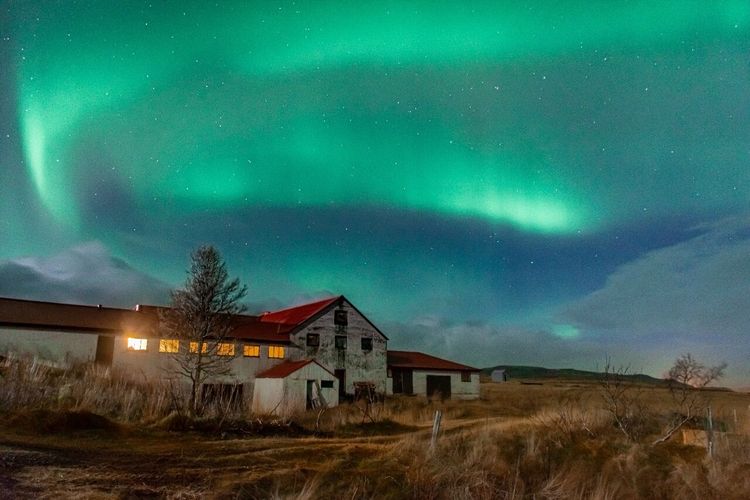
Accommodation choice can transform a failed aurora hunt into success. Some Icelandic establishments have made aurora wake-up service a central marketing argument, and it's not empty marketing.
Aurora Wake-up Service Accommodations
The principle is simple: staff monitor forecasts and, if auroras appear while you sleep, a team member calls or knocks on your door. This service is often free or included in the rate. It's common in south coast guesthouses (between Vik and Höfn), around Lake Mývatn in the north, and in several Snæfellsnes peninsula establishments. Ask explicitly when booking, some don't mention it in their online description but practice it.
For a more immersive experience, isolated cabins on farm properties or lakeside allow aurora observation from the window or from an outdoor geothermal hot tub. Not having to take the car to reach a spot is a real advantage when you're half asleep at 2 AM and the sky just cleared.
7-Night Itinerary to Maximize Chances
Over a week, the following distribution balances country exploration and observation chances:
Nights 1-2: Reykjavik. Arrival, jet lag recovery if needed. Day visits. First night outings from Grótta or to Þingvellir. The Ryo audio guide of Reykjavik, the bay of smokes covers the old port and waterfront to optimize your days in the capital.
Nights 3-4: Vik or south coast. Reynisfjara by day, Dyrhólaey and Seljalandsfoss (waterfall you can walk behind). Night outings from Vik's immediate surroundings.
Nights 5-6: Jökulsárlón and surroundings. Diamond Beach by day to scout positions. Night outings to the lagoon and beach. Night in Höfn or guesthouse near the lagoon.
Night 7: return Reykjavik. Stop at Skógafoss if conditions allow. Last night attempt from Grótta if sky is clear.
This itinerary covers the main Ring Road South spots while leaving two consecutive nights in the Jökulsárlón area, statistically the most productive for aurora photography. The Snæfellsnes peninsula and north integrate better into a 10 to 12-night stay.
FAQ
Can You Guarantee Seeing Northern Lights in Iceland?
No. No guarantee is possible, regardless of period or stay duration. Geomagnetic activity depends on the sun, and Icelandic weather is unpredictable by nature. That said, statistically, a 5 to 7-night stay between October and March gives very good chances of observation at least once. Most travelers staying a week see auroras once or twice, sometimes more. With less than 3 nights, chance becomes decisive.
What Is the Best Month to See Northern Lights in Iceland?
There's no single answer, but February and March are consensus among local guides. Nights are still long (10 to 14 hours), days offer more light for exploring, and road conditions are safer than January. If you want even longer nights and accept more severe winter conditions, December and January maximize darkness volume. If you prefer milder weather and temperatures above 0°C, September and October are early season months.
How Do You Read Northern Lights Forecasts?
Two combined sources cover essentials. The NOAA Space Weather Prediction Center provides KP-index forecasts at 1 and 3 days. Vedur.is provides hourly cloud coverage with radar maps. The Aurora Forecast app synthesizes both sources with automatic alerts. The strategy: check each evening between 9 PM and 10 PM. If KP ≥ 3 and cloud coverage < 30% in your area, go out.
Can You See Northern Lights from Reykjavik?
Yes, during strong activity (KP5 and above). For moderate activities (KP2-4), move 30 to 40 km away from the capital to escape light pollution. The closest and most effective spots within the city are Nauthólsvík beach and Grótta point in Seltjarnarnes, 15 minutes from center by bus or foot.
What Is the Average Duration of a Northern Lights Display?
An aurora can last from a few seconds (a fleeting green veil crossing the sky) to several hours during major geomagnetic storms. Duration is not predictable. Strong activity nights (KP5+) often produce recurring episodes over 3 to 4 hours, with intense phases of 5 to 20 minutes interspersed with pauses. Plan sessions of 1 to 3 hours according to your cold resistance.
What Photo Equipment Is Needed for Northern Lights?
Essentials: a DSLR or mirrorless with bright wide-angle lens (f/2.8 or better), sturdy tripod, and two spare batteries kept warm. Starting settings: ISO 1600-3200, maximum aperture, 4 to 10-second speed depending on aurora speed, manual focus at infinity. With recent smartphone (iPhone 15 Pro, Pixel 9 Pro), advanced night mode results are sufficient for KP4 and above.
Is There Sound During Northern Lights?
Yes, but few hear it. Observers report crackling, whistling or discreet clapping during very intense auroras. This phenomenon is still studied by scientists. A Finnish study published in 2016 located these sound sources at about 70 meters altitude, much lower than the aurora itself. Most observers perceive nothing. Those who hear it describe a particularly intense experience. Turn off noise sources around you if you want a chance to hear it.
Conclusion
Hunting northern lights in Iceland means accepting an uncertainty that few trips impose so clearly. The sun decides. The clouds decide. You organize, equip yourself, choose your spots, and stay available for the moment when everything aligns. It's precisely what makes the spectacle so memorable when it happens.
Iceland is worth the trip anyway: frozen waterfalls, geysers, iceberg lagoons, volcanic coasts. Auroras are the highlight, not the condition. To discover Reykjavik by day between two nights of hunting, the Ryo audio-guided tour of the bay of smokes is the best way to understand the Icelandic capital at your own pace, with its historical accounts and local anecdotes.
À lire également