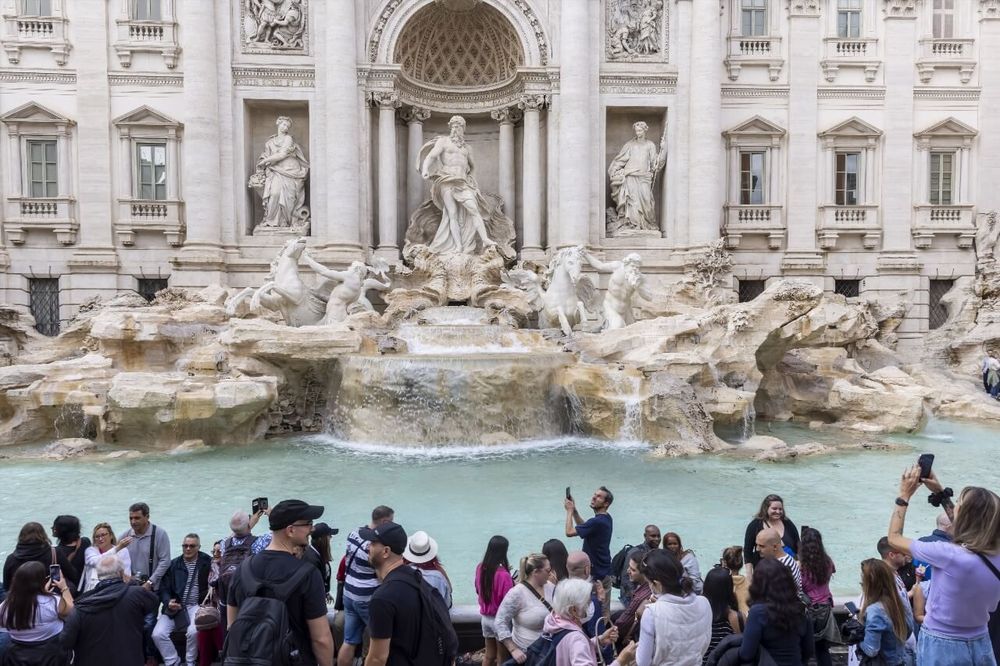
© Shutterstock
 Votre guide Ryo
Trevi Fountain in Rome: Complete Guide 2026
At 26 meters tall and nearly 50 meters wide, the Trevi Fountain in Rome covers an entire palace wall — and still manages to take you by surprise, bursting into view at the end of an impossibly narrow alley. That is the miracle of Trevi: you walk, you turn a corner, and suddenly the Baroque explodes before you, three times larger than anything you imagined. The Fontana di Trevi is the largest Baroque fountain in the world, fed by an aqueduct two thousand years old. Since February 2026, it has become ticketed — a change that profoundly alters how you approach it, and how much you get out of it.
This guide tells you everything the others leave out: how the ticketing system works and how to buy at the right price (not €8 on a third-party platform), what time the square finds its calm, what the sculptures are really saying, and why going beneath the fountain is just as rewarding as gazing at it from above. To walk from Trevi to the Vatican with commentary at every key junction, the Ryo audio-guided tour from Trevi to the Vatican lays out 25 stops, a structured way to move through this dense neighborhood without missing a thing.
The History of the Trevi Fountain
The name "Trevi" most likely comes from the intersection of three roads (tre vie) that converged in this part of ancient Rome. But the history of the monument begins well before the Baroque era — it traces back to an aqueduct ordered by Marcus Agrippa, a close friend of Augustus, in 19 BCE.
That aqueduct, the Acqua Vergine, carries water from springs in the hills about ten kilometers from Rome — water of exceptional purity by ancient standards. Its name comes from a legend: a young virgin (virgo) is said to have shown thirsty Roman soldiers where to find the source. What the legend does reflect truthfully is that the water was of remarkable quality. The Acqua Vergine is one of the very few aqueducts in Rome that never ceased to function: unlike the others, it does not rely on open arches but follows the underground terrain, which protected it from medieval destruction. To this day, it feeds the Trevi Fountain — non-potable water, but flowing continuously for two thousand years without interruption.
In the 15th century, Pope Nicholas V had a simple basin built at the point where the aqueduct reached the neighborhood — functional, modest, with no monumental ambition. That unpretentious basin remained the "Trevi Fountain" for more than two centuries. The popes who followed restored the aqueduct but left the fountain untouched.
Everything changed in 1730 when Pope Clement XII decided to erect a monument worthy of papal prestige at the mouth of the aqueduct. A competition was launched. According to tradition, the winning design was that of Nicola Salvi, a then little-known Roman architect whose proposal drew on Bernini's unfinished work for the same site — sketches the master of the Baroque had produced but never executed.
Construction began in 1732. The project was long and costly. Salvi did not live to see his work completed: he died in 1751, having devoted two decades to overseeing it. Giuseppe Pannini took over the direction of the project and brought the fountain to completion. The inauguration took place on May 22, 1762, under the pontificate of Pope Clement XIII.
The fountain is built against the Palazzo Poli, whose façade serves as the architectural backdrop for the entire composition. This choice — treating a palace wall as a stage set — is one of Salvi's major innovations: rather than constructing a freestanding fountain in an open space, he anchored it within the surrounding architecture, creating a seamless continuity between water, stone, and the buildings enclosing it.
Several restorations have taken place since the inauguration. The most recent is also the most spectacular: between 2014 and 2015, the house of Fendi funded a full renovation at a cost of €2.2 million, including cleaning of the travertine, consolidation of the sculptures, and modernization of the nighttime lighting. A private sponsorship deal that sparked debate — some critics objecting to a fashion brand's name on a public monument — but whose visual results are undeniable.
Architecture and Sculptures: What Every Detail Tells
What strikes you first is the sheer scale. The fountain measures 26.3 meters tall and 49.15 meters wide — wider than the square that contains it. It seems compressed within its frame, as if designed for a space three times larger. This effect is not accidental: Salvi intended it, so that the fountain would seem to overflow into its own neighborhood.
The central figure represents Neptune (Oceanus), standing on a shell-shaped chariot pulled by two sea horses, each guided by a triton blowing into a conch shell. The contrast between the two horses is deliberate: one is calm and docile, the other rearing and wild. This opposition symbolizes the dual nature of the ocean — the peaceful sea and the sea in fury. The tritons, half-man half-fish, represent the boundary between the terrestrial world and the marine world.
On either side of Neptune, two niches frame the main scene. On the left, a figure represents Abundance (Abbondanza), crowned with foliage, pouring water from an urn. On the right stands Health (Salute), holding a serpent — the classical medical symbol since Hippocrates. In the upper register, the coat of arms of Pope Clement XII presides at the center of the pediment, flanked by bas-reliefs illustrating the legend of the virgin pointing out the source.
A well-known anecdote surrounds one of the decorative elements of the basin. During construction, a barber whose shop stood on via della Stamperia reportedly criticized Salvi's work in public. In retaliation, the story goes, the architect placed a large stone vase (asso di coppe) in front of the shop, blocking the view. The vase is indeed there, in the left corner of the basin — but the story is probably apocryphal.
The basin and the rocks supporting Neptune are carved from travertine, the creamy white limestone quarried at Tivoli and characteristic of Roman architecture. The rocks imitate a wild, irregular nature — a deliberate contrast with the neoclassical rigor of the Palazzo Poli in the background.
Paid Entry Since February 2026: Prices and Booking
Since February 2, 2026, accessing the platform bordering the Piazza di Trevi basin requires a ticket during peak hours. This decision was made by the Municipality of Rome after years of debate over crowd management — the square receives up to 15,000 visitors per day in high season, a pressure that made visits uncomfortable and sometimes dangerous in the access alleyways.
The system works as follows: electronic turnstiles are installed at every entrance to the square. A maximum of 400 people may be present simultaneously on the Piazza di Trevi. Access is regulated in timed slots, from 9 a.m. to 10 p.m. (from 11:30 a.m. to 10 p.m. on Mondays and Fridays, last entry around 9 p.m.). Outside these hours, access reverts to being free and unrestricted.
The price is €2 per adult. That is the official rate — no more. Several third-party platforms resell these tickets with hidden fees, up to €8 or €15 each. The only reliable channel is the online portal of the Municipality of Rome (comune.roma.it) or the automatic kiosks installed at each entrance to the square. On-site kiosks accept bank cards.
Categories entitled to free entry:
- Children under 6
- People with disabilities and their companion
- Residents of Rome and the Città Metropolitana with proof of residence
- MIC Card holders and accredited tourist guides
The Roma Pass (Rome's museum-and-transport pass, available in 48-hour or 72-hour versions) offers priority access via a dedicated lane — not free entry, but a worthwhile time-saver in high season.
A few practical points to know before booking: the ticket is name-specific but non-refundable. If you miss your slot, you will need to purchase a new one. Online booking opens 30 days in advance. Early morning and late evening slots tend to remain available without too much advance planning, even in peak summer. Slots between 11 a.m. and 6 p.m. in July and August, however, go quickly.
What the ticket does not cover: the underground site at Trevi (Vicus Caprarius) is a separate visit with its own ticket, costing around €6.
The overall effect on the visitor experience has been largely positive. Those who knew the fountain in the 2018–2023 period — when selfie sticks were clashing 50 centimeters from the water — describe a radical transformation. At 400 people, the square can breathe. You can sit on the steps facing Neptune without being jostled. The sculptures are finally visible without raising an elbow.
When to Visit the Trevi Fountain: Times and Seasons
An entry ticket is only required during peak hours: from 9 a.m. to 10 p.m., and from 11:30 a.m. to 10 p.m. on Mondays and Fridays, with last entry around 9 p.m. Outside these hours — early in the morning before the turnstiles open and late at night after 10 p.m. — the square remains freely accessible and the fountain, permanently illuminated, can be enjoyed without a ticket.
The best time: early morning, before 9 a.m. At this hour, access is still free, the raking morning light strikes the sculptures from the side, bringing out the volumes of the travertine in a way that the midday sun — too vertical, too harsh — never allows. The square has not yet reached its daytime crowds. The atmosphere is close to what it must have been before mass tourism: calm, almost intimate.
A late evening visit after 10 p.m. is the second option. The white-blue LED lighting installed during the Fendi restoration gives Neptune a deeply theatrical presence. The contrast between the illuminated monument and the dark sky entirely transforms the reading of the work. Visitor numbers drop noticeably after 9:30 p.m., especially outside peak season.
The seasons:
- April–May: excellent balance between temperatures and crowds. Watch out for Easter weekends, the busiest of the year in Italy.
- June–August: high season. The heat is overwhelming at midday. Prioritize the 7 a.m. or 10 p.m. slots.
- September–October: the best time to visit. Summer recedes but temperatures remain pleasant. October offers a particularly beautiful light on Rome's stones.
- November–January: few crowds, cheaper accommodation, low golden light. Rain is possible, but the fountain never closes.
Days to avoid: May 1st (Italian Labor Day), July–August weekends, and national public holidays that simultaneously bring in foreign tourists and Romans.
The Coin Tradition: Myth and Reality
Every year, municipal workers retrieve approximately €1.4 million in coins from the bottom of the basin. This amounts to several tonnes of metal. The entire sum is donated to Caritas Roma, which funds soup kitchens, emergency shelters, and programs for homeless people. A quiet but massive redistribution — one that most visitors who toss their coin never know about.
The precise codification of the ritual dates back to the American film Three Coins in the Fountain (1954), which transformed a vague local custom into a worldwide ritual with established rules. The most widely known version: toss one coin with your back to the fountain, over your right shoulder, to guarantee a return to Rome. Two coins promise a romantic encounter, or strengthen an existing relationship. Three coins predict a marriage — or, in the more cynical versions of the story, a divorce.
Before that film, tossing coins into Rome's fountains was a widespread practice but with no such structured symbolism. La Dolce Vita (1960) then embedded the fountain in the global imagination, but it was Three Coins that created the ritual.
Since 2012, retrieving coins from the basin has been strictly prohibited and subject to a fine. Regular patrols by municipal police and permanent camera coverage monitor the square around the clock. Since the introduction of the entry ticket, the volume of coins collected has slightly decreased — mechanically, fewer people means fewer coins — but the annual total remains in the same ballpark.
The Trevi Underground: The Ancient Aqueduct Beneath Your Feet
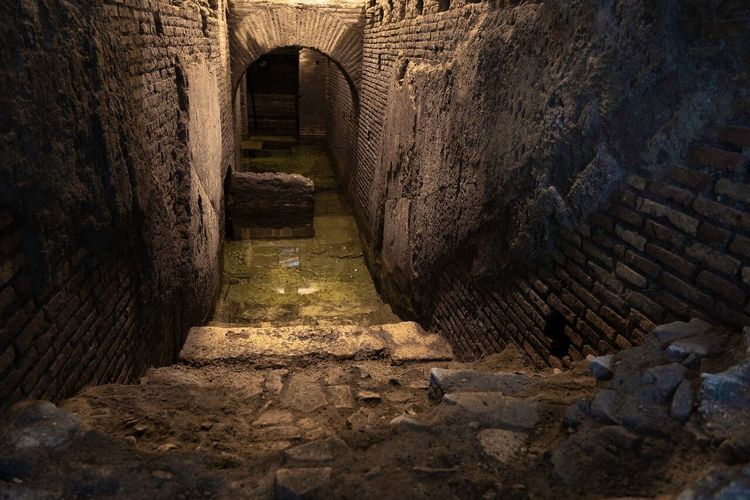
Just 150 meters from the fountain, beneath an ordinary apartment building on via della Muratte, lies the entrance to the Vicus Caprarius (Via della Muratte 52, 00187 Rome, rated 4.2/5 on Google based on 1,851 reviews) — what is commonly called the Trevi underground. It is an archaeological site discovered by chance in 1999 during renovation works on a cinema. No one expected what lay hidden there.
The site reveals several superimposed layers of Rome. At the first level, the remains of an insula — a Roman apartment building from the 2nd century CE — whose walls still reach 8 to 9 meters in height. Doorways, staircases, and ceramic pipes are all visible. Deeper down, lead pipes and brick channels attest to the passage of the Acqua Vergine, which fed both the fountain above and the neighborhood's thermal baths.
The visit lasts between 30 and 45 minutes. Glass walkways allow you to move above the ruins without damaging them. Explanatory panels are available in English. The ticket costs around €6 for adults, with reductions for children and students. Open Wednesday to Monday, 10:30 a.m. to 6:30 p.m.
What the experience gives you is a very concrete understanding of what Rome actually is: a city built in successive strata, each century laid upon the last. Standing underground while knowing that the fountain is running just above your head — separated by a few meters of masonry and twenty centuries of history — is a sensation that is hard to describe without living it.
What to See Around the Fountain
The Trevi neighborhood is one of the densest in Rome for monuments. From the fountain, several major sites are within a twenty-minute walk.
To the north, Piazza Barberini (10 minutes on foot)
Piazza Barberini is home to two works by Gian Lorenzo Bernini. At the center, the Fontana del Tritone depicts a kneeling triton blowing into a conch to support an open basin — one of Bernini's most elegant compositions in Rome. In the northwest corner of the square, the small Fontana delle Api is adorned with the heraldic bees of the Barberini family. Both fountains were commissioned by Pope Urban VIII, who came from that family. The square is also the starting point of Via Veneto and its historic cafés.
To the west, Piazza di Spagna and the Spanish Steps (15 minutes on foot)
The Scalinata di Trinità dei Monti climbs 135 steps toward the French church overlooking the Piazza di Spagna. At the foot of the steps, the Fontana della Barcaccia — a sinking boat — is the work of Pietro Bernini, father of the more famous Gian Lorenzo. The ingenuity of the design stems from a hydraulic constraint: the low water pressure at this location forced the architect to sink the fountain into the ground rather than raise it up.
To the south, the Pantheon (15–20 minutes on foot)
The walk from Trevi to the Pantheon is one of the richest strolls in the historic center. Heading down via della Stamperia and then via di Sant'Ignazio, you will pass the Baroque church of Sant'Ignazio di Loyola and its trompe-l'œil ceiling fresco by Andrea Pozzo — one of the most spectacular perspective illusions in Rome. The Pantheon itself has been ticketed since 2023 (€5 per adult).
To the east, Palazzo del Quirinale (8 minutes on foot) (Piazza del Quirinale, 00187 Rome, rated 4.7/5 on Google based on 5,246 reviews)
The Palazzo del Quirinale, the official residence of the President of the Italian Republic since 1947, is open to the public on certain days (generally Sunday mornings). The state apartments are remarkable, and the view from the garden toward the dome of St. Peter's is one of the finest in the city.
To structure your exploration of this area all the way to the Vatican, the Ryo audio-guided tour from Trevi to the Vatican follows, in English, the quieter back streets between the two monuments, with commentary at every significant point.
Where to Eat and Drink in the Trevi Neighborhood
The immediate surroundings of the fountain are among the most treacherous areas in Rome for dining. Establishments that open directly onto the Piazza di Trevi charge two to three times the going rate for quality that rarely justifies it. The golden rule applies here more forcefully than anywhere else: never walk into a restaurant where someone is calling you in from the door.
For coffee: a 12-minute walk away, the Antico Caffè Greco (Via Condotti 86, 00187 Rome, rated 3.9/5 on Google based on 4,137 reviews) has been open since 1760 and has counted Keats, Goethe, Byron, and Casanova among its regulars. Prices inside are high, but an espresso standing at the counter remains within the Roman norm, and the historical experience is unmatched.
For gelato: Fatamorgana (via Laurina, 6) offers gelato made with quality ingredients and original recipes — bergamot and honey, walnut and grappa, dark chocolate and pepper. Not the most traditional gelato in Rome, but certainly among the most interesting in this neighborhood.
For lunch or dinner: two or three side streets are enough to shift the price range entirely. Via del Lavatore (perpendicular to the square) has several decent trattorias. Heading toward the Pantheon, the value-for-money improves further — the Pigna neighborhood draws more Romans than tourists at lunchtime, which is generally a reliable sign.
How to Get to the Fountain
No metro station serves the fountain directly. The closest is Barberini (line A), about 7–8 minutes on foot. From the exit, head up via delle Quattro Fontane, turn onto via del Tritone, then follow the brown tourist signs.
By bus, lines 52, 53, 62, 63, and 71 stop nearby. The express line 40 from Termini station stops on via del Tritone, a 5-minute walk from the fountain.
The monument is 15 minutes on foot from the Pantheon, 20 minutes from Piazza Navona, and 25 minutes from Piazza Venezia. Rome's historic center is compact enough that a well-planned stay lets you do everything on foot. For day-by-day sequences tailored to each trip length, the article Rome in 3, 4, or 5 Days on Ryo offers complete itineraries.
By car or taxi, ask to be dropped at Piazza Venezia or via del Corso — the streets in the Trevi neighborhood are largely pedestrianized or have complex one-way systems. On foot, our audio-guided tour carries on past the Pantheon to Piazza Navona.
Practical Information
Address: Piazza di Trevi, 00187 Rome
Entry: ticketed from February 2, 2026, €2 per adult, in timed slots from 9 a.m. to 10 p.m. (11:30 a.m.–10 p.m. on Mondays and Fridays)
Tickets: online (official portal of the Municipality of Rome), at civic museums and tourist information points, or at automatic kiosks on site. Booking recommended in high season for midday slots.
Paid access hours: 9 a.m.–10 p.m., or 11:30 a.m.–10 p.m. on Mondays and Fridays, last entry around 9 p.m. Outside these hours, access is free.
Free entry: children under 6, residents of Rome and the Città Metropolitana, people with disabilities + companion, MIC Card holders, accredited guides
Underground site (Vicus Caprarius): via della Muratte 52, open Wednesday to Monday, 10:30 a.m.–6:30 p.m. Separate ticket: around €6.
Accessibility: the square is wheelchair-accessible from via Poli. The underground site has stairs with no alternative and is not accessible for visitors with reduced mobility.
Photography: permitted without restriction from inside the square. Tripods are not allowed.
FAQ
How Much Does Entry to the Trevi Fountain Cost in 2026?
Since February 2, 2026, access to the Piazza di Trevi costs €2 per adult, in timed slots between 9 a.m. and 10 p.m. (11:30 a.m.–10 p.m. on Mondays and Fridays). Entry is free for children under 6, residents of Rome and the Città Metropolitana, accompanied people with disabilities, MIC Card holders, and accredited guides. Tickets are available on the official portal of the Municipality of Rome or at automatic kiosks on site. Several third-party platforms resell these tickets at inflated prices (€8–15); make sure you are on the official Municipality website before paying.
What Is the Best Time to Visit the Trevi Fountain without Crowds?
The ideal slot is early morning, before 9 a.m.: access is still free, the raking light is perfect for photography, and the square has not yet reached its daytime footfall. Late evening after 10 p.m. is the second option: once the turnstiles close, the nighttime lighting gives Neptune a theatrical presence and visitor numbers drop significantly. In July and August, the slots between 11 a.m. and 8 p.m. are best avoided.
Can You Still Throw a Coin into the Trevi Basin?
Yes, the tradition remains alive from inside the square. With your back to the fountain, toss the coin over your right shoulder: one coin ensures a return to Rome, two coins a romantic encounter. The money collected — around €1.4 million per year — is donated in full to Caritas Roma. However, retrieving coins from the basin has been strictly prohibited since 2012 and is subject to a fine.
What Is the Vicus Caprarius, the Underground Site beneath Trevi?
The Vicus Caprarius is an archaeological site on via della Muratte, 150 meters from the fountain. Discovered in 1999 during construction works, it reveals the remains of a 2nd-century Roman insula and sections of the Acqua Vergine aqueduct that still feeds the fountain above. The visit lasts 30 to 45 minutes, with explanatory panels available in English. Separate ticket: around €6. Open Wednesday to Monday, 10:30 a.m. to 6:30 p.m.
Has the Fontana di Trevi Appeared in Famous Films?
Yes. The most iconic sequence remains the one featuring Anita Ekberg and Marcello Mastroianni in La Dolce Vita by Federico Fellini (1960), where Ekberg wades into the basin in an evening gown — a scene that became a global cinematic icon. The American film Three Coins in the Fountain (1954) had previously popularized the coin-throwing tradition on an international scale. The fountain also appears in Roman Holiday (1953) with Audrey Hepburn, and in many more recent productions. Since 2016, swimming in the basin has been banned and subject to a fine.
Conclusion
The Trevi Fountain is to Rome what very few monuments manage to be: a place that lives up to its promise, even after decades of overexposure. It is genuinely spectacular, genuinely surprising at the end of a narrow alley, and genuinely different depending on the hour you discover it.
With the ticketing system introduced in 2026, the conditions for visiting have improved for everyone. Two euros for thirty minutes in a space that can finally breathe — that is a fair deal for a site of this scale. By choosing the right time slot, 7 a.m. or 10 p.m., you will see a fountain that most visitors never truly see.
To explore more of Rome, the Ryo audio-guided tours of Rome cover all the neighborhoods of the historic center with thematic itineraries in English. The audio guide dedicated to the route from Trevi to the Vatican is particularly well suited if you are visiting this part of the city: it connects the two monuments through the back streets and squares that paper maps never point out.
À lire également