© Shutterstock
 Votre guide Ryo
Things to Do in Indonesia in 2026: the Complete Island-by-Island Guide
What to do in Indonesia when the country has more than 17,000 islands spread across three time zones? That's the question that stumps most travelers when they go to book their ticket, and it has no single answer. You can climb the smoking slopes of an active volcano in the morning and float, that very same afternoon, above a fluorescent reef, all without ever leaving the same archipelago. Bali draws the vast majority of international arrivals and shared online images, yet it represents only a tiny fraction of the territory — barely 0.3% of Indonesia's total surface area.
This guide unfolds the archipelago island by island, in the order most travelers discover it: the thousand-year-old temples of Borobudur and Prambanan on Java, the sunrise over the crater of Mount Bromo, the terraced rice fields of Ubud on Bali, the Komodo dragons that exist nowhere else on Earth, and the near-pristine reefs of Raja Ampat, accessible only by boat. You'll also find three itinerary frameworks (10 days, 2–3 weeks, 1 month), a realistic budget estimate, and practical information (visa, domestic flights, ferries) for linking worlds that, from one island to the next, sometimes have almost nothing in common. Before you set off, keep in mind that the Ryo app offers audio-guided tours in many cities around the world — a handy reflex to activate from your stopover, before diving deeper into the archipelago.
1. Java: Borobudur, Prambanan, and the Sacred Temples
On the island of Java, the most populous in the country with more than 150 million inhabitants, Indonesia reveals its densest and most spiritual face. This is where the two monuments that appear in virtually every travel journal about the archipelago are concentrated.
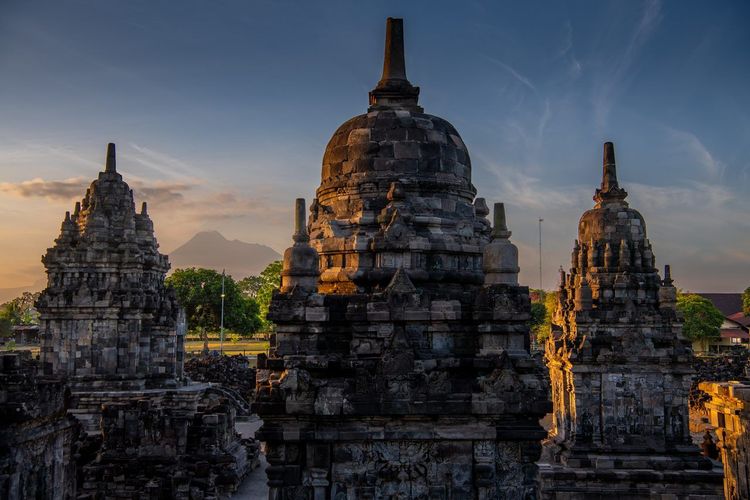
The Borobudur temple (Magelang, Central Java, Indonesia), an hour's drive from Yogyakarta, remains the largest Buddhist monument in the world: a stepped pyramid from the 9th century, built with around two million blocks of volcanic stone, adorned with 2,672 bas-relief panels and crowned by 72 openwork stupas each housing a statue of the Buddha. Be aware that the rules have changed: since 2023, climbing the structure itself requires a specific ascent ticket, separate from garden access, with a guide and plant-fiber sandals (upanat) provided to protect the stone. If you dream of watching the mist rise over the rice fields from the stupas, book the sunrise slot weeks in advance — it is limited to about one hundred people per day.
About fifty kilometers away, on Java's other religious flank, stands Prambanan (Sleman, Yogyakarta, Java), the largest Hindu complex in the country: eight main temples dedicated to Shiva, Vishnu, and Brahma, with the central sanctuary reaching 47 meters. Unlike Borobudur, Prambanan is best visited in the late afternoon, when the andesite stone takes on an orange hue and the tower silhouettes pierce the skyline of the neighboring volcanoes.
Allow half a day for each site, avoiding if possible Indonesian weekends and school holidays, when tour buses fill the esplanades by 9 a.m. Combined Borobudur-Prambanan tickets are available at certain times of year: check at the ticket office — the saving is modest but spares you a second queue.
Between Jakarta and Yogyakarta, the train remains the best option: six to eight hours depending on class, reclining seats, and views over the rice fields that line the tracks for much of the journey. A domestic flight cuts this to an hour, if you'd rather save your energy for climbing the nearby volcanoes.
Many travelers combine Borobudur in the morning and Prambanan at sunset on the same day — an intense pace, but doable: the road between the two sites takes about 1h15 to 1h30 depending on traffic. If time is short, choose Borobudur: its scale and morning silence leave a deeper impression than a rushed second site.
Jakarta, at the other end of the island, plays a different role: a megacity of more than 10 million people, it serves primarily as an air gateway. Most visitors stay no longer than a day or two, between the old colonial quarter of Kota Tua with its crumbling Dutch facades, and the national museum, reopened in late 2024 after a fire, which offers a useful shortcut through the archipelago's history and cultures before moving on to calmer destinations.
Yogyakarta itself deserves a night or two rather than a mere transit stop. The Malioboro district comes alive at sunset with vendors selling gudeg (the local sweet-savory jackfruit dish) and artisans who still paint batik with hot wax, a technique inscribed on UNESCO's Intangible Cultural Heritage list. It is also from here that many travelers organize their excursion to Mount Bromo, described in the next section.
2. Java's Legendary Volcanoes: Bromo, Kawah Ijen, and Merapi
The island of Java has more than 45 active volcanoes, aligned like a backbone from west to east. Three of them attract the bulk of visitors, each with its own logistics and its own pre-dawn wake-up call.
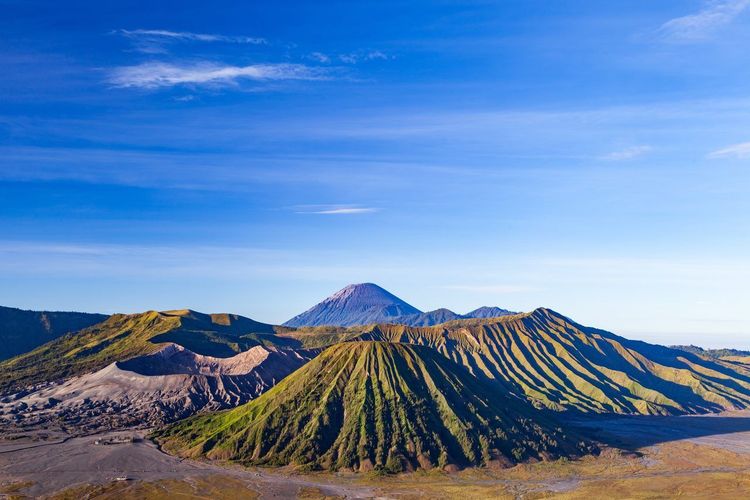
Mount Bromo (Probolinggo, East Java, Indonesia), at 2,329 meters, remains the most photographed volcanic spectacle in the country: an active crater standing alone in the center of a black sand sea, surrounded by the walls of an ancient caldera. The classic visit starts around 3:30 a.m. by 4WD jeep from the village of Cemoro Lawang, heading to the Penanjakan viewpoint where the sun rises over Bromo, Batok, and, in the background, the smoking Semeru. Hiking onto Mount Bromo itself then takes an extra hour, on foot or on horseback, across the sand sea to the roughly 250 steps leading to the crater rim.
Further east, the ascent of Kawah Ijen (Banyuwangi, East Java, Indonesia, rated 4.7/5 on Google across 5,204 reviews) attracts a different crowd: those willing to hike at night with a gas mask, to witness the blue flames shooting from burning sulfur — a phenomenon visible in only a handful of places on Earth where it occurs with such spectacular intensity. Sulfur miners still work there, carrying down 70 to 90 kilos of yellow rock on their shoulders for a few euros per load. The turquoise acid lake that fills the crater, the largest of its kind in the world, then appears at sunrise.
Mount Merapi (Sleman, Yogyakarta) lives up to its name: "mountain of fire" in Javanese, and Indonesia's most active volcano. Don't rely on old trekking accounts: the summit ascent of Mount Merapi has been officially banned since May 2018, and the ban was still in effect in 2026, with authorities regularly fining hikers caught in the closed zone. The legal way to approach it is the "lava tour" by jeep from Kaliurang, which winds through the 2010 eruption flows and buried villages, with the smoking cone as a backdrop. If you're keen to hike, the neighboring Merbabu, when open, offers the best view of Merapi.
Further west, the Sunda Strait is home to what remains of Krakatau (Java), the volcano whose 1883 explosion remains one of the most violent ever recorded, audible up to 4,800 kilometers away. The current island, Anak Krakatau ("the child of Krakatau"), emerged from the sea in 1927 and continues to reshape itself through successive eruptions. It is approached by boat from the western coast of Java or southern Sumatra, on a day trip that is quieter than Bromo or Ijen and subject to current alert levels.
For all these volcanoes, the best window remains the dry season, from April to October: outside this period, trails become slippery and the sky clouds over, often making sunrises invisible. Allow one overnight stop for Bromo and one for Ijen if you plan to do both, which works very well: the two are connected by five to six hours of road.
Of the two night ascents, Kawah Ijen remains the most physically demanding (sustained elevation gain, air sometimes heavy with sulfur fumes), while Bromo ends with a short walk accessible to most fitness levels, including with children.
3. Bali: Rice Terraces, Temples, and Iconic Beaches
Bali, the island of the gods with ten thousand smiles as the saying goes, remains the most-cited destination in every guide to Indonesia, and for good reason: over an area equivalent to a single French department, it packs in volcanoes, rice terraces, black and white sand beaches, Hindu temples, and a culinary scene that has exploded over the past ten years.
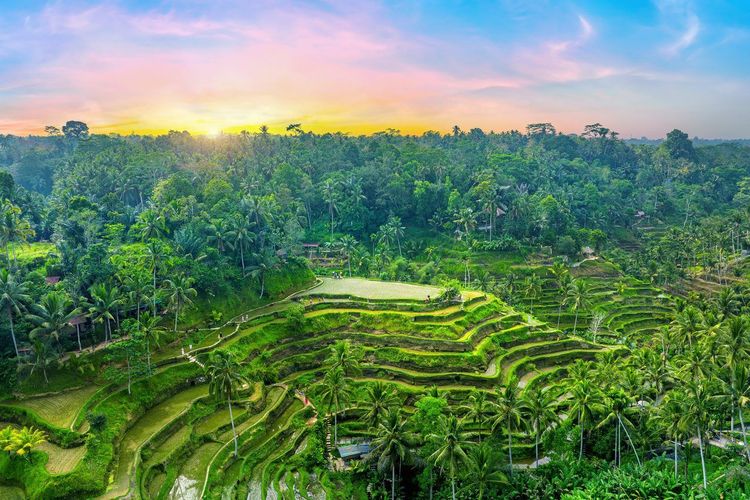
Ubud and Its Rice Terraces form the island's cultural anchor, far from the coast and its beach clubs. The town itself brings together art galleries, a traditional market bustling from 6 a.m., and Balinese cooking classes, but it is above all the terraced rice fields of the surrounding area — particularly those of Tegalalang — that draw visitors: an emerald-green vegetated staircase, irrigated by the subak, a water-sharing system documented since the 9th century and inscribed on the UNESCO World Heritage List in 2012. Arrive before 8 a.m. if you want to photograph them without the crowds or the giant swings installed for social media.
Further to the southwest, on the coast, the Tanah Lot temple (Beraban, Tabanan, Bali) stands on an isolated rock battered by waves, one of the sea temples said to protect the island from spirits coming from the ocean. Photographed at sunset by hundreds of visitors every evening, it can only be reached on foot at low tide, and the interior of the sanctuary remains reserved for worshippers — a detail many discover only on arrival.
Two other sites complete the must-see trio. The Jatiluwih rice terraces, far more expansive and much less crowded than those of Tegalalang, stretch across several hundred hectares at the foot of Mount Batukaru and are part of the UNESCO-listed site themselves: a panorama that justifies half a day's walk or cycle ride on its own. And the Pura Ulun Danu Batur temple (Kintamani, Bangli, Bali, Indonesia, rated 4.5/5 on Google across 3,643 reviews), perched on the rim of the Kintamani caldera, overlooks Lake Batur and the volcano that formed it — a rare setting for a sanctuary.
On the satellite island side, Nusa Penida and Nusa Lembongan, 30 to 45 minutes by fast boat from Sanur, offer a complete change of scenery: vertiginous limestone cliffs, Kelingking beach shaped like a T-Rex that has become one of the most shared images in the entire Balinese archipelago, and snorkeling spots where manta rays sometimes glide past. Nusa Lembongan, smaller and quieter, can be covered by scooter in a morning.
Finally, Bali's beaches are worth distinguishing by atmosphere: Amed, to the east, keeps its fishing village pace, a quarter of an hour from the Tulamben wreck where you can dive from the shore; Sanur, to the southeast, draws families and retirees to a calm seafront promenade; Denpasar and the southwest coast, finally, concentrate most of the nightlife around Seminyak and Canggu, where surfers and digital nomads cross paths in dozens of cafés open onto the beach.
Getting around between these different hubs requires forward planning: traffic around Canggu, Seminyak, and Denpasar clogs up at peak hours, and it's not unusual to lose two hours covering twenty kilometers in high season. Many travelers choose to hire a driver for the day rather than rent a scooter, especially for trips to Ubud, Lake Batur, or Tanah Lot from the south.
Religious ceremonies, occurring almost daily somewhere on the island, also punctuate Balinese life: banana-leaf offerings placed on the ground at dawn, white-clad processions sometimes blocking the main road for an hour. Far from being an inconvenience, these moments say much about what sets Bali apart from the rest of the archipelago, which is predominantly Muslim. On the food front, a simple roadside warung sometimes serves a babi guling (roast suckling pig) more memorable than a trendy Seminyak table, at a fraction of the price. And keep an evening for a kecak dance performance at Uluwatu, a male chorus chanting a cappella an episode of the Ramayana facing the setting sun.
One final piece of advice, valid for the whole island: don't try to do everything in fewer than five days. Bali rewards slowness far more than a race from viewpoint to viewpoint.
4. Lombok and the Gili Islands: Unspoiled Tropical Paradise
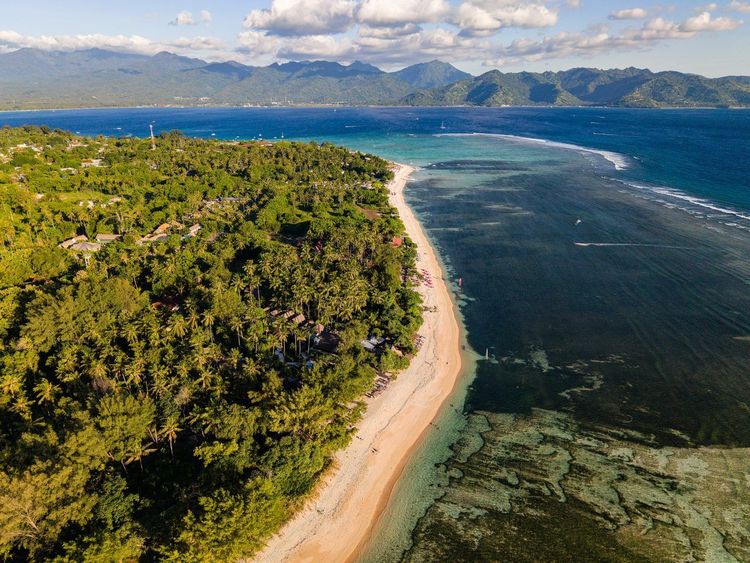
In Lombok and the Gilis, the pace changes. An hour and a half to two hours by fast boat from Bali, the island of Lombok cultivates a different tempo: less tourist development, more rice fields, and a volcano that dominates the entire north of the island.
The Gili Islands — Trawangan, Meno, and Air — form a miniature archipelago off the northwest coast of Lombok, with no motorized vehicles. Gili Trawangan (Lombok, West Nusa Tenggara, Indonesia, rated 4.5/5 on Google across 4,067 reviews), the largest and most lively of the three, blends white sand beaches, beach bars, and bicycle or horse-drawn cart (cidomo) rentals for all transport. Gili Meno, in the center, remains the most tranquil, prized for its inland salt lake and crowd-free sunsets. Gili Air, finally, strikes a compromise: lively enough to find a good restaurant, yet calm enough to escape Trawangan's rowdy nights. Can't decide? For a first couples' stay, Gili Air often ticks all the boxes.
On Lombok itself, the ascent of Mount Rinjani (3,726 meters) remains one of Indonesia's most demanding and most rewarding treks: two to three days of hiking, high-altitude camping, and a turquoise crater lake, the Segara Anak, nestled at the center of the caldera. The final push begins around 2 a.m. to reach the summit before sunrise, along a volcanic ash trail that discourages more than a few hikers at the halfway point. Book through a licensed operator: guides and porters are mandatory.
For those who want to relax on Lombok's beaches without climbing Rinjani, the Kuta Lombok region in the south lines up nearly deserted bays framed by green hills, light-years from the far more developed Balinese Kuta. Selong Belanak, a little further west, attracts beginner surfers thanks to its gentle, consistent swell.
When to visit Lombok? The dry season, from April to November, is by far preferable, especially for Rinjani: the national park closes every year during the height of the monsoon, generally from January to the end of March.
Lombok — a rediscovery of authenticity for many travelers returning from a first stay in Bali — is ideally visited as a complement to the neighboring island rather than a substitute: Bali for the energy and culinary scene, Lombok for the space and silence.
5. Komodo National Park and Its Legendary Dragons
In Komodo National Park, you are walking through one of the rare territories on the planet where you can still encounter, in the wild, the animal that gave the park its name.
The Komodo National Park (Labuan Bajo, Flores, East Nusa Tenggara), UNESCO-listed since 1991, spans more than 1,700 km² of volcanic islands and turquoise sea. It is the only natural habitat of the Komodo dragon, the largest living lizard, capable of reaching three meters in length and 70 kilos. Rangers accompany every visit to the islands of Komodo and Rinca, forked stick in hand: the animal, a predator with a venomous bite, is nothing like a zoo exhibit.
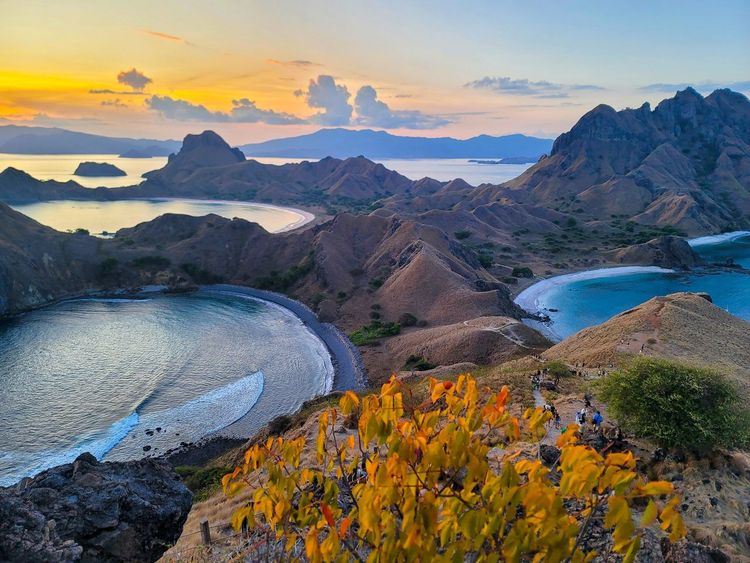
Labuan Bajo, the port town that serves as base camp, has undergone a spectacular transformation over a decade: from a simple fishing village, it has become the departure point for hundreds of traditional wooden boat (phinisi) cruises lasting two to four days, combining visits to the dragons, snorkeling on the park's reefs, and the ascent of Padar, whose viewpoint over three bays with differently colored sands (pink, white, black) is among Indonesia's most reproduced images.
Flores, the island on which Labuan Bajo sits, deserves a few extra days beyond the Komodo park. Heading east, Kelimutu (Ende, Flores) peaks at 1,639 meters and harbors three crater lakes of distinct colors — turquoise, green, and near-black brown — that shift hues over the years according to volcanic and mineral activity, a phenomenon still not fully understood.
Flores and Komodo do, however, demand time: the road between Labuan Bajo and Kelimutu takes about ten hours along the winding route that crosses the island, versus roughly an hour's flight to Ende. A good approach is to fly one way and drive the other, passing through villages no boat can reach.
6. Raja Ampat and Papua: the Natural Sanctuary of the Far East
After the more accessible islands of the central archipelago, Indonesian Papua marks a shift in category: more expensive, more remote, more difficult to organize, but reserved for those seeking near-pristine nature. If you only have two weeks, save it for a second trip.
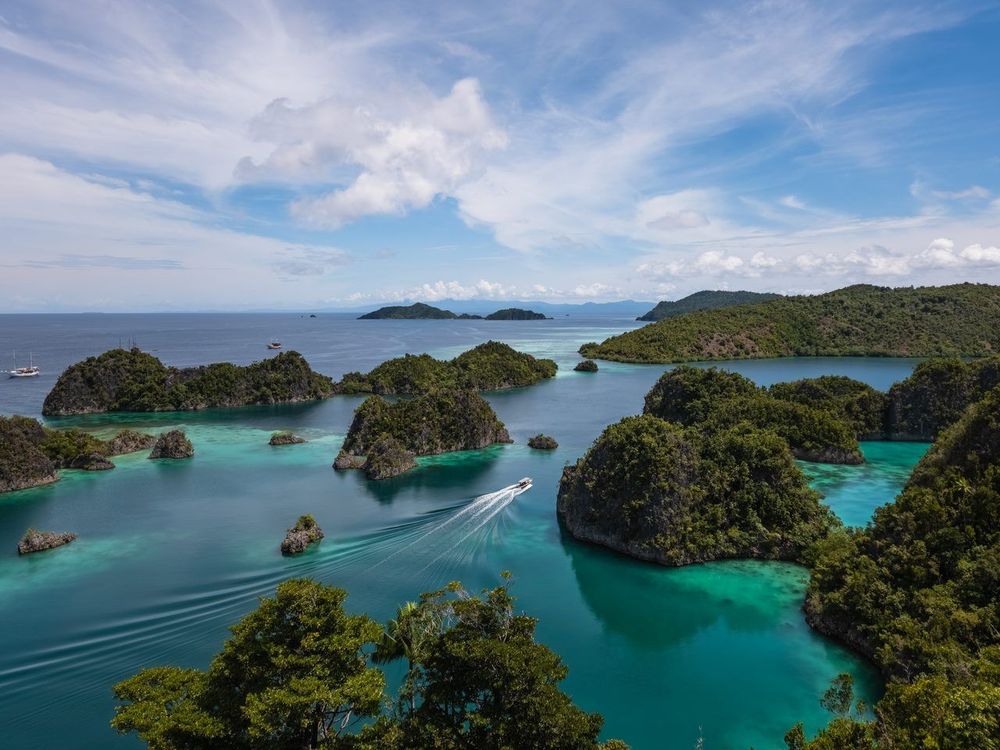
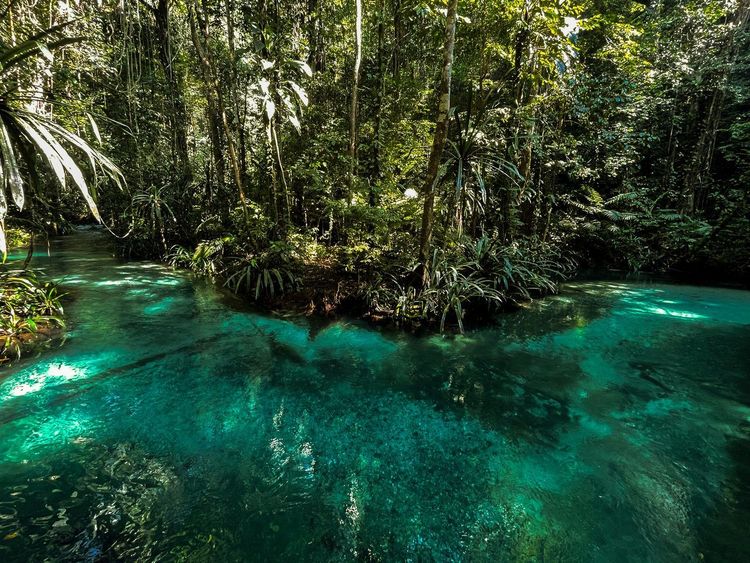
The Raja Ampat islands ("the four kings" in Indonesian), off the northwestern tip of New Guinea, form the most marine-biodiversity-rich coral archipelago recorded on the planet: more than 1,500 fish species and around 75% of all known coral species have been identified there. Diving in Raja Ampat draws divers from around the world for its pristine drop-offs, manta rays, and reef sharks, protected by a network of marine reserves created from 2007 onwards.
The Piaynemo viewpoint, reached after a ten-minute climb up wooden steps, offers the most photographed panorama in the archipelago: a mosaic of karst islets rising from a turquoise sea. Budget significantly more than for the rest of the trip: domestic flights to Sorong, ferry to Waisai, accommodation in isolated homestays or resorts, and an entrance fee channeled toward protecting the marine park.
Further south, the Baliem Valley (Central Papua), at 1,600 meters altitude around the town of Wamena, opens onto a completely different face of Indonesia: that of the Dani, Lani, and Yali peoples, whose first contact with the outside world dates back only to the 1930s. The Baliem Valley Festival, every August, brings together simulated tribal battles, dances, and traditional markets. Before you go, check the travel advisories from your country's foreign ministry: the security situation on the Papuan highlands evolves regularly.
Finally, Lorentz National Park (Papua), the largest in Southeast Asia at nearly 2.5 million hectares and UNESCO-listed, remains reserved for expeditions and seasoned trekkers: equatorial glaciers, tropical rainforests, and summits exceeding 4,800 meters coexist within a single protected territory, without any meaningful tourist infrastructure.
7. Wild Sumatra: Lake Toba, Orangutans, and Volcanoes
Sumatra, the sixth-largest island in the world, paradoxically remains one of the least visited in Indonesia relative to its size. If you're looking for space and less packaged encounters, this is where to look.
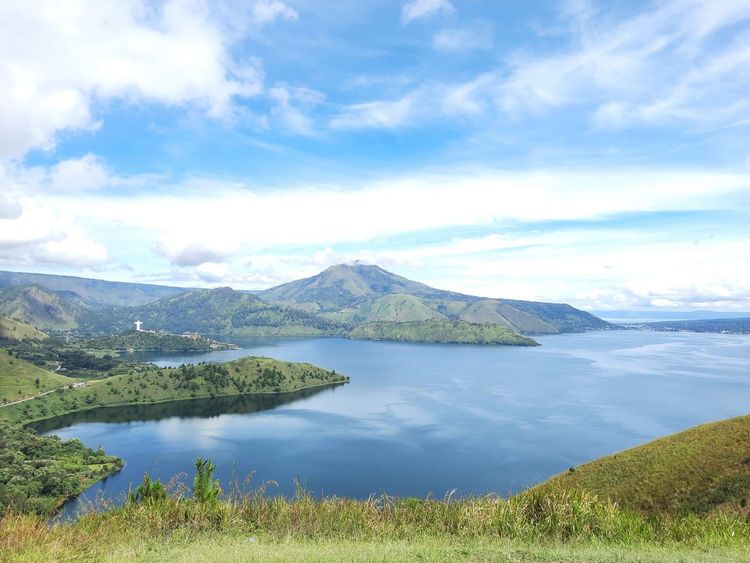
Lake Toba (North Sumatra), formed around 74,000 years ago by one of the largest known volcanic eruptions, stretches 100 kilometers in length: the world's largest volcanic lake. At its center, the island of Samosir, uplifted after the eruption, is home to the traditional villages of the Batak people, with their characteristic saddle-roofed houses and carved tombs.
Further north, Bukit Lawang (Langkat, North Sumatra, Indonesia, rated 4.4/5 on Google across 7K reviews) serves as the gateway to Gunung Leuser National Park, one of the last refuges where Sumatran orangutans can be observed in the wild — a species classified as critically endangered with around 14,000 individuals remaining. Treks ranging from one to several days venture into dense primary jungle where gibbons, macaques, and, more rarely, hornbills also roam. Choose a licensed guide who does not feed the animals: it is the best way to support conservation efforts.
To the west, the Harau Valley (West Sumatra), sometimes nicknamed the "Indonesian Yosemite," unfolds vertical cliffs often exceeding 100 meters, against a backdrop of rice paddies and waterfalls that tumble directly into the fields. The place remains surprisingly little known despite its spectacular scenery.
For surfers, two offshore archipelagos along the west coast complete the picture: the Mentawai Islands, renowned for some of the most consistent and powerful waves on the planet, accessible only by boat from Padang, and the Banyak Islands, even more off the beaten track, where a handful of isolated surf camps coexist with a few fishing villages.
8. Sulawesi and Tana Toraja: Land of Ancient Traditions
The Celebes, Sulawesi's other name inherited from the colonial era, sketches an orchid-shaped island whose every arm hides a different world: a spectacular funerary culture at its center, pristine coral reefs along the coasts.
Tana Toraja, around the town of Rantepao (South Sulawesi), offers one of the most powerful cultural experiences in the entire archipelago. The Toraja people practice funeral rites that can stretch for several years after death: the deceased remains considered "ill" and stays in the family home until the family has gathered enough buffaloes to hold a ceremony befitting their status, sometimes attended by hundreds of guests. The tongkonan houses, with their buffalo-horn roofs, complete the visit. If you attend a ceremony, come with a local guide and bring a gift (cigarettes or sugar are customary): you are a guest of a grieving family, not a spectator at a show.
Heading to the coast, diving at Bunaken (Manado, North Sulawesi), a protected marine park since 1991, offers coral drop-offs that plunge to great depths just a few dozen meters from shore. Further to the southeast, Wakatobi National Park (Southeast Sulawesi) is part of the Coral Triangle and rivals the archipelago's best dive sites, but remains far less visited due to the lack of easy connections.
Finally, the Togian Islands, isolated in the center of the Gulf of Tomini, stack three marine ecosystems in a single spot (coral reefs, mangroves, and seagrass beds) — a rare combination that draws a handful of seasoned divers willing to accept long and sometimes uncomfortable boat connections.
9. Kalimantan (Borneo) and Tanjung Puting National Park
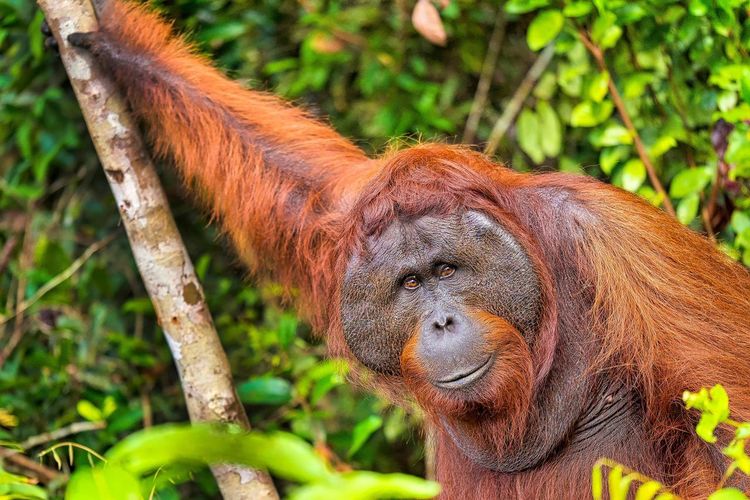
In Borneo, the Indonesian portion of the world's third-largest island is called Kalimantan. For a traveler, its appeal centers mainly around a single site — but a major one.
Tanjung Puting National Park (Central Kalimantan) is explored almost exclusively by klotok, a traditional two-deck wooden boat that slowly travels up the Sekonyer River over two or three days, with nights spent on board under mosquito nets. The park is home to one of the largest orangutan populations in Borneo, observable notably during feeding sessions organized at Tanjung Harapan, Pondok Tanggui, and Camp Leakey, where rangers set out bananas and milk for reintroduced individuals.
Beyond the orangutans, the klotok journey is an experience in itself: the cries of invisible gibbons in the canopy, proboscis monkeys (Borneo's emblematic long-nosed primates) on the riverbanks at dusk, and total disconnection, with no mobile signal for most of the trip. You sleep on the deck, lulled by the forest: few nights of travel leave such a vivid memory.
Access is generally by flight from Jakarta or Surabaya to Pangkalan Bun, followed by a short drive to the Kumai embarkation point. Two days of cruising cover the essentials; three allow you to venture further into the park and observe a greater diversity of wildlife.
10. Indonesia's Secret Islands: off the Beaten Path
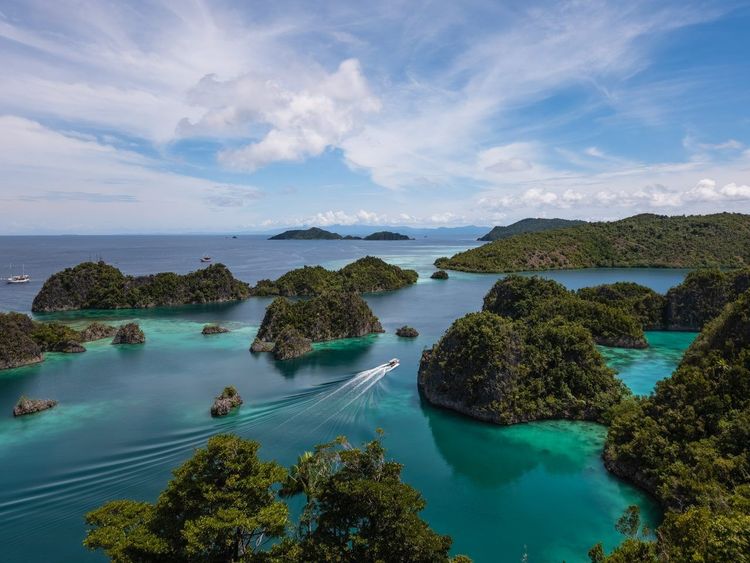
Getting off the beaten path in Indonesia is still possible, even after more than a decade of tourist boom. Here are six destinations that general-interest guides rarely bring together on the same list.
The Karimunjawa Islands, off the north coast of Java, form an archipelago of 27 islands largely spared from mass tourism, with a marine national park where blacktip reef sharks and turtles can be approached while snorkeling.
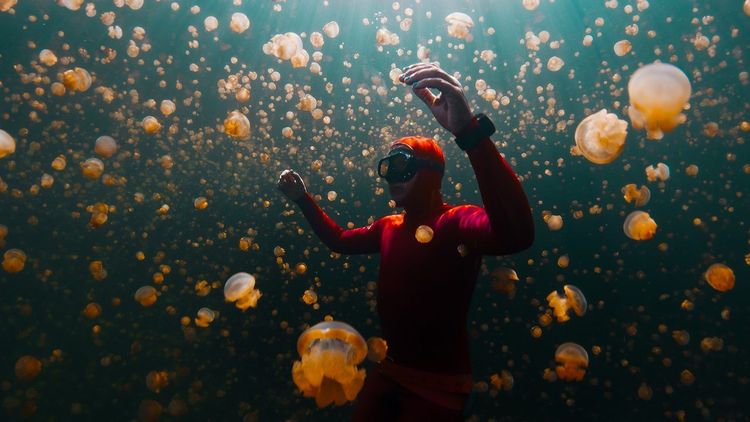
The Derawan Islands (East Kalimantan) attract visitors chiefly for Kakaban Lake, an isolated brackish lake where thousands of jellyfish swim with almost no stinging capability — a phenomenon shared with only a handful of sites worldwide, Palau among them. The archipelago is also a major nesting ground for green turtles.
The Banda Islands, in the Moluccas, were the center of the world's nutmeg trade in the 17th century: crumbling Dutch forts, still-active spice plantations, and pristine reefs compose a setting that feels frozen in time today.
Pangandaran (West Java), a human-scale seaside resort on Java's south coast, remains one of the few Javanese beaches that is still affordable and largely un-internationalized, with the Green Canyon gorge nearby.
The Tumpak Sewu waterfall (East Java), nicknamed "the thousand falls" for the multitude of water threads cascading down an amphitheater-shaped cliff of around 120 meters, is reached via a slippery descent equipped with ladders and ropes — best reserved for travelers comfortable with some exposure to heights. It can easily be combined with Bromo, a few hours' drive away.
Finally, Ujung Kulon National Park (western tip of Java), UNESCO-listed, protects the last global refuge of the Javan rhinoceros, with around 80 individuals recorded and a tropical forest that still covers nearly the entire peninsula. If you have already ticked Bali, Java, and Lombok on a first trip, these six destinations make excellent reasons to return.
11. The Best Diving and Snorkeling Spots in Indonesia
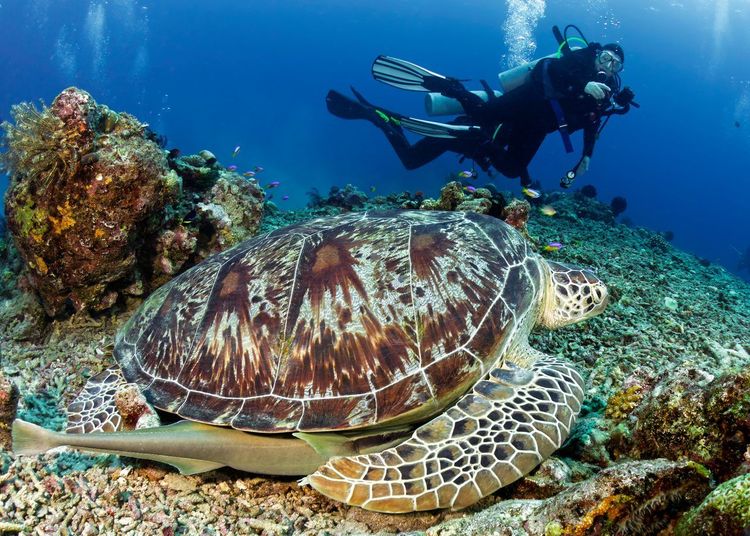
The best places to dive in Indonesia are spread across almost the entire archipelago, which complicates the choice for a time-limited trip. Here is how to decide based on your level and budget.
For maximum biodiversity, Raja Ampat has no equal, but it demands the highest budget and travel time on this list. For a more accessible alternative, Bunaken (North Sulawesi) and Komodo National Park offer spectacular reefs and a real chance of encountering manta rays, with far simpler logistics. Be aware of Komodo's currents, often strong: they are reserved for experienced divers.
Around Bali, three spots stand out: Pemuteran, in the northwest, with the island of Menjangan and its drop-offs; Nusa Penida, to the southeast, for manta rays visible almost year-round at Manta Point; and Tulamben, near Amed, for the wreck of the USS Liberty, an American cargo ship torpedoed in 1942, beached on the shore then slid into the sea during the 1963 eruption of Agung, now colonized by corals and accessible directly from the shore.
For beginner snorkeling, with no certification required, the Gili Islands off Lombok and the Karimunjawa park off Java remain the simplest options: calm, shallow waters and equipment rental available on-site for a few euros.
Allow three to four days to obtain a PADI Open Water certification at most Indonesian dive centers, generally cheaper than in Europe or Australia — which explains why so many travelers use their time in Bali or Gili Trawangan to get certified.
As a general rule, the dry season (April to November for the central and western archipelago) offers the best visibility, with peaks of 30 meters at the top sites; northern Sulawesi can be dived year-round. The practical details of each spot are covered in the sections dedicated to each island earlier in this guide.
12. How Long to Visit Indonesia: Itineraries from 10 Days to 1 Month
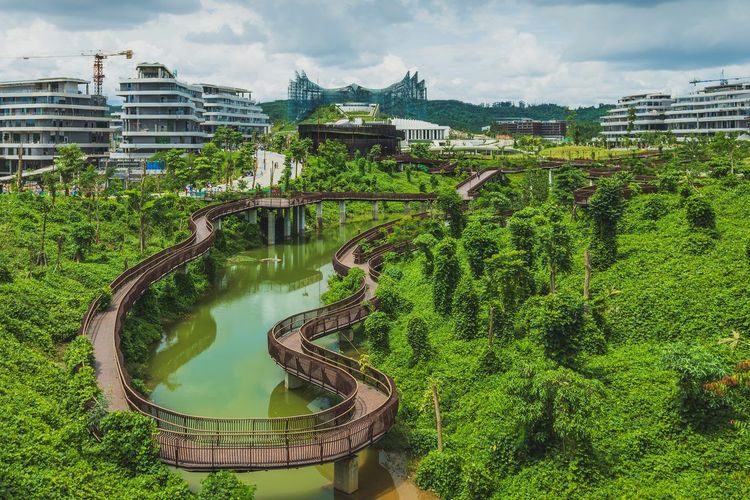
What to do in Indonesia in 10 days, two weeks, or three weeks clearly calls for very different itineraries: here are three realistic frameworks, built around actual travel times between islands rather than a theoretical chain of points of interest.
What to do in Indonesia in 10 days: with a week and a half, focus on two islands at most rather than stacking domestic flights. The most efficient combination remains Java and Bali: two to three days around Yogyakarta (Borobudur, Prambanan), a detour to Bromo, then a week in Bali split between Ubud, the north (Jatiluwih, Lake Batur), and a beach of your choice. A more focused alternative: five days in Bali and five days in Lombok and the Gilis, if you prefer the sea to temples.
What to do in Indonesia in 2 weeks: the format offering the best balance between depth and variety. A common framework chains Java (3–4 days: Yogyakarta, Bromo, Ijen), Bali (4–5 days), and Lombok or the Gilis (3–4 days), for a total of fourteen to sixteen days including travel. One variation replaces Lombok with Komodo, for those who prioritize wildlife over beaches.
Three-week trip to Indonesia: at this point, a third region becomes realistic without sacrificing pace. In addition to the Java-Bali-Lombok combo, add Komodo (3–4 days departing from Labuan Bajo, reachable by direct flight from Bali) or switch to Sumatra (Lake Toba, Bukit Lawang) for a sharper contrast with the central islands.
Visiting Indonesia in 1 month: the duration that finally allows you to break out of the Java-Bali-Lombok triangle. A typical month allocates roughly one week per major region: Java (temples and volcanoes), Bali (culture and beaches), Nusa Tenggara (Lombok, Komodo, possibly Flores to Kelimutu), and a fourth week of your choice between Sulawesi (Tana Toraja, Bunaken) or Sumatra (Lake Toba, Gunung Leuser). Many travelers transit through Singapore or Kuala Lumpur on the way there or back: a stopover where a Ryo audio-guided tour can help you explore the city on foot in a few hours, if it features in the app's catalog.
In all cases, build in buffer time: Indonesian domestic flights experience frequent delays, and inter-island ferries are directly dependent on the weather, particularly during the monsoon.
13. When to Visit Indonesia: Climate and Best Season by Region
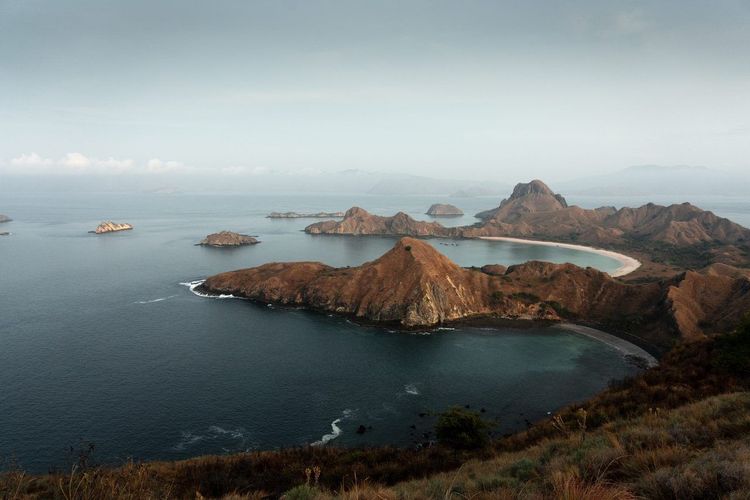
When to visit Indonesia depends almost entirely on the region you're targeting, as the archipelago stretches over more than 5,000 kilometers from west to east with distinct climatic patterns.
For Java, Bali, and Lombok, the dry season runs from April to October-November, with a peak in visitor numbers (and prices) in July-August and around Christmas. It is also the best window for the volcanoes (Bromo, Ijen, Rinjani), as trails become slippery and even dangerous during the monsoon.
When to visit Bali in particular? May, June, and September offer the most favorable balance between stable weather and manageable crowds, on either side of the July-August rush.
For Komodo and Flores, the best season also runs from April to November, with calmer seas for navigation between the islands.
Sulawesi has a more humid and less clear-cut climate: Tana Toraja is best visited from June to September, the peak period for major funeral ceremonies, while Bunaken can be dived year-round, with the best conditions from April to November.
Sumatra, straddling the equator, experiences frequent rainfall almost year-round, especially in the jungle. In the north (Lake Toba, Bukit Lawang), the relative dry season runs from May to September, with July-August offering the best trekking conditions — a calendar close to Java's, contrary to a persistent misconception.
Across the entire archipelago, temperatures vary little throughout the year, hovering between 26 and 33°C during the day: it is humidity and rainfall that distinguish the seasons, more than the thermometer. Targeting a shoulder season (April or October) often allows you to benefit from lower rates while still enjoying workable weather across the majority of your itinerary.
14. Budget and Money-Saving Tips for Traveling in Indonesia
Where to go in Indonesia according to your budget changes almost the entire equation: between a traveler in a dorm and a stay at a private resort in Raja Ampat, the price gap on the same archipelago can reach a factor of ten.
For budget travel, count around 25 to 40 euros per day per person: accommodation in a guesthouse or local losmen (8–15 euros per night), meals at warungs (2–4 euros per dish), and travel by public transport or rented scooter (4–6 euros per day).
A mid-range budget, with 3-star hotels, a few organized excursions, and more domestic flights instead of overnight buses, runs around 60 to 100 euros per day.
The costs that inflate your budget fastest are multiple domestic flights (30 to 80 euros one-way depending on the airline and distance), guided excursions to Komodo or Raja Ampat (often 150 euros or more for a day boat trip), scuba diving certification, and some site entry fees: the Borobudur ascent, for example, costs significantly more than simple garden access. On the other hand, Indonesian street food remains one of Southeast Asia's best value-for-money options — a nasi goreng or satay rarely costs more than two euros at a neighborhood warung. Book domestic flights several weeks in advance rather than on the spot: you'll often pay far less on high-demand routes such as Bali to Labuan Bajo.
15. Getting Around and Organizing Your Trip: Visa, Transport, Safety
The most useful travel information for Indonesia to know before you leave comes down to a few practical points, often overlooked in the excitement of planning an itinerary.
The Indonesia visa: French citizens, like most European travelers, obtain a visa on arrival for 500,000 rupiah (around 28 euros), valid for 30 days and extendable once for an additional 30 days. You can also apply online before departure (e-VOA), which saves valuable time at the airport. If you are arriving in Bali, also budget for the tourist tax of 150,000 rupiah (around 9 euros), in effect since February 2024 and payable online via the official "Love Bali" portal. Check the current conditions before you leave: a visa fee increase is regularly discussed.
For island-hopping, two options dominate: domestic flights, operated mainly by Garuda Indonesia, Lion Air, and Citilink, fast but prone to frequent delays during the rainy season, and inter-island ferries, slower but often practical for short distances (Java-Bali, Bali-Lombok), with fast boats covering the most popular routes in 1h30 to 2 hours.
On the health side, tap water is not safe to drink anywhere in the country: stick to bottled or filtered water, and carry a basic first-aid kit covering digestive issues. Travel insurance covering repatriation and high-risk activities (diving, volcano hiking) is strongly recommended, especially for Rinjani or Ijen.
Before you set off, also prepare your travel app kit: offline maps, a translator, and a Ryo audio guide if your return route passes through a major stopover city — a complement to the Indonesia-specific apps, for making the most of an urban layover.
FAQ
How much time should you plan to visit Indonesia?
Allow a minimum of 10 days for an overview of Java and Bali, two weeks to add Lombok or Komodo, and three weeks to a month to seriously explore three or four distinct regions. With fewer than 10 days, it's better to focus on a single island rather than stacking multiple domestic flights.
What to do in Indonesia in 2 weeks?
The most common combination pairs Java (Borobudur and Prambanan temples, Mount Bromo), Bali (rice terraces, temples, beaches) and Lombok or the Gili Islands, totaling roughly fourteen to sixteen days including travel. One variation replaces Lombok with Komodo National Park for those who prioritize wildlife.
What to do in Indonesia in 3 weeks?
Three weeks allow you to add an extra region to the Java-Bali-Lombok combo: Komodo for the dragons and diving, or Sumatra for Lake Toba and the orangutans of Bukit Lawang. This is the duration that offers the best balance between depth and diversity for a first major trip to Indonesia.
Where should you go in Indonesia for a first trip?
Java and Bali remain the most accessible combo for a first visit: numerous international connections via Gulf or Asian hubs, well-established tourist infrastructure, and reasonable distances between major sites. Lombok and its Gili Islands nicely complement this duo for those seeking less-crowded beaches without sacrificing logistical comfort.
What is the best time to visit Indonesia?
The dry season, from April to October-November, suits the majority of the archipelago (Java, Bali, Lombok, Komodo), with a peak in visitor numbers in July-August. Northern Sumatra follows a similar calendar (relative dry season from May to September), while diving in northern Sulawesi is possible year-round.
Do you need a visa to travel to Indonesia?
Yes: French and European travelers obtain a visa on arrival (or online before departure) for 500,000 rupiah, valid for 30 days and extendable once on-site. In Bali, a tourist tax of 150,000 rupiah also applies. As conditions change regularly, check official information in the weeks before departure.
How do you get around between the Indonesian islands?
Domestic flights, operated notably by Garuda Indonesia, Lion Air, and Citilink, quickly connect the main islands, while ferries and fast boats cover short routes such as Java-Bali or Bali-Lombok. Build flexibility into your itinerary: both modes of transport experience frequent delays during the rainy season.
Conclusion: What to Do in Indonesia — a Summary
Indonesia never lets itself be summed up in a single image, and that is precisely what makes the question "what to do in Indonesia" as exciting as it is impossible to settle in one sentence. Between the temples of Java, the rice terraces of Bali, the night ascent of Rinjani on Lombok, and the pristine reefs of Raja Ampat, the archipelago offers enough ground for several separate trips, each with its own personality.
Whether you're going for ten days or a month, the most important thing is to accept that you can't see everything: slowing down in two or three regions is far more rewarding than chasing an exhaustive list of sites. And if your route passes through a major city before or after Indonesia, open the Ryo app: an audio-guided tour will add a whole new dimension to that urban leg of the journey.