© Shutterstock
 Votre guide Ryo
New York at Night: 15 Experiences You Absolutely Must Have in 2026
New York never sleeps — and that's not a marketing slogan, it's a physical reality. At 2 a.m., hundreds of restaurants are still serving at full capacity, jazz clubs are launching into their third set, and Times Square blazes like an artificial sun in the rain. The city changes its face after sunset, and that face is often more captivating than the daytime one. The Ryo audio guide tour of New York covers many of the city's iconic sites, but at night most of them light up in ways that standard guides never quite manage to capture.
In this guide you'll find 15 concrete ways to experience New York at night in 2026: climbing to the top of the Empire State Building when Manhattan looks like a glowing circuit board, walking across the Brooklyn Bridge at golden hour, sipping a cocktail at 1,300 feet above street level on a Midtown skyscraper rooftop, or joining the line outside a Village jazz club where Miles Davis played in the 1950s. The city after dark belongs to those who know where to go.
Times Square after Midnight: the Permanent Spectacle
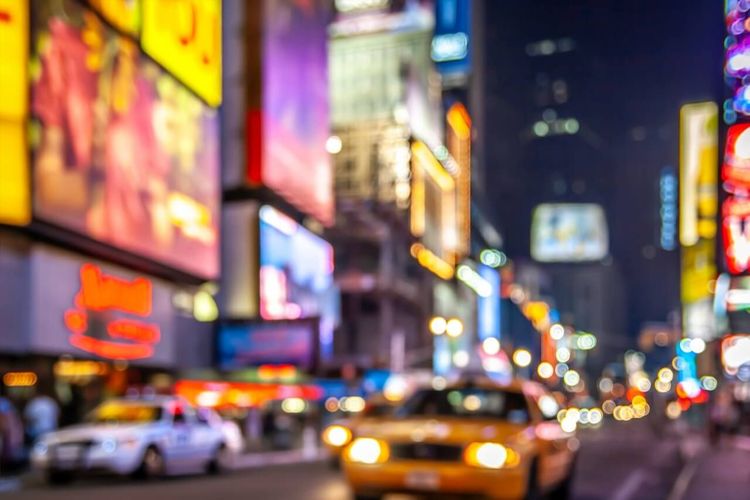
Times Square alone concentrates more than 4.8 million square feet of LED screens, making it the most illuminated district on the planet according to several satellite measurements. Most visitors pass through early in the evening, squeezed between tour groups and costumed characters demanding tips. The real experience unfolds after 11 p.m.: the tour buses have gone, the sidewalks clear out, and the light intensity stays exactly the same.
Stand at the center of the intersection of 7th Avenue and 45th Street and look north. The billboards stack up over 30 stories high, facades shift color every 10 seconds, and wet pavement after a shower reflects everything like a giant mirror. It's visually overwhelming — and yet, past midnight, there's something hypnotic about this flood of artificial light.
The best spot to photograph Times Square after dark remains the TKTS steps balcony (the red staircase at the corner of 47th Street), which offers a bird's-eye view of the entire intersection. Access is free. Avoid the "discount" ticket vendors operating on surrounding sidewalks — they are well-documented scams flagged by local authorities. For last-minute discounted show tickets, the official TKTS booth on the steps accepts lines until around 8 p.m.
The restaurants around Times Square stay open very late: Junior's, the Brooklyn-born diner on 45th Street, serves cheesecake until 2 a.m. on some nights. It's pricey and touristy, but the atmosphere at that hour — exhausted waitstaff, happy but wiped-out tourists, revelers wrapping up the night — has an authentically New York flavor.
Observatories: Manhattan from Above after Sunset
New York has three major paid observatories, and the ranking between them shifts dramatically between day and night. During the day, Top of the Rock (30 Rockefeller Plaza, New York, NY 10112, rated 4.7/5 on Google based on 82,915 reviews) offers the most instructive view — you can clearly identify Central Park to the north, the Chrysler Building to the east, and the Statue of Liberty to the south. At night, it's the Empire State Building that reigns supreme: its illuminated spire, visible from across the state, becomes part of the spectacle itself as all 102 floors light up in color.
The Empire State Building stays open until midnight (last elevator at 11:15 p.m.), making it one of the latest-accessible observatories in the city. A ticket costs $44 for the 86th floor; adding access to the 102nd floor costs around twenty dollars more, for a total of roughly $79 depending on the time slot booked. The difference is significant: the 86th floor is an open-air terrace where you feel the wind and hear the city; the 102nd is a glass-enclosed, air-conditioned cabin — more claustrophobic but 50 feet higher. On a clear night, visibility exceeds 80 miles and you can spot the lights of New Jersey, Long Island, and sometimes even Connecticut.
The Top of the Rock (Rockefeller Center, 30 Rockefeller Plaza) closes at 11 p.m. Its decisive advantage over the Empire State Building: from this terrace you can see the Empire State Building in its entirety — something impossible from its own summit. The nighttime view over Midtown, with the skyscraper skyline lighting up progressively at dusk, remains one of the most photographed vistas in New York.
The third observatory, Edge (30 Hudson Yards, western Midtown), is the newest and most visually dramatic: its cantilevered glass floor at 1,131 feet above ground places you literally over the void, with the city shimmering beneath your feet. Open until 11 p.m. The standard ticket is $38, but slots after 8 p.m. are often available without a wait through the app. The Ryo audio guide to the Wall Street neighborhood passes through this area — a great way to prepare for the day before your evening in the sky.
Timing tip: sunset in New York in summer falls around 8:30–9 p.m. Arrive 40 minutes early to catch the day-to-night transition from the terrace — the moment when Manhattan transforms before your eyes, office lights flickering on progressively in the towers as the sky shifts from orange to violet. Once back down, the Empire State Building and the Flatiron turn up again on our In the Heart of Manhattan audio-guided tour.
The Brooklyn Bridge at Dusk and Beyond
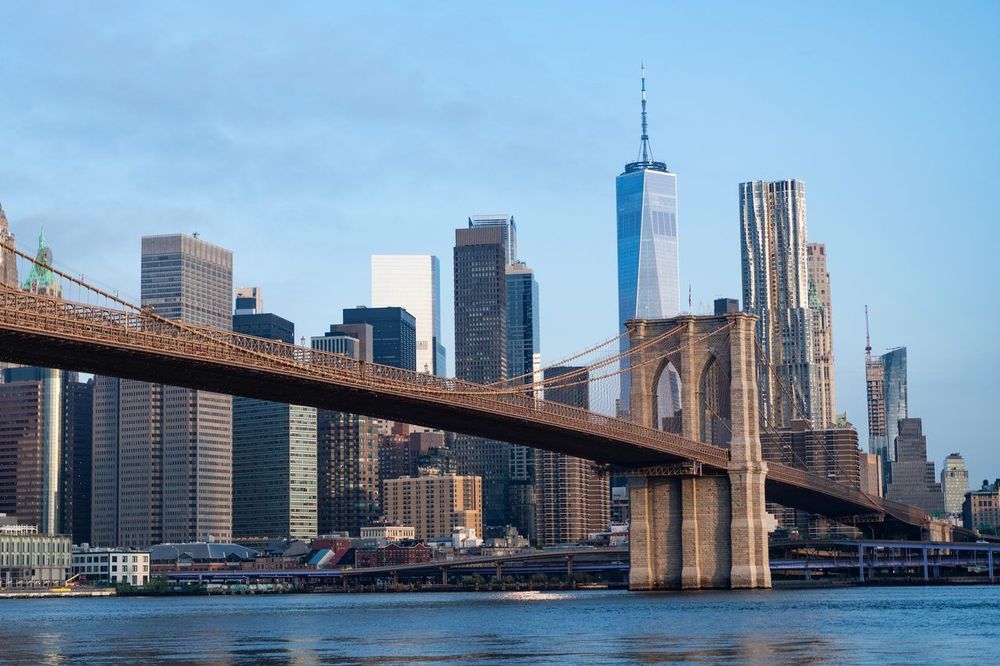
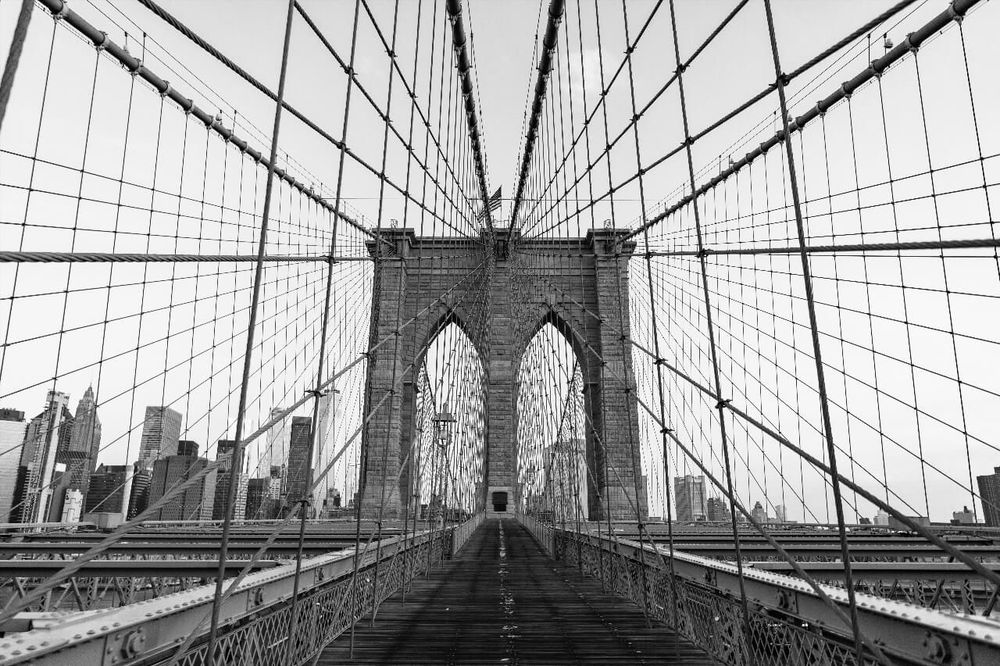
The Brooklyn Bridge is one of the most photographed monuments in the world, and one of those that people actually look at the least carefully. The pedestrian crossing (roughly 1 mile, 20–25 minutes) takes place on a raised walkway above the traffic lanes, offering an unobstructed view of both riverbanks. At 9 p.m. in summer, when the low golden light hits the steel cables and the brown sandstone towers, the crossing becomes something almost unreal.
Most visitors cross from Manhattan to Brooklyn (west to east). This is the right direction for photos: you have the Manhattan skyline in front of you, the setting sun at your back, and the Statue of Liberty in the distance to your right. Crossing in the opposite direction (Brooklyn to Manhattan) in early evening places the illuminated skyscrapers of Lower Manhattan as a backdrop — different, and equally beautiful.
Once on the Brooklyn side, the neighborhood of DUMBO (Down Under the Manhattan Bridge Overpass) has transformed into one of the most dynamic areas in the city. The 19th-century warehouses converted into galleries, studios, and restaurants stay busy in the evening. Main Street in DUMBO offers the classic framing: the Manhattan Bridge in the background, with the Statue of Liberty in the center of the frame. Arrive after 9 p.m. on a weeknight to find the spot quieter. A dedicated article covers visiting the Brooklyn Bridge in greater depth if you'd like to explore this stop further.
Safety: the pedestrian walkway is well lit and busy well past midnight. There are no particular concerns, but stay alert to cyclists using the adjacent lane — the markings are not always respected.
Jazz Clubs and Live Music: the Best of New York after Dark
New York remains the jazz capital of the world, and that is confirmed every night in a dozen clubs that have changed nothing about their programming since the 1950s. The Village Vanguard (178 7th Avenue South, Greenwich Village) is the most famous: Miles Davis, John Coltrane, and Bill Evans recorded live albums here that rank among the greatest records in the genre's history. Today the club books internationally renowned groups Tuesday through Sunday at 7:30 p.m. and 9:30 p.m., with a third set on Fridays and Saturdays at 11:30 p.m.
A ticket to the Village Vanguard costs $35 plus a drink minimum (generally $20 per person). The room is small, the tables are close together, the sound is not over-amplified — you can hear the musicians breathe. Book online in advance, especially for Friday and Saturday night sets: seats often sell out within hours.
The Blue Note (131 West 3rd Street) is larger and more commercial, which means walk-ins are possible on weeknights, but the programming quality remains very high. Prices are similar to the Village Vanguard. Smalls Jazz Club (183 W 10th St, New York, NY 10014, rated 4.6/5 on Google based on 3,670 reviews) (183 West 10th Street), two blocks from the Village Vanguard, is the most under-the-radar of the three: a tiny basement room, often younger musicians who are technically impressive, and a late-night supplement from 11 p.m. onward where sets run until 4 a.m. on weekends.
Beyond jazz, Manhattan offers an extraordinarily diverse live music scene. The Bowery Ballroom (Lower East Side) hosts rock and indie concerts, while the Beacon Theatre (Upper West Side) welcomes internationally acclaimed artists in a 2,800-seat Art Deco venue. Check Bandsintown or Songkick a week before your trip to align your evening with a show that suits your taste. Most concerts start between 8 and 9 p.m. and run until midnight.
Rooftop Bars: Terraces Overlooking Manhattan
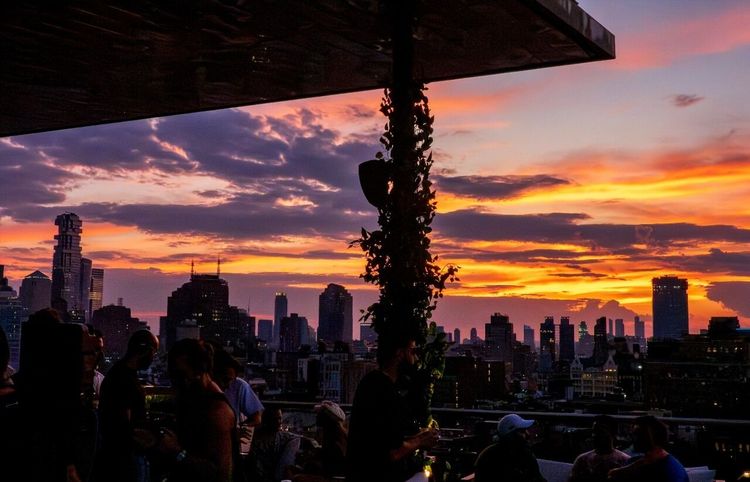
New York invented the modern rooftop bar, and competition among venues has reached such a level that several panoramic terraces rival paid observatories — with a cocktail in hand as a bonus. Addresses in this sector change quickly (openings, closures, renovations), but a few institutions have proven their staying power.
The 230 Fifth (230 Fifth Avenue, Flatiron District) is one of Manhattan's most accessible rooftops: free entry, a direct line-of-sight view of the Empire State Building within arm's reach, and year-round operation with blankets provided in winter. Cocktails run $18 to $28. The roof is spacious but fills up fast on Friday and Saturday nights — arrive before 9 p.m. to secure a table.
The PHD Rooftop Lounge (Dream Midtown Hotel, 210 West 55th Street) offers a different perspective: from Midtown you look south and watch the Lower Manhattan skyline take shape in the distance, the Financial District towers sparkling 3 miles away. The New York audio-guided tour available on our Ryo app can help you identify the buildings you see from these heights.
The Magic Hour Rooftop Bar leans into deliberate kitsch: giant carousel horses on a rooftop with a direct view of Times Square. Touristy, but visually one-of-a-kind. Prices are steep ($25–$35 per cocktail), but the photo opportunity justifies a quick visit.
For an off-the-beaten-path rooftop, Westlight (111 N 12th St, Brooklyn, NY 11249, rated 4.2/5 on Google based on 3,571 reviews) (111 North 12th Street, Williamsburg, Brooklyn) offers one of the best views of Manhattan from outside the island. The Midtown and Lower Manhattan skyscrapers stretch out in a 360-degree panorama from this terrace on the 22nd floor of a Brooklyn residential building. Fewer tourists, a more local vibe, serious mixology. Open Wednesday through Sunday until 1 a.m.
Tip: virtually all New York rooftop bars enforce a dress code (no shorts, flip-flops, or baseball caps). Check the dress code before heading out. Some venues operate a selective door policy on Friday and Saturday nights — calling ahead or booking a table makes all the difference.
Broadway and Musicals: a New York Evening Like No Other
Attending a Broadway show is one of the most distinctly New York experiences there is — and it doesn't have to cost a fortune if you play it right. The TKTS booth at Times Square sells tickets at up to 50% off for evening performances starting at 3 p.m. (the digital display in the red staircase lobby shows that day's availability in real time). The most popular shows (Hamilton, Chicago, The Lion King) rarely appear at a discount here, but productions of equivalent quality show up regularly.
A Broadway show typically starts at 8 p.m. and runs 2.5 to 3 hours including intermission. If you want to dine beforehand, plan a table between 6 and 7 p.m. at one of the many restaurants in the Theater District (around 8th Avenue between 40th and 50th Streets). The best-reviewed productions of 2026 can be found on the Broadway League website, updated weekly.
For Off-Broadway musicals (outside the perimeter of the 41 official theaters), prices are lower and subject matter is often more adventurous. The Public Theater (425 Lafayette Street, East Village) regularly produces work that goes on to Broadway with Tonys in tow — Hamilton had its first performances there. Tickets range from $25 to $55.
Budget alternative: some theaters run a digital lottery for a limited number of seats at $35 on the day of the show. Several productions participate in this system — download the Broadway Direct app to track all active lotteries in one place.
The Staten Island Ferry: a Free Panorama of Manhattan
The Staten Island Ferry is one of the best free views in New York, and most tourists don't know it exists. The crossing takes 25 minutes each way, passes less than a mile from the Statue of Liberty, and offers a head-on view of the Lower Manhattan skyline from the water. The service runs 24/7, with departures every 30 minutes at night.
The trick: most passengers rush to the bow to see the Statue of Liberty on the outbound trip. On the return, position yourself at the stern to watch the Manhattan skyline recede, then move to the bow as the towers of the Financial District loom larger in the darkness. The nighttime crossing, with the skyscraper lights reflecting in the black harbor water, is extraordinarily cinematic. No ticket required — the ferry has been entirely free since 1997.
Central Park at Dusk: the Wild City in the Heart of Manhattan
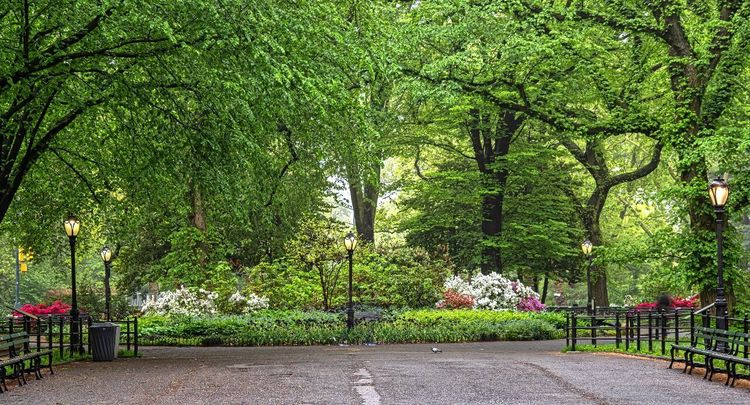
Central Park after sunset is a topic that divides opinion. Official guides often advise against entering after 8 p.m., but the reality in 2026 is more nuanced: the main paths and central areas of the park (Bethesda Fountain, The Mall, Sheep Meadow on the south side) remain busy with joggers, walkers, and families until 10–11 p.m. in summer. The more remote areas (the northern part of the park above 100th Street) call for greater caution.
The Bethesda Fountain lit up at dusk is one of the most romantic spots in New York: a brown sandstone terrace overlooking an artificial lake, with Manhattan shimmering through the trees. The Central Park walk with the Ryo audio guide covers the park's main highlights and can be done in a condensed version in the evening. On weeknights you'll find the spot relatively quiet; on weekends, music groups sometimes play until 9 p.m. near the Bandshell.
Another twilight option: the Loeb Boathouse lake (at 75th Street) rents rowboats until sunset. Rowing on the water while the skyscrapers of Central Park West light up above the trees is an experience very few cities in the world can offer. Our audio walking tour A Stroll in Central Park takes in The Mall and Bethesda Fountain along the way.
Eating in New York at Night: from Street Food to Fine Dining
New York is one of the best cities in the world for eating at night — and contrary to popular belief, quality is not reserved for three-star restaurants charging $400 per head. The city has a nocturnal culinary depth that stretches from an $8 halal food cart all the way to starred restaurants still serving after 10 p.m.
The halal cart on the corner of 53rd Street and 6th Avenue has become a cultural phenomenon: chicken or lamb over rice, drizzled with creamy white sauce and spicy red sauce, served 24/7 from a sidewalk cart. The line sometimes stretches 20 meters late at night, but it moves fast.
For a proper sit-down meal without a reservation after 10 p.m., the Lower East Side and East Village are the two neighborhoods to target. Dozens of spots stay open until 2 a.m.: Japanese ramen, Mexican street tacos, Korean bibimbap, Lebanese shawarma. The culinary diversity of these neighborhoods reflects the waves of immigration that have shaped New York since the 19th century.
The Katz's Delicatessen (205 E Houston St, New York, NY 10002, rated 4.5/5 on Google based on 53,200 reviews) (205 East Houston Street) is open on Fridays and Saturdays until 2:45 a.m. This diner founded in 1888 serves New York's most famous pastrami sandwiches — over a pound of smoked meat on rye bread for $28. The interior hasn't changed in decades: ceilings hung with numbered tickets, neon lights, loud and bustling at any hour.
For upscale late-night dining, several restaurants in Midtown and the Upper East Side offer late seatings (last service at 10:30 or 11 p.m.). Per Se (Time Warner Center, Columbus Circle) and Le Bernardin (155 West 51st Street) are among the rare three-Michelin-star restaurants that maintain late services on weekends. These tables must be booked weeks in advance on their websites or through Resy. A full article on New York's culinary specialties covers the subject in depth.
The food halls are a solid middle-ground option of growing quality: Urbanspace Vanderbilt (Park Avenue, opposite Grand Central) and Essex Market (Lower East Side) feature dozens of artisan vendors in a shared space, some open until 10 p.m. on weeknights and 11 p.m. on weekends.
Nightclubs and Dance Bars
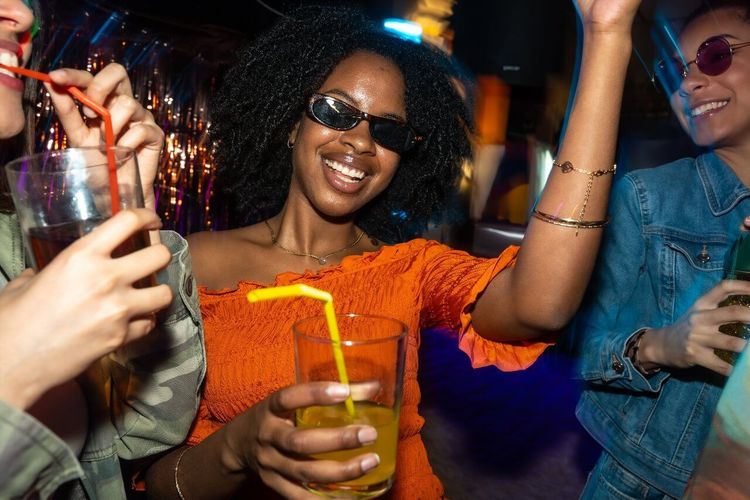
New York's clubbing scene has gone through difficult phases — post-pandemic closures, gentrification, tighter after-midnight licensing — but it remains one of the richest in North America. The heart of nightlife has gradually shifted from Midtown toward Chelsea, the Meatpacking District, and above all the Brooklyn neighborhoods of Bushwick and Greenpoint, which now concentrate the most experimental clubs.
Output (74 Wythe Avenue, Williamsburg) is New York's most recognized club for electronic music: a large indoor room and an open-air rooftop in summer, international bookings, high-quality sound. Tickets sell for $20 to $40 in advance (higher at the door). The venue opens at 11 p.m. and runs until 8 a.m. on weekends.
The Brooklyn Mirage (120 N 1st St, Brooklyn, NY 11249, rated 3.7/5 on Google based on 516 reviews) (120 North 1st Street, Williamsburg) is an open-air 6,000-capacity venue hosting outdoor electronic music festivals from May through October, with international lineups. Tickets run $40 to $90 depending on the artist, and often sell out weeks in advance.
For more accessible dance bars in Manhattan, Cielo (18 Little West 12th Street, Meatpacking District) charges moderate cover prices ($15–$20) and books house and techno DJs aimed at genuine enthusiasts. Elsewhere (599 Johnson Avenue, Bushwick) is a multi-room complex with three stages and a rooftop, open Thursday through Sunday.
Beware of classic scams: "promoters" approach tourists near Times Square and promise free entry to Midtown clubs in exchange for signing up to a list. These venues often charge extortionate drink prices once you're inside.
Late-Night Museums: Culture after Official Closing Time
New York has developed a culture of extended museum access that few American cities can match. Several institutions host themed evening events on Fridays or Saturdays, with bars, DJs, and access to permanent collections until 9 p.m. or even 11 p.m..
The Metropolitan Museum of Art (1000 5th Avenue) stays open until 9 p.m. on Fridays and Saturdays. After 5 p.m. crowds drop significantly and several galleries become accessible without queuing. On Friday evenings in summer (June–October), the museum's rooftop hosts outdoor concerts with spectacular views over Central Park. Visiting the Metropolitan Museum deserves a full article of its own, but in the evening the atmosphere changes completely compared to daytime.
The MoMA (Museum of Modern Art, 11 West 53rd Street) holds late-night openings on Thursdays until 9 p.m. with slightly reduced prices after 5:30 p.m. for New York State residents. The American Museum of Natural History (Central Park West, 79th Street) periodically holds adult evening events with access to the dinosaur halls and dioramas after 6 p.m.
The Brooklyn Museum (200 Eastern Parkway, Brooklyn) deserves a special mention: its First Saturdays events on the first Saturday of each month are free from 5 to 11 p.m., with DJs, dancing, and special exhibitions. The atmosphere is radically different from regular daytime visits — the crowd is younger, more local, more diverse.
The High Line at Night: a Suspended Walk above Manhattan
The High Line is a former elevated railway line converted into a 1.4-mile linear park along the western edge of Midtown. Open since 2009, it welcomes visitors from 7 a.m. to 10 p.m. from April through November, with shorter hours the rest of the year. The evening walk offers perspectives on the streets of Chelsea and the Meatpacking District that you simply cannot get anywhere else — you stroll at second-floor height, above the traffic.
The lighting was designed to remain subtle: low-angled spots that highlight the vegetation planted between the original rails, with no harsh lights. In summer, street performers and food vendors operate until closing time. The stretch between 18th Street and 30th Street is the most photographed at night. Free entry from any of the 20 signposted entrances.
A Night Bus Tour: the Guided Version of Nocturnal New York
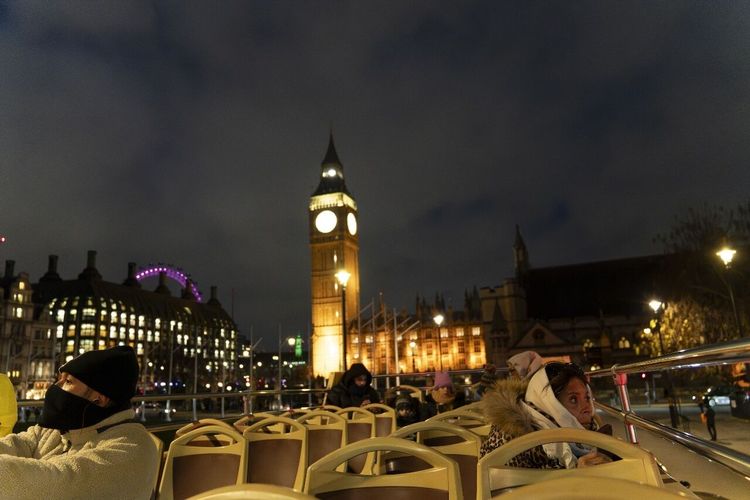
New York offers several open-top double-decker bus options for a nighttime sightseeing tour, with routes covering the illuminated main landmarks over 2 to 3 hours. These tours are not cheap ($55 to $75 per person depending on the operator), but they let you cover Manhattan from north to south in a single evening, with an audio guide contextualizing each site.
The most reliable operators are Big Bus New York (770 7th Ave, New York, NY 10019, rated 4.7/5 on Google based on 21,146 reviews) and Gray Line New York. Departures run every 30 to 60 minutes between 7 p.m. and 10 p.m. depending on the season. Booking online is always cheaper than buying at the counter. For families with children, this is often the most practical format for seeing the city lights without walking miles on foot.
Neighborhoods to Explore at Night: beyond the Standard Circuit
The nocturnal city is not limited to Midtown and Broadway. Several neighborhoods take on a special dimension after dark — less covered by tourist itineraries, they reveal another side of the city.
Chinatown and Little Italy (Lower Manhattan) come alive in a unique way in the evening. Chinese restaurants serve until 2 a.m., bakeries reopen at midnight for fresh batches, and Mott Street glows with red lanterns. Two blocks away, Nolita (North of Little Italy) blends multigenerational Italian delis with cocktail bars open until 4 a.m.
Harlem after 8 p.m. is often left off standard tourist itineraries, which is a shame. The 125th Street area around the Apollo Theater (253 W 125th St, New York, NY 10027, rated 4.6/5 on Google based on 8,310 reviews) stays lively in the evening, with soul food restaurants and live music bars. The Amateur Night events at the Apollo (typically on Wednesdays) are one of New York's most authentic traditions: amateur performers take the stage that launched Ella Fitzgerald and James Brown, to the cheers — or jeers — of an audience that pulls no punches.
The Lower East Side is Manhattan's densest concentration of late-night bars, clubs, and restaurants. The cluster of venues on Orchard Street, Ludlow Street, and Delancey Street is extraordinary: you can move from an experimental cocktail bar to an indie concert venue and end up in a 24-hour bakery within three blocks. The social mix here remains more diverse than in the Meatpacking District or Midtown.
Williamsburg (Brooklyn) is worth the trip from Manhattan (15 minutes by subway from the center). North 6th Street and Bedford Avenue pack in a dense concentration of bars, restaurants, and late-night shops. On weekends, queues form outside certain clubs as early as 11 p.m. Back in Manhattan, our Towers of Wall Street audio-guided tour links Lower Manhattan to Chinatown and Little Italy.
The Statue of Liberty and the Bay through the Night
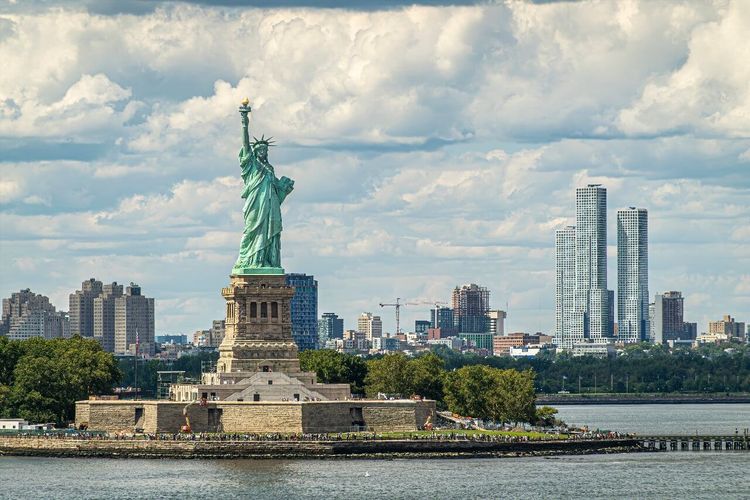
The Statue of Liberty has been lit up every night since the 1930s, and nighttime cruises allow you to approach it from the Hudson or the bay. These cruises cost $35 to $75 depending on duration (1.5 to 3 hours), with multilingual commentary on the landmarks passed along the way.
Circle Line Sightseeing runs a Harbor Lights Cruise departing from Pier 83 (West 42nd Street) every evening during the summer season at 7:30 p.m. The cruise passes the Statue of Liberty, glides under the illuminated Brooklyn Bridge, circles the island of Manhattan, and offers views of the nighttime skyline from the water — a perspective impossible to obtain any other way. The article everything you need to know about the Statue of Liberty covers the history and the daytime island visit.
Free alternative: from Brooklyn Bridge Park (particularly Pier 1), you can see the illuminated Statue of Liberty from the riverbank, with the Lower Manhattan skyline as a backdrop. Accessible all night, entirely free. Less spectacular than a cruise, but effective if your budget is tight.
FAQ
Which neighborhoods are the most lively in New York at night?
Midtown (Times Square, Theater District) is the most touristy. Greenwich Village and East Village are home to jazz clubs and quality bars. The Meatpacking District and Chelsea cater to club-goers. Brooklyn (Williamsburg, Bushwick) draws locals looking for a more authentic atmosphere. Harlem and the Lower East Side are worth exploring for their distinctive vibe.
How late is the Empire State Building open?
The Empire State Building observatory stays open until midnight, with the last elevator at 11:15 p.m. It is one of the latest-accessible observatories in the city. A ticket to the 86th floor costs $44; access to the 102nd floor adds around twenty dollars, for a total of approximately $79.
How do you get around New York once night falls?
The subway runs 24/7 and remains the fastest and most affordable way to cross the city. Yellow cabs and ride-hailing apps Uber and Lyft are available everywhere. Night buses replace certain subway lines under construction. Avoid rental cars: parking overnight in Manhattan is an unnecessary expense.
Is it dangerous to walk around the city after dark?
Midtown, Lower Manhattan, Greenwich Village, the Lower East Side, and Brooklyn (Williamsburg, DUMBO) are busy and safe until late. As in any major city, stay alert in poorly lit areas. Northern Harlem and parts of the Bronx call for more caution from visitors who are unfamiliar with those neighborhoods.
Which nighttime activities in New York are free?
The Staten Island Ferry (free 24/7), walking across the Brooklyn Bridge, the High Line, strolling through Chinatown or the Lower East Side, street performances at Times Square, and outdoor concerts in Central Park in summer are all free. The article on free activities in New York covers these options in detail.
Conclusion
New York at night is a city within the city — with its own rules, its own rhythm, its own inhabitants. Visitors who head back to the hotel after dinner miss half of the New York experience: the moment when Times Square truly belongs to those who are there, when the top of the Empire State Building reveals a Manhattan of glowing circuit boards, when the Village jazz clubs come back to life as if Coltrane never left the stage.
To plan your trip and discover the city's landmarks in daylight before returning to them after sunset, the Ryo audio guide to New York is a solid resource. New York is waiting for you after dark.
À lire également