© Shutterstock
 Votre guide Ryo
30 Things to Do in New York Absolutely in 2026
What to do in New York when the city is like no other? Not because its skyscrapers are taller than elsewhere, it's the human density, the permanent background noise, the smell of warm bagels and steam rising from manholes that grabs you as soon as you exit the subway. Eight million people live here on less than 800 km², and each one seems to have something urgent to accomplish. To prepare your stay and discover the city at your own pace, the Ryo audio guide tour of New York will accompany you neighborhood by neighborhood, from the alleys of Lower Manhattan to the heights of Harlem.
In this article, you'll find addresses forgotten by competitors: Saint Paul's Chapel where rescuers slept after 9/11, the trick to see the Empire State Building without queuing for two hours, or the best table at Smorgasburg on the Williamsburg waterfront. To know what to do in New York in four days as well as in ten, from classics to experiences worth telling at dinner that same evening, here are thirty activities to know before you leave.
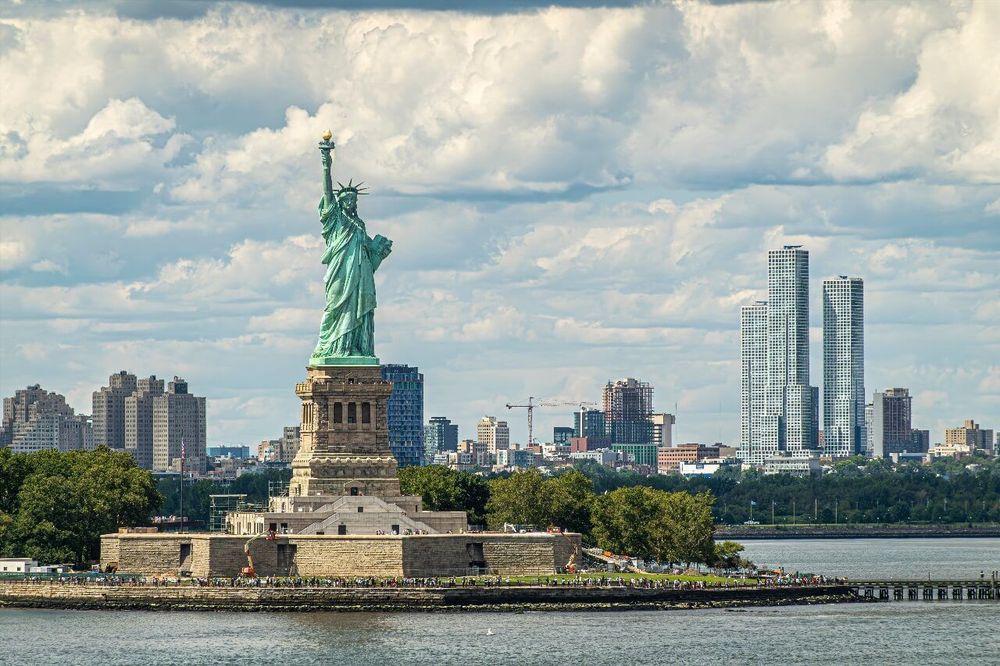
1. The Statue of Liberty and Ellis Island
The Statue of Liberty remains, nearly 140 years after its inauguration in 1886, the most immediately recognizable image of New York. What photos don't convey: its 93 meters from ground to torch tip, and the feeling of insignificance you feel at its feet before going up. The ferry departs from Battery Park, at the southern tip of Manhattan, and serves two islands, Liberty Island then Ellis Island, in one trip.
Tickets exist in three levels: access to the island gardens (cheapest), access to the pedestal, and climb to the crown. This last option requires a reservation several months in advance, capacity is limited to 240 visitors per day. If you haven't planned ahead, the pedestal remains a good option: it offers an unobstructed view of Manhattan from 46 meters high, and the interior exhibition on the statue's history is more interesting than you'd expect.
The stop at Ellis Island is often rushed by visitors who spend most of their time on Liberty Island. This is a mistake. Between 1892 and 1954, more than 12 million immigrants passed through this red brick building, coming from Italy, Poland, Ireland or Russia to start a new life. The online registry allows you to search for an ancestor's name by nationality. The Great Registry Hall, with its tiled vaults and long rows of benches, feels like both a courthouse and central station. Allow at least half a day for both islands, ideally on weekdays and early morning to avoid ferry queues.
Practical tip: the "Statue Cruises" ferry is the only one authorized to dock on Liberty Island. Tourist boats offer "statue tours" without docking, cheaper, but you stay at a distance. If your budget is tight, the Staten Island Ferry is entirely free and offers a striking panorama of the statue from the water, without getting off. Our article on free activities and visits in New York details all the alternatives without tickets.
2. Central Park
Four kilometers long, 800 meters wide, 341 hectares planted in the heart of Manhattan. Central Park isn't just another green space: it's the very breath of the city, the place where New Yorkers meet to run at dawn, play chess on stone tables, let their dogs run free or simply hold a book on a bench without anyone bothering them.
The park was designed by Frederick Law Olmsted and Calvert Vaux starting in 1858. What seems natural, the gentle hills, bodies of water, groves, is entirely artificial: 5 million m³ of rock and earth had to be moved to create this landscape. Today, the park receives more than 40 million visitors per year, making it the most frequented green space in the world.
Must-sees inside the park: Bethesda Fountain (the fountain with Archangel Raphael, backdrop for dozens of New York films), the lake and its boats for rent in spring, the Conservatory Garden in the northeast, the only formally landscaped section, often ignored by tourists, and Strawberry Fields in memory of John Lennon, killed steps from the park in 1980. In winter, the Wollman Rink ice rink opens from mid-October to early April; in summer, the Delacorte Theater hosts free Shakespeare in the Park performances.
To explore the park differently than on foot, the Ryo audio guide dedicated to the Central Park walk offers a commented route between the least signposted monuments: the Egyptian obelisk Cleopatra's Needle (3,500 years old, gifted by Egypt in 1880), Manhattan schist cliffs visible to the naked eye along northern trails, and Blockhouse #1, remnant of the War of 1812 hidden in the woods above 108th Street.
Note: the park is accessible 24/7, but the northern part (above 96th Street) is less frequented at night. During the day, bike paths are shared with joggers, watch out for fast bikes. The public restrooms closest to Fifth Avenue are located at 72nd Street and 102nd Street. Our audio walking tour of the park threads Bethesda Fountain and Strawberry Fields over 20 stops.
3. Times Square
Times Square provokes two reactions: either you love it, or you flee after ten minutes. This crossroads between Broadway and 7th Avenue remains an experience in itself, less for what you do than for what you see. 500,000 people pass through here every day. At night, the 7,000 LED screens covering the facades create brightness close to daylight, a phenomenon without equivalent outside Tokyo.
The thing guides don't tell you: the TKTS Booth, the red kiosk located on the steps at 47th Street, offers show tickets at 50% off same-day for Broadway and off-Broadway theaters. The queue opens at 3pm for evening performances. This is often where New Yorkers buy their tickets when they haven't planned their evening in advance. The selection changes daily and sometimes includes hit musicals.
Arrive early in the morning, before 7am, if you want to photograph the square without being jostled. The neon signs are still on, delivery trucks replace tourists, and Times Square takes on an almost melancholic dimension at that hour.
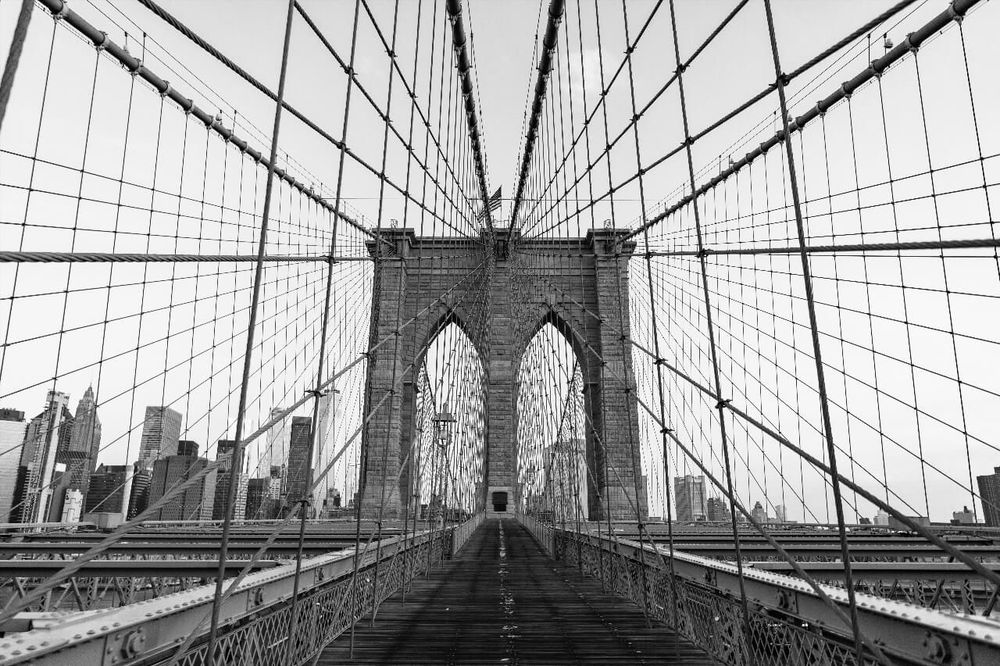
4. Brooklyn Bridge
The Brooklyn Bridge is one of the rare 19th century engineering works still used daily for its original purpose. Inaugurated in 1883, it was the world's longest suspension bridge for twenty years with its 486-meter central span. Its construction cost 27 workers' lives, including architect John Roebling himself, who died of tetanus contracted during preliminary work.
The pedestrian promenade on the bridge's upper deck is 1.8 km each way and takes about 30 minutes without stopping, double if you take time to look. The view of Downtown Manhattan from the middle of the bridge, with the One World Trade Center towers dominating the skyline on the left and Brooklyn Heights buildings on the right, is one of the most photographed in New York. Arrive early morning (before 8am) or evening after 7pm to avoid crowds of organized groups that clog the deck during the day.
Once on the other side, the DUMBO (Down Under the Manhattan Bridge Overpass) neighborhood deserves an hour. The cobblestone streets under the Manhattan Bridge shadow have served as the set for dozens of films, and warehouses converted into galleries and restaurants line the waterfront with direct views of the bridge. The Brooklyn Bridge Park spans 34 hectares along the East River, with lawns, sports fields, picnic areas and continuous views of Manhattan.
To contextualize the bridge's history and the adjacent Financial District, the Ryo audio guide on the towers of Wall Street covers the Financial District and its architectures stacked on four centuries of New York history.
Practical advice: on the Brooklyn side, the most cited address for pizza is Juliana's, if the line exceeds the street, go to Grimaldi's, 50 meters away, often less crowded for comparable results.
5. The Empire State Building
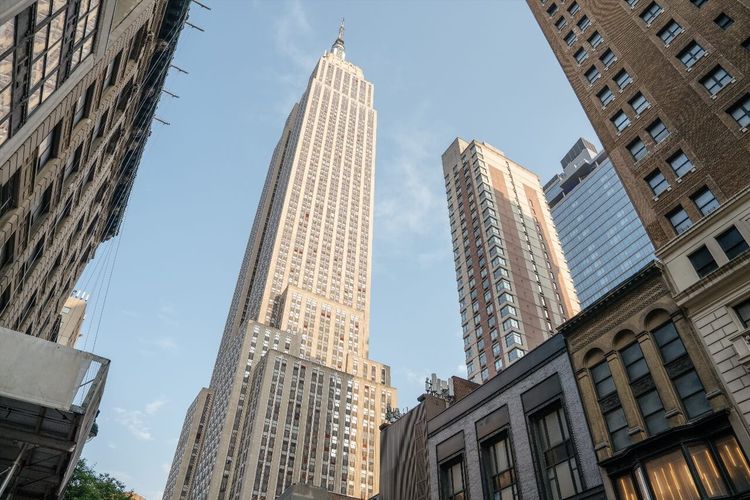
The Empire State Building was built in 410 days between 1930 and 1931, a record that still stands. Its 443 meters (antenna included) make it New York's 6th tallest skyscraper, it was long the world's tallest, from 1931 to 1972. The observation platform on the 86th floor offers a 360-degree view of Manhattan and, on clear days, up to 130 km.
Queues can reach two hours in high season without reservation. The solution: buy your ticket online at least 48 hours in advance to choose a specific time slot. A second platform exists on the 102nd floor, accessible with a supplement, space is more restricted, but the additional height gives the impression of floating above the city. In the evening, the building is illuminated in colors according to events (red for Valentine's Day, green for St. Patrick's Day), the list is published on the official website.
6. Rockefeller Center and Top of the Rock
The Rockefeller Center is a complex of 19 buildings constructed between 1930 and 1940, including 30 Rockefeller Plaza (called "30 Rock"), NBC's historic headquarters and starting point for many American shows. The ice rink below, inaugurated in 1936, is one of the world's most famous, and one of New York's smallest, with only 122 skaters allowed simultaneously.
The Top of the Rock observation platform atop 30 Rock deserves comparison to the Empire State Building's. First advantage: Central Park is visible from here, while it's invisible from the ESB (too far north). Second advantage: the outdoor platform isn't screened, just a low railing, for photos without barriers. Levels 67, 69 and 70 each offer different perspectives; the intermediate level has a glass floor for looking directly down.
Rockefeller Center is also worth it for its artworks integrated into the architecture: Art Deco bas-reliefs on facades, José Maria Sert's mural in the 30 Rock hall (Diego Rivera's original painting was destroyed in 1934 because it depicted Lenin), and the bronze sculpture of Prometheus overlooking the ice rink.
7. The High Line
The High Line is a freight railway line built in 1934 and decommissioned in 1980, converted into an elevated park between 2009 and 2014. It extends 2.3 km from the Meatpacking District (Gansevoort Street) to Hudson Yards (34th Street), at a height of 9 meters above the street.
What distinguishes the High Line from a simple path: the landscape project preserved the original rails integrated into the plantings, and the chosen plant species reproduce the spontaneous flora that colonized the tracks during years of abandonment, wild grasses, sumacs, beach grass. Each season completely changes the landscape. In May, blooms are dense; in January, golden dry grasses create an almost bucolic atmosphere.
The park is also an open-air art gallery: installations are presented along the route, some permanent, others temporary. Access is entirely free and entrances are numerous (about every 5 minutes' walk). The segment between 14th and 23rd Street is the densest in activities and Hudson views; the Hudson Yards section to the north is newer and less crowded.
8. The Metropolitan Museum of Art
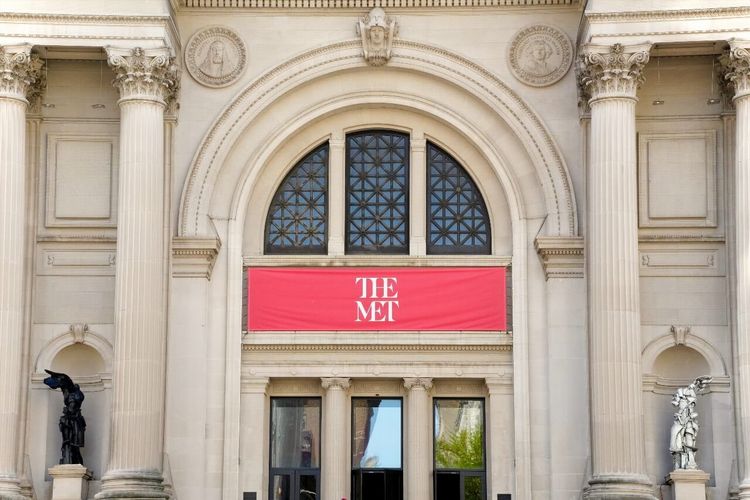
The Metropolitan Museum of Art, the Met for New Yorkers, is one of the world's largest museums. Not just in terms of area (its 190,000 m² of exhibition space makes it one of the most extensive), but especially in historical density: more than 5,000 years of human civilization represented, from ancient Egypt to contemporary design, including European chivalry, Islamic arts and Flemish painting.
The collections count 1.5 million objects, of which only 26,000 are exhibited at once. The Egyptian collection is one of the most complete outside Egypt, notably featuring the Temple of Dendur (15 BC), reconstructed in an entire room with artificial water basin. The medieval arms and armor gallery presents 14,000 pieces including full-size mounted knight armors. The rooftop sculpture garden is open from May to October, direct view of Central Park and the skyline from the 5th floor.
Met admission is officially at a "suggested" rate ($30 for adults), but this amount is a suggestion: you can pay less, even a symbolic cent, without being refused entry, an old New York tradition the museum maintains for New York State residents. For foreign visitors, the full rate is generally applied.
Devote at least half a day, ideally a full day. The Met also has two branches: the Cloisters in Fort Tryon Park (specializing in the Middle Ages, with French cloisters dismantled and reassembled stone by stone) and Met Breuer, dedicated to modern art. Our dedicated article on visiting the Metropolitan Museum of Art details the must-see collections section by section.
Tip: the museum is open Friday and Saturday until 9pm. These evening slots are significantly less crowded than weekend afternoons, and the golden light entering through the central facade in late afternoon is worth the trip alone.
9. The 9/11 Memorial
The 9/11 Memorial (National September 11 Memorial & Museum) opened in 2011, exactly ten years after the attacks. It occupies the site of the two World Trade Center towers on an area of 32,000 m², now dominated by two black pools whose edges are engraved with the names of the 2,983 victims of the 2001 attacks and the 1993 bombing.
The architecture of the pools, designed by Michael Arad, expresses something words struggle to convey: water falls along vertical walls toward an invisible central hole from the edge, a bottomless disappearance. The waterfalls are the United States' largest artificial waterfalls.
The underground museum, accessible separately (paid admission, $26), descends to the foundations of the former towers. Survivors testify in audio, objects found after the attacks are exhibited with their individual stories. One section preserves a portion of the emergency staircase, dubbed "Survivors' Staircase," by which hundreds of people evacuated the towers that morning.
50 meters from the memorial, St. Paul's Chapel (St. Paul's Chapel (209 Broadway, New York, NY 10007, rated 4.6/5 on Google for 2,092 reviews)) is an often ignored monument. Built in 1766, it's Manhattan's oldest church still in operation. During the nine months following 9/11, it served as a base camp for rescuers, cots had been set up between the pews. The interior walls preserve drawings and messages left by rescue workers.
10. Broadway Musicals
Broadway refers to both the avenue and the ensemble of 41 theaters located within a few streets around Times Square. A Broadway musical is a complete sensory experience: live orchestras of 25 musicians, motorized sets that change in seconds, millimeter-precise choreography. Productions running in 2026 include revivals of classics like Hamilton, The Lion King or Wicked, and several original creations.
Prices range from $50 to $300 depending on seats and days. The cheapest strategy: the TKTS Booth on the 47th Street steps (discounts up to 50% same day) or official lottery sites (Hamilton offers for example a daily lottery at $10). Wednesday evening and Thursday evening performances are generally cheaper than weekends. For fall-winter visits, our article on New York at night gives a complete itinerary for combining shows and nighttime exploration.
11. Brooklyn: DUMBO, Williamsburg and Bushwick Street Art
Brooklyn is no longer New York's forgotten borough, it's been one of the city's most dynamic areas for ten years, both in gastronomy, culture and street art. Three areas deserve a full day.
DUMBO (Down Under the Manhattan Bridge Overpass) concentrates galleries, designer boutiques and Brooklyn Bridge Park. The view of Manhattan from the intersection of Washington Street and Water Street has become one of New York's most photographed, the Brooklyn and Manhattan bridges perfectly frame the skyline from the angle. Jane's Carousel (a restored 1922 carousel housed in a glass pavilion by Jean Nouvel) still spins on weekends.
Williamsburg is the hipster neighborhood gone mainstream, but it retains authentic culinary vitality. Smorgasburg, an outdoor food market active from April to October on Saturdays (on the East River waterfront) and Sundays (at Prospect Park), brings together 100 local vendors: smoked salmon bagels, vegan ramen, Argentine empanadas, Korean tacos. This is where New York's culinary trends are tested before landing in restaurants.
The Bushwick street art, accessible by subway from Williamsburg, covers entire blocks of industrial warehouses. The Bushwick Collective (Jefferson St, Brooklyn, NY 11237, rated 4.7/5 on Google for 257 reviews) has coordinated works since 2011: more than 50 international artists have painted here, including major names in world street art. The neighborhood changes every year, some frescoes are covered, new ones appear. Our article on visiting Brooklyn Bridge gives a complete itinerary for combining the bridge crossing and Brooklyn exploration.
12. Harlem and Sunday Gospel
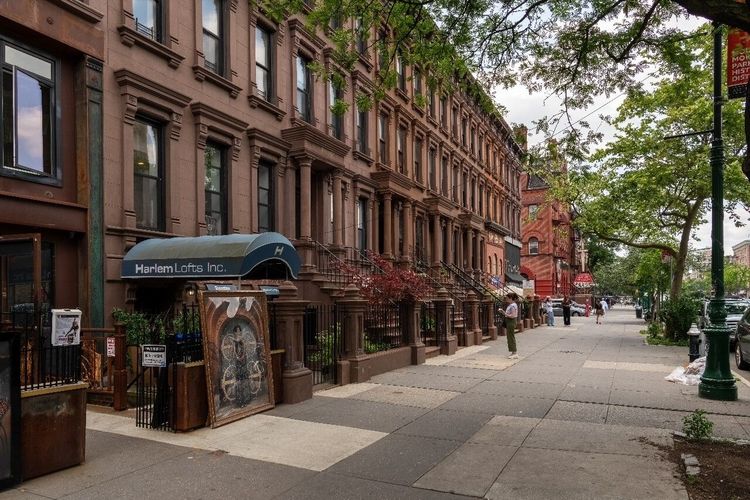
Harlem begins above 96th Street east of Central Park, and above 110th Street west. This emblematic African-American neighborhood was the birthplace of the Harlem Renaissance movement in the 1920s-1930s, an artistic and intellectual explosion that produced Langston Hughes, Duke Ellington and Zora Neale Hurston.
The Sunday morning ritual: attending a service at one of Harlem's gospel churches. Abyssinian Baptist Church (132nd Street) is the best known, it welcomes visitors during services at 9am and 11am, but requires proper attire and respectful behavior (no photos during service). The several dozen voice choir in this neo-Gothic space produces something unexpected in visitors most impervious to religion.
On 125th Street, Harlem's main commercial artery, Apollo Theater (253 W 125th St, New York, NY 10027, rated 4.6/5 on Google for 8,310 reviews) has held its place since 1934. This is where Ella Fitzgerald, James Brown and Michael Jackson made their debuts or great comebacks. Guided tours of the building are organized on weekdays; Wednesday evening Amateur Night shows remain open to the public.
For dining in Harlem, Sylvia's (328 Lenox Avenue), an institution since 1962, and Red Rooster (310 Lenox Avenue), opened by chef Marcus Samuelsson, offer two very different versions of African-American cuisine: the first in the soul food tradition of the 1960s, the second in contemporary reinterpretation with local products.
13. The Natural History Museum
The American Museum of Natural History (200 Central Park West, New York, NY 10024, rated 4.6/5 on Google for 24,852 reviews) (AMNH) is one of the world's largest natural history museums with 45 permanent halls and more than 33 million specimens in its collections. Most visitors remember the skeleton in the entrance hall, it's actually a Barosaurus rearing to protect its young from an Allosaurus, a dramatic composition unique in the world.
The least frequented sections are often the most fascinating: the meteorite hall (with the Willamette Meteorite, the largest ever found in North America, 15 tons), the Nordic anthropology hall (18th-century Native American masks and totems), and the Hall of Ocean Life with its blue whale suspended from the ceiling over 29 meters. The Hayden Planetarium, separate from the main museum, offers regular astronomical projections.
14. Governors Island
Governors Island (New York, NY 10004, rated 4.7/5 on Google for 21K reviews) is a small 70-hectare island in New York Harbor, 8 minutes by ferry from Lower Manhattan. A former military base until 2003, it was transformed into a public park: no cars, no permanent residences, just meadows, bike paths, hammocks suspended between trees and exceptional views of Manhattan.
The island is accessible seasonally only (May to October), on weekends and certain weekdays. Bikes can be rented on site upon arrival. Historic houses dating from British colonial occupation then the American army are partially open for visits. It's one of the places least known to tourists and one of New Yorkers' favorites.
15. The Flatiron Building and Madison Square Park
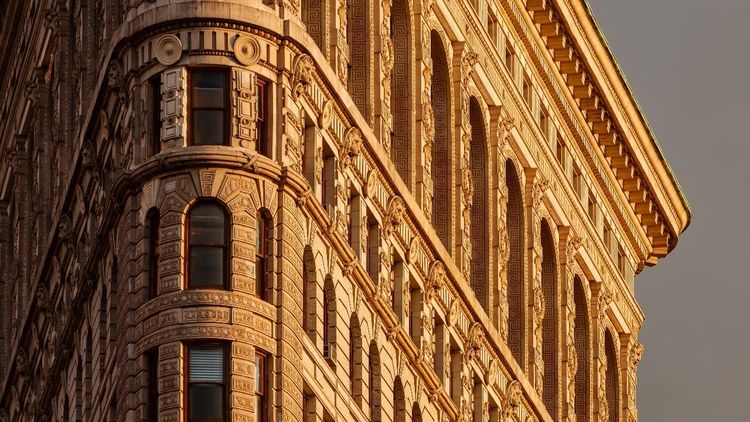
The Flatiron Building (175 Fifth Avenue) was built in 1902 on a flatiron-shaped lot, at the intersection of Broadway and 5th Avenue. Its 22 floors and 87 meters no longer impress amid today's skyline, but its triangular silhouette remains one of New York's most photographed facades.
Madison Square Park, opposite, is a 2-hectare park with fountains, ping-pong tables and a Shake Shack burger branch, the original kiosk of the chain, founded here in 2001. The Flatiron District surrounding it is now the heart of New York tech, nicknamed "Silicon Alley." Both the park and the Flatiron sit on our 23-stop audio-guided route across Manhattan.
16. Grand Central Terminal
Grand Central Terminal (89 E 42nd St, New York, NY 10017, rated 4.8/5 on Google for 32,714 reviews) isn't just a station, it's one of America's most beautiful public halls. Built between 1903 and 1913, the Main Concourse spans 75 meters long and 37 meters high, with its green windows filtering natural light. The painted ceiling represents 2,500 stars of the northern hemisphere constellation, upside down, which has fueled decades of controversy over a deliberate or unintentional artist error.
The station receives 750,000 passengers per day, making it one of the world's busiest. The underground market (Grand Central Market, lower level) offers gourmet groceries, cheese shops and fishmongers that supply neighborhood restaurants. The "whispering gallery" in the corridor leading to the Oyster Bar restaurant allows you to distinctly hear a conversation whispered 15 meters away, an acoustic effect of the elliptical vaults.
17. SoHo, Chelsea and Art Galleries
SoHo (South of Houston Street) owes its aesthetic to its 19th-century cast iron warehouses, built for the textile industry and converted into artists' lofts from the 1970s. The artists have since been replaced by luxury boutiques, but the cast iron facade architecture remains intact and listed. On Saturdays, the neighborhood is overrun, on Sunday mornings, before 10am, SoHo resembles what it was thirty years ago.
Chelsea (between 14th and 30th Street, west of 8th Avenue) is the contemporary art gallery neighborhood, more than 200 galleries concentrated on a few blocks, including international names like Gagosian, Pace or David Zwirner. Most are free and open to the public Tuesday to Saturday. This is where New York's contemporary art market is made, accessible to any visitor.
The Chelsea Market (75 9th Avenue) is a covered food market installed in the former National Biscuit Company (Nabisco) premises, factory conveyor rails are visible above the stalls. Ideal for varied lunch: sushi, tacos, Thai soups, artisan bakeries.
18. A Helicopter Tour
A helicopter tour of Manhattan is the most spectacular way to understand the city's geography: the rectangle of Manhattan surrounded by water, the bridges connecting it to the Bronx, Brooklyn and Queens, Central Park like a perfectly defined rectangle of greenery amid the concrete. Flights take off from FDR Heliport (East 34th Street) or from Downtown Manhattan Heliport (6 East River Piers, New York, NY 10004, rated 4.6/5 on Google for 1,203 reviews) (Wall Street).
Rates start at $150 for a 12-15 minute flight. Major companies (FlyNYON, Blade, New York Helicopter) offer flights with or without doors for photographers. Book well in advance during high season, sunset flights book up first.
19. The Whitney Museum and Meatpacking District
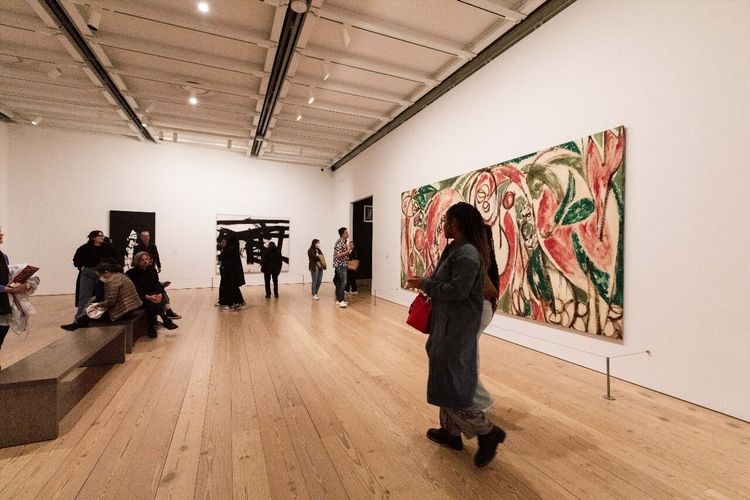
The Whitney Museum of American Art (99 Gansevoort St, New York, NY 10014, rated 4.5/5 on Google for 14,882 reviews) opened its new building at the entrance to the High Line in 2015, designed by Renzo Piano. The museum is dedicated exclusively to 20th and 21st century American art, with emphasis on living artists. Its 50,000 works include Hopper, Calder, Basquiat and one of the world's most complete collections of 1980s New York scene paintings.
The surrounding Meatpacking District, former meat market converted into a neighborhood of restaurants and nightclubs, is the place to dine before going up the High Line in the evening. The restaurants on Gansevoort Street and adjacent streets offer world cuisines in carefully designed industrial settings. The neighborhood is very different depending on the time: calm in the morning, very lively in the evening.
20. Coney Island
Coney Island (Brooklyn, New York, NY 11224, rated 4.4/5 on Google for 45K reviews) is 45 minutes from Manhattan by subway (D or F line to Coney Island-Stillwell Avenue) and feels like another New York. This Brooklyn peninsula was the world's most frequented amusement park in the early 20th century, 500,000 visitors came each summer weekend. Today, the atmosphere is more run-down, but that's precisely what gives it its charm.
The Wonder Wheel (1920 ferris wheel, classified historic monument) still turns, so does the Cyclone (1927 roller coaster). The 4.5 km beach runs along the boardwalk, the wooden promenade, where neighborhood families, corn vendors and chess players mingle. Nathan's Famous on Surf Avenue has served since 1916 the hot dogs that defined the American format. Coney Island doesn't resemble other New York attractions: it's popular, noisy, a bit nostalgic, and authentically New York.
21. MoMA
The Museum of Modern Art (11 W 53rd St, New York, NY 10019, rated 4.6/5 on Google for 59,640 reviews) (MoMA) is the world reference for modern and contemporary art, located in the heart of Midtown on 53rd Street. Monet's Water Lilies, Van Gogh's Starry Night, Picasso's Les Demoiselles d'Avignon, Warhol's Campbell's Soup Cans: the permanent collection concentrates works you've only seen in reproduction until now.
The museum covers six floors with a bright central atrium. Friday evenings, it stays open until 9pm with reduced admission after 5:30pm. The outdoor sculpture garden, designed by Philip Johnson, is a rare calm space in the neighborhood. Allow at least three hours for the permanent collections.
22. The Bronx Zoo
The Bronx Zoo (2300 Southern Blvd, The Bronx, NY 10460, rated 4.6/5 on Google for 39,231 reviews) is the largest urban zoo in the United States with 107 hectares and more than 6,000 animals representing 700 species. The "Congo Gorilla Forest" section houses one of the largest colonies of western lowland gorillas in captivity. The zoo is open 365 days a year, tickets are cheaper on weekdays and in winter (November-March), when some sections are closed.
Accessible by subway on line 2 (Pelham Pkwy stop). Allow at least half a day to see the major sections. In summer, heat makes animals less active during midday, arrive early or late afternoon.
23. Bryant Park
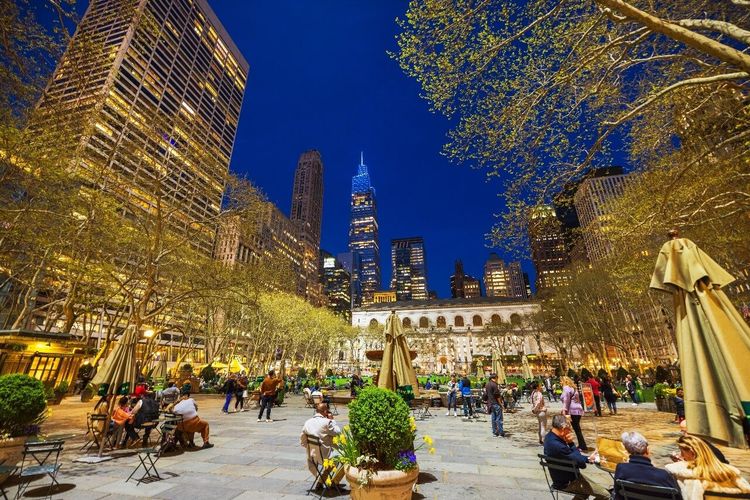
Bryant Park is a 3.9-hectare public garden behind the New York Public Library, between 40th and 42nd Street. You can borrow books from the library, play ping-pong or pétanque on free-access tables. In summer, outdoor film screenings take place on Monday evenings. In winter, the ice rink is free (skate rental fee), one of Midtown's most pleasant spots in December.
24. Wall Street and the Financial District
Wall Street takes its name from the wooden wall erected by Dutch colonists in the 17th century to protect the colony of New Amsterdam. The New York Stock Exchange, with its neoclassical facade from 1903, remains the symbol of world capitalism, and one of Manhattan's most guarded buildings since 2001.
The neighborhood also concentrates Trinity Church (1846, colonial cemetery since 1681 with tombstones in French and Dutch), Federal Hall (where George Washington was sworn in in 1789) and the Charging Bull, the bronze sculpture by artist Arturo Di Modica illegally installed in front of the Stock Exchange in 1989. It's one of the densest neighborhoods in history within less than one square kilometer.
25. The Staten Island Ferry
The Staten Island Ferry is one of the best kept secrets: a completely free 25-minute crossing between Whitehall Terminal (Lower Manhattan) and Saint George Terminal (Staten Island), with a direct and close view of the Statue of Liberty and Manhattan skyline. It operates 24/7, with departures every 30 minutes during the day.
The ferry is used daily by Staten Island residents to reach Manhattan. Take it both ways to extend the view. No need to visit Staten Island itself if you don't have time, the round trip takes less than an hour.
26. The Frick Collection
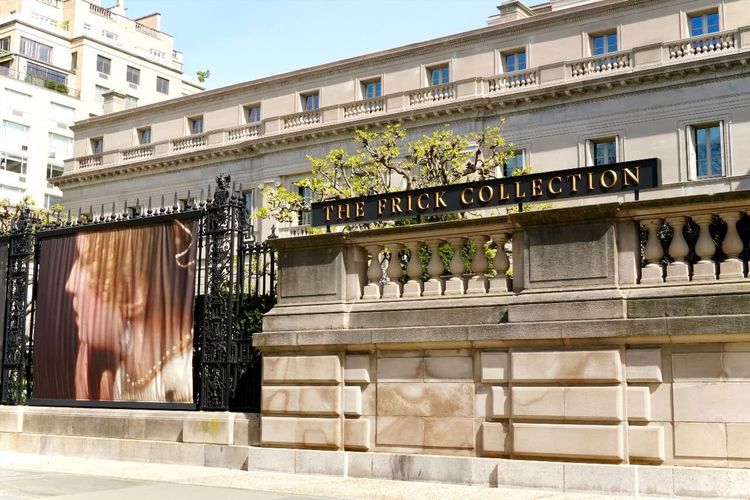
The Frick Collection is one of New York's least known art galleries, and yet one of the most beautiful. Housed in the former residence of steel magnate Henry Clay Frick, built in 1914 on 5th Avenue, it preserves a collection of old masters in an intact domestic setting: Vermeer, Rembrandt, Velázquez, Renoir, Turner.
Closed five years for major renovation, it reopened to the public in April 2025, at the corner of 70th Street and 5th Avenue, with 30% additional exhibition space. The absence of crowds compared to the Met makes it a venue of rare visit quality in New York. Closed Mondays.
27. One World Observatory
Atop One World Trade Center, the Western Hemisphere's tallest tower (541 meters), One World Observatory (285 Fulton St, New York, NY 10007, rated 4.7/5 on Google for 42K reviews) occupies the 100th, 101st and 102nd floors. The elevator ride is itself an experience: in 47 seconds, animated projections retrace Manhattan's skyline evolution from 1609 to today.
The view on clear days extends up to 80 kilometers in all directions. Tickets are more expensive than the Empire State Building, but the terrace is generally less crowded. Advance booking is recommended, especially in summer.
28. New York Culinary Specialties
Some unmissable addresses to taste real New York. Ess-a-Bagel (East 21st Street) for cream cheese bagel, Manhattan's absolute reference. Katz's Delicatessen (205 E Houston St, New York, NY 10002, rated 4.5/5 on Google for 53,200 reviews) (205 East Houston Street, open since 1888) for pastrami on rye, served thick as in the last century. Junior's in Brooklyn for the original cheesecake since 1950.
For world cuisines, Flushing in Queens concentrates the most authentic Chinese restaurants outside Asia (Sichuan, Beijing, Fujian, dim sum). Jackson Heights (Queens) for Indian and Bangladeshi cuisine. Arthur Avenue in the Bronx for Italian groceries and trattorias that have fed families since the 1950s. Our article on New York culinary specialties lists addresses by neighborhood and cuisine.
29. New York at Night
New York doesn't stop after dinner. Village Vanguard (178 7th Ave S, New York, NY 10014, rated 4.6/5 on Google for 2,082 reviews) (178 7th Avenue South, Greenwich Village) has presented jazz concerts since 1935 in a basement with legendary acoustics, Coltrane, Miles Davis and Bill Evans recorded live albums there. The jazz scene continues in Harlem bars (Minton's Playhouse, founded in 1938) and Hell's Kitchen clubs.
For rooftop terraces, 230 Fifth and Magic Hour Rooftop in Midtown offer nighttime views of the Empire State Building with a drink in hand. If you want to see New York from the water at night, private Hudson River ferries offer panoramic evening cruises. Our article on visiting New York at night lists the best addresses by neighborhood and atmosphere.
30. New York Surroundings: Day Trips
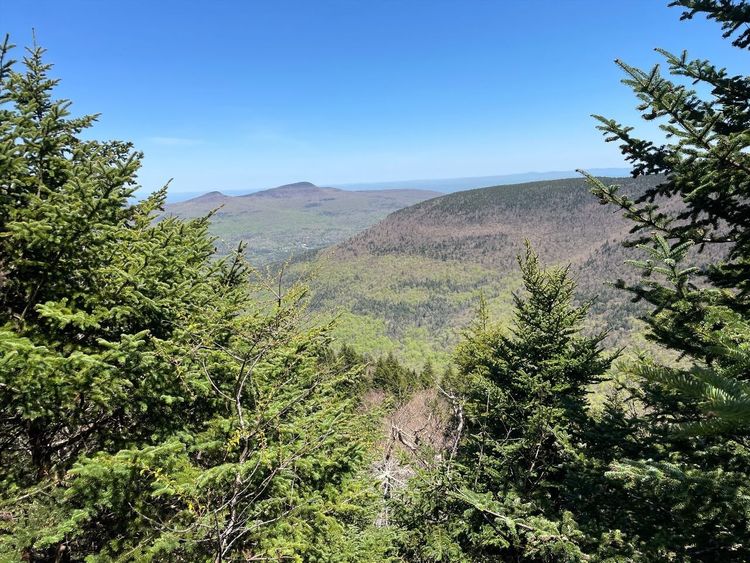
New York serves as a starting point to several destinations less than 2 hours by car or train. Philadelphia is 1h15 by Amtrak, the Founding Fathers' city, the Liberty Bell, Philadelphia Museum of Art and Reading Terminal markets. The Catskills (2h by car) offer hiking, waterfalls and artisan villages in the Appalachians.
In summer, the Hamptons (2h30 by car or Long Island Rail Road) concentrate the East Coast's chicest beaches. Newport (Rhode Island, 3h) is the city of Gilded Age Mansions, 19th-century palaces open for visits on Atlantic cliffs. For those who prefer staying in New York State, the Hudson Valley Wineries and the city of Hudson (2h by train) constitute an excellent half-day of American countryside. Our article on activities around New York details the best options by duration and season.
FAQ
What to do in New York in 4 days?
In 4 days, focus on two or three neighborhoods per half-day. Day 1: Lower Manhattan (9/11 Memorial, Brooklyn Bridge, Financial District). Day 2: Midtown and museums (Metropolitan Museum of Art, Central Park, Empire State Building in the evening). Day 3: Brooklyn (DUMBO, Williamsburg, Bushwick). Day 4: Upper West Side, Natural History Museum, High Line, Chelsea. Budget around 80 to 120 dollars per day for admissions if you visit two paid museums.
What to do in New York in 10 days?
Ten days allow you to explore all five boroughs. Dedicate 5 days to Manhattan, 2 days to Brooklyn, 1 day to Queens (MoMA PS1, Astoria, Flushing and its Asian restaurants), 1 day to the Bronx (Yankee Stadium, Bronx Zoo, New York Botanical Garden) and 1 day to Staten Island (the free ferry, plus Snug Harbor Cultural Center). Day trips outside the city are possible: the Catskills 2 hours by car, the Hamptons in summer, or a day in Philadelphia by Amtrak train (1h15).
What to do in New York in October?
October is one of the best months to visit New York. Temperatures range between 10 and 18°C, the sky is often clear and tourist crowds diminish after summer. Central Park leaves begin to turn red from mid-October. The Greenwich Village Halloween Parade on October 31st is one of the country's largest and remains free and open to all.
What to do in New York in November?
November marks the entry into cold season (5 to 12°C) but offers concrete advantages: Thanksgiving (4th Thursday of the month) and its Macy's parade on Broadway in the morning, the first Christmas lights at Rockefeller Center (tree lit at the end of November), and Black Friday sales in department stores. Museums are less crowded than in summer, restaurants easier to book.
What to do in New York in winter?
New York in winter can be positively surprising. Ice rinks at Rockefeller Center, Bryant Park and Wollman Rink in Central Park are open from November to March. The city also offers Columbus Circle Christmas market and department store illuminations (Saks Fifth Avenue, Macy's, Bergdorf Goodman). Temperatures sometimes drop below -10°C in January-February, but the subway network allows you to visit everything without facing the cold more than necessary. Flights and hotels are significantly cheaper than in summer.
What to do in New York today or this week?
For real-time activities, check Time Out New York or NYC Tourism, the city's official tourism service. These platforms list temporary exhibitions, free concerts in parks (in summer, Bryant Park Picnic Performances is daily), outdoor screenings and neighborhood events. Wednesday evening is traditionally the evening for discounted Broadway previews. And for the empty hours between two bookings, our audio-guided walk links Bryant Park to the Empire State Building with no timetable to keep.
Conclusion
New York is a city that must be earned. The first hours can be disorienting, too big, too noisy, too expensive, but the city gradually reveals its best moments: a conversation with a Lower East Side vendor who knows the history of every street, a sunset over the Hudson River from Williamsburg waterfront, a gospel service in a Harlem church on a Sunday morning.
To explore the city at your own pace, with historical context and anecdotes that transform a walk into discovery, the audio-guided tour of New York by Ryo accompanies you through Manhattan streets with audio available offline. Our app covers major stages as well as details that paper guides pass over in silence.
À lire également