





Walk
The Fiery City
Liège, Belgium
Walk
The Fiery City
Liège, Belgium
5.5 km
Distance
2h30
Durée
31
Audios
Loop
Parcours
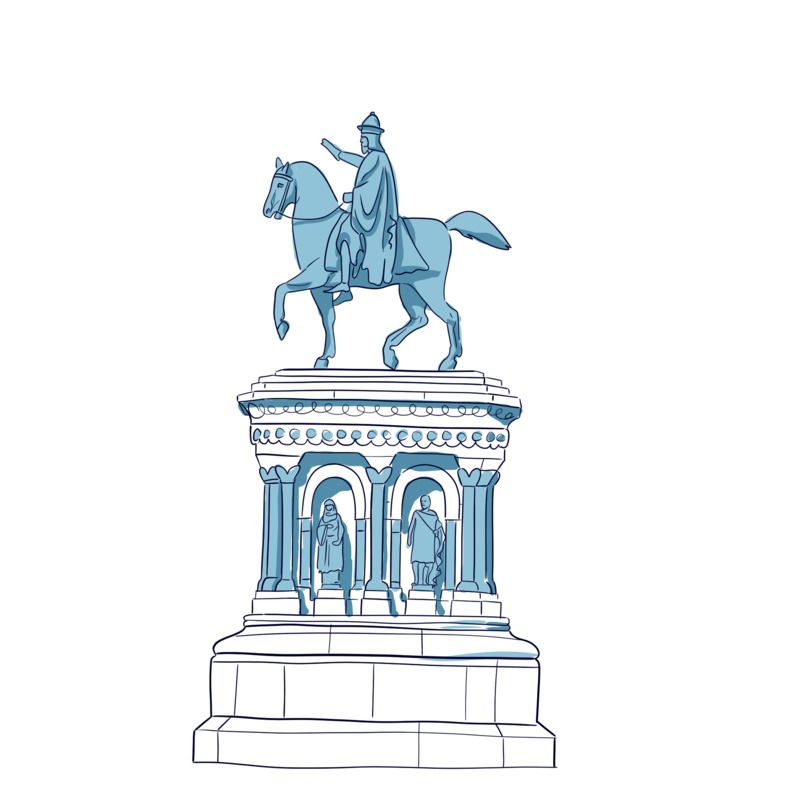
The Liège audio-guided tour brings you to this esplanade where you stand face to face with the great equestrian statue of Charlemagne. Erected in 1868 by the Liège sculptor Louis Jéhotte, it recalls how closely the Carolingian emperor is bound to the history and identity of the region.
Although Charlemagne reigned from Aachen, several traditions place his birth much closer to here, at Herstal or Jupille, two localities neighbouring Liège. It was this local pride that led the city to honour him. Originally intended for Place Saint-Lambert, the bronze statue was finally set at this crossing of the boulevards, where it watches over the strollers.
The statue shows the emperor in majesty on his mount, in a solemn posture dominating the crossing of Boulevard d'Avroy and Boulevard Piercot. A notable work by the sculptor Louis Jéhotte, it illustrates the nineteenth-century taste for great commemorative monuments and Liège's attachment to the founding figure of Charlemagne.
The statue of Charlemagne stands at the crossing of Boulevard d'Avroy and Boulevard Piercot, in central Liège, near Parc d'Avroy. It can be seen freely at all hours and on the level, while walking along the boulevards.
The bronze equestrian statue was erected in 1868 by the Liège sculptor Louis Jéhotte. First intended for Place Saint-Lambert, it was finally placed at the crossing of the boulevards.
Several traditions place Charlemagne's birth at Herstal or Jupille, two localities neighbouring Liège. This supposed closeness feeds a local pride that lay behind the erection of the statue.
Aucun avis pour le moment
