





Walk
Where colours reinvent history
Tirana, Albania
Walk
Where colours reinvent history
Tirana, Albania
5 km
Distance
2h00
Durée
22
Audios
Loop
Parcours
©Malyszkz - Domaine Public
As you walk along the Lana River, a narrow ribbon of water running through the heart of Tirana, it’s the perfect moment to step back in time and see how this discreet-looking capital was shaped, layer by layer, by history. Unlike most European capitals, Tirana is a young city. It was founded in 1614, when Sulejman Pasha Bargjini, an Albanian general in the Ottoman Empire, created a small eastern-style settlement around a mosque, a hammam and a market.
For the next three centuries, Tirana remained a modest trading town under Ottoman rule. Everything changed in 1912, when Albania declared its independence after five hundred years of Ottoman domination, but it was in 1920 that Tirana, chosen for its central location, became the capital of the new Albanian state. At that time, the city counted only about ten thousand inhabitants.
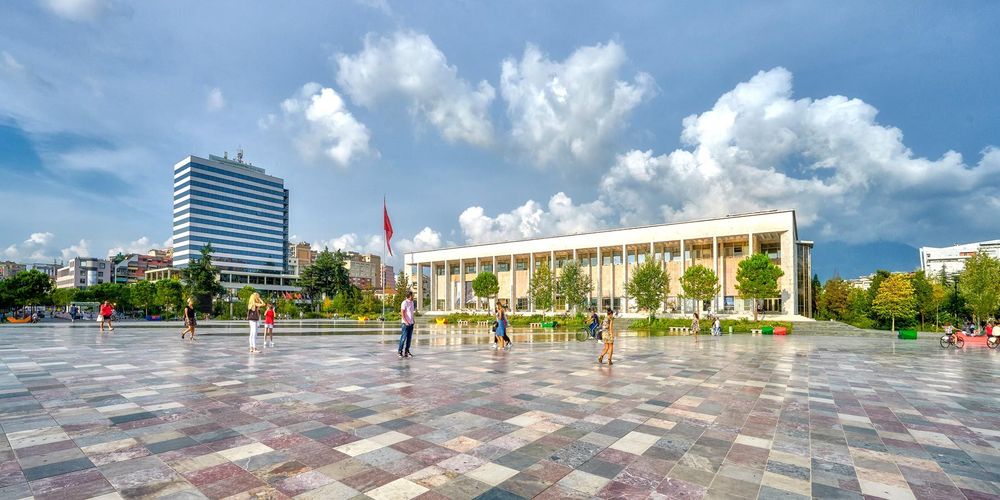
The 1930s marked its first major transformation, as Italian architects designed a modern city center with Skanderbeg Square as its monumental core, reshaping the former Ottoman town into a European-style capital with elegant boulevards and modernist buildings. History then took a dramatic turn in 1944, when Albania emerged from Italian and then German occupation into the communist dictatorship of Enver Hoxha. For nearly fifty years, the country sealed itself off from the world, cutting ties successively with Yugoslavia, the Soviet Union and China, becoming the most isolated regime in Europe.
Religion was banned, travel was impossible and freedom was almost non-existent, while more than seven hundred thousand concrete bunkers were built across the country, lasting symbols of the dictator’s paranoia. Tirana turned into a grey city of uniform housing blocks, even as its population grew rapidly, from around eleven thousand inhabitants in 1923 to nearly two hundred thousand by 1975. In 1991, the communist regime gradually collapsed under popular pressure, and the first free elections opened a chaotic but hopeful new chapter.
After decades of suffocation, Tirana could finally breathe again. A striking visual shift came in 2000, when Edi Rama, an artist turned mayor, launched a bold color revolution, repainting grey façades in bright reds, yellows and blues and bringing public spaces back to life. Tirana began to assert itself as a vibrant, creative capital looking ahead.
Today, with more than five hundred thousand inhabitants, the city embodies Albania’s rebirth, embracing its complex past while confidently turning toward Europe, a capital quite unlike any other.
Aucun avis pour le moment
