





Walk
Where colours reinvent history
Tirana, Albania
Walk
Where colours reinvent history
Tirana, Albania
5 km
Distance
2h00
Durée
22
Audios
Loop
Parcours
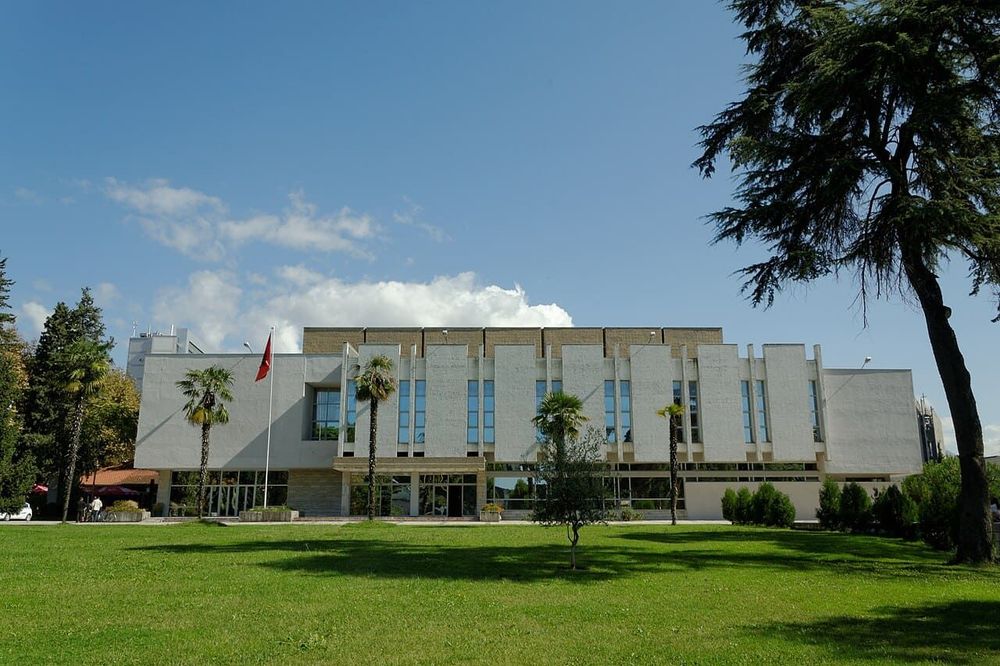
©Dritan Mardodaj CC BY-SA 4.0. <https://creativecommons.org/licenses/by-sa/4.0/deed.fr>via Wikipedia Commons
The country's main visual-arts institution, the National Gallery of Art of Tirana retraces the evolution of Albanian creation. Set in a modernist building, it holds thousands of works, from medieval icons to contemporary canvases. The Tirana audio-guided tour stops here to explore the country's history through its art, including the singular period of socialist realism.
Officially founded in 1954, the gallery is housed in a modernist building designed by architect Enver Faja and completed in the early 1970s. It holds several thousand works spanning centuries of Albanian art. Its collection is notably renowned for its important body of socialist-realist works, inherited from the dictatorship period, a rare testimony to the official art of that time.
The route leads from medieval icons to modern works, by way of socialist-realist painting, where art served the regime's propaganda. It is a fascinating dive into Albania's visual memory, shedding light on the history of art as much as on that of the country. The gallery also presents temporary exhibitions that bring the collection into dialogue with current creation.
The National Gallery of Art is in the centre of Tirana, near Skanderbeg Square, reachable on foot. A working museum, it can be visited; its opening hours and prices may vary with the season and the exhibitions, and it is advisable to check them before coming. Allow enough time to go through the various rooms of the collection.
Several thousand works retracing Albanian art, from medieval icons to modern creations, with a renowned body of socialist-realist works from the communist period.
It was officially founded in 1954 and occupies a modernist building by architect Enver Faja, completed in the early 1970s.
Aucun avis pour le moment
