





Walk
Where colours reinvent history
Tirana, Albania
Walk
Where colours reinvent history
Tirana, Albania
5 km
Distance
2h00
Durée
22
Audios
Loop
Parcours
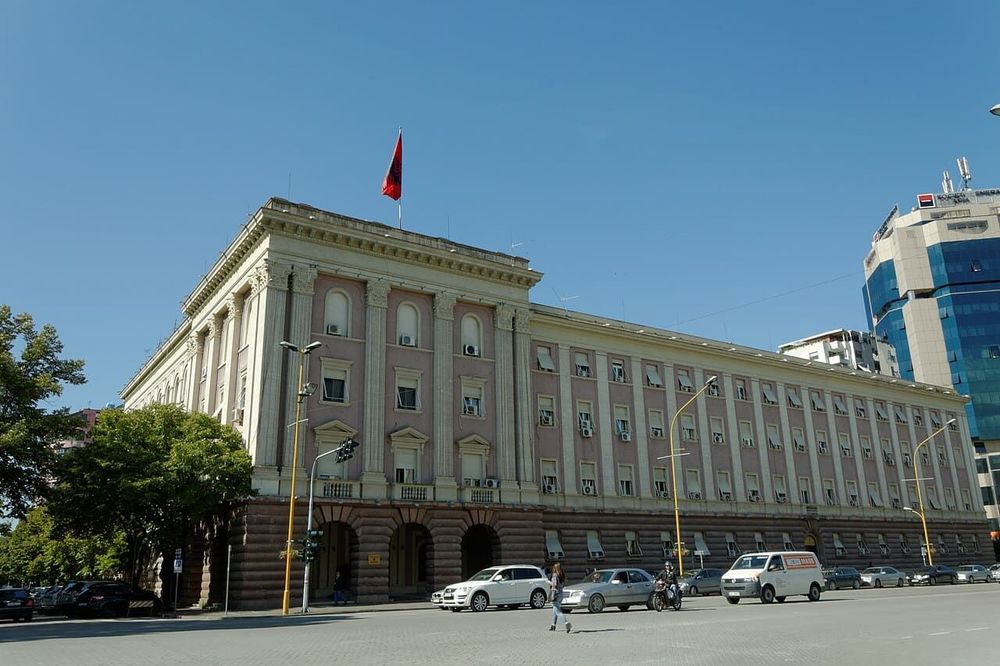
©Dritan Mardodaj - CC BY-SA 4.0 <https://creativecommons.org/licenses/by-sa/4.0/deed.fr>via Wikipedia Commons
In the heart of the government zone of Tirana, the Parliament building houses the debates and legislative decisions of Albania. All around, several key buildings embody the working of the state. The Tirana audio-guided tour stops here to explain how, after decades of absolute power, the country gave itself democratic institutions.
The Albanian Parliament, called the Assembly of Albania or Kuvendi i Shqipërisë, is the republic's single-chamber assembly, in its current form since 29 April 1991. It is here that laws are voted and the country's political life unfolds. The building stands in the institutions zone, along the Boulevard of the Martyrs of the Nation, the capital's official and symbolic axis.
The Parliament is seen from the outside, in an area where the state's great buildings are concentrated. A walk through this government zone helps you understand the organisation of Albanian power, a stone's throw from Skanderbeg Square and the city's major monuments. It is a stop for those interested in the recent political history of Albania, from dictatorship to democracy.
The Parliament lies in the government zone of Tirana, along the Boulevard of the Martyrs of the Nation, reachable on foot from the centre. It is an institutional building: it is observed from the public space, as access inside is restricted and subject to the institution's own rules. The area, central and flat, is easily explored on foot.
The Assembly of Albania, the republic's single-chamber parliament, has existed in its current form since 29 April 1991, on emerging from the communist regime.
It is an institutional building observed from the outside; access inside is restricted and subject to the Assembly's own rules.
Aucun avis pour le moment
