





Walk
Where colours reinvent history
Tirana, Albania
Walk
Where colours reinvent history
Tirana, Albania
5 km
Distance
2h00
Durée
22
Audios
Loop
Parcours
Shutterstock
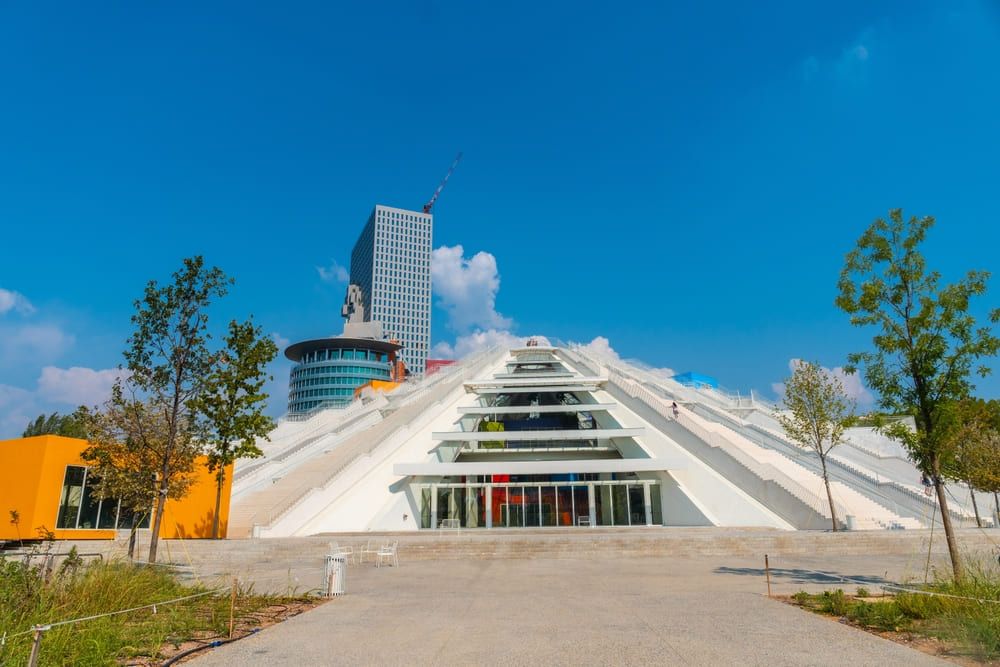
A few minutes from Skanderbeg Square, on the Boulevard of the Martyrs of the Nation, the Pyramid of Tirana is one of the most emblematic and paradoxical monuments of contemporary Albania. This vast concrete structure intrigues by its eventful history. The Tirana audio-guided tour stops here to tell how a mausoleum to the glory of a dictator became a symbol of renewal.
Inaugurated in 1988, the pyramid, then the Enver Hoxha museum, was conceived as a monument to the dictator's glory, even as his future mausoleum. At 21 metres high and 17,000 square metres, it dominates the institutional district. Long left abandoned, seen by many as an eyesore, it has been radically transformed to become a space dedicated to youth and new technologies, reversing its symbol.
After its renovation, the pyramid opened to the public with outdoor stairs you can climb to enjoy the view over the city. Its angular outline, now a playground and a meeting place, illustrates how Tirana reinvents its heritage. It is one of the places where you best grasp the contrast between the communist past and the energy of today's Albania.
The Pyramid lies on the Boulevard of the Martyrs of the Nation, a few minutes' walk from Skanderbeg Square. The exterior and its stairs are freely accessible; for the interior spaces and their activities, hours and conditions may vary, so it is best to enquire on site. Climbing the outdoor stairs calls for a minimum of caution, especially in wet weather.
Inaugurated in 1988, it was first a museum to the glory of the dictator Enver Hoxha, designed as a monument to his memory.
Renovated, it has become an open space dedicated to youth and technology, whose outdoor stairs you can climb to admire the view over Tirana.
Aucun avis pour le moment
