





Walk
Where colours reinvent history
Tirana, Albania
Walk
Where colours reinvent history
Tirana, Albania
5 km
Distance
2h00
Durée
22
Audios
Loop
Parcours

Shutterstock
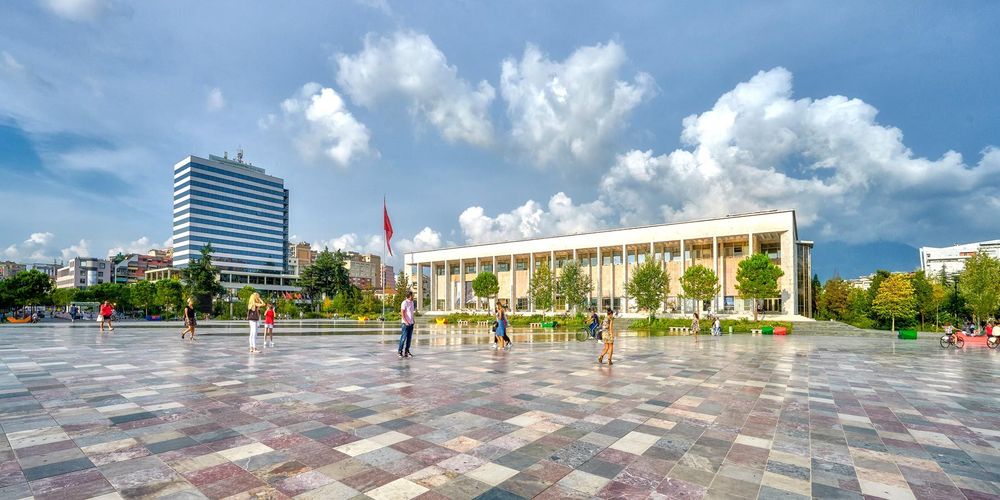
On the edge of Skanderbeg Square, three monuments alone tell the story of Tirana: the equestrian statue of the national hero, the Et'hem Bey mosque and the Clock Tower. This trio sums up centuries of Albanian history, from the Ottoman era to the assertion of national identity. The Tirana audio-guided tour lingers here to connect these three neighbouring symbols.
The equestrian statue of Skanderbeg was inaugurated in 1968 for the five-hundredth anniversary of his death. With sword raised, it depicts this fifteenth-century leader who long resisted the Ottoman Empire and embodies Albanian identity. Close by, the Et'hem Bey mosque, one of the city's emblematic monuments, and the Clock Tower recall Tirana's Ottoman heritage.
The Et'hem Bey mosque is renowned for its dense painted decoration, inside and under its portico, with floral motifs and views inspired by the Ottoman Empire, rare in Islamic art. Its slender minaret and the neighbouring Clock Tower form a characteristic outline of Tirana. With the statue of Skanderbeg, they make up one of the most photographed ensembles of the capital.
These three monuments are on Skanderbeg Square or its immediate surroundings, in the centre of Tirana, to be discovered on foot. The statue and the Clock Tower can be freely admired from the public space; the Et'hem Bey mosque, a working place of worship, can be visited in accordance with the rules specific to the site, with hours and conditions to be checked on site and suitable dress.
Skanderbeg is the fifteenth-century Albanian national hero, famous for his long resistance to the Ottoman Empire; his equestrian statue, inaugurated in 1968, dominates the square that bears his name.
It is a working place of worship that can be visited in accordance with custom, with suitable dress; hours and access conditions are to be checked on site.
Aucun avis pour le moment
