





Walk
The Empress of Austria
Vienna, Austria
Walk
The Empress of Austria
Vienna, Austria
7.6 km
Distance
3h10
Durée
27
Audios
Loop
Parcours
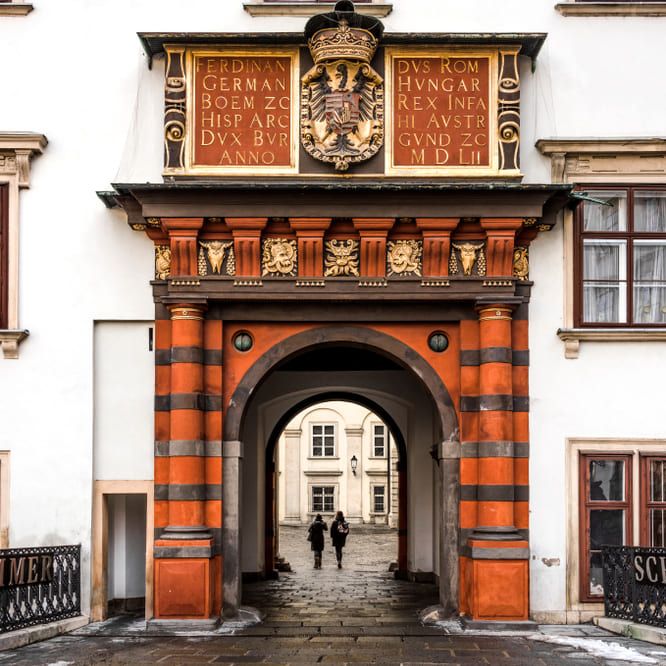
The Vienna audio-guided tour leads you into the main inner courtyard of the Hofburg, before the Swiss Gate, in red and black colours. It owes its name to the Swiss guards who defended it in the 16th century and marks the entrance to the oldest wing of the imperial palace.
Built in 1552, the gate with its Renaissance-decorated vaulted ceiling opens onto the Swiss wing, the oldest part of the Hofburg, where the imperial chapel and the access to the treasury amassed over the centuries by the Habsburgs are located. At the centre of the square stands the statue of Francis II, last Holy Roman Emperor and first Emperor of Austria from 1804 to 1835. He took this title in response to Napoleon's coronation as Emperor of the French.
The gate, with its heraldic colours and vaulted passage, gives access to the imperial chapel and the imperial treasury, which gathers jewels, insignia and objects of power of the Habsburgs. It is one of the starting points for exploring the historic heart of the palace and understanding the long history of the dynasty that ruled Austria and the Holy Roman Empire.
The Swiss Gate is in the inner courtyard of the Hofburg, in the centre of Vienna; it can be crossed freely on foot. Access to the imperial treasury and the chapel is, however, ticketed, with hours and prices varying by season. It is best to check the information in advance to plan the visit.
It takes its name from the Swiss guards who defended it in the 16th century; it was built in 1552.
It opens onto the oldest wing of the Hofburg, with the imperial chapel and the access to the Habsburg treasury.
Aucun avis pour le moment
