





Walk
The Fiery City
Liège, Belgium
Walk
The Fiery City
Liège, Belgium
5.5 km
Distance
2h30
Durée
31
Audios
Loop
Parcours
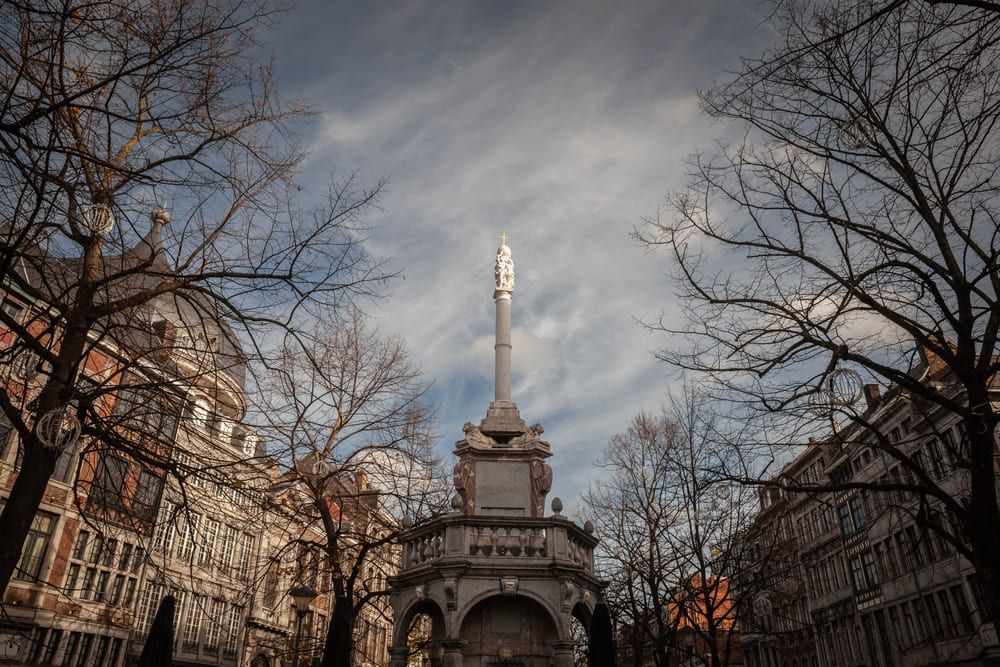
The Liège audio-guided tour leads you to Place du Marché, the historic heart of the city for more than a thousand years. It was here that the city took shape from the Middle Ages, between the arms of the Légia river and the trading lanes of Féronstrée.
Over the centuries the square hosted everything: medieval markets, guild halls, public proclamations, festivals and tournaments. Before you stands the Perron, the absolute symbol of Liège freedoms. Now set on a baroque fountain, it has three steps supported by lions and a column crowned by the Three Graces. It was here that justice was dispensed and edicts proclaimed. In 1468, Charles the Bold carried it off to humiliate the people of Liège, before it was returned.
Besides the Perron, the square is dominated by the town hall, nicknamed la Violette, an elegant eighteenth-century building. In the shade of the plane trees, the place remains a lively meeting point, lined with terraces. Place du Marché thus brings together, in a single space, the two great symbols of the city and more than a thousand years of urban life.
Place du Marché lies in the historic heart of Liège, near the town hall and close to the palace of the prince-bishops. It is freely accessible at all hours and on the level. The Perron and the town hall can be contemplated from the square.
The Perron is the symbol of Liège freedoms. It was before it that justice was dispensed and the city's edicts proclaimed. In 1468, Charles the Bold carried it off to humiliate the city.
La Violette is the traditional nickname of the Liège town hall, an elegant eighteenth-century building that dominates Place du Marché alongside the Perron.
Aucun avis pour le moment
