



Walk
The City in the Sky
La Paz, Bolivie
Walk
The City in the Sky
La Paz, Bolivie
Distance
2.7 kmDurée
1h15Audios
16Parcours
Loop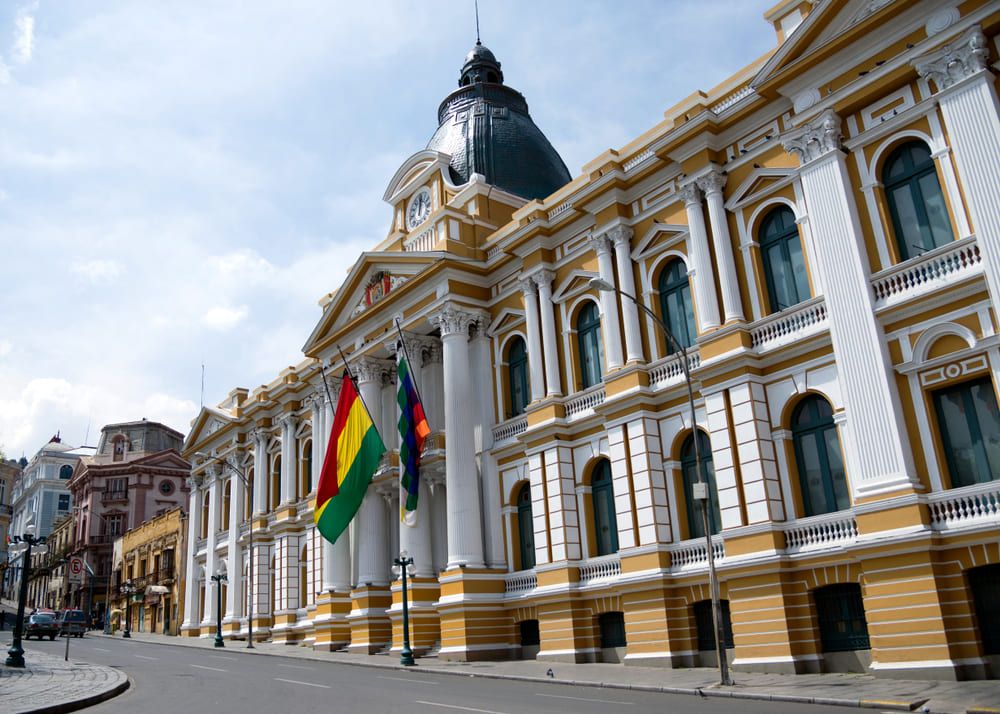
Shutterstock
With its two massive towers, grand dome, and restrained Neoclassical lines, the Metropolitan Cathedral looks as though it has been watching over La Paz for centuries. But don't be fooled by its old-fashioned appearance: the cathedral only recently celebrated its hundredth birthday. Construction began in 1835, when the young republic wanted a monumental place of worship, but the work dragged on and on. The cathedral wasn't inaugurated until 1925, just in time for the country's centennial. Even then, it took several more decades to complete its towers and finishing touches. And perhaps that's understandable. Building on the steep slopes of the Andes at this altitude is no easy task. Even so, the cathedral isn't the star of this square. That role belongs to the Palacio Quemado, or “Burned Palace,” which quite literally steals the spotlight. In March 1875, during a particularly violent coup, opponents attacked the government palace and set it on fire. In Bolivia, when political tensions heat up, it's not always just an expression! Despite numerous restorations aimed at restoring its pink facade, locals decided to keep its provocative nickname. Now turn your attention to the neighboring building, the Legislative Palace, which is home to Bolivia's Parliament. With its elegant white columns and symmetrical facade, it looks like a Greek temple. But don't be fooled: its clock makes a very deliberate statement. In 2014, Bolivia's foreign minister, David Choquehuanca, decided to make a point. Almost overnight, mechanics reversed the mechanism: the numbers were rearranged backward, and the hands began moving counterclockwise! This wasn't a malfunction. It was an intellectual provocation known as the “Clock of the South.” The idea was to remind people that Bolivia lies in the Southern Hemisphere and doesn't have to blindly follow conventions invented in the North. It was an invitation to question what we think of as universal and to see the world from the Andes. Although the clock eventually returned to its usual direction of rotation in late 2025, after eleven years of chronological rebellion, the philosophical message remains part of the country's collective memory. This assertion of Andean identity can also be seen in other symbols, such as the Wiphala, the colorful checkered flag. Made up of 49 squares in rainbow colors arranged in a checkerboard pattern, the Wiphala is recognized in the Constitution as an official symbol of the state alongside the tricolor flag. It represents the Indigenous peoples of the Andes, particularly the Aymara and Quechua. Its seven colors express an entire worldview encompassing Mother Earth, community, nature, energy, and the cosmos. So remember: even if these buildings may look European in style, the institutions they house represent the country's cultural diversity, including its Aymara, Quechua, and Guarani peoples.
Aucun avis pour le moment
