





Walk
The Museum City
Trogir, Croatia
Walk
The Museum City
Trogir, Croatia
1.4 km
Distance
1h00
Durée
19
Audios
Loop
Parcours
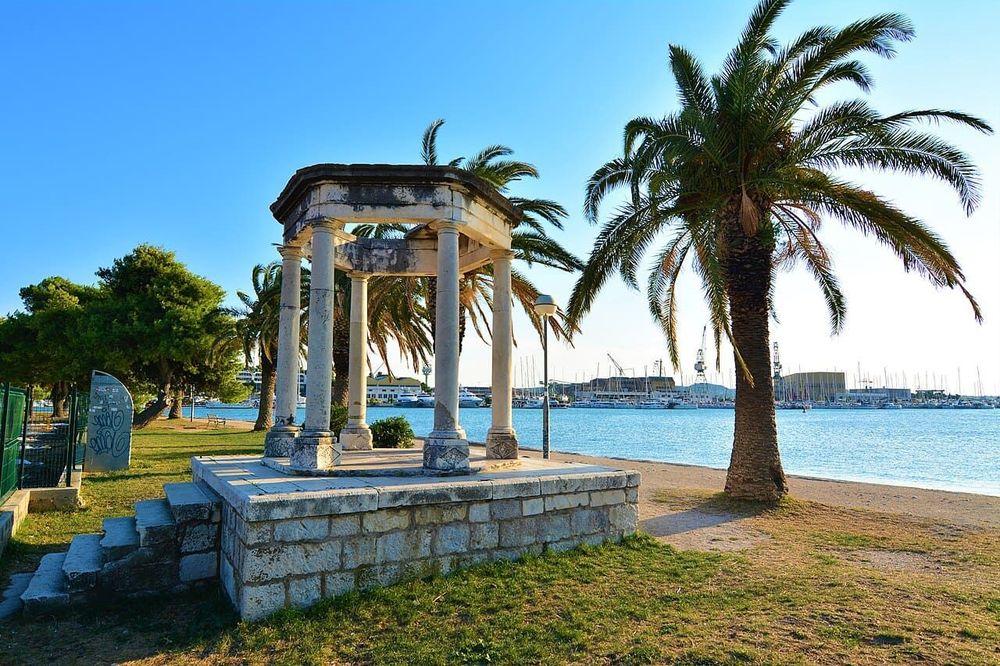
The gloriette of marshal Marmont is a small discreet pavilion near the Kamerlengo Castle, vestige of the brief French period of Trogir. The Trogir audio-guided tour stops here to evoke this arbour raised between 1806 and 1814, under the government of the Illyrian Provinces by the Marshal of the Empire Auguste de Marmont, faithful of Napoleon become Duke of Ragusa, whose paradoxical destiny mingles building work and betrayal.
Near the Kamerlengo Castle hides a small discreet pavilion: the gloriette of marshal Marmont. It dates from the time when Trogir was briefly French, between 1806 and 1814, when the city was part of the Illyrian Provinces, governed by Auguste de Marmont, Marshal of the Empire and close to Napoleon. Marmont had followed Bonaparte from the campaigns of Italy and Egypt, and passed for one of his faithful companions, rewarded with the title of Duke of Ragusa in 1808, then with the government of Dalmatia. It was said that he led a grand lifestyle, surrounded by servants and lodging in sumptuous palaces, but he also left positive traces, roads, schools and modernised administration. This gloriette was built to celebrate the French glory on the Adriatic. The history, however, darkens: in 1814, Marmont rallied to the Bourbons and delivered his army to the Allies. For Napoleon, it was a betrayal, and his name remained marked by it, the verb "raguser", drawn from his title, becoming in France synonymous with "to betray". This small gloriette thus tells a paradoxical story, that of a building marshal and brilliant servant of the Empire, whose glory was eclipsed by a fatal gesture.
Here you discover a small discreet pavilion near the Kamerlengo Castle, vestige of the brief French period of Trogir (1806-1814), raised to celebrate the French glory on the Adriatic under marshal Marmont, governor of the Illyrian Provinces; this faithful of Napoleon, builder of roads and schools, ended however marked by his betrayal of 1814. The gloriette tells a paradoxical story. It is a fine stop, to be explored on foot.
The gloriette of general Marmont hides near the Kamerlengo Castle, at the western tip of the old town of Trogir, reachable on foot. It is a monument in free access in the public space, that you discover during a walk.
Marshal of the Empire and close to Napoleon, whom he followed from the campaigns of Italy and Egypt, he was made Duke of Ragusa in 1808 and governed the Illyrian Provinces, of which Trogir was part, modernising roads, schools and administration; but in 1814, he rallied to the Bourbons and delivered his army to the Allies, a gesture perceived as a betrayal that durably marked his name.
Near the Kamerlengo Castle, at the western tip of the old town of Trogir, in Croatia.
Aucun avis pour le moment
