





Walk
The pearl of the Adriatic
Dubrovnik, Croatia
Walk
The pearl of the Adriatic
Dubrovnik, Croatia
2.5 km
Distance
1h00
Durée
19
Audios
Loop
Parcours
Shutterstock
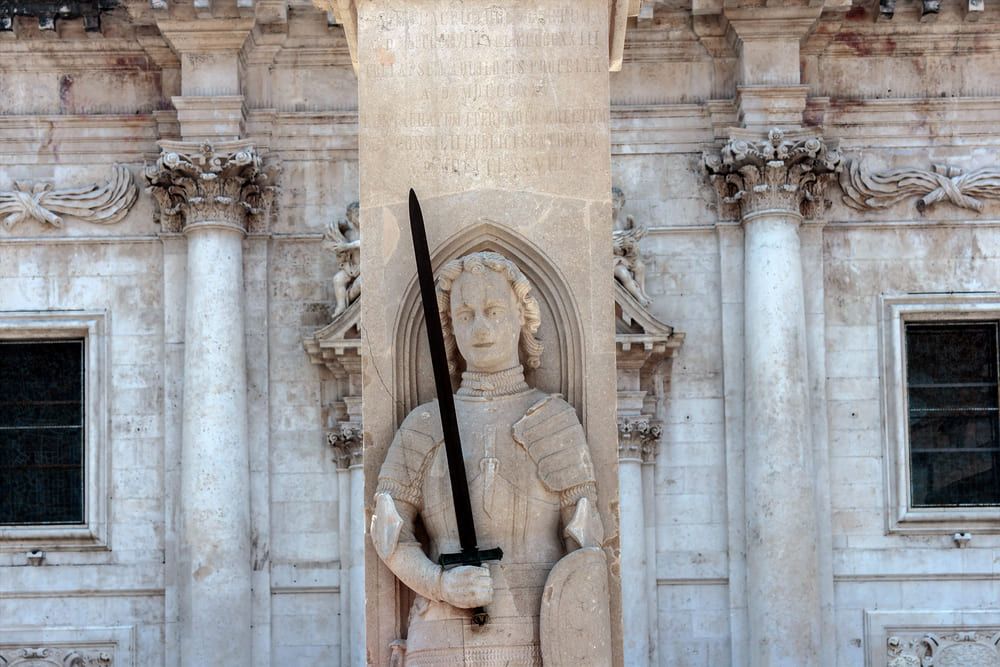
The Dubrovnik audio-guided tour presents you with Orlando's Column, which has watched over Luža Square for more than six centuries and carries a symbolism of freedom.
Carved in a single block of stone in 1417 by a Milanese architect, the column represents Roland, or Orlando, as a knight, sword in hand and shield on arm. This military leader served Charlemagne before dying in 778, an episode immortalised by the Song of Roland. Become a legendary figure of the Middle Ages, Roland embodies in central and Germanic Europe the struggle for freedom against tyranny, to the point that statues of Roland flourished in many cities in the fourteenth and fifteenth centuries. That of Dubrovnik is the only one in the Mediterranean basin. A local legend has it that a knight named Roland defended the city against a siege in the ninth century: myth or reality, this symbol took on its full meaning for the Republic of Ragusa.
Orlando's Column stands proudly on Luža Square, surrounded by the great monuments of Dubrovnik. Beyond its knightly silhouette, it embodies the attachment of the former Republic of Ragusa to its freedom and its independence. It is a strong historical landmark, to be discovered in the heart of the old town.
Orlando's Column is on Luža Square, in the heart of the old town of Dubrovnik. It can be contemplated freely at all hours and on the level, along the walk.
In 1417, in a single block of stone, by a Milanese architect.
The struggle for freedom against tyranny; in Dubrovnik, it expressed the attachment of the Republic of Ragusa to its independence.
Aucun avis pour le moment
