





Walk
The pearl of the Adriatic
Dubrovnik, Croatia
Walk
The pearl of the Adriatic
Dubrovnik, Croatia
2.5 km
Distance
1h00
Durée
19
Audios
Loop
Parcours
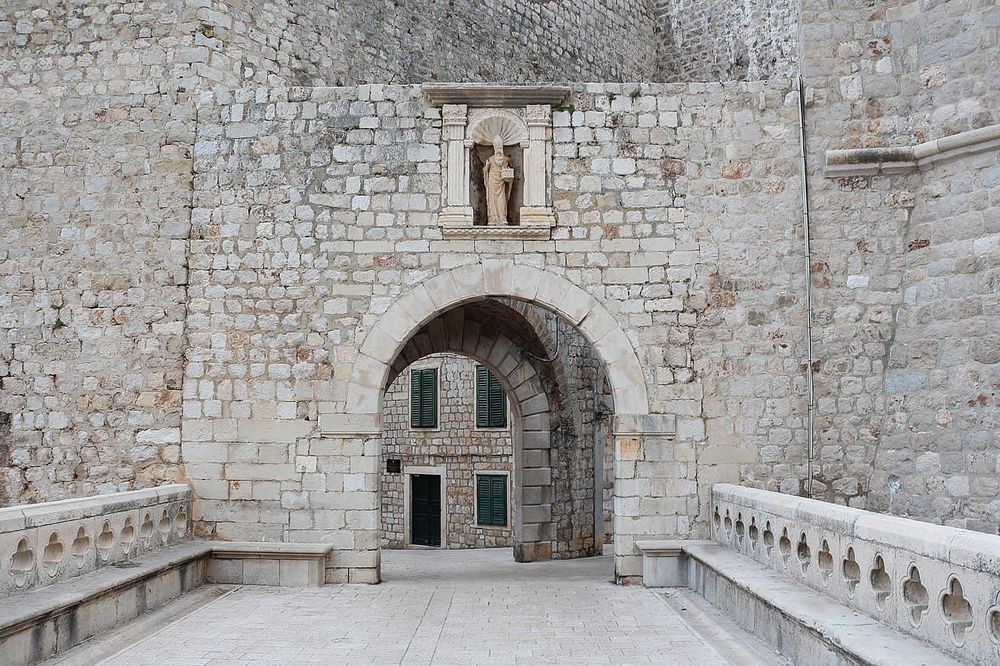
©Bernard Gagnon CC BY-SA 4.0. <https://creativecommons.org/licenses/by-sa/4.0/deed.fr>via Wikipedia Commons
The Dubrovnik audio-guided tour has you enter the old town through the Pile Gate, the majestic and main access on the west side of the ramparts.
Built in 1537 on the west side of the ramparts, the Pile Gate recalls the era when Dubrovnik was closed at night to protect itself from invaders. A long wooden drawbridge, later replaced by a stone bridge, barred the access. This device did not however prevent Napoleon from crossing the gate in 1806, putting an end to the Republic of Ragusa, a former maritime city-state directed by a rector elected each month. On the Renaissance-style external façade is a statue of Saint Blaise, patron saint of the city, made in 1922 by Ivan Meštrović, the most famous Croatian sculptor; on the inside, the gate reveals older Gothic influences, dating from 1460.
To cross the Pile Gate is to make a spectacular entrance into the old town, over a stone bridge then under a Renaissance façade adorned with a statue of Saint Blaise. Inside, the Gothic influences recall the antiquity of the place. It is the most used access to discover the historic heart of Dubrovnik and its main artery, the Stradun.
The Pile Gate is to the west of the ramparts of Dubrovnik. It can be crossed freely on foot at all hours, over a stone bridge; it is one of the main accesses to the old town.
Its Renaissance external façade dates from 1537; on the inside, Gothic influences go back to 1460.
Ivan Meštrović, the most famous Croatian sculptor, in 1922.
Aucun avis pour le moment
