






Walk
Between Marble and the Mediterranean
Split, Croatia
Walk
Between Marble and the Mediterranean
Split, Croatia
2 km
Distance
1h00
Durée
18
Audios
Loop
Parcours
Shutterstock
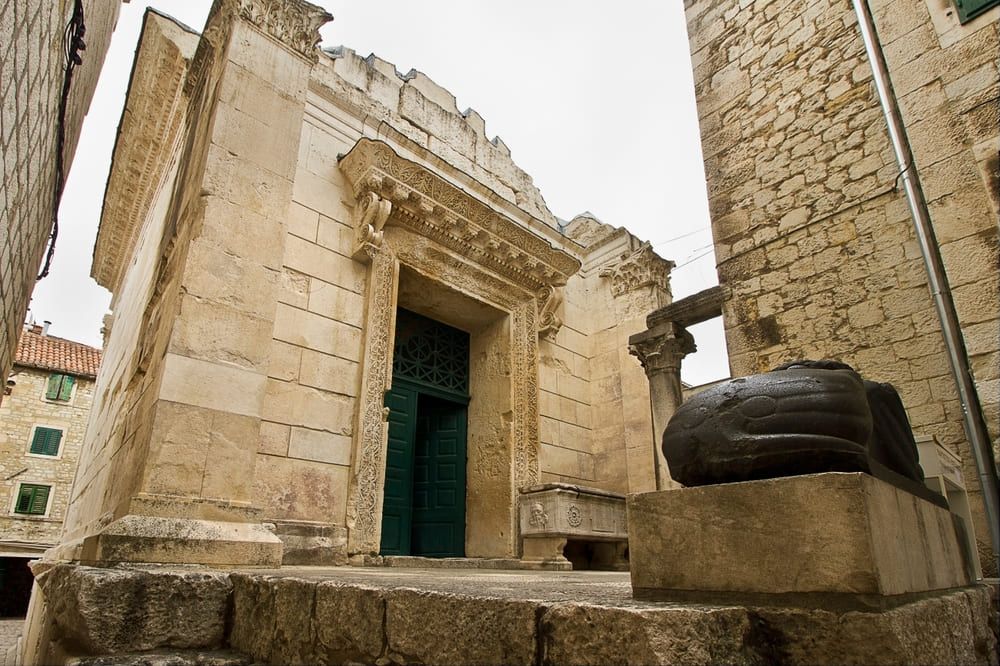
The Split audio-guided tour presents you with the Temple of Jupiter, one of the hidden treasures and best-preserved monuments of the Palace of Diocletian.
Less known than the Peristyle or the cathedral, the Temple of Jupiter is nonetheless among the best-preserved monuments of the imperial ensemble. Built at the beginning of the fourth century of our era, as part of Diocletian's retirement, it was dedicated to Jupiter, king of the gods of Roman mythology. The story takes here a personal turn: Diocletian, a great lover of imperial symbols, presented himself as the "son of Jupiter", so that the temple served as much to glorify the god as to reinforce the divine authority of the emperor. The exterior, sober and elegant, is rectangular and topped by a pediment, with Corinthian columns; inside, the vault is finely sculpted in coffers adorned with faces.
The Temple of Jupiter invites contemplation through its remarkably preserved ancient architecture, its Corinthian columns and its vault sculpted in coffers adorned with faces. A hidden treasure of the Palace of Diocletian, it testifies to the fusion of the sacred and imperial power in ancient Rome. It is a precious stage, to be discovered by going around through the small lane that leads to its façade.
The Temple of Jupiter is within the Palace of Diocletian, in the old town of Split. It can be visited according to hours to be checked on site; access may be subject to a charge, and it is reached by a small lane leading to its façade.
To Jupiter, king of the Roman gods; Diocletian, who called himself "son of Jupiter", also reinforced his divine authority there.
Its vault finely sculpted in coffers adorned with faces, in a remarkably preserved ancient building.
Aucun avis pour le moment
