





Walk
The pearl of the Adriatic
Dubrovnik, Croatia
Walk
The pearl of the Adriatic
Dubrovnik, Croatia
2.5 km
Distance
1h00
Durée
19
Audios
Loop
Parcours
Shutterstock
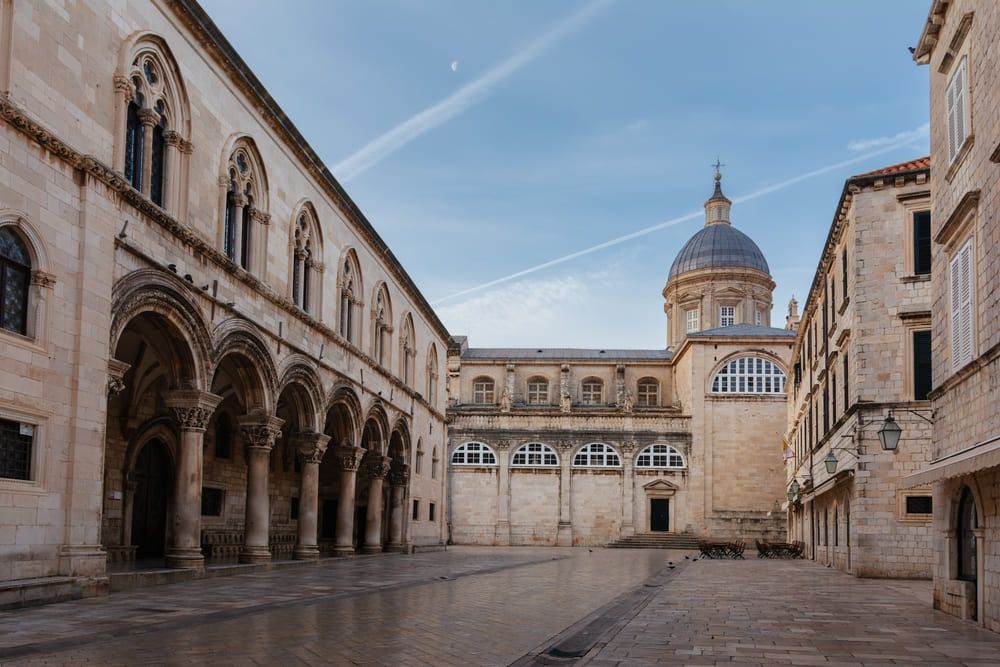
The Dubrovnik audio-guided tour has you walk along the Stradun, the main thoroughfare of the old town, some three hundred metres long and unmissable on the visit.
Built in the twelfth century, the Stradun connected the two old villages of Slave Dubrava and Ragusa, separated by marshy ground; the axis was paved from 1468 to facilitate crossing. Like much of Dubrovnik, it suffered from the 1667 earthquake, which destroyed almost all the houses that bordered it, hence the homogeneity of size and style of the dwellings rebuilt in the seventeenth century. At its two ends are the Onofrio fountains, still used as drinking water points. Each 3 February, the Stradun hosts the procession of the feast of Saint Blaise, celebrated since the tenth century and inscribed on the intangible heritage of UNESCO.
The Stradun unfolds its polished cobbles and its homogeneous façades, lined with shops, cafés and monuments. It is the beating heart of the old town, where one strolls between the two Onofrio fountains and where the great processions take place. A place of life as much as a film setting, it offers an immediate immersion in the unique atmosphere of Dubrovnik.
The Stradun crosses the old town of Dubrovnik from one gate to the other. It can be walked freely on foot at all hours and on the level; its shops and cafés follow their own hours.
Because they were rebuilt homogeneously in the seventeenth century, after the destruction of the old houses by the 1667 earthquake.
The procession of the feast of Saint Blaise, each 3 February, inscribed on the intangible heritage of UNESCO.
Aucun avis pour le moment
