






Walk
Between Marble and the Mediterranean
Split, Croatia
Walk
Between Marble and the Mediterranean
Split, Croatia
2 km
Distance
1h00
Durée
18
Audios
Loop
Parcours
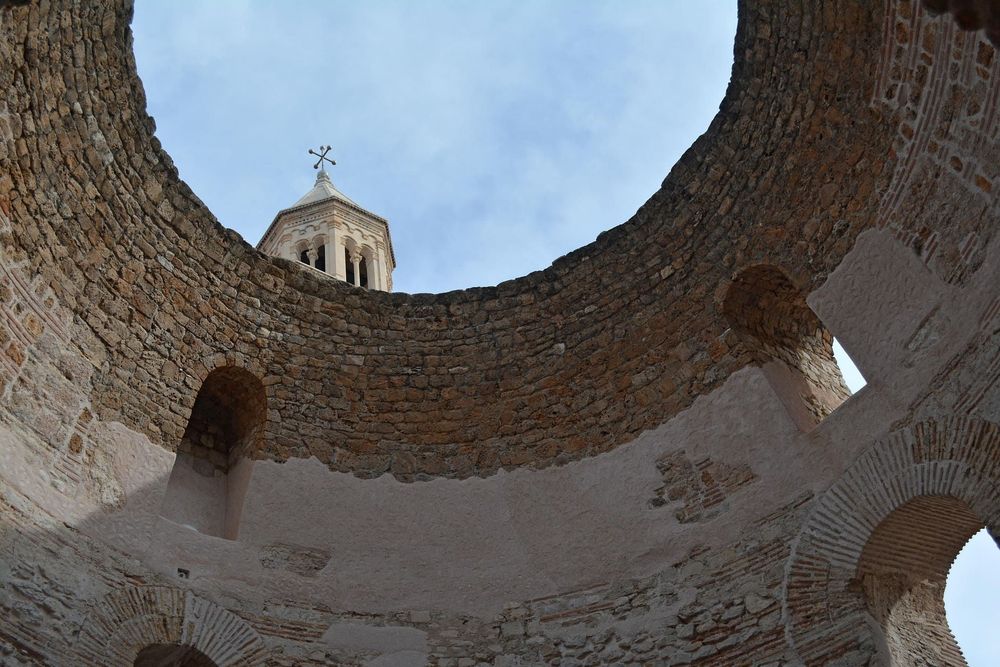
The Split audio-guided tour has you enter the Vestibule, one of the most impressive and most acoustic spaces of the Palace of Diocletian.
The Vestibule designates the monumental entrance hall that once led to the imperial apartments: you are here in the former antechamber of Diocletian. Built at the beginning of the fourth century, it marked the transition between the Peristyle, the public heart of the palace, and the private and sacred space of the emperor. This circular space was topped by a monumental dome, today partially collapsed, which gives a glimpse of the sky through a wide central opening, in the manner of the Pantheon of Rome. Originally, the ceiling was covered with mosaics, gilding and precious stones, and the niches of the walls no doubt sheltered statues. The exceptional acoustics of the place make it today a prized setting for a cappella singing.
The Vestibule impresses with its circular volume and its dome open to the sky, a vestige of Roman imperial grandeur. Its remarkable acoustics often host a cappella singers, whose voices resonate magnificently. It is a striking stage in the heart of the Palace of Diocletian, between the Peristyle and the former apartments of the emperor.
The Vestibule is in the heart of the Palace of Diocletian, in the old town of Split, between the Peristyle and the former imperial apartments. It can be discovered freely on foot at all hours, along the walk in the palace.
The monumental antechamber that led to the imperial apartments, a circular space topped by a dome open to the sky.
Its circular shape and its dome create exceptional acoustics, prized by a cappella singers.
Aucun avis pour le moment
