





Walk
El Vedado: Between Elegance and Revolution
Havana, Cuba
Walk
El Vedado: Between Elegance and Revolution
Havana, Cuba
8 km
Distance
3h15
Durée
20
Audios
Loop
Parcours
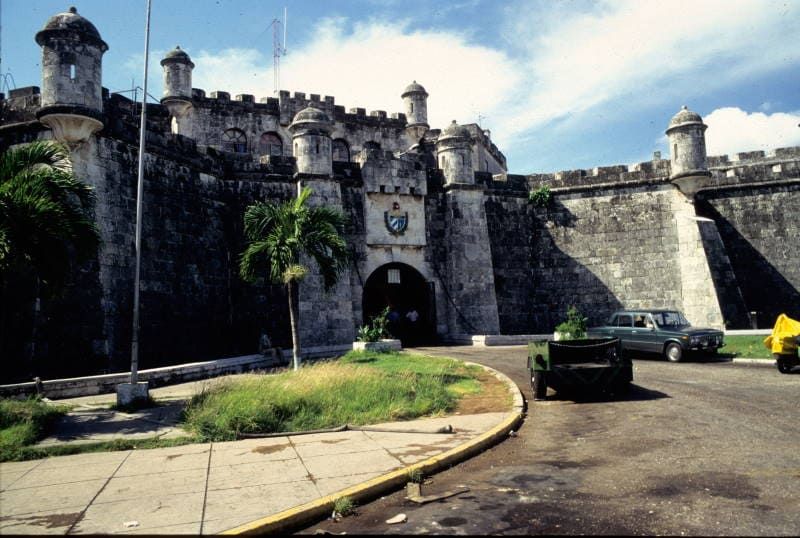
©Diego Tirira BY-SA 2.0 <https://creativecommons.org/licenses/by-sa/2.0/deed.fr>via Wikipedia Commons
The Havana audio-guided tour leads you to the heights of the city, near the Loma de Aróstegui, one of the highest hills, where stands the Castillo del Príncipe, a former fortress charged with protecting the Vedado.
After the siege of Havana by the English, who occupied the city for nearly a year in 1762, the city had several fortresses built. The Castillo del Príncipe, a vast pentagon-shaped castle endowed with bastions and deep trenches, rose from the ground in less than ten years; its name pays tribute to the son of Carlos III, king of Spain. Over time, the site was reconverted, notably taking on the role of prison for nearly half a century. Politicians and revolutionaries were imprisoned there, including Julio Antonio Mella, one of the founders of the Communist Party of Cuba.
The Castillo del Príncipe is today a military installation closed to the public, reserved for protocol functions. It therefore cannot be visited, but its massive silhouette, perched on the hill, recalls the defensive past of Havana and keeps the memory of the prisoners who were held there. Its history remains present in the memory of the city.
The Castillo del Príncipe stands on the heights of the Vedado, in Havana. A military installation, it is closed to the public and cannot be visited; its silhouette can be contemplated from afar, from the edges of the hill.
To defend Havana after the English siege of 1762; it was later used as a prison for nearly half a century.
No, it is a military installation closed to the public; its silhouette can only be contemplated from the outside.
Aucun avis pour le moment
