





Walk
The City
London, England
Walk
The City
London, England
6.9 km
Distance
2h45
Durée
19
Audios
Loop
Parcours
Shutterstock
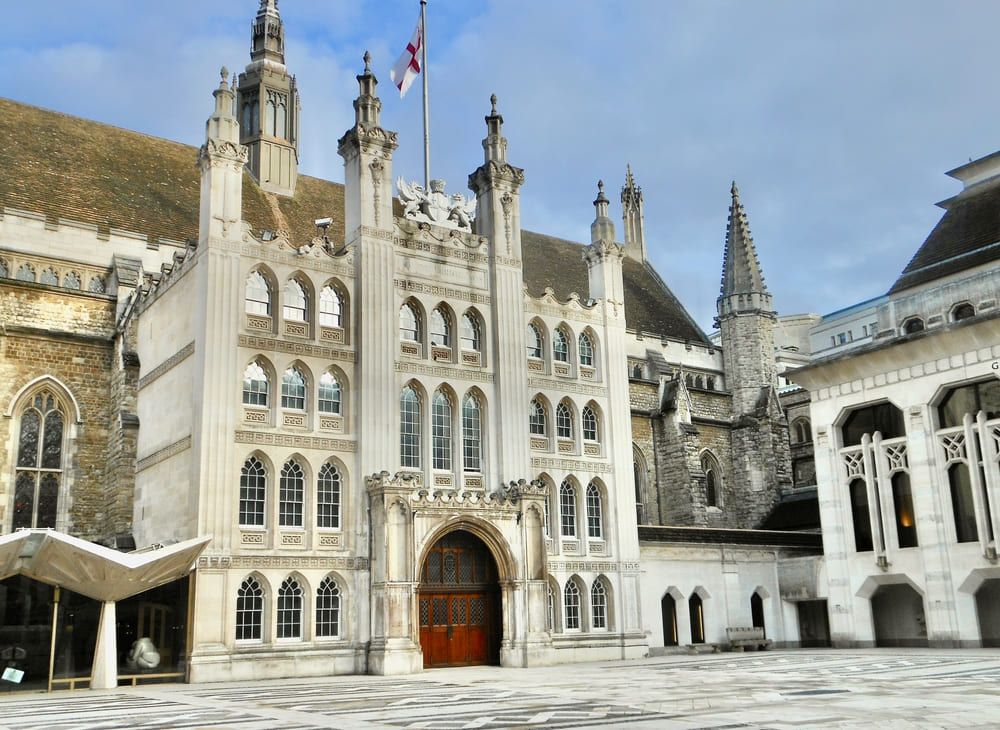
The London audio-guided tour takes you to a small hidden square, an essential stage of the history of the city. It is here that a Roman amphitheatre stood, of which a dark line drawn on the ground today recalls the outlines of the former arena.
The imposing building that dominates the square is the Guildhall, which is the second town hall of the city, after the City Hall located on the other side of the Thames. This fifteenth-century building houses the administrative seat of the City of London, an institution endowed with particular powers and traditions, inherited from the Middle Ages. The place was, for centuries, the centre of the civic and corporate life of the city.
The great medieval hall, with its timber framework and its stained-glass windows, impresses with its proportions. In the basement are the remains of the Roman amphitheatre, brought to light and accessible for visiting. The complex also houses an art gallery. Between Roman past, medieval architecture and living institutions, the Guildhall offers a fascinating summary of the history of London.
The Guildhall is in the heart of the City of London. The square and the façade can be contemplated freely; the great hall, the remains of the Roman amphitheatre and the art gallery follow their own schedule, whose hours and conditions may vary with the season and the events.
A fifteenth-century building housing the administrative seat of the City of London, considered the second town hall of the city.
The remains of a Roman amphitheatre, whose outlines are also marked on the ground of the square by a dark line.
Aucun avis pour le moment
