





Walk
A Medieval Gem on the Baltic Sea
Tallinn, Estonia
Walk
A Medieval Gem on the Baltic Sea
Tallinn, Estonia
4.1 km
Distance
1h40
Durée
22
Audios
Loop
Parcours
Shutterstock
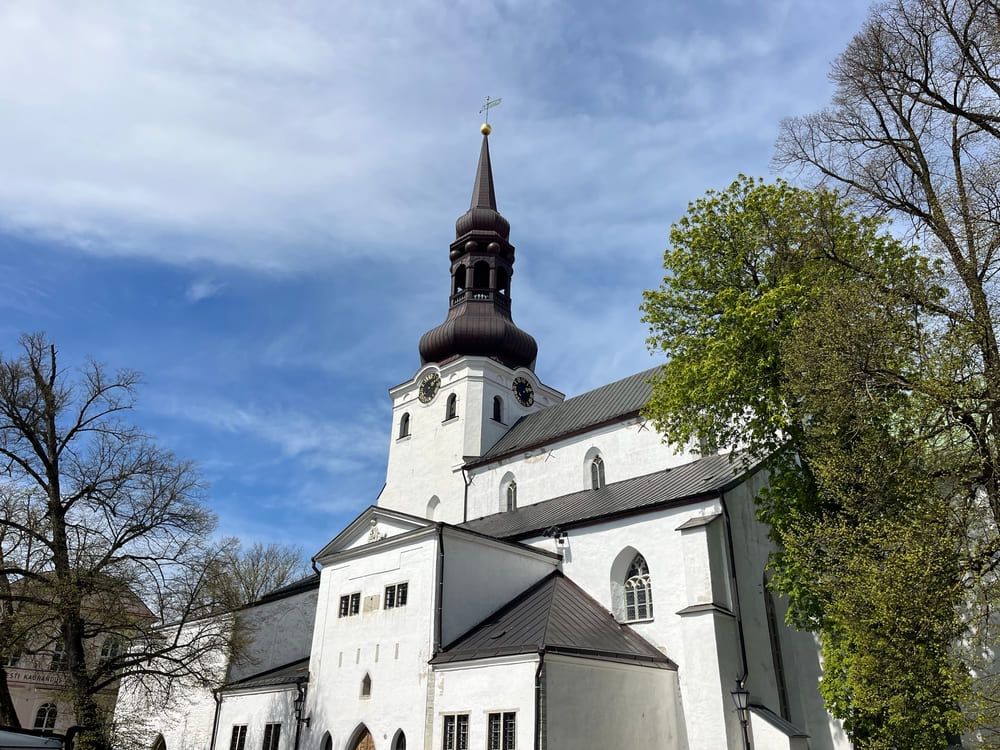
The Cathedral of St Mary, nicknamed the Dome, is said to be the oldest church of Tallinn, on the Toompea hill. The Tallinn audio-guided tour stops here, with respect, to evoke this Lutheran sanctuary laden with history, a setting of tombstones and noble coats of arms.
The Cathedral of St Mary, sometimes called the Dome, or Toomkirik, is said to be the oldest church of Tallinn, even if the historians still debate its precise date of foundation, which dates back to the first times of the Christian town, in the thirteenth century. Located in the heart of the Toompea hill, the upper town, it was the main church of the nobility and power, in contrast to the churches of the lower town, frequented by the merchants. Reworked several times over the centuries, notably after fires, it mixes different styles, from Gothic to baroque, and keeps a sober silhouette crowned with a tower. Inside, the building is a true book of history: its walls and its floor are covered with innumerable tombstones, epitaphs and coats of arms of the great noble families of Estonia, who rest there or are commemorated there, as well as remarkable funerary monuments. Become Lutheran at the time of the Reformation, the cathedral remains a place of worship and a pantheon of the Baltic nobility. A historic sanctuary and a memory of the town, the Cathedral of St Mary is discovered with respect.
You admire, with respect, the cathedral nicknamed the Dome, which is said to be the oldest church of Tallinn, dating back to the thirteenth century, main church of the nobility on Toompea, mixing Gothic and baroque under a sober tower, whose walls and floor are covered with innumerable tombstones, epitaphs and coats of arms of the great noble families of Estonia. The Cathedral of St Mary is the memory of Tallinn. It is a stop to be discovered with respect.
The Cathedral of St Mary lies on the Toompea hill, in Tallinn, reachable on foot. A Lutheran place of worship, it can be visited with respect; the access and the possible climb to the tower follow their own hours and conditions, which vary. It is best to check them before coming and to respect the character of the place.
Because it is said to be the oldest church of Tallinn, dating back to the thirteenth century, and it was the main church of the nobility on Toompea; its walls and its floor are covered with innumerable tombstones, epitaphs and coats of arms of the great noble families of Estonia, making of it a true pantheon of the Baltic nobility.
On the Toompea hill, in Tallinn, in Estonia.
Aucun avis pour le moment
