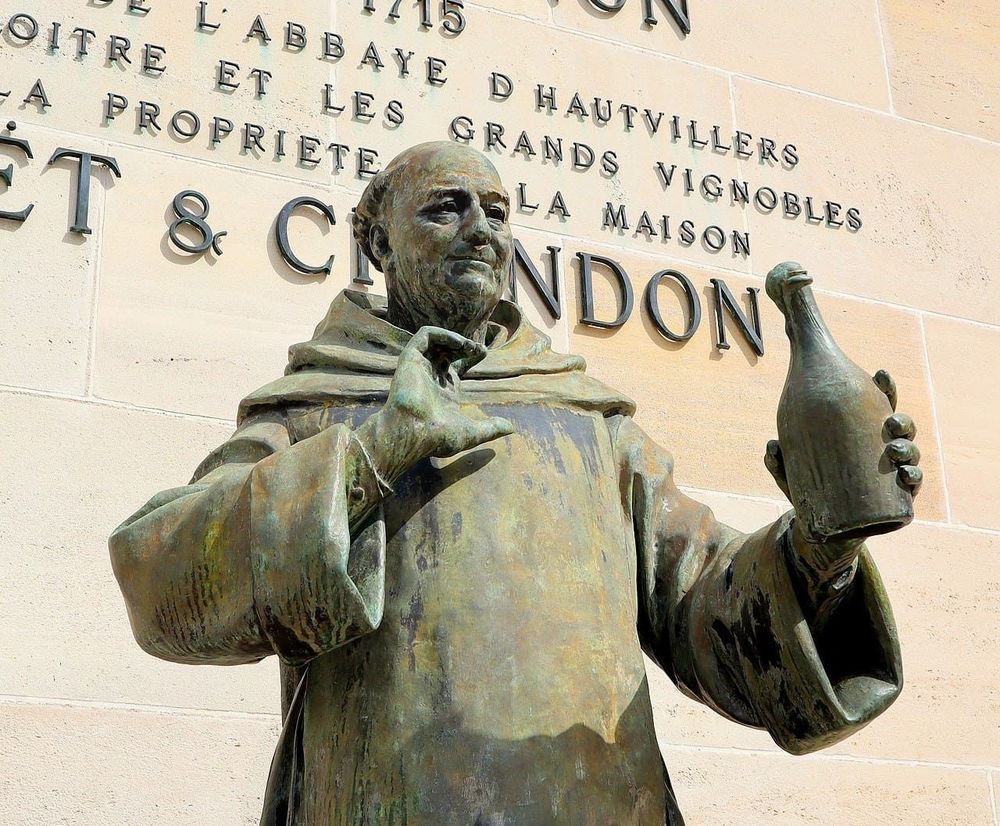




Dom Pérignon Statue
©Palauenc05 CC BY-SA 4.0. <https://creativecommons.org/licenses/by-sa/4.0/deed.fr>via Wikipedia Commons
You’re standing in front of one of the most iconic champagne houses on the avenue—Moët & Chandon, which happens to own the largest vineyard in the entire Champagne region. That’s right, they manage an impressive 1,190 hectares of vines, and they also work with local growers to round out their production. The house was founded back in 1743 by Claude Moët, a winegrower and merchant who was the first to focus solely on sparkling wine. He managed to get the attention of the royal court and supplied big names of the time, including Madame de Pompadour, the famous favorite of King Louis XV. His reputation grew steadily until his death, when his grandson Jean-Rémy Moët took over. It was Jean-Rémy who established the champagne house here on this very avenue and brought his son-in-law, Pierre-Gabriel Chandon de Briailles, into the business—hence the name Moët & Chandon. The brand’s prestige only grew from there, first expanding across Europe, then globally. In 1962, Moët & Chandon acquired Ruinart, and later on Mercier, which opened the door to investments in California and Argentina, where their sparkling wines became hugely popular. Today, Moët & Chandon is part of the LVMH group—the world leader in luxury goods. In fact, the “M” in LVMH stands for Moët, since the company merged with Louis Vuitton and Hennessy in 1987. This house is still one of the biggest names in Épernay and the world, with nearly 23 million bottles sold in 2011 alone. It’s a true symbol of luxury, even getting a name-drop in Queen’s song “Killer Queen.” If you’re curious to learn more, check out the different tours they offer. And if the gate happens to be open when you pass by, step in and glance to your left—you’ll see a statue of Dom Pérignon. Before becoming the name of Moët & Chandon’s most prestigious cuvée, Dom Pérignon was an actual Benedictine monk named Pierre Pérignon, born in 1638. He’s often credited with inventing champagne, with some saying he brought the sparkling wine method back from Limoux, a town near Carcassonne, and applied it to local wines. But truth be told, there’s no hard evidence to confirm that story. What we do know is that he played a major role in improving the quality of wine in his time. He discovered that blending different grape varieties could enhance the final product and also figured out how to better control the wine’s effervescence—no small feat back then, when sparkling wine often happened by accident and bottles could explode unexpectedly. These explosions were such a problem that champagne was once nicknamed “devil’s wine.” Dom Pérignon studied the phenomenon and realized it was caused by re-fermentation in the bottle, triggered by blending and pressing factors. He refined these processes and started using thicker glass bottles with cork stoppers to contain the pressure. Ironically, his goal wasn’t to make wine sparkle—it was to stop it from doing so. But thanks to his innovations, later generations were able to perfect champagne’s signature fizz. That’s why the name Dom Pérignon lives on today, reserved for a vintage cuvée that’s only produced in exceptional years. Vintage means all the grapes come from a single year’s harvest, unlike non-vintage champagnes, which are blends from several years. Because of this, vintage champagnes are rarer and more prestigious. And now you know why a statue of this 17th-century monk stands proudly here. All that’s left is to raise a glass—responsibly, of course!