




Walk
Standing Stones, Bell Tower, and Salted Butter
Carnac, France
Walk
Standing Stones, Bell Tower, and Salted Butter
Carnac, France
2.4 km
Distance
1h00
Durée
17
Audios
Loop
Parcours
@Shutterstock
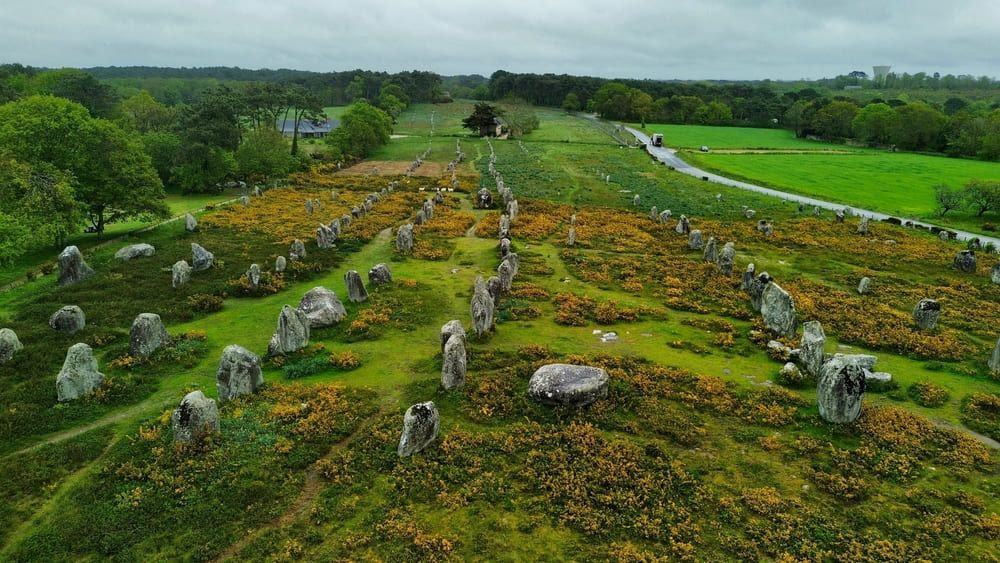
Follow Rue de Courdiec for about 1 kilometer (0.6 miles), and you’ll reach the famous Ménec Alignments. The site is too far away to be included in this walking loop through the town center, but of course, we couldn’t leave it out! So whether you decide to head there now or later during your stay, here are a few things to help you understand what you’ll see.
By now, you know what a menhir is. But at Ménec, it’s not just the individual stones that matter. What’s remarkable is the way more than a thousand of them were arranged together.
Picture eleven long rows of standing stones stretching for nearly 1 kilometer (0.6 miles). To appreciate the full scale of the site, try to forget the roads, fences, and houses you see today. Imagine the landscape more than 6,000 years ago.
Sea level was lower, and some of the monuments could probably be seen from one another. These stones weren’t simply placed there to decorate the landscape. They helped organize it and gave it a particular meaning.
The first detail to look for is at the end of the site, near the hamlet. Here, the rows of menhirs meet a large oval enclosure measuring roughly 70 by 90 meters (230 by 295 feet). Several thousand years after it was built, probably as early as the Middle Ages, houses were constructed right inside the enclosure.
So the village of Ménec literally stands within a prehistoric monument! Today, houses, gardens, and old farm buildings mingle with the standing stones. It’s a reminder that this site was never completely cut off from everyday life.
People continued to live here, farm the land, and reshape the area over the centuries. There’s another common misconception to leave behind: the eleven rows aren’t perfectly straight or evenly spaced from beginning to end. Some move closer together, change direction, or disappear altogether, while the stones themselves become smaller.
Some of these irregularities can be explained by stones that were destroyed or moved. But they may also point to several different phases of construction. In other words, Ménec may not have been planned and completed all at once.
It could be the result of a project that grew and changed over several generations. One stone in particular seems to tell an even older story. About 100 meters (330 feet) from the enclosure stands a slender menhir more than 3 meters (10 feet) tall, nicknamed the Giant of Ménec.
Taller and thinner than the stones around it, it may have already been standing before the present rows were created, and later incorporated into the monument—as though our ancestors were adding to something their own ancestors had begun. Of course, one big question remains: why did people raise so many stones? The truth is, we simply don’t know.
The alignments were probably not an astronomical calendar, as was once believed, and they have nothing to do with the Druids, who lived several thousand years later. Archaeologists tend to see the site instead as a communal, symbolic, and perhaps sacred space. The rows may have guided people toward the enclosures or marked a transition between two different realms: everyday life on one side, and on the other, a place reserved for ceremonies, ancestors, or the sacred.
It’s an intriguing idea, but unless someone invents a time machine, it will remain impossible to prove completely. Still, we don’t need to know exactly what the alignments were for to appreciate the scale of the achievement. The stones had to be transported and raised, and large numbers of people had to work together.
How were these communities of farmers and livestock herders able to devote so much time and energy to a collective project that went far beyond the needs of daily life? Could they ever have imagined that more than 6,000 years later, visitors would still wander through this immense monumental landscape, moved and amazed, yet unable to solve its mystery? If you’d like to learn more, head to the Maison des Mégalithes, across from the site.
Its exhibits, videos, models, and panoramic terrace offer a better understanding of the alignments as a whole. This is also where guided tours begin. They’re especially recommended for anyone who wants to explore the different theories in greater depth and continue investigating one of prehistory’s greatest mysteries.
Aucun avis pour le moment