





Walk
Echoes of the Middle Ages
Sarlat-la-Canéda, France
Walk
Echoes of the Middle Ages
Sarlat-la-Canéda, France
1.1 km
Distance
1h00
Durée
16
Audios
Loop
Parcours

©Bruno - CC BY-SA 3.0. <https://creativecommons.org/licenses/by-sa/3.0/deed.fr>via Wikipedia Commons
As you climb the steps of the Côte de Toulouse, take a moment to look back — not just at the view, but at Sarlat’s long and remarkable story. It all began in the 9th century, when Benedictine monks founded an abbey around a natural spring — the Cour des Fontaines. From that humble beginning, a town slowly grew, protected from invasions and blessed with prosperity.
During the Middle Ages, Sarlat became both a spiritual and commercial hub of the Périgord. Its influence was so great that in 1317, Pope John XXII made it a bishopric. The Cathedral of Saint-Sacerdos and the former Episcopal Palace still stand as proud reminders of that golden age.
But Sarlat’s history wasn’t always peaceful. The Hundred Years’ War and the Wars of Religion both left deep scars, dividing and weakening the town. Over time, Sarlat’s political and economic importance faded.
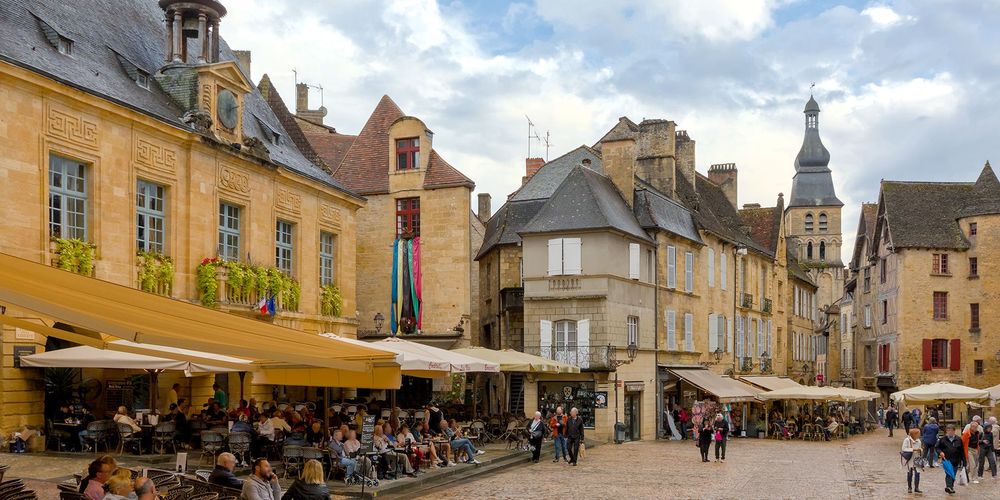
Yet this decline turned out to be its salvation — because the town was never modernised, its medieval streets, grand townhouses, and glowing golden facades were preserved almost intact. That’s what gives Sarlat its extraordinary charm today. In the 19th century, the creation of Rue de la République reshaped part of the town, but Sarlat’s true renaissance came in the 20th century.
Thanks to the Malraux Law of 1962, it became the very first protected heritage sector in France. Its careful restoration brought the old stones back to life, transforming Sarlat into the jewel you see today — a place admired around the world for its beauty and authenticity. To walk through Sarlat is to step through the centuries: a town born of faith, enriched by trade, shaken by war, yet always resilient — a living testament to the soul of the Périgord Noir.
Aucun avis pour le moment
