





Walk
From the Concorde square to the Eiffel Tower
Paris, France
Walk
From the Concorde square to the Eiffel Tower
Paris, France
8.9 km
Distance
3h40
Durée
19
Audios
Loop
Parcours
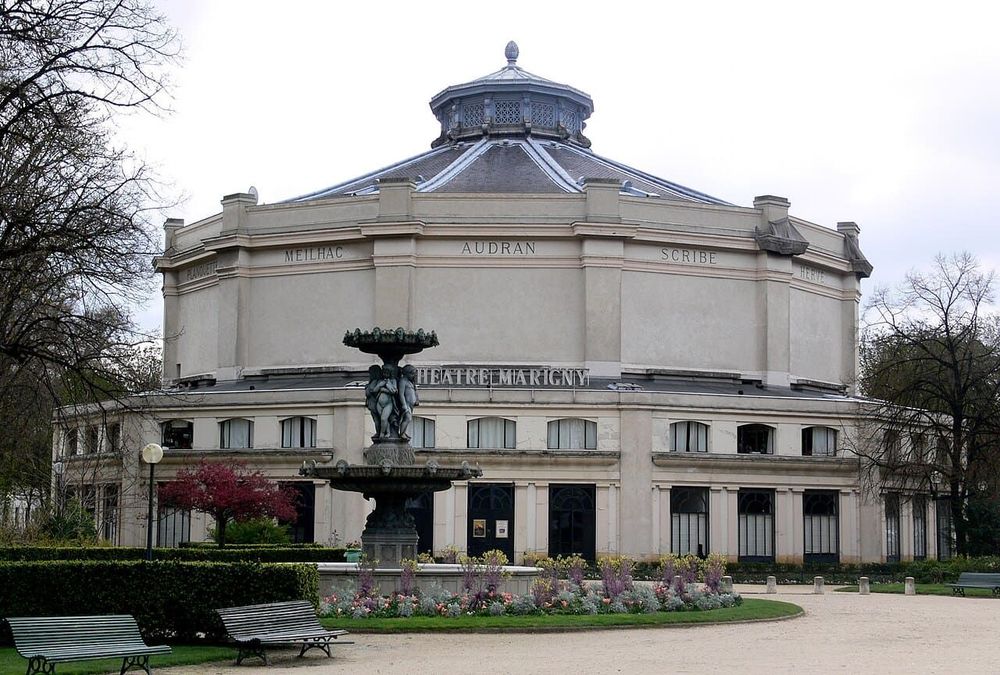
©Andreas Praefcke CC BY-SA 3.0. <https://creativecommons.org/licenses/by-sa/3.0/deed.fr> via Wikipedia Commons
The Paris audio-guided tour presents you with the Marigny theatre, an elegant rotunda listed as a historic monument, nestled in the gardens at the lower end of the Champs-Élysées, whose history is marked by transformations.
The history of the place begins in 1835, when a physicist-magician presents his acts at the Carré Marigny in a small hall. The composer Jacques Offenbach then takes over the place and opens there the Théâtre des Bouffes-Parisiens, whose name refers to the Italian opera buffa, that is comic. The site becomes the Théâtre Debureau, then the Folies-Marigny, before being demolished in 1881. Charles Garnier, the architect of the Paris Opera, then builds a panorama there, a vast 360-degree painting. In 1894, the architect Édouard Niermans transforms it into the beautiful rotunda one sees today. The Marigny theatre now numbers among the private Parisian theatres and strings together successful productions.
The theatre charms with its rotunda silhouette and its setting of greenery, a stone's throw from the Champs-Élysées. On its façade, a plaque pays homage to the German playwright Ödön von Horváth, who died in front of the theatre, struck by a chestnut branch torn off by the storm. A living place of the Parisian stage, the Marigny is worth a glance along the walk in the gardens.
The Marigny theatre is in the gardens of the Champs-Élysées, in the 8th arrondissement of Paris. Its façade can be contemplated freely from the paths; the hall opens during performances, whose programme is to be consulted on site.
The composer Jacques Offenbach, who opened there the Théâtre des Bouffes-Parisiens, before the site was rebuilt and then transformed into a rotunda in 1894.
The memory of the playwright Ödön von Horváth, who died in front of the theatre, struck by a chestnut branch during a storm.
Aucun avis pour le moment
