



Walk
The Plantagenet City
Le Mans, France
Walk
The Plantagenet City
Le Mans, France
2 km
Distance
1h00
Durée
21
Audios
Loop
Parcours
Shutterstock
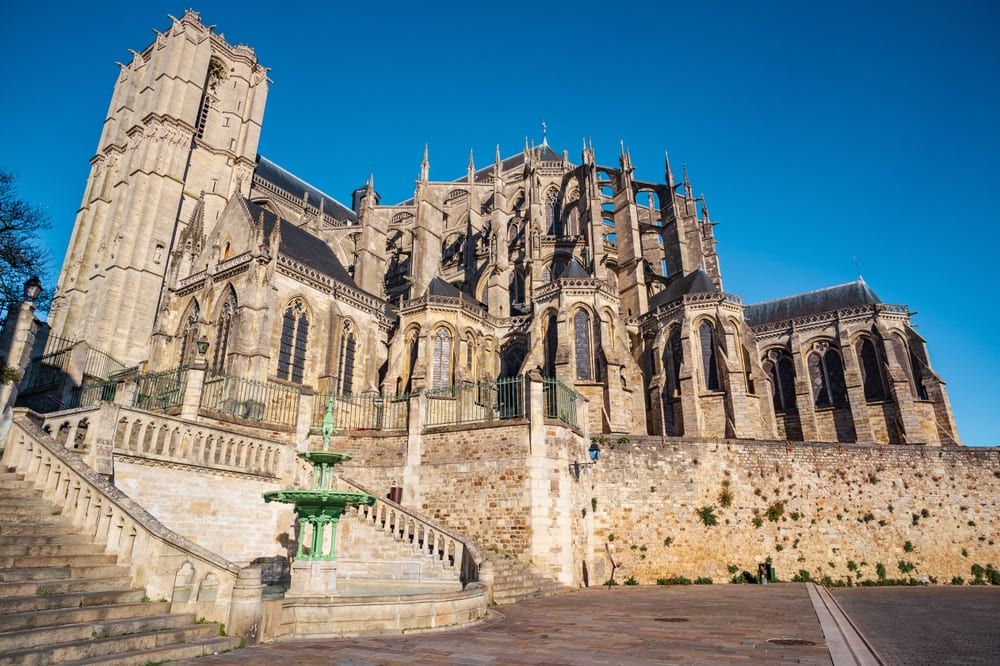
The St. Julian's Cathedral is one of the jewels of old Le Mans, a majestic building that dominates the Plantagenet City with its spectacular Gothic chevet. The Le Mans audio-guided tour stops here, with respect, to evoke this thousand-year-old sanctuary, built on Gallo-Roman foundations, where Saint Julian, the first bishop of Le Mans, is said to have established his seat from the fourth century.
Here you are facing one of the most emblematic jewels of old Le Mans, to be discovered with respect: the majestic St. Julian's Cathedral. Take a moment to raise your eyes towards its imposing façade. Up there, the flying buttresses seem to still carry the breath of those who built it, stone after stone, over the centuries. Imagine yourself in the thirteenth century: the surrounding streets are only beaten earth, the echoes of the hammers resound, and the builders busy themselves, in quest of height and light. But the history begins well before: the cathedral rises on the foundations of a former Gallo-Roman building. Le Mans, formerly called Vindunum, saw a Christian sanctuary rise from the fourth century, and it is here, according to tradition, that Saint Julian, the first bishop of the city, is said to have established his seat, on a promontory offering an unobstructed view over the valley. The construction of the current building, begun in the eleventh century, harmoniously mingles the Romanesque nave and a Gothic choir of great elegance, girded with a double crown of spectacular flying buttresses. Inside, to be explored in contemplation, you admire superb stained-glass windows, among the oldest of France, adorned chapels and the tomb of Charles IV of Anjou. A thousand-year-old cathedral and a Gothic masterpiece, the St. Julian's Cathedral is discovered with respect.
Here you discover, with respect, one of the jewels of old Le Mans, a thousand-year-old cathedral raised on Gallo-Roman foundations, where Saint Julian is said to have established his seat from the fourth century; begun in the eleventh century, it mingles Romanesque nave and Gothic choir with a spectacular chevet, girded with flying buttresses, and shelters among the oldest stained-glass windows of France. The St. Julian's Cathedral dominates the Plantagenet City. It is a stop to be discovered with respect.
The St. Julian's Cathedral stands at the summit of the Plantagenet City, in old Le Mans, reachable on foot. A place of worship, it can be visited with respect; entry is generally free and the hours follow the conditions in force, which vary and may be restricted during services. It is best to enquire before coming.
Because Saint Julian was the first bishop of Le Mans, who is said to have established his seat here from the fourth century, on a promontory dominating the valley; the current cathedral, raised from the eleventh century on Gallo-Roman foundations, mingles Romanesque nave and Gothic choir with a spectacular chevet, and shelters among the oldest stained-glass windows of France, to be discovered with respect.
At the summit of the Plantagenet City, in old Le Mans, in France.
Aucun avis pour le moment